
RadSec: How RADIUS over TLS Improves WiFi Authentication Security
This authoritative technical reference explains how RadSec (RFC 6614) secures enterprise WiFi authentication by wrapping traditional RADIUS traffic in TLS encryption. Designed for IT managers and network architects, it covers architecture, deployment strategies, and practical steps to mitigate the risks of unencrypted UDP RADIUS traffic across corporate and guest networks.
Video overview
Listen to this guide
View podcast transcript
Part of our core series: Enterprise WiFi Security Guide →
Executive Summary
Traditional RADIUS over UDP (ports 1812/1813) was not designed for the modern enterprise threat landscape. Relying solely on a shared secret and MD5 hashing, it leaves authentication credentials and session attributes vulnerable to interception, particularly when traversing public networks or large distributed estates like hospitality and retail chains. RadSec (RADIUS over TLS, RFC 6614) solves this fundamental security gap by encapsulating RADIUS traffic within a TCP-based TLS 1.3 tunnel over port 2083.
For CTOs and network architects, deploying RadSec is no longer just a best practice - it is a critical requirement for protecting corporate wifi, maintaining PCI DSS 4.0 compliance, and participating in modern federated roaming frameworks like OpenRoaming. This guide details the architecture, implementation patterns, and operational requirements for securing your authentication infrastructure.
Technical Deep-Dive: RADIUS vs. RadSec
The Vulnerability in Traditional RADIUS
In a standard 802.1X deployment, the access point (authenticator) forwards client credentials to the RADIUS server (authentication server). In traditional RADIUS, this payload is sent over UDP. The only protection is a pre-shared key (PSK) used to obfuscate the password via MD5.
This architecture presents three critical risks:
- Lack of Transport Encryption: User attributes, MAC addresses, and session data are transmitted in cleartext.
- Cryptographic Weakness: MD5 is vulnerable to offline dictionary attacks if an attacker captures the traffic.
- No Mutual Authentication: The access point cannot cryptographically verify it is talking to the legitimate RADIUS server, enabling rogue server attacks.
The RadSec Architecture (RFC 6614)
RadSec addresses these flaws by shifting the transport layer from UDP to TCP and wrapping the entire payload in TLS.
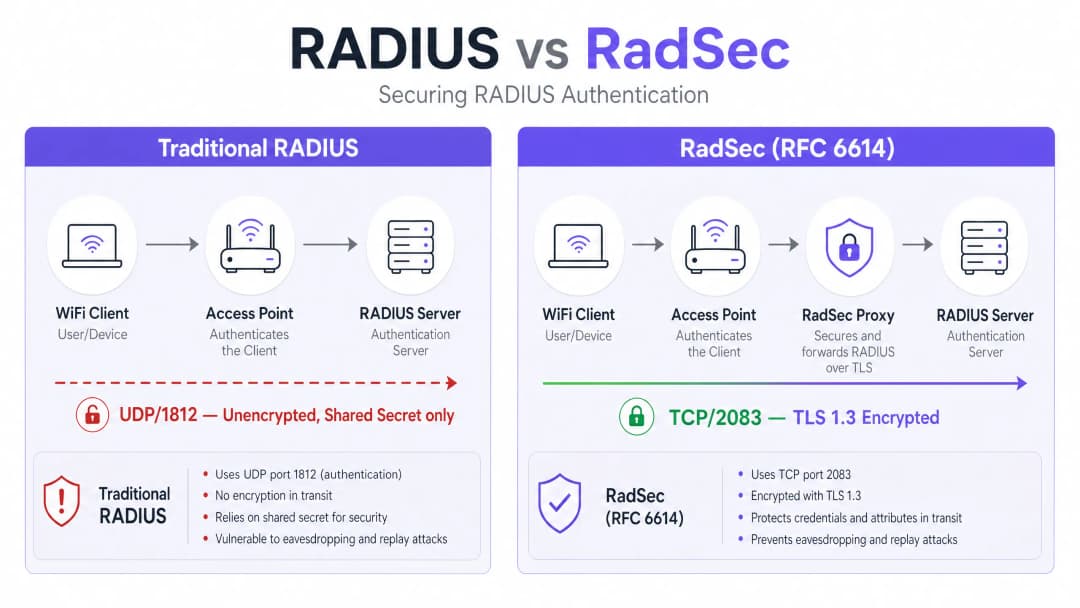
- Transport: TCP Port 2083 ensures reliable delivery and stateful connections, improving performance in high-latency environments.
- Encryption: TLS 1.2 or 1.3 provides robust, end-to-end encryption of all RADIUS attributes.
- Mutual Authentication: Both the RADIUS client (or proxy) and the server must present valid X.509 certificates issued by a trusted Certificate Authority (CA). The shared secret is retained only for backwards compatibility; TLS provides the actual security. This architecture is essential for distributed environments, such as Retail chains or Hospitality venues, where access points backhaul authentication requests over the public internet to a central or cloud-hosted RADIUS server.
Got questions about your specific setup?
Our team works with venue operators, IT managers, and network engineers across 80,000 venues. Book a 20-minute call and we will show you how others like you solved it.
Implementation Guide
Deploying RadSec typically follows one of two patterns: Native Support or Proxy-based.
Pattern 1: Native RadSec
If your infrastructure supports it natively (e.g., FreeRADIUS 3.0+, Cisco ISE, Aruba ClearPass), you configure TLS certificates directly on the RADIUS server and the access points/controllers. This provides true end-to-end encryption from the edge to the core.
Pattern 2: The RadSec Proxy
Many legacy RADIUS servers (notably Microsoft NPS) do not natively support RadSec. In these environments, a proxy (such as radsecproxy) is deployed.
- Local Leg: The AP sends standard UDP RADIUS to the local proxy.
- WAN Leg: The proxy encapsulates the traffic in TLS and sends it over TCP 2083 to the upstream server.
This pattern allows you to secure wide-area traffic without replacing legacy infrastructure.
Integration with Purple
Purple's Guest WiFi and WiFi Analytics platforms integrate seamlessly with enterprise RADIUS infrastructure. Under the Connect licence, Purple acts as a free identity provider for OpenRoaming, where RadSec is a mandatory requirement for securing federation traffic between venues and the central hub.
Best Practices
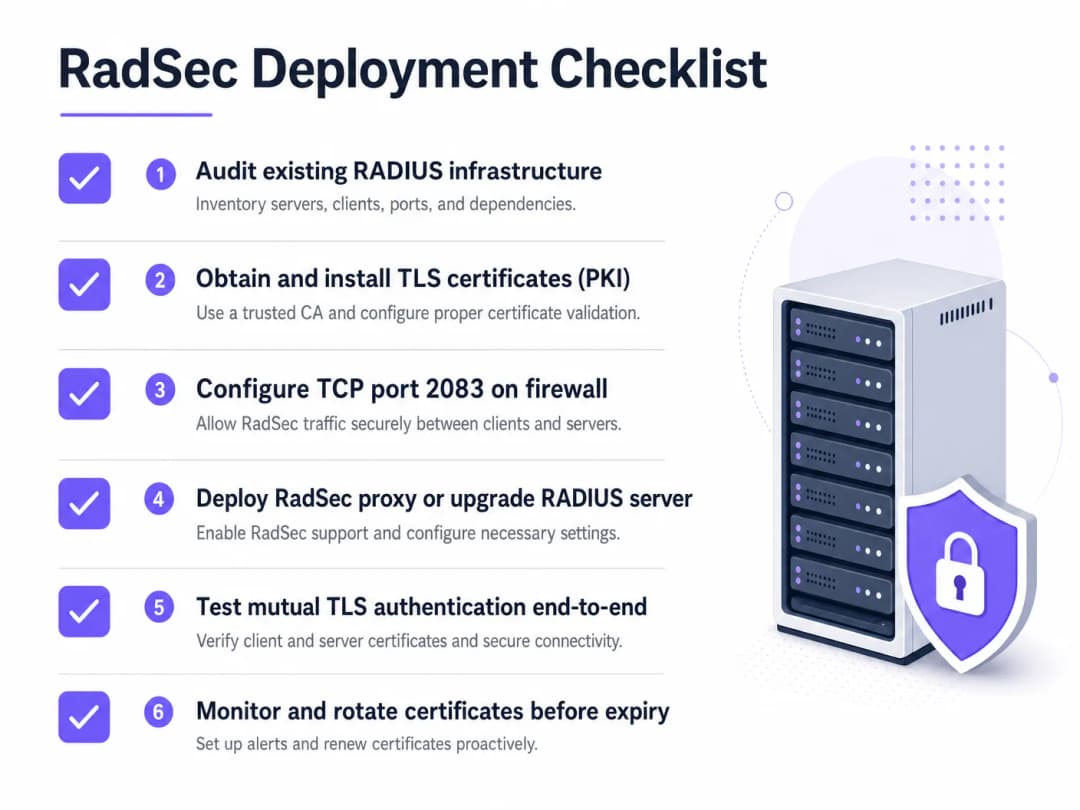
- Certificate Lifecycle Management: Mutual TLS relies on valid certificates. Implement automated renewal (e.g., via ACME) and strict monitoring. An expired certificate will cause a total authentication outage.
- Firewall Configuration: Ensure TCP port 2083 is explicitly allowed both outbound from the venue and inbound to the RADIUS server. Do not assume existing UDP 1812 rules will apply.
- Prioritise High-Risk Traffic: Begin deployment on links that traverse the public internet or untrusted WANs before moving to local management VLANs.
For more on securing the edge, read our guide on Access Point Security: Your 2026 Enterprise Guide.
Troubleshooting & Risk Mitigation
When RadSec fails, it is rarely an authentication issue; it is almost always a TLS or TCP issue.
- Symptom: Access points show as disconnected from the RADIUS server.
- Check: Firewall rules for TCP 2083. Traditional RADIUS uses UDP; network teams frequently forget to open the TCP port.
- Symptom: TCP connection establishes, but authentication fails immediately.
- Check: Certificate validation. Verify that the Common Name (CN) or Subject Alternative Name (SAN) matches, the certificate has not expired, and the client trusts the signing CA. Use
openssl s_client -connect <server>:2083to debug the handshake.
- Check: Certificate validation. Verify that the Common Name (CN) or Subject Alternative Name (SAN) matches, the certificate has not expired, and the client trusts the signing CA. Use
Ensure your network fundamentals are solid. Review our advice on Protect Your Network with Strong DNS and Security.
ROI & Business Impact
Implementing RadSec is a risk mitigation investment. The ROI is measured in the avoidance of data breaches, compliance fines (PCI DSS, GDPR), and reputational damage. Furthermore, it enables participation in modern roaming federations like OpenRoaming, which can significantly enhance the guest experience in Healthcare and Transport environments.
Listen to the Briefing
For a deeper dive into the operational realities of deploying RadSec, listen to our 10-minute technical briefing:
For specific configuration steps on client devices, refer to How to Set Up Enterprise WiFi on iOS and macOS with 802.1X.
Key Definitions
RadSec
An extension to the RADIUS protocol that encapsulates RADIUS traffic within a TLS tunnel over TCP port 2083.
Used to secure authentication traffic when traversing untrusted networks, preventing credential interception.
Mutual TLS (mTLS)
A security process where both the client and the server present X.509 certificates to verify each other's identity before establishing an encrypted connection.
The core authentication mechanism of RadSec, replacing reliance on static shared secrets.
802.1X
The IEEE standard for port-based network access control, used to authenticate devices attempting to connect to a LAN or WLAN.
The framework that relies on RADIUS (and by extension, RadSec) to validate user credentials against a directory.
radsecproxy
An open-source daemon that acts as a proxy, converting standard UDP RADIUS traffic into RadSec (TLS over TCP) and vice versa.
Deployed when native RadSec support is missing from access points or legacy RADIUS servers like Microsoft NPS.
OpenRoaming
A federation standard developed by the WiFi Alliance that allows users to seamlessly and securely connect to participating WiFi networks globally.
OpenRoaming mandates the use of RadSec to secure authentication traffic between venues and identity providers.
Shared Secret
A static text string used in traditional RADIUS to obfuscate passwords and verify the source of requests.
While still technically present in RadSec configurations for backward compatibility, it is superseded by TLS encryption.
FreeRADIUS
A widely deployed open-source RADIUS server that provides native support for RadSec.
Often used in enterprise environments and roaming federations due to its flexibility and native TLS capabilities.
PKI (Public Key Infrastructure)
The framework of roles, policies, and software needed to create, manage, distribute, and revoke digital certificates.
A prerequisite for deploying RadSec, as you must issue and manage certificates for all RADIUS clients and servers.
Worked Examples
A 200-property hotel group uses Microsoft NPS centrally for staff authentication. Access points at each hotel currently send RADIUS requests over the public internet via UDP 1812. The CTO mandates encryption for all authentication traffic, but replacing NPS is not an option this year.
Deploy a RadSec proxy (e.g., radsecproxy) at each hotel site and a corresponding proxy in the central data centre in front of the NPS servers. The local APs send UDP RADIUS to the local proxy. The local proxy establishes a mutual TLS tunnel over TCP 2083 across the internet to the central proxy. The central proxy terminates the TLS tunnel and forwards standard UDP RADIUS to the NPS server.
A large university is deploying OpenRoaming across its campus to allow seamless access for visiting academics. They are running FreeRADIUS 3.0.
Enable native RadSec within FreeRADIUS. Generate X.509 certificates from a CA trusted by the OpenRoaming federation. Configure the campus firewall to allow inbound and outbound TCP 2083 traffic to the federation hubs. Configure the wireless LAN controllers to use RadSec for all federation-bound authentication requests.
Practice Questions
Q1. Your team has deployed native RadSec between your remote branch access points and your central FreeRADIUS server. The APs can ping the server, but authentication requests are timing out completely, and no traffic is hitting the RADIUS logs.
Hint: RadSec uses a different transport protocol and port than traditional RADIUS.
View model answer
The firewall is likely blocking TCP port 2083. Network teams accustomed to traditional RADIUS often only permit UDP ports 1812/1813. You must explicitly allow TCP 2083 outbound from the branch and inbound to the RADIUS server.
Q2. You are auditing a retail client's WiFi architecture. They use Microsoft NPS centrally. Their store APs send authentication requests over the internet via an IPsec VPN. Is RadSec required here?
Hint: Consider the layers of encryption already in place.
View model answer
While RadSec is best practice, the IPsec VPN is already providing transport layer encryption for the UDP RADIUS traffic over the untrusted internet. Deploying RadSec here would provide defence-in-depth but is less urgent than if the traffic were traversing the internet natively.
Q3. A week after a successful RadSec proxy deployment, all WiFi authentication across the enterprise fails simultaneously at 09:00 AM on a Monday. The network team confirms firewall rules are unchanged.
Hint: What is the primary authentication mechanism for the TLS tunnel itself?
View model answer
The X.509 certificates used for mutual TLS authentication have likely expired. When certificates expire, the TLS handshake fails, the TCP connection drops, and RADIUS traffic cannot flow. Implement automated certificate monitoring and rotation to prevent this.
Continue reading in this series
How to Securely Segment Staff and Guest WiFi Networks: Best Practices for Enterprise LANs
This guide provides IT managers and network architects with a vendor-neutral, technical blueprint for securing enterprise LANs by properly segmenting staff and guest WiFi traffic. It covers 802.1X authentication, cloud RADIUS, VLAN isolation, and the credential lifecycle management required to eliminate shared passphrases and protect corporate assets.
Best DNS filtering: a comprehensive guide for businesses
This technical reference guide explains how enterprise DNS filtering secures public networks by blocking malicious domains at the resolution layer - before a connection is ever established. It gives IT directors, network architects, and venue operations teams the deployment architecture, firewall configuration, and compliance context they need to protect Guest WiFi across hospitality, retail, and public-sector environments. Purple Shield blocks malware, botnets, and inappropriate content at the DNS level across 80,000+ live venues.
Understanding Cisco SUDI: Hardware-Anchored Identity in Secure Network Access Control
This guide explains how Cisco SUDI provides hardware-anchored, cryptographically secure identity for enterprise network infrastructure. Learn how to replace spoofable MAC addresses with immutable 802.1AR certificates to secure your venue's network access control.
Got questions about your specific setup?
Our team works with venue operators, IT managers, and network engineers across 80,000 venues. Book a 20-minute call and we will show you how others like you solved it.