
RadSec: Como o RADIUS over TLS Melhora a Segurança de Autenticação WiFi
Esta referência técnica autorizada explica como o RadSec (RFC 6614) protege a autenticação WiFi corporativa ao encapsular o tráfego RADIUS tradicional em criptografia TLS. Desenvolvido para gerentes de TI e arquitetos de rede, ele aborda arquitetura, estratégias de implantação e etapas práticas para mitigar os riscos de tráfego UDP RADIUS não criptografado em redes corporativas e de convidados.
Video overview
Ouça este guia
Ver transcrição do podcast
Parte da nossa série principal: Enterprise WiFi Security Guide →
Resumo Executivo
O RADIUS tradicional sobre UDP (portas 1812/1813) não foi projetado para o cenário moderno de ameaças corporativas. Baseando-se apenas em um segredo compartilhado e hash MD5, ele deixa as credenciais de autenticação e os atributos de sessão vulneráveis à interceptação, especialmente ao atravessar redes públicas ou grandes propriedades distribuídas, como redes de hotéis e varejo. O RadSec (RADIUS sobre TLS, RFC 6614) resolve essa lacuna fundamental de segurança encapsulando o tráfego RADIUS dentro de um túnel TLS 1.3 baseado em TCP sobre a porta 2083.
Para CTOs e arquitetos de rede, implantar o RadSec não é mais apenas uma prática recomendada - é um requisito crítico para proteger o WiFi corporativo, manter a conformidade com o PCI-DSS 4.0 e participar de estruturas modernas de roaming federado como o OpenRoaming. Este guia detalha a arquitetura, os padrões de implementação e os requisitos operacionais para proteger sua infraestrutura de autenticação.
Análise Técnica Detalhada: RADIUS vs. RadSec
A Vulnerabilidade no RADIUS Tradicional
Em uma implantação 802.1X padrão, o ponto de acesso (autenticador) encaminha as credenciais do cliente para o servidor RADIUS (servidor de autenticação). No RADIUS tradicional, essa carga útil é enviada sobre UDP. A única proteção é uma chave pré-compartilhada (PSK) usada para ofuscar a senha via MD5.
Esta arquitetura apresenta três riscos críticos:
- Falta de Criptografia de Transporte: Atributos de usuário, endereços MAC e dados de sessão são transmitidos em texto claro.
- Fraqueza Criptográfica: O MD5 é vulnerável a ataques de dicionário offline se um invasor capturar o tráfego.
- Ausência de Autenticação Mútua: O ponto de acesso não pode verificar criptograficamente se está se comunicando com o servidor RADIUS legítimo, permitindo ataques de servidores não autorizados.
A Arquitetura RadSec (RFC 6614)
O RadSec aborda essas falhas mudando a camada de transporte de UDP para TCP e envolvendo toda a carga útil em TLS.
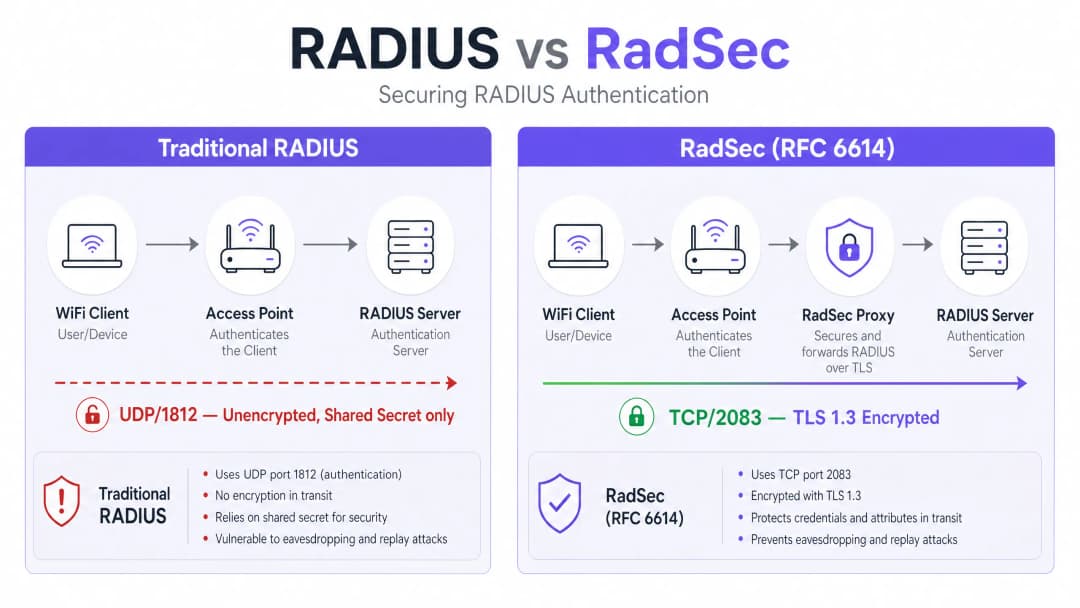
- Transporte: A porta TCP 2083 garante uma entrega confiável e conexões com estado estável, melhorando o desempenho em ambientes de alta latência.
- Criptografia: TLS 1.2 ou 1.3 fornece criptografia robusta de ponta a ponta de todos os atributos RADIUS.
- Autenticação Mútua: Tanto o cliente RADIUS (ou proxy) quanto o servidor devem apresentar certificados X.509 válidos emitidos por uma Autoridade Certificadora (CA) confiável. O segredo compartilhado é mantido apenas para compatibilidade com versões anteriores; o TLS fornece a segurança real.Esta arquitetura é essencial para ambientes distribuídos, como redes de Varejo ou locais de Hospitalidade, onde os pontos de acesso fazem o backhaul das solicitações de autenticação pela internet pública para um servidor RADIUS central ou hospedado na nuvem.
Tem dúvidas sobre a sua configuração específica?
A nossa equipa trabalha com operadores de espaços, gestores de TI e engenheiros de rede em 80.000 locais. Agende uma chamada de 20 minutos e mostraremos como outros profissionais na sua situação o resolveram.
Guia de Implementação
A implantação do RadSec geralmente segue um de dois padrões: Suporte Nativo ou Baseado em Proxy.
Padrão 1: RadSec Nativo
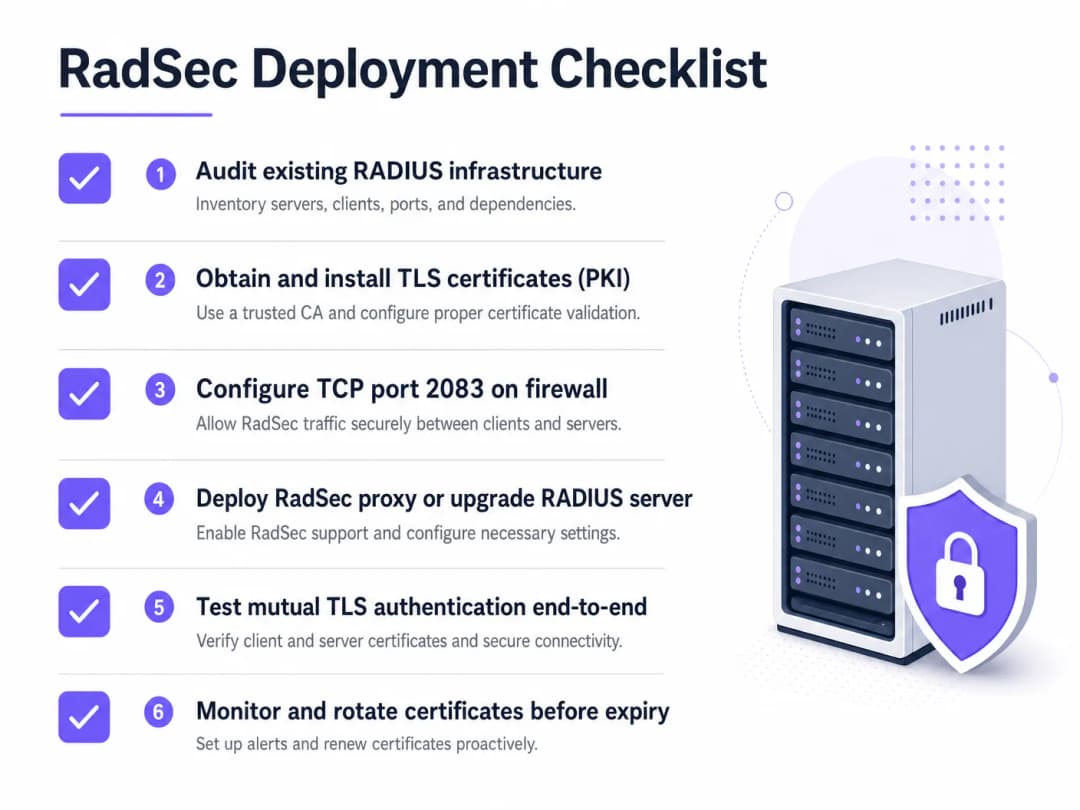
Se a sua infraestrutura suportar nativamente (por exemplo, FreeRADIUS 3.0+, Cisco ISE, Aruba ClearPass), você configura os certificados TLS diretamente no servidor RADIUS e nos pontos de acesso/controladoras. Isso fornece criptografia ponta a ponta real da borda ao núcleo.
Padrão 2: O Proxy RadSec
Muitos servidores RADIUS legados (notadamente o Microsoft NPS) não oferecem suporte nativo ao RadSec. Nesses ambientes, um proxy (como o radsecproxy) é implantado.
- Etapa Local: O AP envia RADIUS UDP padrão para o proxy local.
- Etapa WAN: O proxy encapsula o tráfego em TLS e o envia via TCP 2083 para o servidor upstream.
Este padrão permite proteger o tráfego de longa distância sem a necessidade de substituir a infraestrutura legada.
Integração com a Purple
As plataformas de Guest WiFi e WiFi Analytics da Purple integram-se perfeitamente com a infraestrutura RADIUS empresarial. Sob a licença Connect, a Purple atua como um provedor de identidade gratuito para OpenRoaming, onde o RadSec é um requisito obrigatório para proteger o tráfego de federação entre os locais e o hub central.
Melhores Práticas
- Gerenciamento do Ciclo de Vida dos Certificados: O TLS mútuo depende de certificados válidos. Implemente a renovação automatizada (por exemplo, via ACME) e um monitoramento rigoroso. Um certificado expirado causará uma interrupção total na autenticação.
- Configuração de Firewall: Certifique-se de que a porta TCP 2083 esteja explicitamente permitida tanto na saída do local quanto na entrada do servidor RADIUS. Não presuma que as regras de UDP 1812 existentes serão aplicadas.
- Priorize o Tráfego de Alto Risco: Inicie a implantação em links que atravessam a internet pública ou WANs não confiáveis antes de migrar para as VLAN de gerenciamento locais.
Para saber mais sobre como proteger a borda, leia nosso guia sobre Segurança de Ponto de Acesso: Seu Guia Empresarial para 2026.
Solução de Problemas e Mitigação de Riscos
Quando o RadSec falha, raramente é um problema de autenticação; quase sempre é um problema de TLS ou TCP.
- Sintoma: Os pontos de acesso aparecem como desconectados do servidor RADIUS.
- Verificação: Regras de firewall para TCP 2083. O RADIUS tradicional usa UDP; as equipes de rede frequentemente esquecem de abrir a porta TCP.
- Sintoma: A conexão TCP é estabelecida, mas a autenticação falha imediatamente.
- Verifique: Validação de certificado. Verifique se o Common Name (CN) ou o Subject Alternative Name (SAN) correspondem, se o certificado não expirou e se o cliente confia na CA signatária. Use
openssl s_client -connect <server>:2083para depurar o handshake.
- Verifique: Validação de certificado. Verifique se o Common Name (CN) ou o Subject Alternative Name (SAN) correspondem, se o certificado não expirou e se o cliente confia na CA signatária. Use
Garanta que os fundamentos da sua rede estejam sólidos. Revise nossos conselhos em Proteja sua Rede com DNS Forte e Segurança.
ROI e Impacto nos Negócios
A implementação do RadSec é um investimento em mitigação de riscos. O ROI é medido na prevenção de violações de dados, multas de conformidade (PCI-DSS, GDPR) e danos à reputação. Além disso, ele permite a participação em federações de roaming modernas, como o OpenRoaming, o que pode melhorar significativamente a experiência do visitante em ambientes de Saúde e Transporte.
Ouça o Briefing
Para um aprofundamento nas realidades operacionais da implantação do RadSec, ouça nosso briefing técnico de 10 minutos:
Para etapas de configuração específicas em dispositivos clientes, consulte Como Configurar WiFi Corporativo em iOS e macOS com 802.1X ou a versão em português Como Configurar WiFi Corporativo em iOS e macOS com 802.1X.
Definições principais
RadSec
Uma extensão do protocolo RADIUS que encapsula o tráfego RADIUS dentro de um túnel TLS sobre a porta TCP 2083.
Usado para proteger o tráfego de autenticação ao atravessar redes não confiáveis, impedindo a interceptação de credenciais.
mTLS (Mutual TLS)
Um processo de segurança em que tanto o cliente quanto o servidor apresentam certificados X.509 para verificar a identidade um do outro antes de estabelecer uma conexão criptografada.
O mecanismo de autenticação principal do RadSec, substituindo a dependência de segredos compartilhados estáticos.
802.1X
O padrão IEEE para controle de acesso à rede baseado em porta, usado para autenticar dispositivos que tentam se conectar a uma LAN ou WLAN.
A estrutura que depende do RADIUS (e por extensão, do RadSec) para validar credenciais de usuários em um diretório.
radsecproxy
Um daemon de código aberto que atua como um proxy, convertendo o tráfego padrão UDP RADIUS em RadSec (TLS sobre TCP) e vice-versa.
Implantado quando o suporte nativo ao RadSec está ausente nos pontos de acesso ou em servidores RADIUS legados como o Microsoft NPS.
OpenRoaming
Um padrão de federação desenvolvido pela WiFi Alliance que permite aos usuários se conectarem de forma simples e segura a redes WiFi participantes globalmente.
O OpenRoaming exige o uso de RadSec para proteger o tráfego de autenticação entre os locais e os provedores de identidade.
Segredo Compartilhado
Uma string de texto estática usada no RADIUS tradicional para ofuscar senhas e verificar a origem das solicitações.
Embora tecnicamente ainda presente nas configurações do RadSec para compatibilidade com versões anteriores, ele é substituído pela criptografia TLS.
FreeRADIUS
Um servidor RADIUS de código aberto amplamente implantado que oferece suporte nativo ao RadSec.
Frequentemente usado em ambientes corporativos e federações de roaming devido à sua flexibilidade e recursos TLS nativos.
PKI (Public Key Infrastructure)
A estrutura de funções, políticas e software necessários para criar, gerenciar, distribuir e revogar certificados digitais.
Um pré-requisito para a implantação do RadSec, pois é necessário emitir e gerenciar certificados para todos os clientes e servidores RADIUS.
Exemplos práticos
Um grupo hoteleiro de 200 propriedades utiliza o Microsoft NPS de forma centralizada para autenticação de funcionários. Os pontos de acesso em cada hotel atualmente enviam solicitações RADIUS pela internet pública via UDP 1812. O CTO exige a criptografia de todo o tráfego de autenticação, mas a substituição do NPS não é uma opção para este ano.
Implante um proxy RadSec (por exemplo, radsecproxy) em cada hotel e um proxy correspondente no data center central à frente dos servidores NPS. Os APs locais enviam UDP RADIUS para o proxy local. O proxy local estabelece um túnel mTLS sobre TCP 2083 através da internet até o proxy central. O proxy central encerra o túnel TLS e encaminha o UDP RADIUS padrão para o servidor NPS.
Uma grande universidade está implantando o OpenRoaming em seu campus para permitir acesso contínuo a acadêmicos visitantes. Eles utilizam o FreeRADIUS 3.0.
Ative o RadSec nativo no FreeRADIUS. Gere certificados X.509 a partir de uma CA confiável pela federação OpenRoaming. Configure o firewall do campus para permitir o tráfego TCP 2083 de entrada e saída para os hubs da federação. Configure os controladores de LAN sem fio para usar RadSec em todas as solicitações de autenticação destinadas à federação.
Questões práticas
Q1. Sua equipe implantou o RadSec nativo entre os pontos de acesso da sua filial remota e o servidor FreeRADIUS central. Os APs conseguem pingar o servidor, mas as solicitações de autenticação estão expirando completamente e nenhum tráfego está chegando aos logs do RADIUS.
Dica: O RadSec usa um protocolo de transporte e porta diferentes do RADIUS tradicional.
Ver resposta modelo
O firewall provavelmente está bloqueando a porta TCP 2083. Equipes de rede acostumadas com o RADIUS tradicional costumam permitir apenas as portas UDP 1812/1813. Você deve permitir explicitamente a porta TCP 2083 de saída da filial e de entrada para o servidor RADIUS.
Q2. Você está auditando a arquitetura de WiFi de um cliente de varejo. Eles usam o Microsoft NPS de forma centralizada. Os APs das lojas enviam solicitações de autenticação pela internet através de uma VPN IPsec. O RadSec é necessário neste caso?
Dica: Considere as camadas de criptografia que já estão em vigor.
Ver resposta modelo
Embora o RadSec seja a melhor prática, a VPN IPsec já fornece criptografia na camada de transporte para o tráfego RADIUS UDP sobre a internet não confiável. Implantar o RadSec aqui forneceria defesa em profundidade, mas é menos urgente do que se o tráfego estivesse atravessando a internet de forma nativa.
Q3. Uma semana após uma implantação bem-sucedida do proxy RadSec, toda a autenticação WiFi em toda a empresa falha simultaneamente às 09:00 de uma segunda-feira. A equipe de rede confirma que as regras de firewall não foram alteradas.
Dica: Qual é o principal mecanismo de autenticação para o próprio túnel TLS?
Ver resposta modelo
Os certificados X.509 usados para autenticação mútua TLS provavelmente expiraram. Quando os certificados expiram, o handshake TLS falha, a conexão TCP cai e o tráfego RADIUS não consegue fluir. Implemente o monitoramento e a rotação automatizados de certificados para evitar isso.
Continue a ler esta série
Como Segmentar Redes WiFi de Funcionários e Convidados com Segurança: Melhores Práticas para LANs Corporativas
Este guia fornece aos gerentes de TI e arquitetos de rede um modelo técnico e neutro em relação a fornecedores para proteger LANs corporativas por meio da segmentação adequada do tráfego WiFi de funcionários e convidados. O conteúdo aborda autenticação 802.1X, RADIUS em nuvem, isolamento de VLAN e o gerenciamento do ciclo de vida de credenciais necessário para eliminar senhas compartilhadas e proteger os ativos corporativos.
Best DNS filtering: a comprehensive guide for businesses
Este guia de referência técnica explica como o DNS filtering empresarial protege redes públicas bloqueando domínios maliciosos na camada de resolução - antes mesmo que uma conexão seja estabelecida. Ele fornece a diretores de TI, arquitetos de rede e equipes de operações de locais a arquitetura de implantação, configuração de firewall e contexto de conformidade que precisam para proteger o Guest WiFi em ambientes de hospitalidade, varejo e setor público. O Purple Shield bloqueia malware, botnets e conteúdo inadequado no nível de DNS em mais de 80.000 locais ativos.
Entendendo o Cisco SUDI: Identidade Ancorada em Hardware no Controle de Acesso a Redes Seguras
Este guia explica como o Cisco SUDI fornece uma identidade criptograficamente segura e ancorada em hardware para a infraestrutura de rede corporativa. Saiba como substituir endereços MAC clonáveis por certificados 802.1AR imutáveis para proteger o controle de acesso à rede do seu local.
Tem dúvidas sobre a sua configuração específica?
A nossa equipa trabalha com operadores de espaços, gestores de TI e engenheiros de rede em 80.000 locais. Agende uma chamada de 20 minutos e mostraremos como outros profissionais na sua situação o resolveram.