
WiFi 7 Venue Deployment: Infrastructure Readiness for Stadiums and Hospitality Sites
This operational guide helps venue IT teams validate WiFi 7 infrastructure before access-point orders are placed. It covers PoE, multi-gig switching, cabling, controller and licensing readiness, analytics validation and a transparent 200-AP planning model for stadium and hospitality environments.
Video overview
Listen to this guide
View podcast transcript
Part of our core series: Marketing & Analytics Platform →
Executive summary
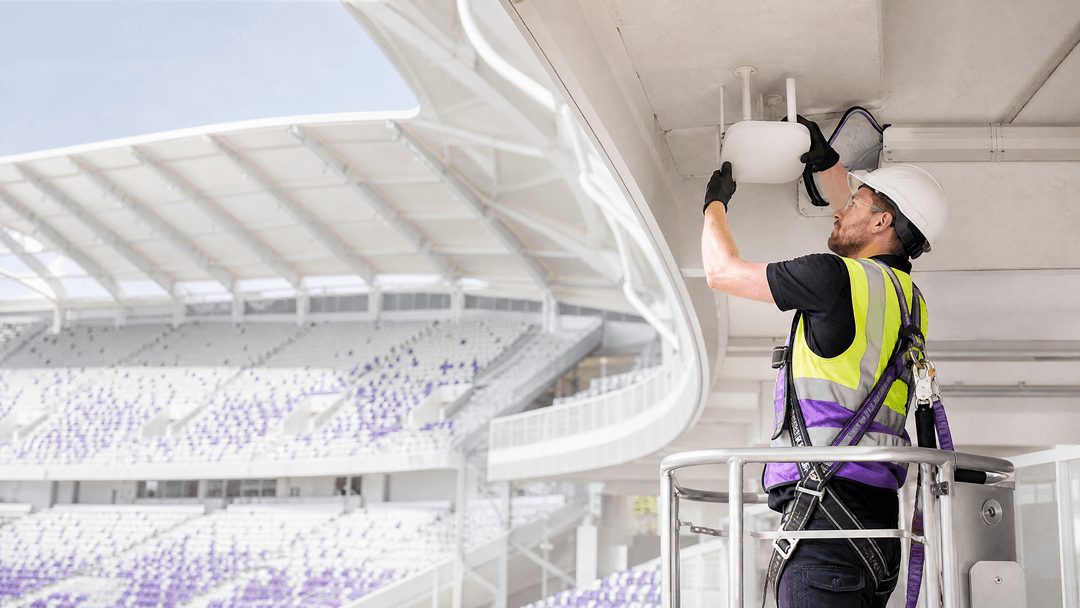
If you are planning WiFi 7 for a stadium, hotel or conference venue, the most expensive mistake is to treat it as an access-point refresh. WiFi 7 access points may be the visible purchase, but the work usually begins somewhere less glamorous: cable pathways, access switches, power supplies, controller entitlement and the event-day operations plan.
The business reason for doing that groundwork is straightforward. You want more guests or fans to connect successfully when demand peaks. You want mobile ordering, venue information and staff communications to work consistently. You want a Guest WiFi service reliable enough to support meaningful operational and engagement reporting. None of those outcomes arrive because a box says WiFi 7 on the label.
So the practical question for a venue IT team is narrower than "should we move to WiFi 7?". It is this: can the wired edge actually deliver the feature set we are about to buy? Answering it means checking power, Ethernet capacity, management compatibility and analytics validation before purchase orders go out.
This guide walks through the four readiness areas in the order a venue team should tackle them, and finishes with the measures that tell you whether the rollout genuinely worked.
Why venue WiFi 7 is an infrastructure project
A WiFi 7 access point is the end of a chain, not the whole of it. Between a guest's phone and a working service sit the access switch and its power supply, the cable run and its terminations, the uplink fabric, the identity and policy layer, and the management plane that provisions and monitors the estate.
Each of those can independently prevent an access point from delivering the profile you paid for. Worse, most of them fail quietly. An access point that comes up on insufficient power still appears online. A cable that passes at 1 Gbps but not at its target rate still shows a link. The failure surfaces on the busiest thirty minutes of the day, which is exactly when nobody has time to diagnose it.
That is why readiness work belongs before procurement rather than after it.
Readiness area one: Power over Ethernet
The 90 W shortcut is wrong
There is a popular but unhelpful shortcut that says every WiFi 7 access point needs 90 watts. It is not correct. IEEE 802.3bt can deliver up to 90 watts from the power source across all four pairs of an Ethernet cable, but access points have different powered-device classes and different operating profiles.
A high-capacity access point may deliver its full radio configuration and its highest Ethernet speed on 802.3bt. On 802.3at, the same unit may still power on, but run with reduced radios, a lower link rate or a disabled USB function. That is not a fault. It is the designed power profile working as documented.
The problem starts when the procurement paperwork never records which profile you intend to run. You then discover the difference after installation, at scale, in a venue full of people.
Four questions for every access point
For each access point you have selected, get four answers from the data sheet and write them down:
- Which PoE class supports the intended radio profile?
- What is the maximum power draw at the powered device?
- What Ethernet speed does that profile support?
- What is disabled if the switch supplies less power?
That fourth question is the one most often skipped, and it is the one that determines whether a compromise is acceptable or not. A reduced link rate in a back-of-house corridor may be perfectly reasonable. The same compromise in a seating bowl is a design failure.
Prove capacity at cabinet level, not port level
Then repeat the exercise at switch level, because a per-port label proves very little on its own. A switch can have 802.3bt ports and still have an insufficient aggregate power budget once every access point in the cabinet draws power at the same time.
Check four things per cabinet: the per-port class, the total PoE budget, the power-supply configuration and the resilience position. In a stadium, use the cabinet design to prove that every access point served by that cabinet can receive its intended profile simultaneously. Do not calculate from an average draw. Peak demand is the only number that matters, and peak is what a match day delivers.
Readiness area two: switching and cabling
The cable label is not a test certificate
WiFi 7 access points may present 2.5 Gbps, 5 Gbps or 10 Gbps interfaces. Existing Cat5e, Cat6 and Cat6a runs may well be reusable, but a cable category printed on a jacket is not a certification result. The full path includes patching, termination, length and physical condition, and any one of those can hold a run below its nominal rate.
Test each path against the speed you actually plan to use. Cat6a is a sensible starting point for a 10 Gbps target, but installation condition still decides the outcome.
Build a location register
Build a register covering every proposed access point. For each one, record:
- the venue zone
- the mounting type
- the cable identification
- the serving cabinet
- the planned access-point model
- the required PoE class
- the intended Ethernet rate
- the test status
This sounds administrative, and it is. It is also the single document that prevents an engineer discovering an unreachable cable route after the fixture list has been announced. Treat it as the shared source of truth for the programme rather than a spreadsheet that disappears into a project folder.
Design by venue zone, not by seat count
Treat the venue as a set of zones with genuinely different outcomes. A seating bowl is one design conversation. A concourse with arrivals, queues and retail is another. Premium hospitality, meeting rooms, guest bedrooms, kitchens and external queue areas each carry their own client density, mounting constraints and operating hours.
The radio design should reflect those zones. It should not be a copy-and-paste channel plan derived from an empty-room survey, because an empty venue is the one condition under which the network is never required to perform.
Test the arrival surge
If 50,000 people arrive within thirty minutes, test the arrival sequence as a surge.
This is not only an RF test. It is simultaneously an authentication, DHCP, DNS, policy, captive-portal and support-desk test. What you want to observe is the behaviour when a large number of devices discover the service, attempt to join, and roam through the venue together. Capacity problems and policy problems look very similar from a guest's point of view, and only a realistic surge separates them.
Got questions about your specific setup?
Our team works with venue operators, IT managers, and network engineers across 80,000 venues. Book a 20-minute call and we will show you how others like you solved it.
Readiness area three: controller, management and licensing
Controller support, cloud-management compatibility and licensing are technical prerequisites. They are not a finance-only detail to be settled later.
What to obtain before authorising the order
Your access-point vendor should supply the supported controller or cloud-management release, the capacity limits, the entitlement model and the upgrade path. Test the selected access points against the intended management plane in a representative cabinet before authorising an estate-wide rollout.
While testing, check how the platform reports power negotiation and link negotiation, radio state, switch errors and client experience. Those are the signals your team will rely on during an event, so confirm they are trustworthy while the stakes are low. Agree explicitly who owns the rollback decision if the pilot exposes a problem.
What published stadium programmes do and do not tell you
Published deployments are useful for structure, not for numbers.
Extreme Networks announced a WiFi 7 deployment at the University of Florida's Ben Hill Griffin Stadium, a venue that can hold around 90,000 people. The announcement is helpful because it points to distinct stadium zones. It does not publish a switch design or an event-day capacity figure, so do not borrow a number from it.
HPE announced a staged programme at Riyadh Air Metropolitano Stadium involving more than 1,500 WiFi 7 access points, describing RF optimisation, traffic validation and a separate production-over-IP network with segmentation and quality-of-service controls. Again, the access-point count is not the lesson. The lesson is that management, testing and protected operational traffic are treated as part of the infrastructure programme rather than as follow-up work.
Segmentation, compliance and handover
Do not merge guest WiFi, staff, payment, production, CCTV and IoT traffic simply because they happen to share an access-point estate. Agree segmentation and ownership before go-live, while the boundaries are still cheap to draw.
Where payment card data is in scope, apply your PCI DSS architecture. Where guest data is processed, apply the UK GDPR security requirements appropriate to the risk, considering confidentiality, integrity, availability, testing and recovery. All of that is considerably easier to reason about before an incident than during one.
The operational handover should include access arrangements for difficult locations, spare hardware, cable records, cabinet documentation, support contacts and a documented rollback method. The team on duty should never need to reconstruct the design while a queue is forming outside.
A controlled deployment sequence
Work through the rollout in a deliberate order:
- Approve the access-point profile, cable target and switch specification.
- Test and remediate the physical runs.
- Install a representative pilot across every cabinet type and area type.
- Prove controller and licence readiness.
- Run guest and staff journeys end to end.
- Roll out by zone.
- Run an event-style acceptance test before the first major event.
The order matters. Each step produces the evidence the next one depends on, and skipping ahead usually means discovering a physical constraint after it has become expensive to fix.
Proving the guest service after go-live
A rollout is not complete when every access point is online. It is complete when the physical records, power negotiation, Ethernet speed, controller health, guest login behaviour and operational dashboards all agree with the approved design.
Before go-live, confirm the exact supported hardware path, make sure your access points are registered, perform controlled test logins and capture a pre-upgrade baseline. Without that baseline, you cannot later distinguish an infrastructure fault from an unusually quiet fixture.
After go-live, use Purple's operational measures to confirm that guests are genuinely connecting as planned:
- registered access points, against your installed inventory
- access points with logins, which exposes zones that are live but unused
- authentication rate, comparing successful authentications against attempts
- visits and visitors, by zone and by event window
Compare each against the pre-upgrade baseline for equivalent event windows. Agree those windows in advance, so that if a measure moves the team can tell whether the cause is the event, a zone change or an infrastructure fault.
Building a business case that survives scrutiny
If you are preparing a business case, separate access-point cost from access switching, cabling, rack remediation, testing and cutover labour. A transparent model built from your own register is far more useful, and far more defensible, than an optimistic per-access-point multiplier.
Ask access-point, switch and cabling suppliers to quote against that register, including cabinet power supplies, multi-gig uplinks and any restricted-hours working. Quoting against a register makes commercial risk visible early, while there is still time to do something about it.
Define the go-live scorecard before the pilot rather than after it. Include the installed access-point inventory, the intended power and link state, access points registered, access points with logins, authentication rate, visits and visitors.
Frequently asked questions
Do we need to replace every switch?
No. Replace the switches that cannot supply the selected access point's intended power profile or Ethernet rate, and retain only the cable paths that pass certification at their target rate.
Do we need to re-cable every location?
No. Test each path against the speed you plan to use. Cat6a is a useful starting point for a 10 Gbps target, but the condition of the installation still matters more than the category printed on the cable.
Does every WiFi 7 access point need 90 W?
No. IEEE 802.3bt can deliver up to 90 W, but individual access points have their own powered-device classes and operating profiles. Read the data sheet for the profile you intend to run, and record which features are disabled at lower power.
What should we configure in Purple before go-live?
Confirm the exact supported hardware path, make sure your access points are registered, perform controlled test logins and capture a pre-upgrade baseline. Then validate access points with logins, authentication rate, and total visits and visitors by zone and by event window.
How do we know the rollout is complete?
Not when every access point is online. It is complete when physical records, power negotiation, Ethernet speed, controller health, guest login behaviour and operational dashboards all agree with the approved design.
Practical next moves
Three actions are worth taking before this leaves your desk.
First, appoint one technical owner for the physical readiness register and one operational owner for event acceptance. The register only works as a shared source of truth if somebody is accountable for it.
Second, ask your suppliers to quote against that register, including cabinet power supplies, multi-gig uplinks and restricted-hours working.
Third, in a hotel, make the pilot cover rooms, reception, meeting space and back-of-house. In a stadium, cover external arrival, turnstiles, concourses, seating bowl, premium hospitality and egress. In a retail estate, cover entrance, queue, shop floor and stock areas. The aim is not to prove one best-case speed test. It is to prove repeatable service in the places people actually use.
With that evidence in hand, the WiFi 7 decision becomes a calmer one. You know which switches need to change, which cable runs need attention, which licences must be in place, and what good looks like on the dashboard. That is the point at which access-point procurement stops being a leap of faith and becomes an implementation plan.
Key Definitions
IEEE 802.3bt
A Power over Ethernet standard that can deliver up to 90 W from the power source over all four pairs of an Ethernet cable.
Check it when the selected AP's intended radio profile needs higher power or a multi-gig link.
PoE power budget
The total power a switch and its installed power supplies can deliver across all powered ports at once.
It prevents a cabinet from supporting only some APs at their intended profile during peak demand.
Multi-gig Ethernet
Copper Ethernet rates above 1 Gbps, commonly including 2.5G, 5G and 10G, used between an AP and its serving switch.
Match it to the AP data sheet and cable test result before retaining a legacy access switch.
WiFi 7
The WiFi Alliance certification programme based on IEEE 802.11be, with capabilities such as 320 MHz channels, multi-link operation and 4096-QAM.
It informs the chosen AP profile but does not remove wired power, Ethernet or RF design constraints.
802.1X
A port-based network access-control standard used to authenticate devices or identities before network access is granted.
Use it as a design input for the appropriate operational SSIDs and network segments.
WPA3
A WiFi security certification that strengthens wireless protection and is supported by the Cisco WiFi 7 AP examples cited in this guide.
Consider it as part of SSID and authentication design, alongside client support and venue policy.
Controller or cloud management plane
The management layer that provisions, monitors and controls the access-point estate.
Validate software support, capacity, licensing and rollback before estate-wide AP deployment.
Radio frequency plan
The approved combination of AP placement, antenna selection, channels and transmit-power design for defined venue zones.
It should be validated for real arrival, seating, hospitality and external-queue patterns rather than an empty venue.
Authentication rate
A measure that compares successful authentication against attempts for a selected time period.
Use it with access-point login activity to find guest-journey issues after a rollout.
Network segmentation
The deliberate separation of guest, staff, payment, production, CCTV and IoT traffic into approved network boundaries and policies.
It protects service priorities and supports compliance decisions during the infrastructure design.
Worked Examples
A 200-room hotel wants to move from 1G 802.3at switches to WiFi 7 without unnecessary re-cabling. What should the team do?
Create a floor-by-floor readiness register for each proposed AP. Match every AP to its required power profile and Ethernet rate, then certify retained cable runs against that rate. Pilot rooms, lobby, meeting space and back-of-house from each cabinet type. Replace only access switches that cannot provide the intended per-port PoE class, aggregate power budget or multi-gig port rate. Confirm the selected AP and firmware in Purple's Supported Hardware guidance before the rollout.
A 50,000-capacity stadium needs WiFi 7 ready for a high-arrival match day. How should it plan the acceptance test?
Build the design and test plan by arrival, turnstile, concourse, seating-bowl, hospitality and egress zones. Verify switch power, uplinks, cables and controller readiness by cabinet. Keep payment, staff, production, CCTV, IoT and guest traffic in approved segments. Run staged test logins and a controlled arrival-style surge, then compare Purple measures for registered APs, APs with logins, authentication rate, visits and visitors against the pre-upgrade baseline.
Sources
- HPE Aruba Networking: 802.3bt support
- Cisco Wireless 9176 Series Access Points Data Sheet
- Cisco Wireless 9174 Series Access Points Data Sheet
- Extreme Networks: University of Florida WiFi 7 deployment
- HPE: Riyadh Air Metropolitano Stadium network
- Purple Support: Supported Hardware
- Purple Support: Analytics Beta - Partner Dashboard
- ICO: A guide to data security
Continue reading in this series
Measuring the Business ROI of Guest WiFi and Location Analytics
This technical reference shows IT and venue teams how to measure the ROI of guest WiFi with a defensible chain from network health and consented data to validated operational or commercial outcomes. It separates measurable evidence from assumptions, maps Purple Connect, Capture and Engage to the right measurement layer, and gives planning scenarios for hotels, retail estates and event venues.
Privacy by Design: Anonymising WiFi Data for GDPR Compliance
This authoritative guide details the technical architecture and implementation strategies for anonymising WiFi data to ensure GDPR compliance. It provides IT leaders and network architects with actionable frameworks for balancing robust venue analytics with strict data privacy requirements.
Heatmapping vs Presence Analytics: Technical Differences
This authoritative technical guide details the critical architectural and operational differences between WiFi heatmapping and presence analytics for enterprise venue operators. It provides IT leaders, network architects, and operations directors with actionable deployment frameworks, real-world implementation scenarios, and vendor-neutral best practices for extracting maximum ROI from their existing wireless infrastructure.
Got questions about your specific setup?
Our team works with venue operators, IT managers, and network engineers across 80,000 venues. Book a 20-minute call and we will show you how others like you solved it.