Amusement park WiFi capacity and ROI planner
Model outdoor access point density, monthly guest marketing data capture, and concession revenue uplift for your theme park or attraction venue.
Medium to large theme park with roller coasters, themed lands, and centralised dining plazas.
Operational parameters
Estimated architecture & ROI projections
Amusement park wireless deployment matrix
| Park zone | RF environmental factor | Recommended AP hardware | Purple analytics focus |
|---|---|---|---|
| Ride queue switchbacks | Dense human body absorption, steel coaster interference | Directional narrow-beam IP67 APs (30°/60° patch) | Real-time queue wait time measurement & dwell alerts |
| Main entrance and turnstiles | Simultaneous morning arrival bursts | High-density 4x4 WiFi 6/6E with load balancing | Instant captive portal onboarding & digital ticketing pass |
| Central plazas and walkways | Expansive open RF path loss, rapid pedestrian traversal | Omnidirectional lamp-post mounts, fibre backhaul | Crowd density heatmaps and park dispersal routing |
| Dining halls and food courts | Extended 45-60 min dwell times, POS transaction traffic | Dual-radio indoor APs with isolated POS VLANs | Mobile ordering acceleration & repeat visitor surveys |
| Water park and splash zones | Water spray, chlorine vapour, moisture attenuation | IP67/IP68 (NEMA 4X) sealed enclosures with UV stabilisation | Locker & rental kiosk digital engagement |
Design your amusement park WiFi network with Purple
Purple integrates directly with your existing enterprise wireless hardware (Cisco Meraki, HPE Aruba, Ruckus, Juniper Mist, Extreme) to deliver frictionless guest WiFi, GDPR/COPPA-compliant data capture, real-time queue analytics, and targeted concession marketing. Speak with an entertainment venue wireless architect for a customized design review.
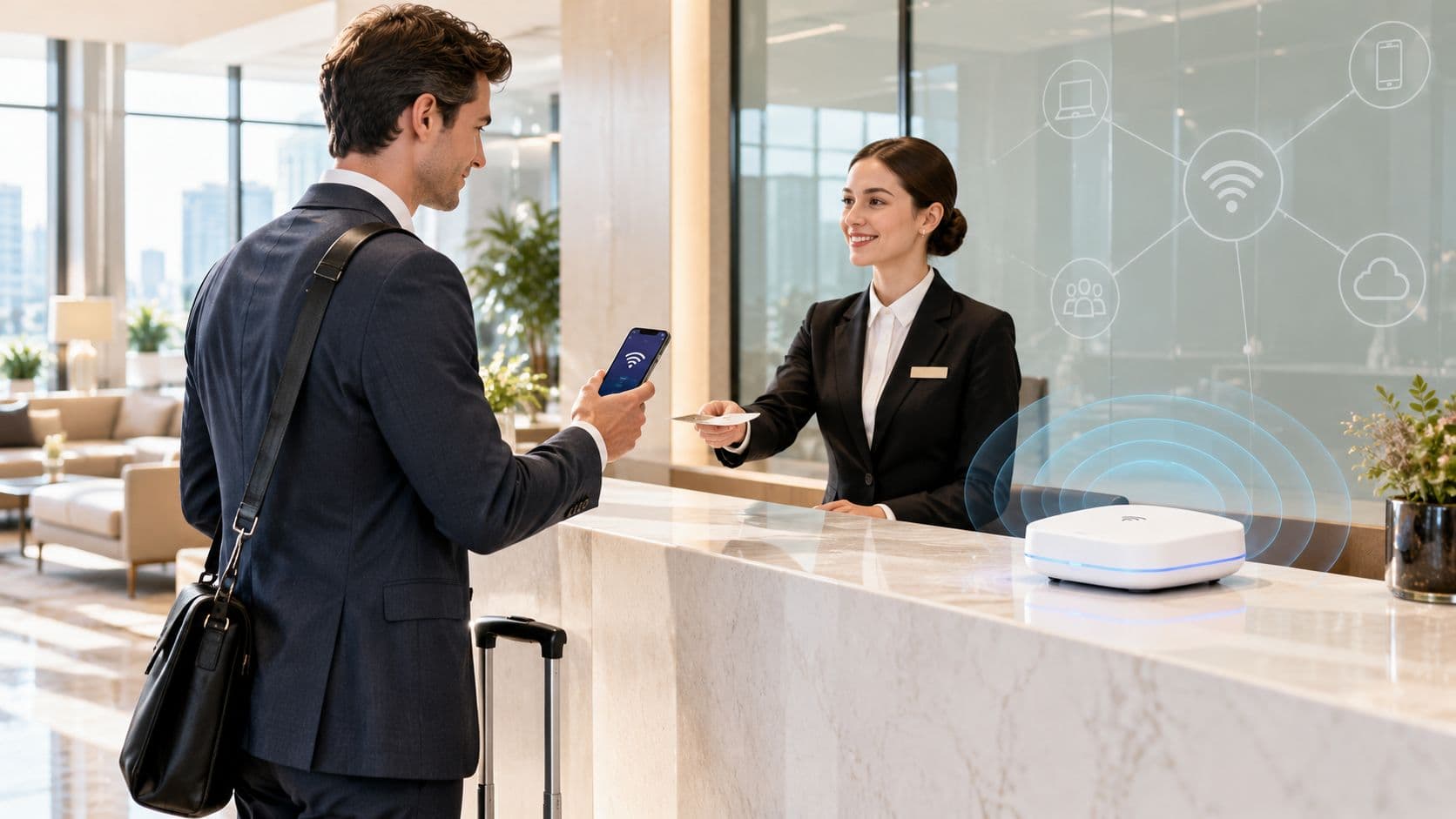
Amusement parks, theme parks, water parks, and large attraction venues operate in an environment where reliable wireless connectivity is no longer just a luxury for visitors - it is an essential operational layer. Roller coaster riders share videos instantly, families use mobile apps for interactive maps and food ordering, and park management relies on location data to balance crowd density and manage line times.
High-density outdoor environments present unique wireless challenges: fast-moving steel rollercoasters, dense crowds of thousands of active devices, high-humidity splash zones, and sprawling geographical footprints. Deploying enterprise guest WiFi solutions alongside branded captive portal authentication allows theme park operators to secure their networks while turning connectivity into a driver of foot traffic revenue and guest satisfaction.
Key takeaways: Guest WiFi for amusement parks and theme parks
- High-density coverage: Deploy weather-rated IP67 access points to handle thousands of concurrent mobile connections across entry gates, queue lines, and food courts.
- Queue management & mobile app integration: Enable virtual queuing and mobile food ordering without friction or cell phone dead zones.
- Presence analytics & footfall insights: Track real-time visitor movement, peak occupancy hours, and dwell times across park zones to optimize staffing and attraction throughput.
- Captive portal data capture: Collect opt-in guest contact details upon WiFi sign-in to trigger personalized post-visit offers and ticket renewal campaigns.
- Family-friendly security & compliance: Protect visitors with content filtering, VLAN network isolation, and Friendly WiFi certification across all public access points.
Why amusement parks require dedicated guest WiFi architecture
Traditional public wireless setups fail in amusement park environments due to extreme device density, physical obstacles, and fluctuating crowd patterns. Modern theme park visitors expect seamless connectivity throughout their visit, while operators need actionable intelligence to streamline park logistics:
- Guest satisfaction and social amplification: Visitors stream high-definition media, upload photos, and coordinate group meetups in real time. Fast WiFi eliminates frustrating cell phone dead zones caused by steel ride structures and dense crowds.
- Revenue expansion via venue analytics: Integrating WiFi presence analytics helps park managers analyze visitor movement, identify underutilized dining outlets, and push targeted promotional offers to visitors during long wait times.
- Digital ticket and mobile app adoption: Modern parks rely on proprietary mobile apps for contactless entry, ride reservations, and interactive maps. Dedicated guest WiFi ensures all visitors can download and use park apps without consuming cellular data.
- Network segregation and operational security: Isolating guest traffic from back-of-house networks protects ticketing terminals, point-of-sale (POS) systems, ride control telemetries, and operational security cameras.
Amusement park WiFi deployment zones: hardware and capacity requirements
Theme parks feature diverse environmental conditions that demand specialized wireless planning. The table below outlines key hardware specifications and security configurations by park zone:
| Park zone | Device density & demand | Hardware & rating specs | Security & authentication |
|---|---|---|---|
| Entry turnstiles & ticket plazas | Very high density; rapid onboarding; digital ticket scanning. | High-capacity outdoor APs; narrow beam directional antennas. | Branded captive portal; One-Touch social or SMS auth. |
| Ride queue lines & concourses | High dwell time; video streaming; social sharing. | Mesh-capable dual-band APs; rate-limiting per connected client. | Client isolation; automated idle session disconnects. |
| Dining courts & food halls | Moderate-to-high density; mobile food ordering; payment processing. | High-density indoor/outdoor APs; PoE switches. | Dedicated retail guest VLAN; PCI-DSS compliant POS isolation. |
| Water parks & splash zones | Moderate density; casual browsing; digital locker management. | IP67-rated waterproof APs; corrosion-resistant enclosures. | Walled garden for safety guidelines; encrypted HTTPS login. |
Captive portals and guest marketing automation
A custom splash page serves as the digital front door to the theme park. When visitors log into guest WiFi, park operators can collect compliant opt-in contact information while presenting instant venue updates:
- Data capture for marketing campaigns: Collect verified email addresses, cell phone numbers, and demographic details. Segment audience lists based on visit date, family status, or preferred park attractions.
- Targeted in-park promotions: Use WiFi marketing automation to trigger real-time promotional notifications, such as discounts on dining vouchers during off-peak meal hours or fast-pass upgrades.
- Post-visit feedback and review collection: Automatically send micro-surveys when guests exit the park to capture real-time satisfaction ratings and encourage positive Google or TripAdvisor reviews.
Optimize your amusement park WiFi experience
Purple powers secure guest WiFi, presence analytics, and marketing automation for venues, theme parks, and attractions worldwide.
Family-friendly WiFi security and compliance
Theme parks host millions of families each year. Ensuring a safe browsing environment is essential to protect children and preserve park reputation:
- Content filtering: Enforce automated web filtering to block inappropriate content, adult materials, and malicious sites across all public access points.
- Friendly WiFi certification: Purple is certified under the global Friendly WiFi standard, assuring parents that public access points meet strict digital safety benchmarks.
- Data protection standards: Full compliance with ISO 27001, GDPR, CCPA, and Cyber Essentials ensures guest data is encrypted and handled in strict accordance with international privacy regulations.
Frequently asked questions about amusement park WiFi
How many access points does an amusement park need?
Access point requirements depend on total acreage, physical terrain, tree canopy cover, build materials, and peak concurrent visitor numbers. A comprehensive wireless site survey is essential to calculate exact AP counts and map signal propagation around ride structures.
How do access points perform near steel roller coasters?
Steel structures cause RF attenuation and signal reflection. Wireless engineers mitigate these challenges using directional antennas, channel planning, and strategically placed outdoor APs to ensure seamless roaming handovers as guests walk past major attractions.
Can guest WiFi integrate with theme park mobile apps?
Yes. Purple's SDK and API integrations allow guest WiFi splash pages to redirect users directly to mobile app store downloads or open installed venue apps for digital ticketing and interactive park maps.