Venue digital inclusion & accessibility audit
Assess your venue WiFi for login friction, WCAG accessibility, and community impact. Calculate how many local visitors are currently excluded by captive portal barriers.
Key hub in the National Digital Inclusion Network supporting non-confident users.
Severe friction. The tool assumes 46% of low-confidence users abandon the connection attempt.
Critical digital exclusion barriers found. Current login friction or lack of public WiFi locks out hundreds of vulnerable local residents.
In 2025, the digital divide is a crisis of digital equity, fundamentally restricting access to life's essentials. The fight to establish connectivity as a right, not a privilege, is often framed in terms of high-level national strategy and multi-billion-dollar infrastructure projects. But for millions who lack consistent access, the solution isn't miles of fiber optic cable; it's the welcoming sign of a local library, a bustling café, or a community center with free, reliable and secure WiFi.
Closing the digital gap starts locally. Public venues and socially conscious businesses hold an immense, and often underestimated, power: they are the last mile of connectivity and the front lines of digital inclusion.
Public venues as critical infrastructure for connectivity
The reality of digital exclusion in the US is stark: millions lack the access, devices, and skills needed to thrive in today’s increasingly digital world.
- An estimated 7.9 million people in the US lack basic digital skills.
- Approximately 1.6 million adults don't have a smartphone, tablet, or laptop.
- 1.9 million households struggle to afford their cell phone contract.
For many people, especially the 3.7 million families below the Minimum Digital Living Standard, the cost of data is a significant barrier.
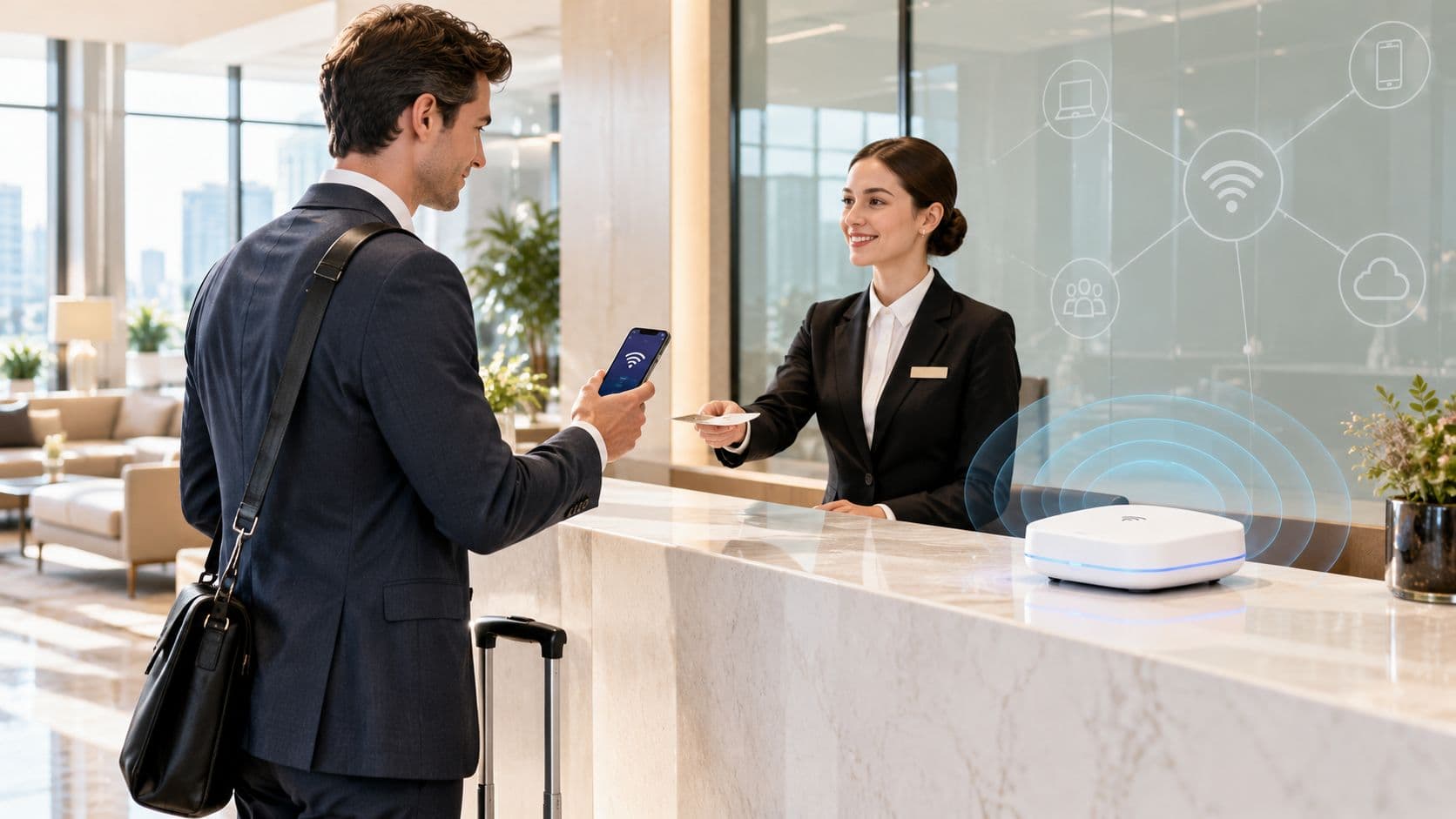
This is where local venues step in. By offering free, reliable and secure internet access, local public spaces provide critical social infrastructure - just as essential as local water and power supply.
The foundational role of libraries, cafés, and community centers
The concept of a local venue as a digital lifeline goes beyond simply providing a signal. It often acts as the entry point to a wider digital journey:
- Libraries and Community Hubs: These locations are often the primary touchpoints within the National Digital Inclusion Network, with over 7,000 community access points across the US. They are places of non-judgmental, trusted support, crucial for people who aren’t digitally confident.
- Cafés and local businesses: Forward-thinking businesses that offer free public WiFi - such as main street coffee shops - create safe, informal, and convenient environments for essential tasks like checking email, accessing online health portals, or conducting job searches without burning expensive mobile data.
The ripple effect: unlocking opportunity at the local level
When local venues successfully bridge the connectivity gap, the benefits ripple outward, transforming personal and community outcomes in the local area.
Access to health and wealth
Digital exclusion imposes a “poverty premium” on the most vulnerable, simultaneously limiting their access to cost-saving information and increasing financial stress.
- Financial savings: Individuals with high digital capability save on average $1,100 a year more than those with low capability, simply by shopping around and using digital financial tools. Accessible venue WiFi provides the platform for people on low incomes to secure these same savings.
- E-Government and essential services: For those offline, 33% find council and government services difficult to use, incurring delays and greater psychological burdens. Free WiFi allows people to complete essential tasks - ordering prescription refills, checking bus schedules, or filling out housing forms - quickly and easily.
- Health Management: Digital tools are key to the NHS strategy, yet 31% of US adults don't access health services online. Venue WiFi empowers users to book appointments, research symptoms, and access online health tools - a critical step, given that 74% of digitally confident individuals are using online tools to manage their health.
Education and employment opportunities
The connection provided by venues serves as a launchpad for economic mobility, particularly for those facing the deepest workplace challenges.
- Job seeking: The modern job market is fundamentally digital, with digital skills being essential entry requirements for 82% of online job vacancies. Venues with free WiFi provide job seekers with the connection needed for job hunting and online applications.
- Skills acquisition: Learning happens online. For the estimated 7.3 million individuals in the US labor force lacking the Essential Digital Skills for Work, venues provide a free, safe space to engage with learning platforms and practice their digital skills.
How removing barriers increases access (the captive portal problem)
The simple act of providing WiFi is a great first step, but the user experience can create new digital barriers. For someone already struggling with anxiety, low literacy, or a disability, navigating a captive portal - the splash screen that forces users to agree to terms, provide personal details, or watch an ad - can stop them from connecting entirely.
The industry and public sector must adopt a seamless and secure approach to honor the commitment of connectivity as a right.
- Frictionless access: Requiring complex sign-ups, email addresses, or password creation places an unnecessary burden on users already challenged by digital tasks. 16% of the offline population think the internet is too complicated; an overly complicated login only reinforces this belief.
- Privacy and trust: Asking for personal data can be a major barrier, playing directly into the lack of trust cited by many excluded individuals. Venues should prioritize the security and privacy of the user experience to maximize trust and adoption.
- Digital accessibility: Login systems should be designed with accessibility in mind, ensuring they function smoothly with screen readers and voice activation tools for users with physical, sensory, or learning impairments. This aligns with the DDS focus on Digital Inclusion of persons living with disabilities (PWDs).
In short, if WiFi is a right, the access method should be simple, transparent, and immediate.
The task of achieving Digital Equity - where connectivity is a fundamental right - requires investment, yes, but fundamentally, it requires local commitment. The compelling cost-benefit analysis shows that for every $1 invested in digital inclusion, $9.48 is returned to the US economy, making this a smart financial decision as well as a moral one.
What You Can Do:
- For community venues and libraries: Review your public WiFi setup. Are you maximizing accessibility and removing unnecessary barriers like complex sign-up portals?
- For public sector leaders: Recognize and fund local venues as core Digital Public Infrastructure. Provide specific grants for upgrading WiFi capacity and ensuring simplified, secure access protocols that adhere to clear digital hygiene standards.
- For socially conscious businesses (hospitality, retail, banks): Treat your customer WiFi as a social contribution. Prioritize speed, security, and effortless access. Your space can be the critical link that helps someone submit a vital form, check their government assistance payment, or secure an essential saving.
Digital inclusion is not an abstract concept debated in conference rooms. It's an issue of local, granular reality. It is a matter of reliable infrastructure, a helping hand, and an open front door.
By making our physical spaces seamless and secure points of digital connection, we don't just bridge the gap; we build the basic right to participation that everyone deserves.