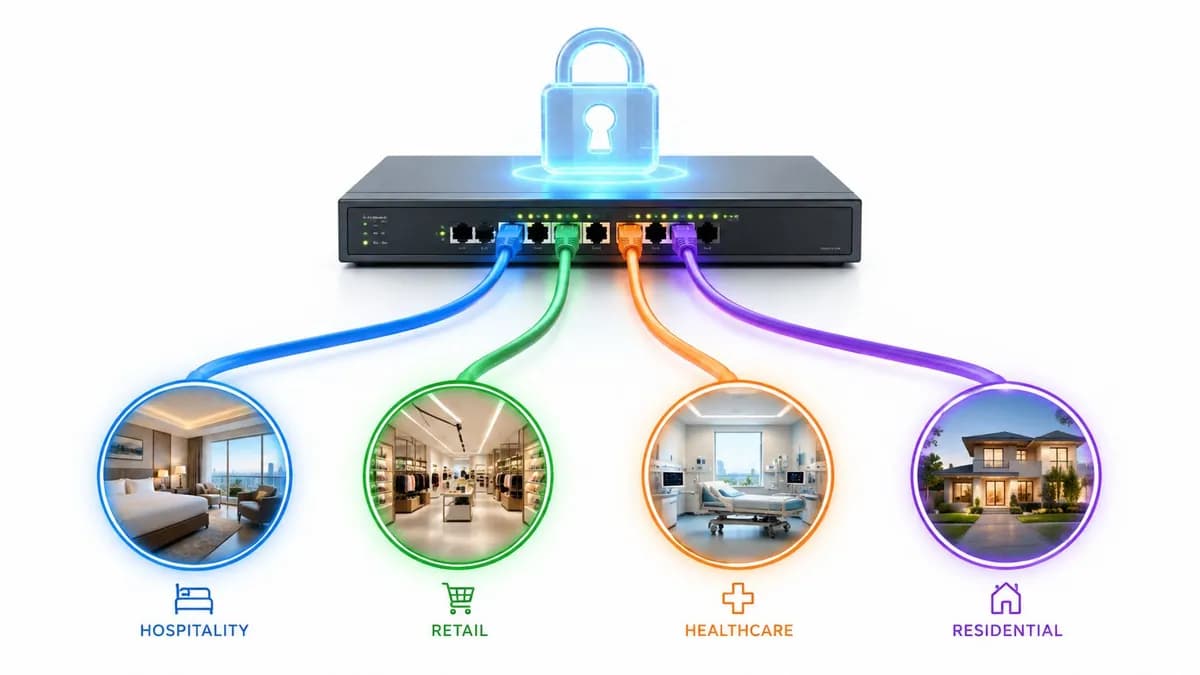
A lot of IT directors inherit the same network story. One hotel has a solid fiber circuit and sensible firewall rules. The next property runs on a different provider, a different router standard, and a VPN that nobody wants to touch before a holiday weekend. In retail, it’s often worse. New stores open fast, cloud apps multiply, and the network ends up stitched together from MPLS, broadband, local workarounds, and too many exceptions.
That model breaks down when guest WiFi, staff access, cloud apps, and security policy all need to work consistently across every site. WAN as a service is the shift away from running each branch like a small networking project and towards consuming wide area connectivity as a managed, cloud-delivered service. For distributed organizations, that’s less about hype and more about operational sanity.
Moving Beyond Legacy Network Pain
A growing hotel group usually doesn’t fail because it lacks internet access. It struggles because every site behaves differently.
One property has reliable connectivity but poor segmentation between guest and staff traffic. Another has decent guest WiFi but slow access to cloud PMS or collaboration tools. A third site needs urgent changes to support a renovation or pop-up event, but the network depends on local kit, carrier lead times, and someone remembering how the last contractor configured the VPN.
That’s the core pain point. Not bandwidth in isolation. Inconsistency.
For retail chains, the pattern is similar. Point-of-sale, inventory, digital signage, staff devices, and guest access all compete on a branch network that was never designed to be centrally governed at scale. IT teams spend too much time firefighting local issues and too little time improving the estate.
Why the model is changing
The market has moved because enterprises want networking to behave more like cloud infrastructure. The global NaaS market was valued at 11.5 billion USD in 2022, grew to 14.6 billion USD in 2023, and is projected to reach 115.5 billion USD by 2032, according to network as a service market statistics from Market.us.
That growth matters because it reflects a broader decision being made by enterprise IT teams. They don’t want to manage every branch as a collection of boxes, circuits, and exceptions. They want central policy, cleaner rollout, and predictable service delivery.
Practical rule: If adding a new venue still means rebuilding security, routing, and access policy site by site, your WAN model is holding the business back.
What improves first
When organizations move away from legacy branch networking, the first gains are usually operational:
- Faster site standardization because policy lives in a central platform, not in local device quirks.
- Cleaner troubleshooting since teams can see traffic paths and service health across venues.
- Better user experience for both staff and guests, because connectivity stops depending on how well each site was built years ago.
The key point isn’t that WANaaS makes networking disappear. It doesn’t. It changes where complexity lives, and who has to manage it.
Deconstructing WAN as a Service
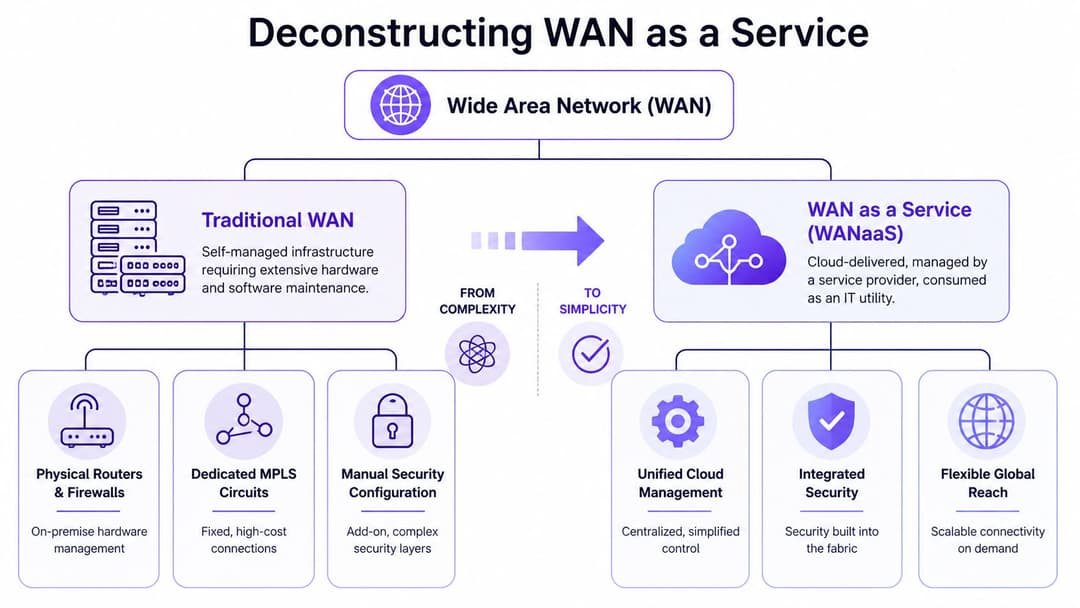
If you want the simplest explanation, wan as a service applies the cloud consumption model to the WAN. It’s the same mindset shift many teams already accepted with email, identity, and infrastructure. You stop owning every moving part at every site and start consuming a service that handles transport, routing logic, visibility, and often security from a central control plane.
The core architectural shift
Traditional WAN design ties performance and policy closely to branch hardware. WANaaS changes that by using a software-defined model. WANaaS platforms use software-defined networking to separate the control and data planes, enabling dynamic traffic routing across MPLS, broadband, and 5G based on real-time network conditions, as described by Red River’s overview of WAN as a service.
In practical terms, that means the branch no longer has to make every decision in isolation. Policy is defined centrally, then applied consistently. The service can steer traffic based on application need, path quality, resilience requirements, or business rules.
For an IT director, the useful question isn’t whether the architecture is elegant. It’s whether the right traffic gets the right treatment without manual tuning at every venue.
What the moving parts actually do
Three components matter most:
The access underlay
This is the physical connectivity you already recognize. Fiber, broadband, mobile backup, or a mix. WANaaS doesn’t remove the need for circuits. It makes them easier to use together.The software-defined overlay
This is where path selection, traffic steering, segmentation, and resilience logic sit. It’s what lets a site use more than one connection type without becoming messy.The cloud management layer
This is the part many teams value most. You get central visibility, central policy, and a service model that scales more cleanly than branch-by-branch administration.
A useful outside perspective on that operating model is Optimizing business networks with WaaS, which frames the shift away from rigid, site-centric WAN design and towards service-based management. For a broader look at the cloud-delivered networking model, Purple’s own guide to networking as a service is also worth reading.
Treat WANaaS like an operating model, not a circuit replacement. If you only swap transport and keep the same manual processes, you won’t get the main benefit.
What works and what doesn’t
What works is using WANaaS to simplify control across many venues. A hotel group can prioritize PMS, payment, voice, and staff collaboration traffic centrally while keeping guest access isolated. A retailer can roll out the same branch policy everywhere without rebuilding the network design store by store.
What doesn’t work is expecting WANaaS to fix poor application design, weak identity controls, or inconsistent LAN standards on its own. It improves the WAN. It doesn’t erase every upstream and downstream problem.
How WANaaS Compares to MPLS and SD-WAN
A hotel group opening three refurbished properties in one quarter does not need another branch design project. It needs each site online fast, with payment, PMS, staff apps, and guest WiFi behaving the same way on day one. That is the context for comparing WANaaS with MPLS and SD-WAN.
Most IT teams are not choosing from a blank sheet. They are usually working around a mix of MPLS, self-managed SD-WAN, commodity internet links, and branch security appliances added over several years.
Traffic patterns have also changed. Enterprises now send much more traffic straight to cloud and SaaS platforms than they did when hub-and-spoke WAN design was the default. As noted in the report on the state of the enterprise WAN, that shift has gone hand in hand with broader SASE adoption. Once branch traffic is heading directly to Microsoft 365, cloud PMS platforms, collaboration tools, and identity services, backhauling everything through a central point becomes harder to justify.
Network Architecture Comparison
| Criterion | MPLS | DIY SD-WAN | WAN as a Service |
|---|---|---|---|
| Cloud alignment | Often built around central backhaul | Better cloud fit if designed well | Designed around cloud-delivered policy and service consumption |
| Operational ownership | Heavy provider and contract dependency, plus local branch complexity | High in-house responsibility for design, hardware, and lifecycle | More responsibility sits with the service provider and cloud management plane |
| Agility for new sites | Usually slower and less flexible | More flexible than MPLS, but rollout quality depends on your team and tooling | Strong fit for standardized branch rollout across distributed venues |
| Security model | Historically separate from transport | Can be strong, but often requires multiple integrations | Commonly built with integrated security controls and central policy |
| Hardware burden | Significant branch and edge dependency | Still substantial in many deployments | Lower on-prem complexity in cloud-native models |
| Best fit | Stable estates with predictable traffic and long planning cycles | Teams that want control and can absorb operational overhead | Organizations that want managed agility, central policy, and cleaner scale |
Where MPLS still has a place
MPLS still suits some environments. If a business has highly stable sites, long planning cycles, strict carrier relationships, and a small set of predictable applications, it can remain useful.
The problem is not that MPLS stopped working. The problem is that many hospitality and retail estates changed around it. New sites open faster. More services are cloud-hosted. Guest expectations for WiFi quality are higher. Staff increasingly authenticate through cloud identity platforms, and those identity decisions need the branch network to respond quickly and consistently.
Where DIY SD-WAN helps, and where it bites
DIY SD-WAN addressed a real gap. It gave network teams path selection, transport flexibility, and better use of broadband and internet circuits. For organizations with strong in-house engineering, that control can still be worth having.
But the trade-off is operational weight. Your team still has to choose vendors, maintain edge hardware, update software, integrate firewalls and secure web gateways, troubleshoot branch exceptions, and keep standards consistent across every venue. In a retail chain or hotel estate, the branch count usually grows faster than the network team.
If you are assessing whether that extra control is worth the support burden, Purple’s guide to SD-WAN benefits for distributed businesses is a useful reference point.
MPLS trades flexibility for predictability. DIY SD-WAN trades flexibility for engineering effort. WANaaS is designed for organizations that want central policy and faster rollout without owning every part of the stack.
Choosing the model your team can run well
The core decision is less about feature checklists and more about operating model.
A capable network engineering team may prefer to design its own SD-WAN, security stack, and cloud integrations. That can work well if the business accepts the lifecycle burden. Many hotel groups, retailers, and mixed-use venue operators want a different outcome. They want consistent segmentation, faster site activation, and fewer branch-specific exceptions.
That matters even more once WiFi access is tied to identity. If guest access uses OpenRoaming and staff access relies on Entra ID or Okta-issued credentials, the WAN cannot be treated as a separate plumbing layer. Policy has to carry from the WAN into the venue edge, so guest traffic stays isolated, staff devices inherit the right access, and cloud security controls see the user and device context they need. WANaaS fits that model better than a patchwork of circuits and branch appliances because it gives you a cleaner way to apply policy across sites, then extend it to the WiFi experience guests and staff use.
Building Security into Your WAN Fabric
The old branch model treated security as a layer you added after connectivity was in place. That approach creates drift. One site gets a slightly different firewall policy. Another delays a hardware refresh. A third has exceptions nobody documents properly. Over time, the WAN becomes connected, but not consistently protected.
Modern WANaaS changes that by making security part of the service fabric.

According to Cloudflare’s WAN as a Service whitepaper, modern WANaaS operates as a cloud-native solution integrating firewalls, DDoS mitigation, and zero-trust protocols at every layer, while eliminating much of the hardware lifecycle burden and providing a unified security posture from a single dashboard.
Why this matters in multi-site environments
A hotel, shopping center, or healthcare estate doesn’t just need “secure internet”. It needs different types of traffic to be treated differently.
Guest traffic should remain isolated from operational systems. Staff devices should inherit policy based on identity and role. Payment systems, admin tools, IoT, and third-party tenant services often need their own lanes. If that segmentation depends on local branch firewall craftsmanship, consistency won’t last.
WANaaS improves this in two ways:
- Policy is centralized so each venue doesn’t become its own security island.
- Security services are integrated rather than bolted on through a chain of separate products and manual handoffs.
What good security design looks like
In practice, strong WANaaS security usually includes:
- Identity-aware access decisions so users and devices don’t get broad access just because they’re on the right subnet.
- Traffic segmentation that keeps guests, staff, operational systems, and tenants apart.
- Central inspection and monitoring so teams can enforce policy uniformly and investigate issues without logging into every branch individually.
That architecture is particularly useful in venues with a mix of trusted and untrusted users. Hotels and malls are obvious examples, but Student Housing, clinics, and residential buildings face the same problem. One physical site can contain several trust zones.
The branch shouldn’t decide security by location alone. It should enforce policy by identity, role, and traffic type.
The trade-off to watch
There is a trade-off. When you move more control into a provider’s cloud platform, your visibility and troubleshooting model changes. Your team needs to understand the provider’s tooling, logs, and policy workflow. That’s a fair exchange if the management plane is mature and your processes adapt to it. It’s a bad exchange if you buy WANaaS and still insist on managing every site like an old branch firewall estate.
Connecting WANaaS with Identity-Based WiFi Access
A guest walks into a hotel, joins WiFi through OpenRoaming, opens a loyalty app, and expects it to work immediately. At the same time, a front-desk employee signs in on a staff device using a certificate tied to Entra ID or Okta. If both sessions land on the same local network with only a VLAN label separating them, the WAN has very little context. It sees traffic. It does not see intent.

That gap matters in distributed venues. Hotels, retail estates, clinics, and mixed-use properties often invest in better WAN policy, then leave WiFi access decisions isolated at the branch. The result is familiar. Guests get a decent onboarding flow, staff get a separate authentication method, and central IT still has to maintain broad network zones because identity is lost before traffic reaches the WAN policy engine.
The better design is to carry identity from the moment a device joins WiFi into the policy model used across the WAN and cloud security stack. Purple fits this pattern well because it supports passwordless guest access through OpenRoaming and Passpoint, plus certificate-based staff access tied to Entra ID, Okta, and Google Workspace. The WiFi platform classifies the user first. WANaaS then uses that classification to apply the right path, inspection, and access controls.
How to extend identity to the WAN edge
In practice, the workflow should look like this:
Authenticate the user on WiFi
- Guest users join through OpenRoaming or Passpoint.
- Staff users authenticate with a certificate or directory-backed method tied to Entra ID or Okta.
Assign a role at the access layer
- Guest
- Employee
- Contractor
- IoT or shared device
Pass that role into network policy
- Map the authenticated role to a VLAN, SGT, VXLAN segment, or equivalent policy tag, depending on your WLAN and WANaaS stack.
- Keep the mapping consistent across every venue.
Apply WANaaS policy by identity, not by SSID alone
- Guest traffic goes to local internet breakout with web filtering and rate policy.
- Staff traffic goes to private applications, SaaS controls, and inspection points defined for employee access.
- Operational devices follow a separate route with tighter east-west restrictions.
Log identity and policy decisions centrally
- The service desk should be able to answer three questions quickly: Who connected? What role were they assigned? Which WAN policy did that trigger?
That is the missing link in many WANaaS projects.
A practical policy example
An OpenRoaming guest should not just land on "guest WiFi." That label is too vague for modern operations. The session should map to a defined policy object in the WAN fabric, such as:
- Identity source: Purple OpenRoaming authentication
- Role: Guest
- Network segment: Guest internet only
- WAN policy: Local breakout, DNS filtering, bandwidth cap, block access to private RFC1918 ranges, no lateral movement to venue systems
- Logging: Session start, venue, device class, policy applied
A staff member on a managed tablet should follow a different path:
- Identity source: Entra ID or Okta certificate-based authentication via Purple
- Role: Staff
- Network segment: Employee secure access
- WAN policy: Route to business apps, allow approved SaaS, inspect traffic according to company policy, block access to guest and IoT segments
- Logging: User identity, device posture if available, application access events, policy changes
That is how WAN-level segmentation reaches the WiFi edge in a usable way. The WLAN decides who the user is. The WANaaS platform decides what that identity is allowed to do across sites, cloud services, and internet breakout.
What IT teams need to standardize
The hard part is rarely authentication itself. The hard part is policy consistency.
If one hotel maps staff to VLAN 20, another maps them to VLAN 40, and a third relies on a local firewall object nobody documented, the WANaaS provider cannot enforce a clean identity-based model across the estate. Standard role definitions matter more than perfect circuit uniformity. A retail chain with 300 stores is usually better served by four or five well-governed identity classes than by dozens of site-specific exceptions.
Teams evaluating branch architecture often hit this point when comparing local SD-WAN policy with cloud-managed WAN controls. These SD-WAN use cases for distributed venues are a useful reference for how application and access policy play out at site level.
The trade-off to plan for
Identity-based enforcement improves control, but it also raises the quality bar for integration. WLAN, identity provider, NAC or policy engine, and WANaaS must agree on role names, policy tags, and failure handling. If Entra ID is unavailable, what happens to staff onboarding? If OpenRoaming succeeds but the policy tag fails to sync, does the user fall into a restricted holding policy or gain broad internet access by mistake?
Good designs answer those questions early. They define a fallback policy, keep role mapping simple, and test onboarding from the user perspective, not just from the admin console.
If Purple identifies the user and the WANaaS platform cannot consume that identity in a consistent way, you have better WiFi onboarding but not better network control.
That is why identity-based WiFi access should be designed as part of the WAN architecture, not attached later as a branch feature.
WANaaS in Action Across Your Venues
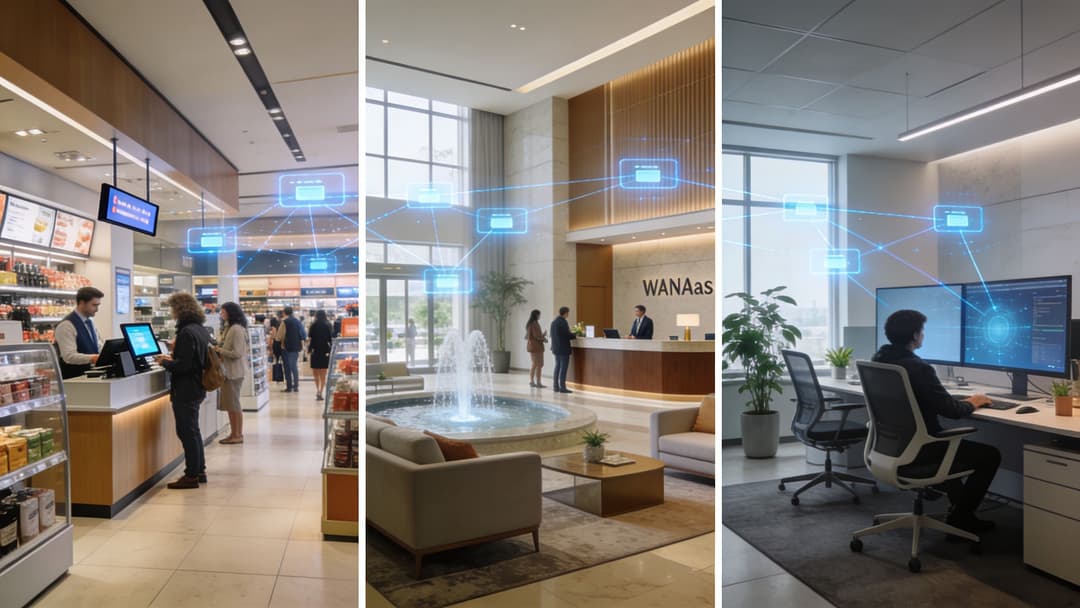
The architecture matters because of what it fixes on the ground. Different sectors hit different problems, but the pattern is consistent. Distributed venues need central control without flattening every local requirement.
Hospitality
A hotel group often wants three things at once. Smooth guest onboarding, secure staff access, and consistent application performance across properties.
With WANaaS, the group can apply one routing and segmentation model across all hotels while adapting to local circuit availability. Guest traffic breaks out cleanly, staff traffic reaches business systems securely, and central IT doesn’t need to tune every site separately. If you’re weighing where SD-WAN and cloud-managed WAN patterns fit operationally, these SD-WAN use cases for distributed venues give useful context.
Retail
Retail stores punish weak networks quickly. Payment traffic can’t wait for guest browsing to calm down. Digital signage, loyalty apps, handheld devices, and cloud inventory tools all need predictable treatment.
What works here is application-aware policy combined with strict segmentation. WANaaS can prioritize business-critical traffic while preserving a usable guest experience. What doesn’t work is giving every store broad internet access and hoping local kit will keep things orderly.
Healthcare
Clinics and outpatient sites need more than internet reachability. They need dependable access to core applications, clean separation for clinical and non-clinical traffic, and simpler operational oversight.
A WANaaS model helps when healthcare estates are spread across many smaller sites with limited local IT presence. Central teams can standardize policy, reduce branch complexity, and avoid turning every clinic into a one-off design.
Residential and multi-tenant
Multi-Family, Student Housing, and mixed-use properties are awkward for traditional branch thinking because one building can behave like many separate networks. Residents want a home-like experience. Staff need managed access. Shared systems and legacy devices still need control.
A good WANaaS design supports per-tenant isolation, clear access boundaries, and central administration. The important lesson is that these environments aren’t “just WiFi projects”. They need WAN, identity, and segmentation working together.
The strongest venue networks don’t just connect sites. They preserve a consistent trust model from property to property.
Planning Your Migration to WANaaS
The best WANaaS migrations start with business friction, not product demos. If you begin with the provider’s feature sheet, you’ll miss the operational issues that matter to your estate.
Start with the estate you already have
Audit sites by business criticality, user type, access method, and support burden. A flagship hotel, a small retail branch, and a healthcare clinic may all sit on the same WAN today, but they won’t have the same tolerance for outage, latency, or policy mistakes.
Map what’s really happening in each venue:
- Traffic behavior across guest, staff, operational, and third-party usage
- Authentication paths for users, devices, and legacy equipment
- Branch dependencies such as local firewalls, VPNs, or provider-managed handoffs
Define success in operational terms
Keep the target practical. Better migration plans usually define success as fewer local exceptions, cleaner onboarding for new venues, stronger segmentation, and faster fault isolation.
Ask direct questions. Can a new property inherit the standard network design without a custom project? Can staff identity changes flow into access policy cleanly? Can guest and operational traffic stay isolated without local rule sprawl?
Choose the service model carefully
WANaaS providers vary a lot. Some are strong on transport flexibility but weak on identity integration. Others have solid security frameworks but awkward operational tooling.
Before you commit, check:
- Policy model. Can it express the trust zones and user types you run?
- Visibility. Will your team get usable monitoring and troubleshooting data?
- Integration. Can it align cleanly with your WLAN, identity providers, and cloud applications?
- Rollout method. Does the provider support phased adoption without forcing a risky cutover?
A short pilot across a few representative venues usually tells you more than a polished sales workshop. Pick sites with different circuit types, different user mixes, and at least one awkward legacy dependency. If the model works there, it has a chance of scaling well.
If you’re reviewing how guest WiFi, staff identity, and WAN policy should fit together across hotels, retail stores, healthcare sites, or multi-tenant properties, Purple is one place to start. It focuses on passwordless guest access, identity-based staff connectivity, and central policy control, which makes it relevant when you’re trying to connect WiFi access decisions with a broader WANaaS and zero-trust design.