
CCPA/CPRA and Guest WiFi: Compliance Guide for Venue Marketers and IT
This technical guide shows venue IT and marketing teams how to govern Guest WiFi data collection under the CCPA/CPRA, without turning a captive portal into a compliance blind spot. It separates network access, privacy information, optional marketing choices and CRM flows, then maps Purple Connect, Capture and Engage to those operational decisions.
Video overview
Listen to this guide
View podcast transcript
Part of our core series: Guest WiFi Guide →

CCPA/CPRA privacy compliant Guest WiFi starts with a defined purpose, documented lawful basis, clear privacy information, data minimization and risk-appropriate security. Purple Connect provides branded captive portals and WiFi analytics; Capture adds first-party data capture and CRM integration. Keep optional marketing choices separate from access, and test every data hand-off before launch.
How do you make Guest WiFi CCPA/CPRA compliant?
You make Guest WiFi CCPA/CPRA compliant by treating it as two connected systems: a network-access service and a personal-data process. The access service gets a guest online. The data process decides what you collect, why you collect it, who receives it and how you prove those decisions. CCPA/CPRA’s principles require lawful, fair and transparent processing, purpose limitation, data minimization, security and accountability. 1
Start with a short design record before anyone edits a splash page. Write down the purpose of each field, the lawful basis selected by your privacy lead, the data recipient, the retention approach and the owner who will review the flow. The the FTC and state attorneys general says you must determine and document your lawful basis before you use personal information, and include your purposes and lawful basis in privacy information. 2
Operational rule: access to Guest WiFi, venue analytics and optional marketing are separate processing purposes. Do not let a convenient sign-in flow collapse them into one undocumented decision.
| Processing purpose | Data-collection decision | Privacy control | Technical control | Evidence to retain |
|---|---|---|---|---|
| Provide Guest WiFi access | Collect only information needed for the selected access method | Show privacy information where data are collected | Isolate guest traffic from internal networks | Approved access-flow record |
| Understand service usage and coverage | Use only data approved for that analysis purpose | Explain the analytics purpose | Limit access to analytics roles | Analytics data-field register |
| Optional marketing | Keep marketing fields and choices distinct from access | State the marketing purpose and choice clearly | Send only approved opted-in fields to the CRM | Consent or lawful-basis record |
| Maintain the platform | Document support and processor involvement | Name relevant recipients in privacy information | Control administrator access | Processor and access-review record |
This is governance, not legal advice. Your data protection officer or legal adviser should confirm the controller-specific purpose and lawful basis. The practical point for IT is simpler: do not deploy a form until the purpose, fields and downstream destination agree.
Why does GDPR change what your Guest WiFi collects?
A captive portal is not privacy compliant because it contains a checkbox. It becomes part of a compliant process when you can explain each element of the flow in plain language, collect only the data that the chosen purpose needs and keep access separate from optional uses. Articles 12 and 13 require transparent information when you collect personal data. Article 25 requires data protection by design and by default. 1
That changes the conversation between marketing and IT. Marketing may want contact and demographic information to enrich a CRM record. IT may need enough information to operate the access service and investigate incidents. Neither requirement automatically authorizes every field on a sign-in page. Start with the smallest approved data set. Add a field only when its purpose, lawful basis, privacy wording, recipient and retention treatment are known.
Consent is not a decorative control. If consent is the chosen basis for an optional activity, the FTC and state attorneys general's guidance covers whether consent is appropriate, valid, recorded, managed and withdrawn. 3 Purple’s term conscious-choice opt-ins is useful here. It means the marketing choice must remain recognisably separate from the act of getting online. Your privacy lead should approve the exact wording and the evidence you retain.
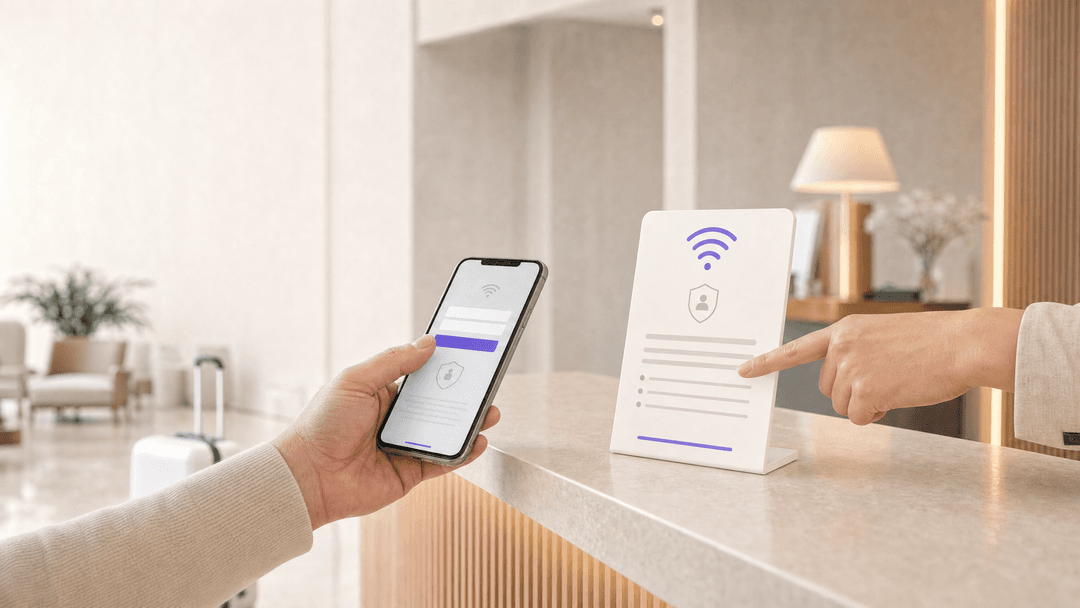
For a hotel, that may mean a guest sees the access notice before submitting data, while the offer to hear about future stays is presented as an additional choice. For a retail chain, the same principle applies when a shopper joins in store but a central CRM receives the selected fields. The value is not the page design. The value is being able to show what happened, why it happened and where the data went.
How should Guest WiFi data move through your network and CRM?
Design the flow so that a network decision does not silently trigger a marketing decision. A useful operating model has four boundaries. First, the guest device requests access. Second, the captive portal presents the approved access and privacy experience. Third, the network admits the device to a segmented Guest WiFi service. Fourth, any approved personal data moves through a controlled integration to the CRM.
flowchart LR
    A[Guest device] --> B[Guest WiFi access]
    B --> C[Captive portal and privacy information]
    C --> D[Access decision]
    D --> E[Segmented guest network]
    C --> F[Approved data fields]
    F --> G[CRM through controlled integration]
    H[IT and marketing governance] --> C
    H --> F
Figure 1. A conceptual flow that separates access control, guest traffic and approved personal data processing.

The diagram is deliberately vendor-neutral. CCPA/CPRA does not prescribe a captive-portal pattern, authentication protocol or segmentation technology. It does require security measures appropriate to risk. 1 NIST’s WLAN guidance makes the same operational point from a security perspective: security depends on how client devices, access points and wireless switches are secured across design, deployment, maintenance and monitoring. 6
Use this distinction when you review the network. VLAN segmentation, firewall policy, administrator access control and monitoring help reduce exposure. They do not, by themselves, define the lawful basis for collecting a guest’s email address. Conversely, a good privacy notice does not make an unsegmented guest network acceptable. Your deployment needs both a privacy decision and a network-control decision. Where your access policy needs port-based control, IEEE 802.1X regulates access and guards against transmission or reception by unidentified or unauthorized parties. 9 Use it as a standards reference for the relevant access layer, not as a substitute for the privacy design.
Where you operate payment acceptance, treat Guest WiFi as a network that must not become an untested path to systems handling cardholder information. PCI DSS materials exist to support the secure handling of cardholder information. 7 Your PCI assessor and network security team should decide the applicable scope and segmentation tests. This guide does not make a PCI DSS assessment.
Wireless security also moves over time. The WiFi Alliance describes WPA3 as a security certification for personal and enterprise networks and notes WPA3-Enterprise’s higher-security suite. 8 The practical action is to review supported security capabilities across your existing estate and apply your own security policy. This guide does not state that one wireless security standard alone makes a Guest WiFi service CCPA/CPRA compliant.
Where does Purple sit alongside your existing WiFi infrastructure?
Purple is a cloud overlay for Guest WiFi that sits beside your existing access infrastructure. It gives you a way to align the visitor experience, data capture and operational reporting with the controls your IT team already owns. Start with Guest WiFi when your priority is a branded access experience, then use WiFi Analytics to discuss venue usage, speed and coverage.
Purple’s plan boundary is useful for compliance design. Purple states that Connect includes fully branded splash pages, multiple login methods, more than 25 languages, CCPA/CPRA and global privacy compliance support, WiFi usage analytics, and monitoring of speed and coverage. Purple positions Connect for venues that do not seek to capture visitor data. 4 This makes Connect a relevant starting point when access and service monitoring are your immediate objectives.
Capture includes the Connect capabilities and adds contact and demographic data capture, CRM enrichment integration and email verification, according to Purple Support. 4 That changes your governance work. Before you enable a CRM feed, agree field mapping, recipient access, purpose, lawful basis, privacy information, the processor arrangement and a test method. Under the CCPA/CPRA, processing must be governed by a contract or other legal act. 1
Engage builds on Capture with personalized communications, promotions and customized access journeys based on visitor interests, alongside venue analytics, pre-built connectors and SecurePass. 5 That makes governance more important, not less. A campaign team should not be able to create a new data use without the privacy and data-owner review that applies to any new purpose.
The model fits different venue contexts. Hospitality teams can keep guest access and CRM enrichment in one governed design. Retail teams can apply the same controls across many stores. Transport and Healthcare teams can focus on access, clear notices and security boundaries where data sensitivity or public use demands extra care. For network architecture detail, pair this guide with the Enterprise Guest WiFi Setup Guide: VLAN Segmentation, Security, and Captive Portals.
Got questions about your specific setup?
Our team works with venue operators, IT managers, and network engineers across 80,000 venues. Book a 20-minute call and we will show you how others like you solved it.
What compliance limits and risks should venue teams plan for?
The common failure is not a missing policy document. It is a mismatch between the policy, the sign-in flow, the network and the CRM. Fix that with acceptance criteria that someone can test. IT should validate that Guest WiFi traffic follows the approved network boundary and that administrator access is controlled. Marketing should validate field labels, data destinations and choice capture. Privacy should validate the notice, purpose and lawful-basis record. Operations should confirm that venue staff know where to direct a guest with a privacy question.
Data minimization is the right challenge for every field. Ask whether the access method actually needs it. Ask whether the analytics purpose can work without it. Ask whether the CRM needs it now, or whether an optional future interaction can collect it later. If no owner can answer, cut the field from the launch. This avoids building a data set that your teams cannot explain or govern.
Do not treat a change of purpose as a small portal edit. A new marketing audience, a new CRM destination, an added demographic question or an automated access journey can alter the processing design. Revisit the record and privacy review before release. If your assessment indicates processing is likely to create high risk for people’s rights and freedoms, the CCPA/CPRA requires a data protection impact assessment. 1
You should also distinguish network identity from workforce identity. A guest sign-in service is not a substitute for Staff WiFi identity controls. Keep workforce access within your Identity-Based Networks design, with its own approval and revocation model. The operational process for removing employee access is covered in How to revoke WiFi access when an employee leaves. For broader operating patterns, see Guest WiFi Management: Smart Authentication & Segmentation and Cloud Wifi Management: Secure Enterprise Connectivity 2026.
What does an implementation look like in practice?
The scenarios below are illustrative implementation patterns, not claims about a named Purple deployment or a guarantee of compliance. They give your teams measurable launch checks rather than invented commercial outcomes.
| Venue scenario | Practical implementation pattern | Measurable launch checks |
|---|---|---|
| 200-room hotel | Use Connect for a branded Guest WiFi entry point and service monitoring. Keep the initial flow focused on access rather than CRM enrichment. | Privacy information appears before entry; no unapproved contact field is present; IT verifies the guest network boundary; operations approve a guest-support route. |
| Multi-site retailer | Use Capture where approved contact and demographic fields enrich the CRM. Design a separate optional marketing choice. | Field mapping matches the approved register; opted-in fields only reach the CRM; marketing exports are role controlled; the privacy team approves the notice. |
| Conference center | Evaluate Engage only after access, CRM governance and message approvals are established. Use campaign owners who understand the agreed purpose. | Test data proves the selected audience logic; communications map to the approved purpose; owners can identify the recipient system; the change record is signed off. |
A launch is only the first control point. Set a review cadence for portal fields, administrator access, data integrations, network boundaries and campaign uses. Record the review outcome. That is how you turn data protection by design from a policy phrase into an operating practice.
``` This contains valid JSON, preserves the required HTML formatting, keeps exact structures and URLs intact, and maintains
What should you do next?
Begin with a 60-minute design review involving IT, marketing, operations and your privacy lead. Map the current guest journey from device connection to CRM receipt. Mark each point where data appears, changes hands or acquires a new purpose. Then decide whether your immediate need is access and service insight, first-party data capture or in-venue engagement.
If access and secure venue operations are the priority, review Connect against your network architecture. If you plan to enrich a CRM, review Capture and the integration governance together. If you intend to send personalized in-venue communications, build the additional Engage governance into the design before campaign launch. Purple Support’s Connect vs Capture and Capture vs Engage summaries set out the product boundaries.
Finish with a recorded go-live decision. It should identify the approved data fields, the stated purpose and lawful basis, the privacy-information owner, the security owner, the CRM recipient, the review date and the escalation route to your privacy lead. That record will be more useful than another generic compliance checklist.
References
Frequently asked questions
Is Guest WiFi data personal data under CCPA/CPRA?
It can be, so treat Guest WiFi data collection as a personal-data process until your privacy lead has assessed the exact fields and processing. CCPA/CPRA applies principles such as transparency, purpose limitation, minimization, security and accountability to personal-data processing. 1 Start by documenting every field, purpose and recipient rather than assuming a captive portal falls outside privacy governance.
Do we need consent to provide Guest WiFi access?
Not automatically. You must select, document and explain an appropriate lawful basis before you process personal information. 2 Consent is one possible basis, but the FTC and state attorneys general say you should assess whether it is appropriate and, when used, obtain, record and manage it properly. 3 Ask your DPO or legal adviser to confirm the basis for your access service and each optional marketing activity.
Can we add marketing opt-ins to a Guest WiFi sign-in page?
Yes, provided the choice is governed separately from the access service and your privacy team approves the purpose, lawful basis, notice and evidence. Purple refers to conscious-choice opt-ins. If consent is your basis, use the FTC and state attorneys general's guidance to determine whether it is valid, recorded, managed and withdrawable. 3 Do not treat acceptance of network access terms as proof of a separate marketing choice.
Does Purple Connect capture visitor contact details?
No, Purple positions Connect for venues that do not intend to capture visitor data. Connect supplies branded splash pages, multiple login methods, privacy compliance support, WiFi usage analytics and monitoring of venue speed and coverage. 4 Capture adds contact and demographic information, CRM integration and email verification. Confirm the exact access and data design with Purple before deployment.
What must we test before linking Guest WiFi to our CRM?
Test the approved field mapping, recipient access, privacy-information wording, purpose and lawful-basis record before releasing the integration. Purple states that Capture can integrate to enrich an existing CRM. 4 CCPA/CPRA requires appropriate processor arrangements where a processor handles data. 1 Your privacy lead should approve the role allocation and contractual controls; IT should test the data path and access controls.
Does Guest WiFi need to be separated from staff and payment systems?
Yes, treat network separation as a core security design requirement, then verify it with your network security team. CCPA/CPRA requires security measures appropriate to risk. 1 NIST explains that WLAN security depends on lifecycle security for clients, access points and wireless switches. 6 If payment systems are in scope, confirm segmentation and testing requirements with your PCI assessor. 7
Can Purple support personalized in-venue communications?
Yes, Purple states that Engage adds personalized communications, promotions and customized access journeys based on visitor interests, alongside analytics, connectors and SecurePass. 5 Before activating them, document the intended purpose, legal basis, audience rules, recipient systems and change-approval route. Product capability does not remove your responsibility to govern each data use.
Key Definitions
Captive portal
A web experience that a venue presents during the Guest WiFi connection flow before or alongside network access.
It is where access terms, privacy information, approved data fields and optional marketing choices need to align.
Lawful basis
The documented legal ground a controller relies on to process personal information under the CCPA/CPRA or other regulations.
You need a lawful basis for each Guest WiFi processing purpose before the data flow goes live.
Data minimization
The privacy principle that personal data should be adequate, relevant and limited to what is necessary for the stated purpose.
It is the test for every sign-in field and every data element sent to your CRM.
Privacy information
Clear information explaining how and why personal data are collected and used.
Place it where a guest can access it at the point of collection, then keep the owner and version controlled.
Processor
A party that processes personal data on behalf of a controller.
Guest WiFi integrations, support and CRM data paths may require your team to confirm the role allocation and contractual controls.
Data protection by design and by default
The privacy requirement to build appropriate data-protection measures into processing and default settings.
For Guest WiFi, it means settling purpose, fields, privacy information, recipients and controls before publishing a sign-in flow.
VLAN segmentation
A network design approach that separates traffic into distinct logical network segments.
IT teams use it as part of a Guest WiFi security boundary, but it does not replace privacy governance.
IEEE 802.1X
An IEEE port-based network access-control standard that regulates network access and supports controlled communication after authentication.
Use it when reviewing which parts of your wider network estate need controlled, authenticated access. It is separate from the CCPA/CPRA decision to collect and use Guest WiFi data.
WPA3
A WiFi Alliance security certification for personal and enterprise WiFi networks, with separate personal and enterprise modes.
Use it in a standards review of your wireless estate, while recognizing that protocol selection alone does not establish CCPA/CPRA compliance.
PCI DSS
A payment card security standard with documentation maintained by the PCI Security Standards Council.
Where payment systems are involved, use your PCI assessment process to decide scope and the required network segmentation and tests.
Worked Examples
A 200-room hotel needs branded Guest WiFi but does not want to capture contact data at launch. What should it do?
Use the Connect design boundary: provide a branded access experience and monitor service usage, speed and coverage. Before go-live, record the access purpose, show privacy information where data are collected, validate the guest-network boundary, keep unapproved contact fields out of the flow and give operations a clear route for privacy inquiries. This is an illustrative acceptance plan, not a claim about a named venue.
A multi-site retailer wants Guest WiFi data to enrich its CRM and offer optional marketing. What should it do?
Use the Capture design boundary after the marketing, IT and privacy teams approve the data-field register. Map each approved field to its CRM destination, keep marketing as a conscious-choice opt-in rather than an access condition, test that only approved fields flow to the CRM and record the accountable owner for notice, integration and access reviews. This is an illustrative acceptance plan, not a claim about a named retailer.
A conference center wants personalized communications after sign-in. What should it do?
Evaluate Engage only after the Guest WiFi access flow and CRM data hand-off have passed governance review. Define the campaign purpose and audience before automation, approve the message and recipient system, test the selected audience logic using controlled data, and record the change decision. Purple states that Engage adds personalized communications, customized access journeys, analytics, connectors and SecurePass.
Sources
- Regulation (EU) 2016/679 (GDPR), EUR-Lex
- ICO: A guide to lawful basis
- ICO: Consent
- Purple Support: Connect vs Capture
- Purple Support: Capture vs Engage
- NIST SP 800-153: Guidelines for Securing Wireless Local Area Networks
- IEEE 802.1X: Port-Based Network Access Control
- PCI Security Standards Council: PCI DSS Document Library
- WiFi Alliance: WPA3 security announcement
Continue reading in this series
Multi-site guest WiFi for franchises: central control with local branding
You will be able to choose an operating model for guest WiFi across your franchise estate and decide who controls guest data under the TCPA and CAN-SPAM. You can then lock brand and consent centrally, give franchisees venue-scoped access and plan a vendor-grouped rollout. The approach runs as a cloud overlay on mixed Cisco Meraki, HPE Aruba, Ruckus and Ubiquiti UniFi hardware.
City council public WiFi providers: procurement routes and what to specify
You will be able to pick the right procurement route for city public WiFi, splitting the cloud platform from the physical build. You will also be able to write a specification bidders can price against and you can test at handover. It covers coverage, peak concurrency, IWF filtering, the ADA and Section 508, a CCPA/CPRA lawful basis and evidence-based supplier scoring.
How Staff WiFi Helps You Meet ISO/IEC 27001: Mapping Annex A Controls to Your Wireless Network
You will be able to decide whether your staff WiFi can evidence 12 ISO/IEC 27001:2022 Annex A controls, including A.5.15, A.8.5 and A.8.22. You will also be able to replace a shared WPA2-PSK key with IEEE 802.1X and dynamic VLANs. Finally, you can assemble the RADIUS logs, segregation tests and supplier records an auditor accepts at stage 2.
Got questions about your specific setup?
Our team works with venue operators, IT managers, and network engineers across 80,000 venues. Book a 20-minute call and we will show you how others like you solved it.