

Indoor WiFi Positioning: How Location Tracking Works on a Guest Network
This authoritative technical reference guide explains how indoor WiFi positioning works on a guest network, covering RSSI triangulation, access point mapping, heatmap generation, and integration with analytics platforms. It is written for IT managers, network architects, and CTOs at hotels, retail chains, stadiums, and public-sector venues who need to make a deployment decision this quarter. By the end, readers will understand the full data flow from probe request to actionable business intelligence, including the critical compliance and privacy considerations that govern any real-world deployment.
🎧 Listen to this Guide
View Transcript
Executive Summary
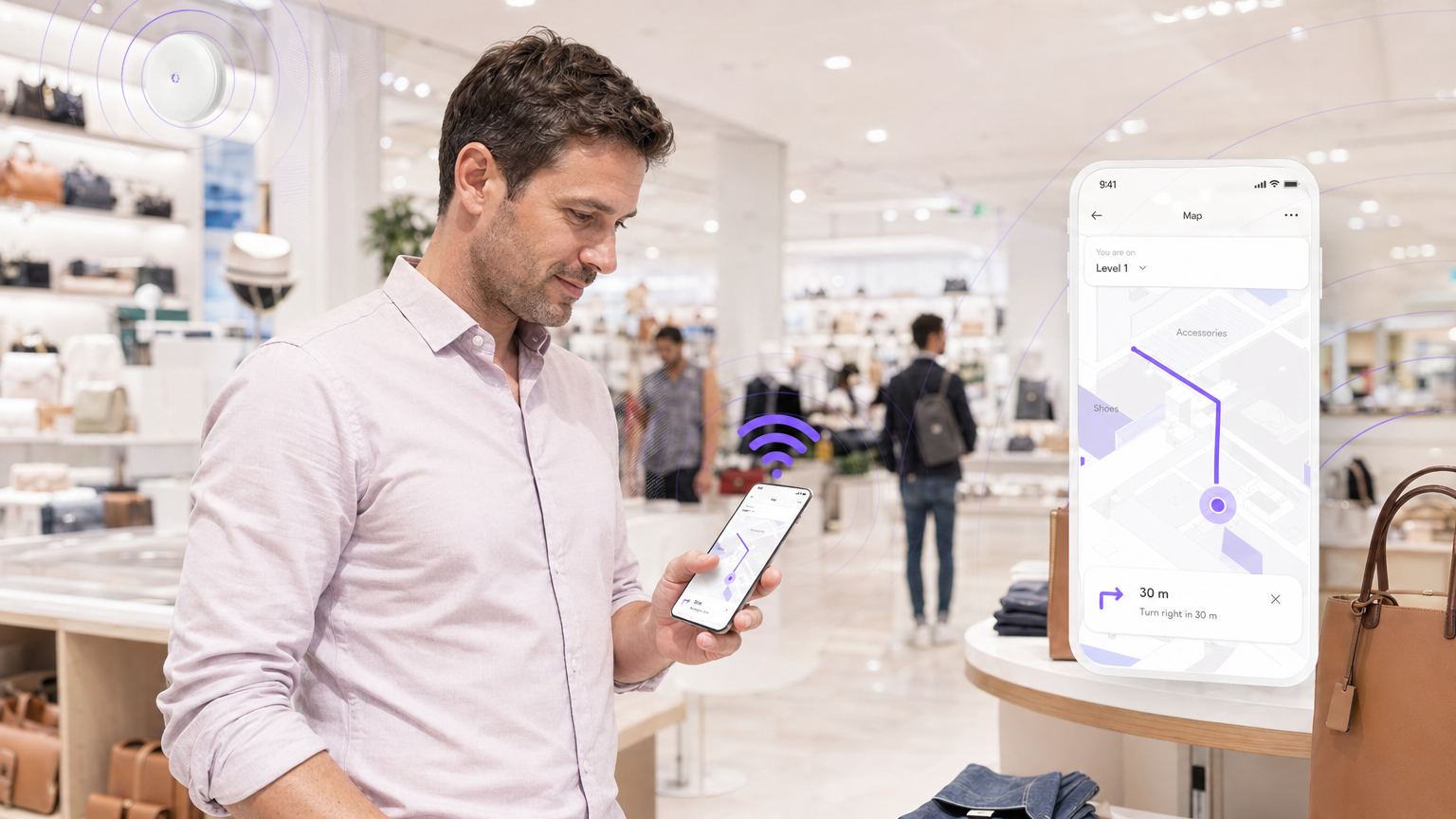
For modern venues — whether a retail flagship, a hotel, or a major stadium — understanding physical visitor flow is as strategically important as tracking digital web traffic. GPS fails indoors, leaving a significant visibility gap that costs operators real revenue. This guide explains how enterprise IT teams can leverage their existing Guest WiFi infrastructure to deploy a WiFi-based indoor positioning system (IPS). The technology is not new, but the integration of RSSI triangulation, calibrated access point (AP) mapping, and cloud-based WiFi Analytics platforms has matured to the point where deployment is now a practical, quarter-deliverable project rather than a multi-year research initiative. This document provides the technical architecture, implementation steps, common failure modes, and the ROI framework needed to make an informed decision. For a broader introduction to the analytics layer, see our guide on What Is WiFi Analytics? A Complete Guide .
Technical Deep-Dive
The Physics of Indoor WiFi Location
The fundamental challenge of indoor positioning is that GPS signals — which operate at around 1575 MHz — attenuate severely when passing through building materials. A concrete ceiling can reduce signal strength by 20–30 dB, rendering GPS unreliable for anything below a few floors of a building. WiFi-based indoor positioning sidesteps this by using the 2.4 GHz and 5 GHz signals already present in any enterprise network deployment.
The core mechanism is the Received Signal Strength Indicator (RSSI). When a mobile device has WiFi enabled, it periodically broadcasts 802.11 probe request frames to discover available networks. Every Access Point within range receives these frames and records the MAC address of the transmitting device alongside the RSSI value — a logarithmic measure of signal power, typically expressed in dBm, where -30 dBm represents a very strong signal and -90 dBm represents a very weak one.
RSSI Triangulation (Trilateration)
A single AP can confirm that a device is within its coverage area, but cannot determine direction or precise distance. To localise a device, the system requires readings from at least three APs simultaneously — a process correctly termed trilateration (though "triangulation" is the term in common industry usage).
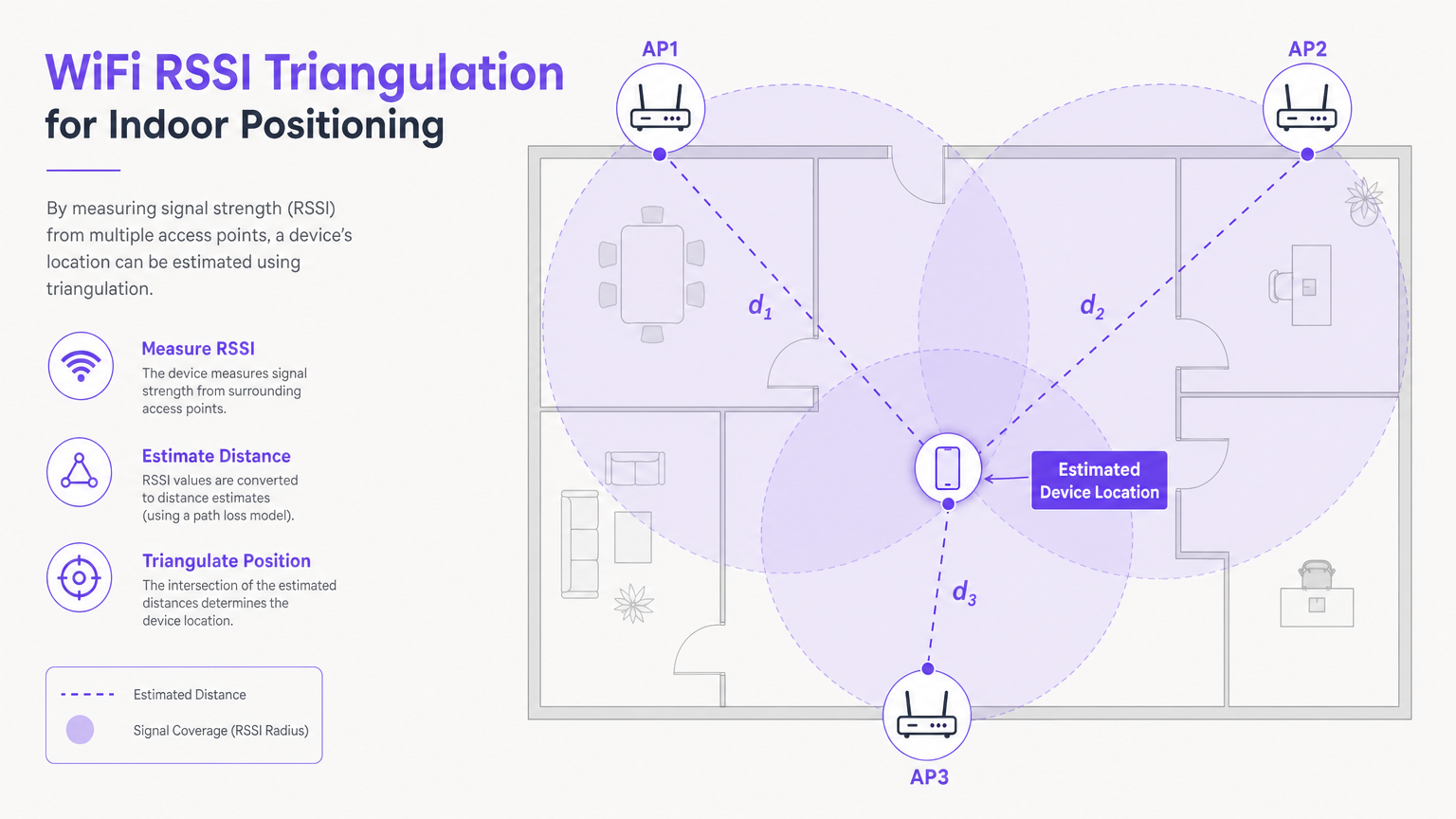
The analytics platform applies a path loss model — typically the log-distance path loss model — to convert each RSSI value into an estimated distance from that AP. With three distance estimates and the known physical coordinates of each AP, the system solves for the intersection point, which represents the device's estimated location. In practice, due to environmental interference, this intersection is rarely a perfect point; the system instead calculates a probability region and reports the centroid.
Key formula reference: The log-distance path loss model is expressed as:
PL(d) = PL(d₀) + 10n·log₁₀(d/d₀) + Xσ
Where n is the path loss exponent (typically 2–4 for indoor environments), d is the distance, and Xσ is a zero-mean Gaussian random variable representing shadowing effects.
Passive Tracking vs. Authenticated Analytics
It is essential to distinguish between two operational modes, as they have fundamentally different data quality and compliance implications:
| Mode | Trigger | Data Quality | Compliance Consideration |
|---|---|---|---|
| Passive Presence Detection | Device has WiFi enabled; not connected | Aggregated footfall, zone density | MAC randomisation limits individual tracking |
| Authenticated Analytics | User connects via captive portal | Rich first-party profile, dwell time, returning visitor | Requires explicit GDPR consent at login |
MAC randomisation is the critical variable here. Since iOS 14 and Android 10, mobile operating systems randomise the MAC address used in probe requests. This means a device appears as a different entity on each visit, preventing passive tracking of returning individuals. The practical implication is that passive data is useful for aggregate heatmaps and footfall counts, but authenticated data — captured when a user logs into the guest network via a captive portal — is required for any individual-level analytics.
For a broader exploration of complementary positioning technologies including UWB and BLE, see our guide on Indoor Positioning System: UWB, BLE, & WiFi Guide .
Implementation Guide
Phase 1: Environment Assessment and RF Planning
Before a single AP is installed, a thorough RF planning exercise is mandatory. The physical environment dictates signal propagation, and assumptions made at the planning stage that prove incorrect in the field will result in inaccurate location data that is difficult to diagnose post-deployment.
AP Density Requirement: For accurate trilateration, a device must be heard by a minimum of three APs at a signal strength of -65 dBm or better at any point in the coverage area. This is a stricter requirement than basic internet access coverage, which can function at -75 dBm. In practice, this means deploying APs at roughly 15–20 metre intervals in open environments, and significantly closer in areas with high obstruction density (metal racking, concrete columns, glass partitions).
Site Survey: Conduct a predictive site survey using RF planning software (e.g., Ekahau, iBwave) before physical installation. Follow up with an active site survey post-installation to validate coverage and identify dead zones.
Phase 2: AP Mapping and Platform Configuration
Once APs are physically installed, the analytics platform must be configured with their precise coordinates.
- Upload a scaled floor plan (in PDF, DWG, or PNG format) to the analytics platform dashboard.
- Map the exact physical coordinates of every AP onto the digital floor plan. This step is non-negotiable — any error here propagates directly into location inaccuracy.
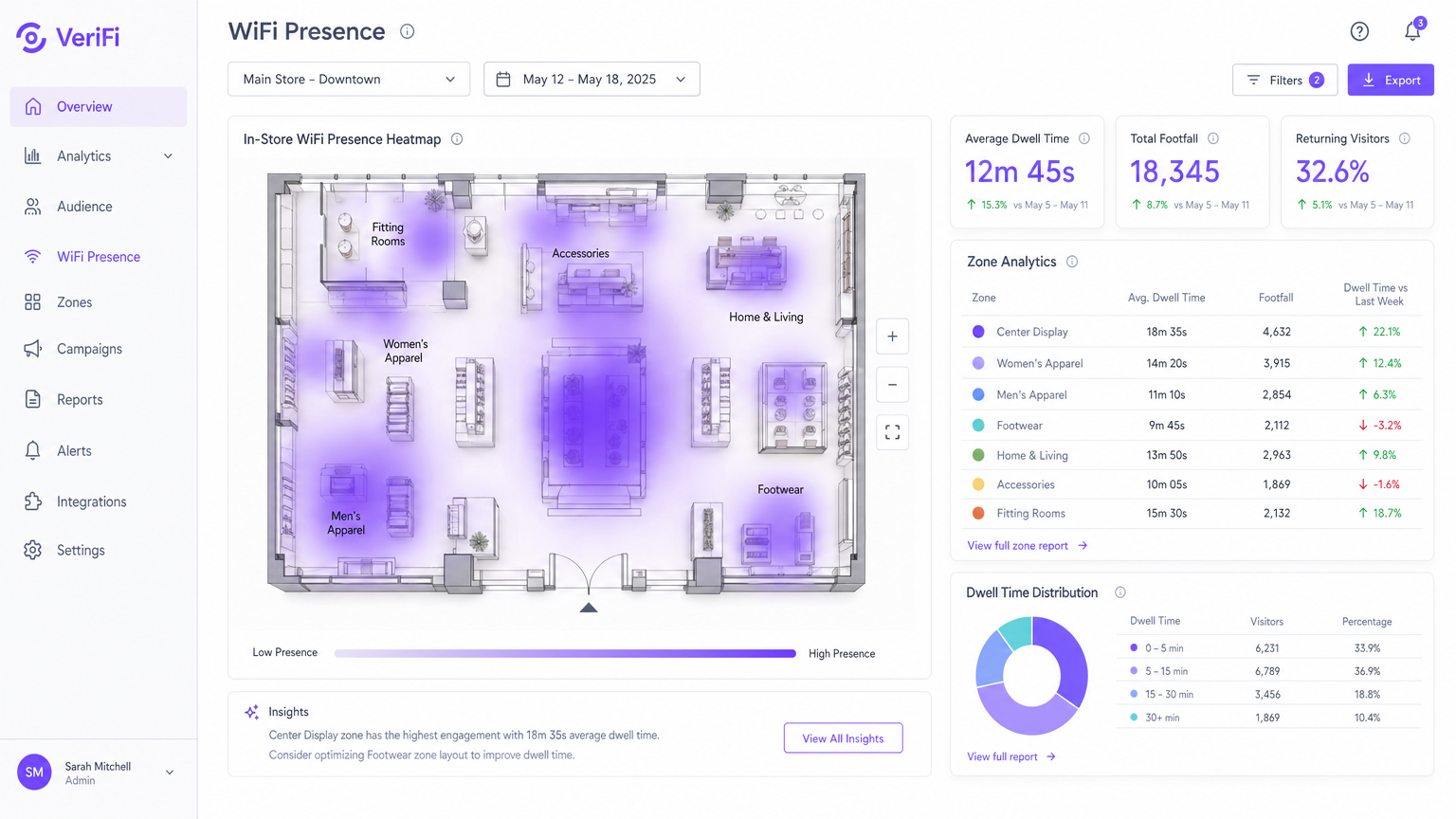
- Define Zones — named polygonal areas on the floor plan (e.g., "Checkout", "Menswear", "Lobby") — to enable granular dwell time and footfall reporting per area.
- Configure the wireless LAN controller (WLC) to forward presence data to the analytics platform via the appropriate API or syslog integration.
Phase 3: Captive Portal and Consent Framework
To capture authenticated data and comply with GDPR and similar frameworks, deploy a captive portal that presents users with a clear consent notice before granting network access. The portal should capture, at minimum: name, email address, and explicit consent to data processing for analytics purposes.
Best Practices
Standardise on 5 GHz for Analytics: While 2.4 GHz penetrates walls more effectively, it is heavily congested and subject to interference from Bluetooth, microwave ovens, and neighbouring networks. Steering clients to 5 GHz produces cleaner, more consistent RSSI readings, improving location accuracy. Configure band steering on the WLC to prefer 5 GHz for capable clients.
Schedule Regular Calibration Reviews: Physical environments are not static. A seasonal retail layout change, a new partition wall, or even a large temporary installation (such as a trade show stand) can significantly alter RF propagation. Schedule a calibration review every quarter, or immediately following any significant physical change to the venue.
Implement Data Minimisation: Under GDPR Article 5(1)(c), only the minimum data necessary for the stated purpose should be collected. For zone-level analytics, this means storing aggregated counts rather than individual device paths. Consult your Data Protection Officer before expanding the scope of data collection.
Leverage the IoT Architecture: WiFi positioning is increasingly integrated with broader IoT deployments. For context on how indoor positioning fits within a wider connected venue architecture, see our guide on Internet of Things Architecture: A Complete Guide .
Troubleshooting & Risk Mitigation
| Failure Mode | Symptom | Root Cause | Mitigation |
|---|---|---|---|
| Insufficient AP Density | Devices "jump" between distant zones on the heatmap | Fewer than 3 APs hearing the device at -65 dBm | Active site survey; add APs in dead zones |
| Inaccurate AP Mapping | Heatmap shows high dwell in physically impossible locations | AP coordinates incorrectly entered in the platform | Cross-check every AP coordinate against physical installation records |
| MAC Randomisation | Near-zero returning visitor metrics despite known repeat footfall | Passive tracking only; no authenticated sessions | Implement captive portal with incentivised login |
| Multipath Interference | Erratic location estimates in specific zones | Signal reflections from metal racks or glass | Reposition APs; use directional antennas; apply Kalman filtering in the analytics platform |
| Channel Congestion | Inconsistent RSSI readings on 2.4 GHz | Co-channel interference from neighbouring networks | Migrate analytics clients to 5 GHz; implement automatic channel assignment on the WLC |
ROI & Business Impact
The business case for indoor WiFi positioning is strongest when framed as an infrastructure investment that delivers returns across multiple departments simultaneously.
Retail: A mid-size fashion retailer with 20 stores can use zone-level dwell time data to identify which product displays generate the most engagement. Redeploying underperforming fixtures based on this data has been shown to improve sales conversion rates by 8–15% in comparable deployments. For sector-specific guidance, see our Retail solutions.
Hospitality: A 300-room hotel can monitor real-time queue lengths at the front desk and F&B outlets, dynamically dispatching staff to prevent service degradation during peak periods. Tracking guest movement through the property also enables housekeeping optimisation, reducing room turnaround time. See our Hospitality case studies for deployment examples.
Healthcare: NHS trusts and private hospitals are using WiFi-based asset tracking (via WiFi-enabled tags on medical equipment) to reduce the average time spent searching for mobile assets from 20 minutes to under 2 minutes per incident. This directly reduces clinical staff time wasted on non-clinical tasks. Explore our Healthcare solutions.
Transport: Airports and rail operators use presence analytics to manage passenger flow through security and boarding gates, reducing congestion and improving on-time departure rates. See our Transport sector page for relevant case studies.
Measuring ROI: Establish a baseline measurement of the key metric (dwell time, queue length, asset search time) before deployment. Re-measure at 30, 60, and 90 days post-deployment. A well-deployed indoor positioning system typically achieves payback within 12–18 months when the full operational efficiency gains are accounted for.
For a comprehensive understanding of the analytics capabilities that sit on top of this positioning infrastructure, refer to our guide: What Is WiFi Analytics? A Complete Guide .
Key Terms & Definitions
RSSI (Received Signal Strength Indicator)
A measurement of the power level of a received radio signal, expressed in dBm (decibels relative to one milliwatt). Values typically range from -30 dBm (excellent) to -90 dBm (very weak).
IT teams use RSSI values reported by multiple APs to estimate a device's distance from each AP and calculate its location via trilateration. The -65 dBm threshold is the industry-standard minimum for reliable positioning.
Trilateration
A geometric method of determining the location of a point by measuring its distance from three or more known reference points, using the intersection of circles (in 2D) or spheres (in 3D).
This is the mathematical foundation of WiFi indoor positioning. It is distinct from triangulation, which uses angles rather than distances, though the terms are often used interchangeably in vendor documentation.
Probe Request
An 802.11 management frame broadcast by a WiFi-enabled device to discover available networks in its vicinity.
Probe requests are the fundamental data source for passive presence detection. They are transmitted even when the device is not connected to any network, as long as WiFi is enabled.
MAC Randomisation
A privacy feature in modern mobile operating systems (iOS 14+, Android 10+) that substitutes a randomly generated MAC address in probe request frames, preventing persistent tracking across sessions.
This is the primary technical barrier to passive individual tracking. IT teams must implement captive portal authentication to obtain a persistent identifier for returning visitor analytics.
Captive Portal
A web page presented to a user before network access is granted, typically requiring authentication or acceptance of terms and conditions.
The captive portal is the critical junction between anonymous presence detection and authenticated first-party analytics. It is also the primary mechanism for GDPR consent capture in guest WiFi deployments.
Dwell Time
The duration a detected device remains within a defined zone or the overall venue, measured from first detection to last detection within a session.
A primary KPI for retail and hospitality operators. High dwell time in a product zone correlates with purchase intent; low dwell time at a service desk may indicate poor service experience.
Multipath Interference
A propagation phenomenon where a radio signal reaches the receiving antenna via two or more paths due to reflections, diffractions, or scattering from obstacles.
Particularly prevalent in environments with metal racking, glass facades, or concrete columns. It causes RSSI readings to fluctuate independently of actual device distance, degrading location accuracy.
Path Loss Exponent
A parameter in the log-distance path loss model that describes how rapidly signal strength attenuates with distance in a given environment. Free space = 2; typical indoor = 3–4; obstructed indoor = 4–6.
Analytics platforms use a calibrated path loss exponent to convert RSSI values into distance estimates. An incorrectly calibrated exponent is a common source of systematic location error.
Zone Analytics
The aggregation of presence and dwell time data within a user-defined polygonal area on the venue floor plan.
Zones are the primary unit of business reporting in WiFi analytics platforms. They translate raw location coordinates into meaningful business areas (e.g., 'Checkout', 'Cafe', 'Exhibition Hall A').
Case Studies
A 12-store fashion retail chain wants to understand how a new store layout affects customer dwell time in the 'Home & Living' section. They have a basic guest WiFi network but no analytics. The IT manager has a 90-day project window and a modest budget.
Step 1: Conduct an active site survey of the flagship store to identify AP coverage gaps. Upgrade AP density in the 'Home & Living' zone to guarantee 3-AP overlap at -65 dBm or better. Step 2: Integrate the wireless LAN controller with the WiFi Analytics platform via the management API. Step 3: Upload the store floor plan and precisely map all AP coordinates. Draw a 'Home & Living' zone polygon in the analytics dashboard. Step 4: Deploy a captive portal offering a 10% discount code in exchange for email registration and GDPR consent. This converts passive MAC-randomised data into authenticated dwell time metrics. Step 5: Run a 30-day baseline measurement before the layout change, then a 30-day post-change measurement. Compare average dwell time and footfall density in the zone between the two periods.
A conference centre hosting 5,000-delegate events is experiencing complaints about 20-minute queues at the main registration desk during the 08:30–09:30 peak window. The operations director wants a data-driven solution that can trigger real-time staff redeployment.
Step 1: Verify AP density around the registration desk is sufficient for accurate presence detection (minimum 3 APs at -65 dBm). Step 2: Define a 'Registration Desk' zone and a 'Registration Queue' zone (the area leading up to the desk) in the analytics platform. Step 3: Configure an automated alert: if the device count in the 'Registration Queue' zone exceeds 40 for more than 3 consecutive minutes, trigger an SMS and push notification to the floor manager's mobile device. Step 4: Establish a secondary alert threshold at 70 devices, triggering escalation to the venue operations director. Step 5: Review the alert logs weekly to refine the threshold values based on actual observed queue-to-complaint correlation.
Scenario Analysis
Q1. You are the network architect for a large department store. The initial heatmaps show devices frequently appearing in the wrong departments — a customer standing in Menswear is being placed in Womenswear on the map. What is the most likely cause and what is your diagnostic and remediation process?
💡 Hint:Consider both the physical environment and the configuration of the analytics platform.
Show Recommended Approach
There are two likely causes: (1) Incorrect AP coordinate mapping — the physical location of one or more APs has been entered incorrectly in the analytics platform, causing a systematic offset in all location estimates derived from those APs. Remediation: physically verify the location of every AP against its recorded coordinates in the platform and correct any discrepancies. (2) Insufficient AP density — if fewer than three APs are hearing the device at -65 dBm, the trilateration is working with incomplete data, producing inaccurate estimates. Remediation: conduct an active site survey to identify coverage gaps and add APs as required. Start with cause (1) as it is faster and cheaper to diagnose.
Q2. Your marketing team reports that the 'returning visitor' metric in the WiFi analytics dashboard has been at 0% for three months, despite strong anecdotal evidence from store managers that many customers visit multiple times per week. What is the technical explanation and what is the solution?
💡 Hint:Consider the privacy features of modern mobile operating systems.
Show Recommended Approach
The platform is relying solely on passive probe request tracking. Because modern iOS and Android devices randomise their MAC addresses with each probe session, every visit appears as a new, unique device. The system has no mechanism to link visits from the same physical device across sessions. The solution is to implement a captive portal that requires user authentication (email login, social login, or similar). Once a user authenticates, their session is tied to a persistent identifier (email address or user ID), enabling the platform to correctly identify and count returning visitors. Incentivising login — for example, with a loyalty discount — is recommended to maximise the authenticated session rate.
Q3. A new AP was installed to cover a previously dead zone in the venue's basement car park. The AP is confirmed online, serving clients, and appearing in the WLC dashboard. However, the analytics platform shows no presence data for the car park area. What step was missed and how do you resolve it?
💡 Hint:The network layer and the analytics layer have separate configuration requirements.
Show Recommended Approach
The AP mapping step was omitted from the analytics platform configuration. While the AP is fully functional at the network layer, its physical coordinates have not been registered in the analytics platform's floor plan. The platform is receiving the presence data from the AP but cannot place it on the map, so it is either being discarded or aggregated into an 'unmapped' category. Resolution: log into the analytics platform, navigate to the floor plan configuration, and add the new AP with its precise physical coordinates. If the car park is on a separate floor level, ensure the correct floor plan level is selected before placing the AP marker.
Q4. The legal team has raised a concern that the indoor positioning system may be processing personal data without adequate legal basis under GDPR. As the IT lead, how do you assess and address this risk?
💡 Hint:Consider both passive and authenticated tracking modes separately.
Show Recommended Approach
Assess the two tracking modes separately. For passive tracking (probe requests): MAC-randomised probe data is generally not considered personal data under GDPR when it cannot be linked to an identified individual. However, if the system retains raw MAC addresses for any period, this should be reviewed with your DPO, as a non-randomised MAC could be personal data. Implement data minimisation by aggregating to zone-level counts as quickly as possible and purging raw MAC logs. For authenticated tracking: this clearly involves personal data (email address, device association). The legal basis is typically consent, captured via the captive portal. Ensure the consent notice is specific, granular, and clearly describes the analytics use case. Implement a data retention policy and a subject access request process. Document both modes in your Records of Processing Activities (ROPA) under GDPR Article 30.




