
Shopping Centre WiFi: A Property Manager's Guide
This guide provides a comprehensive technical and commercial blueprint for deploying estate-wide WiFi across a shopping centre. It covers three-tier network architecture, high-density RF design, GDPR-compliant data capture, and retail media monetisation strategies. Property managers, IT teams, and CTOs will find actionable deployment guidance alongside a clear ROI framework for transforming guest connectivity into a first-party data asset.
Listen to this guide
View podcast transcript
执行摘要
在零售物业中部署全园区WiFi不再仅仅是运营成本或通用的访客便利设施。对于现代购物中心而言,一个强大、高密度的无线网络构成了数据驱动商业战略的基础。通过实施架构合理的网络,物业经理和IT领导者能够将匿名客流转化为可操作的第一方数据,通过零售媒体变现来提升运营效率并创造新的收入来源。
本指南概述了零售环境中企业级 访客WiFi 的技术架构、部署考量和商业案例。它弥合了复杂网络工程与切实业务成果之间的差距,为IT经理、网络架构师和CTO提供了一份蓝图,以交付一个支持访客接入和运营需求的弹性、可扩展且安全的连接解决方案。同样的原则适用于相邻行业,包括 零售业 、 酒店业 和大型公共场所。
技术深潜
网络架构与拓扑
购物中心WiFi网络的架构必须考虑大规模、高客户端密度和复杂的射频环境。对于任何此类规模的部署,标准的三层层次化模型是必不可少的。
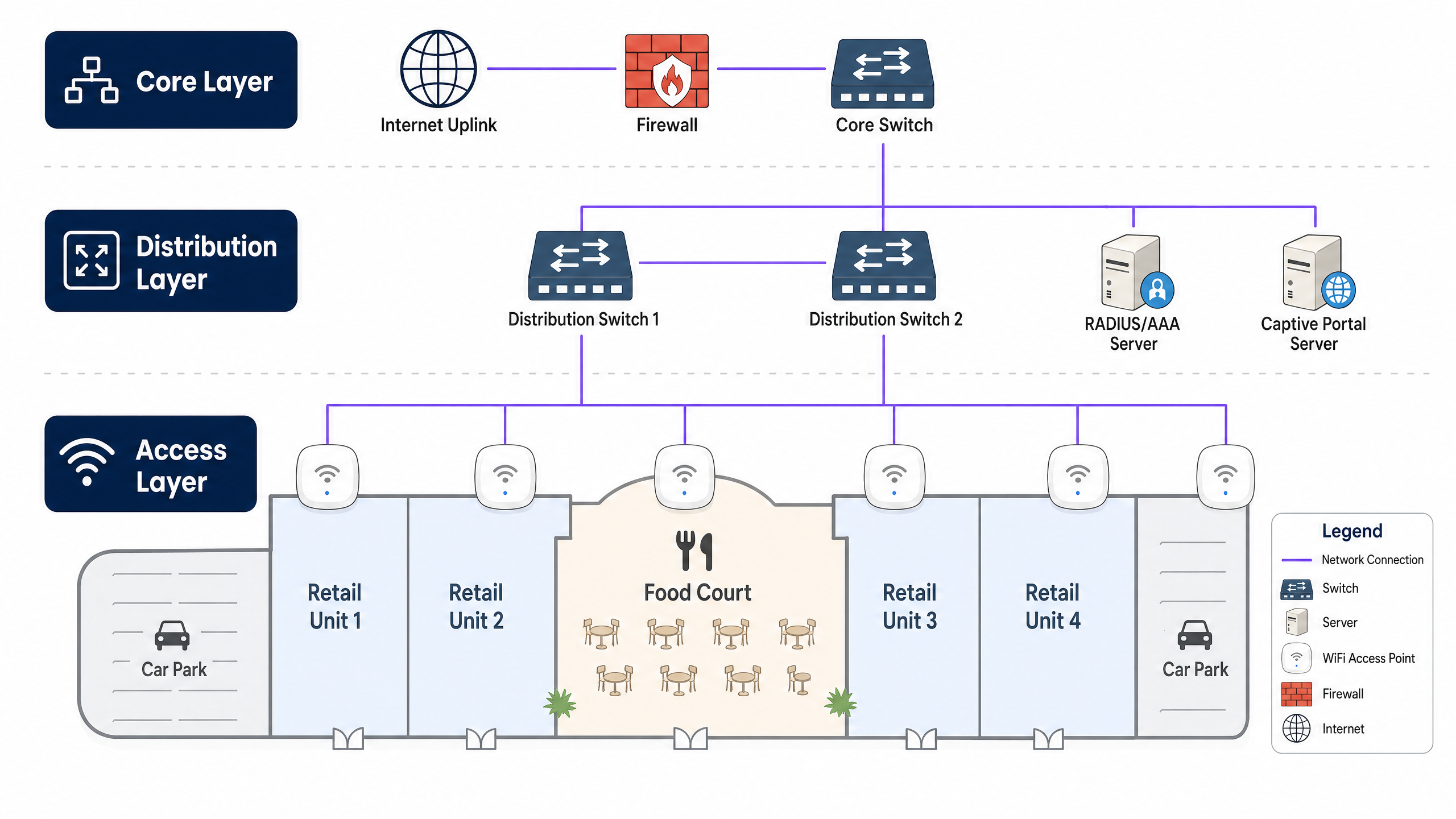 核心层构成高速骨干,提供冗余路由、防火墙服务和互联网上行连接。此层必须支持高吞吐量,以处理峰值流量负载而不产生瓶颈。分布层汇集来自接入层的流量,应用QoS(服务质量)策略并将流量路由至核心层。它通常容纳用于身份验证的RADIUS/AAA服务器和用于访客接入引导的captive portal服务器。接入层是网络边缘,客户端在此连接,包括以太网供电(PoE)交换机和高密度WiFi接入点,分布在零售区域、美食广场和停车场。
无线标准与频率
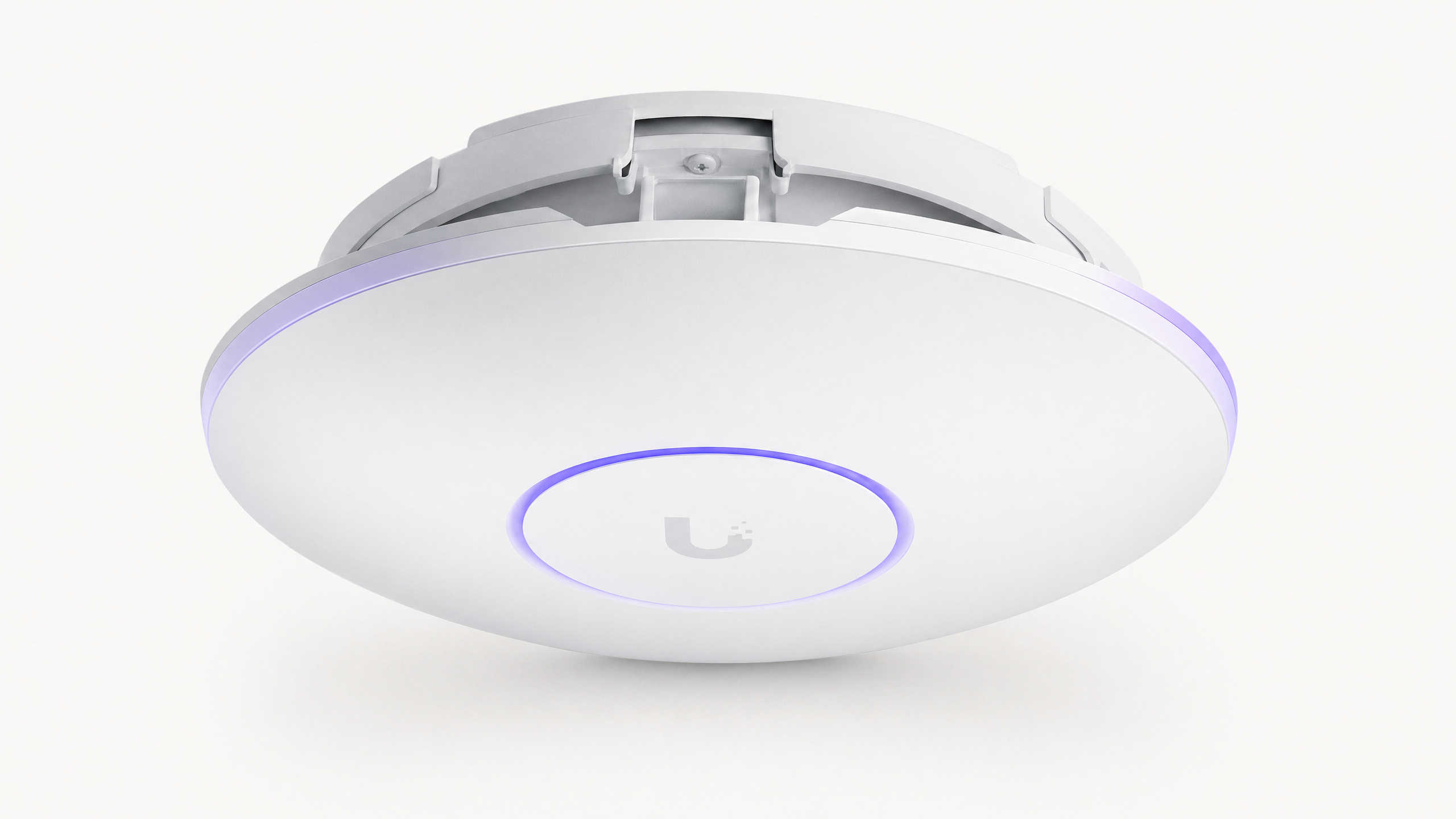
现代部署应标准化于WiFi 6 (802.11ax)或WiFi 6E,它们通过OFDMA(正交频分多址)和MU-MIMO等技术,在高密度环境中提供了显著改进。这些标准允许AP同时与多个设备通信,大幅降低了如美食广场等拥挤区域的延迟。
需要双频(2.4 GHz和5 GHz)或三频(增加6 GHz)的AP。虽然2.4 GHz穿透墙壁的能力更强、范围更远,但高度拥挤。5 GHz和6 GHz提供更宽的信道和更高的吞吐量,但需要更密集的AP部署。一个设计良好的网络将主动将支持双频的客户端引导至5 GHz或6 GHz频段(Band Steering),以优化整体频谱利用率。
安全与合规
安全至关重要,尤其是在处理访客数据并可能集成POS系统或运营技术(OT)时。
对于访客接入,实施安全的captive portal进行接入引导。在支持的情况下使用WPA3-Personal(SAE),或使用Open/Enhanced Open(OWE)实现无缝接入。关键的是,必须在AP级别启用客户端隔离,以防止访客设备之间的点对点通信。对于数据隐私,数据收集机制必须符合GDPR、CCPA或当地数据保护法规。一个强大的 访客WiFi 平台将在接入引导过程中明确管理同意。对于企业/OT接入,将运营流量(例如HVAC传感器、安防摄像头、POS)隔离到专用VLAN上,并通过802.1X认证(WPA3-Enterprise)进行保护。
实施指南
第1步:现场勘测与RF规划
预测性和主动式现场勘测是关键的第一步。零售环境是动态的;店铺布局变化,季节性陈列会显著改变RF传播。
预测性勘测使用软件工具基于平面图和建筑材料对环境进行建模,提供AP数量和放置的初步估计。**主动式勘测(AP-on-a-stick)**在现场实际测试AP覆盖和干扰。这在购物中心至关重要,因为要考虑玻璃店面、金属装置以及现有租户WiFi网络等变量,这些都会引起同频干扰。
第2步:基础设施配置
确保有线基础设施能够支持无线需求。在所有AP位置部署Cat6A布线,以支持多千兆吞吐量和更高的PoE预算(PoE+或PoE++)。选择具有足够PoE预算的接入交换机,以同时为所有AP供电,这在部署功耗较高的WiFi 6/6E AP时尤为关键。稳定的互联网连接至关重要;考虑使用专用专线以获得保证的带宽和SLA。更多信息请参见我们的指南: 什么是专线?专用商业互联网 。
第3步:AP放置与配置
在高密度区域如美食广场或活动空间,使用定向天线AP创建更小、聚焦的微小区,增加容量而不增加同频干扰。在走廊和通道,交错放置AP,为漫游客户端提供连续覆盖。仔细调整发射功率水平;AP不应以最大功率广播,因为这会产生粘性客户端——即拒绝漫游到更近AP的设备——并增加干扰。
第4步:Captive Portal与分析集成
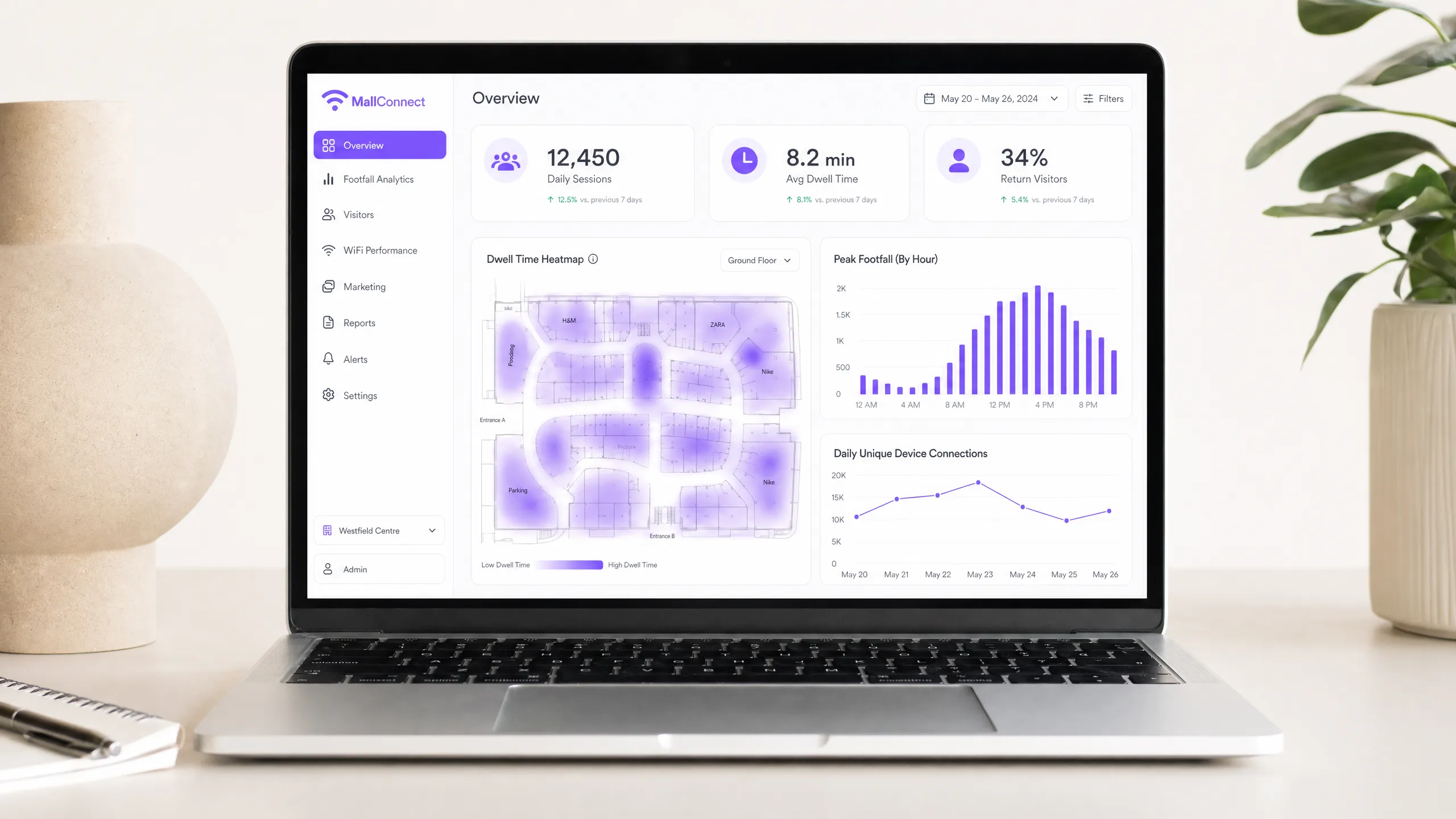
将网络与强大的分析平台集成。Captive Portal是数据收集的网关。通过提供社交登录、电子邮件注册或OpenRoaming等无缝认证,保持接入引导过程无摩擦。一旦连接,平台应开始聚合位置数据、停留时间和回访频率。这将网络从成本中心转变为营销资产。探索全面的 WiFi Analytics 解决方案的能力。
最佳实践
隔离访客和企业流量:始终使用VLAN将访客流量与企业及运营数据逻辑分离。这是一项基本的安全要求,尤其是在遵循PCI DSS合规性的环境中,支付卡数据可能在网络中传输。
实施Band Steering:主动将支持双频的客户端引导至5 GHz或6 GHz频段,为传统设备和IoT传感器释放拥挤的2.4 GHz频谱。
优化DHCP和DNS:像购物中心这样的高周转环境会迅速耗尽DHCP地址池。减少DHCP租约时间(例如1或2小时),以有效地回收IP地址。确保强大的DNS基础设施以处理高查询量。了解更多关于如何 通过强大的DNS和安全性保护您的网络 的信息。
持续监控:RF环境不断变化。利用无线管理系统(WMS)提供对客户端健康状况、AP状态和干扰水平的实时可见性。
故障排除与风险缓解
常见故障模式
**同频干扰(CCI)**发生在多个AP在同一信道上运行且能相互听到时,导致设备等待空闲通话时间,从而大幅降低吞吐量。通过仔细的信道规划、动态射频管理(RRM)和降低AP发射功率来缓解这一问题。
粘性客户端是指即使有更近、信号更强的AP可用,仍保持连接到某个AP的设备。实施最低RSSI阈值,以温和地断开信号弱的客户端,迫使其漫游到信号更好的AP。
DHCP地址池耗尽阻止用户连接,因为网络IP地址已用完。对访客网络使用更大的子网(例如/22或/21),并减少DHCP租约时间。
非法AP是未经授权连接到网络的接入点,构成严重安全风险。启用无线入侵防御系统(WIPS),自动检测和遏制非法设备。
投资回报率与业务影响
数据收集与分析
正确配置的网络可捕获被动分析数据(客流量、停留时间、移动模式)和主动分析数据(人口统计信息、通过captive portal获取的联系方式)。这些数据为场所运营商提供了关于购物者行为的细粒度洞察,从而能够在租户安置、租金估值和营销效果方面做出数据驱动的决策。与我们 动物园和主题公园WiFi:高流量场所连接指南 中详述的相同数据驱动方法一样,在高流量场所同样有效。
零售媒体变现
Captive portal本身就是优质的数字化地产。物业经理可以通过在接入引导过程中投放来自零售租户或第三方品牌的定向广告或赞助来变现。这将WiFi网络转变为一个直接的创收渠道。
提升客户体验
无缝连接支持室内导航、基于位置的优惠和个性化沟通。通过将WiFi数据与现有CRM或忠诚度计划集成,场所可以提供高度定向、感知上下文的体验,从而提升参与度并增加每次访问的消费。
Key Definitions
Co-Channel Interference (CCI)
Occurs when multiple access points transmit on the same frequency channel and can 'hear' each other. Because WiFi is a half-duplex medium (only one device can talk at a time on a channel), CCI forces devices to wait, severely degrading network performance and throughput.
A primary cause of poor WiFi performance in dense retail environments where too many APs are deployed without proper channel planning or power management.
Band Steering
A network feature that detects dual-band capable clients and actively encourages or forces them to connect to the less congested 5 GHz or 6 GHz bands rather than the crowded 2.4 GHz band.
Essential for maximising throughput and capacity in high-density areas like shopping centre food courts where the 2.4 GHz band is saturated.
Captive Portal
A web page that the user of a public-access network is obliged to view and interact with before internet access is granted. Typically used for authentication, accepting terms of service, and marketing data capture.
The primary mechanism for converting anonymous footfall into known contacts and gathering first-party data for marketing and analytics purposes.
Client Isolation
A security feature configured on the access point that prevents connected wireless clients from communicating directly with one another over the local network.
A mandatory security control for public guest networks to prevent peer-to-peer attacks and malware spread among shoppers' devices.
Dwell Time
The length of time a visitor spends within a specific defined area (zone) of the venue, calculated based on the presence of their WiFi-enabled device as detected by the access point infrastructure.
A key metric for venue operators to understand shopper engagement, value different retail zones, and measure the effectiveness of marketing campaigns and store layouts.
RSSI (Received Signal Strength Indicator)
A measurement of the power present in a received radio signal, expressed in dBm (decibels relative to one milliwatt). It indicates how well a device can 'hear' an access point.
Used in network design to determine AP placement and configured in minimum RSSI thresholds to force sticky clients to roam to a stronger access point.
OpenRoaming
A federation of WiFi networks that allows users to seamlessly and securely connect automatically across different venues without needing to repeatedly log in or use captive portals. Based on the Passpoint (802.11u) standard.
A modern approach to frictionless connectivity that improves the user experience while still allowing venues to maintain secure, authenticated connections and capture analytics data.
Power over Ethernet (PoE)
A technology standardised in IEEE 802.3af, 802.3at (PoE+), and 802.3bt (PoE++) that passes electric power along with data on twisted pair Ethernet cabling, allowing a single cable to provide both data connection and power to devices such as wireless access points.
Critical for deploying APs across a large retail estate, as it eliminates the need to install separate electrical outlets at every AP location, significantly reducing installation cost and complexity.
VLAN (Virtual Local Area Network)
A logical subdivision of a physical network that groups devices together regardless of their physical location. Traffic between VLANs requires routing through a Layer 3 device, providing logical isolation between network segments.
The fundamental mechanism for separating guest WiFi traffic from corporate, POS, and operational technology networks in a retail environment.
Worked Examples
A regional shopping centre (approx. 50,000 sqm) is experiencing severe connectivity issues in its central food court during peak lunch hours. Users report being connected to WiFi but unable to load web pages. The current setup uses 4 standard omni-directional APs mounted on the 10-metre high ceiling.
- Conduct an active RF survey to confirm Co-Channel Interference (CCI) and capacity exhaustion. Validate that the APs are all operating on the same or overlapping channels, and measure the concurrent client count during peak hours.
- Replace the 4 omni-directional APs with 8-10 high-density APs utilising directional (patch) antennas. Mount them lower where possible, or angle them to create focused micro-cells over specific seating areas.
- Implement strict Band Steering to force 5GHz/6GHz connections for all capable clients.
- Reduce transmit power on all food court APs to minimise cell overlap and reduce CCI.
- Verify DHCP pool size and reduce lease time to 30 minutes for this specific zone to prevent pool exhaustion.
- Validate backhaul capacity from the distribution switch to the core to ensure the wired network is not the bottleneck.
A luxury retail outlet village wants to implement a guest WiFi network to collect shopper demographics and build a marketing database. However, the IT team is concerned about GDPR compliance and the security of the tenant POS networks.
- Network Segmentation: Create a dedicated, isolated VLAN specifically for guest WiFi traffic, completely separate from the corporate and POS VLANs. Route this guest VLAN directly to the internet firewall, bypassing all internal networks.
- Client Isolation: Enable Layer 2 client isolation on all guest APs to prevent devices from communicating with each other.
- Captive Portal Configuration: Implement a captive portal integrated with a compliant Guest WiFi platform such as Purple.
- Consent Management: Configure the portal to require explicit, opt-in consent for marketing communications and data processing, clearly linking to the privacy policy before granting access. Separate the marketing consent checkbox from the mandatory Terms of Service acceptance.
- Authentication: Offer social login or email registration to capture verified demographic data, and ensure all data is processed and stored in compliance with GDPR Article 6 (lawful basis for processing).
Practice Questions
Q1. Your marketing team wants to implement a new augmented reality (AR) indoor navigation app that relies heavily on the guest WiFi network. The current network was designed three years ago primarily for basic web browsing. What is the most critical technical assessment you must perform before launching the app, and what specific metrics should you measure?
Hint: Consider the difference between a network designed for coverage versus one designed for high throughput, low latency, and precise location accuracy.
View model answer
You must perform a capacity analysis and active site survey. The existing network was likely designed for coverage (basic connectivity). AR applications require high throughput (minimum 10–25 Mbps per active user), low latency (sub-20ms), and sufficient AP density for accurate location triangulation (typically APs within 10–15 metres of each user). Measure concurrent client counts per AP, average and peak throughput per user, RSSI variance across the estate, and roaming event frequency. If the network cannot meet these thresholds, an AP densification project and upgrade to WiFi 6 will be required before the app launch.
Q2. A tenant in the shopping centre complains that their wireless Point-of-Sale (POS) terminals frequently drop connections, especially during busy weekend hours. You observe that the tenant's AP is operating on channel 6 on the 2.4GHz band, and several nearby mall guest APs are also broadcasting on channel 6. What is the immediate recommended action, and what longer-term architectural change should be considered?
Hint: Think about how WiFi devices share airtime on the same frequency, and the implications of POS systems being on the same network as guest devices.
View model answer
The immediate action is to mitigate Co-Channel Interference. Coordinate a channel plan: if the POS terminals support 5GHz, migrate the tenant's AP to the 5GHz band immediately. If 2.4GHz is required, ensure the tenant's AP and surrounding mall APs use non-overlapping channels (1, 6, or 11) with no adjacent APs on the same channel. The longer-term architectural change is to ensure POS systems are on a dedicated, isolated VLAN with a separate SSID, completely segregated from the guest network. This also addresses PCI DSS compliance requirements for cardholder data environments.
Q3. The property management team wants to monetize the guest WiFi by selling targeted ads on the captive portal. The legal team has flagged GDPR concerns. How should the network architecture and onboarding flow be designed to satisfy both the commercial requirement and legal compliance?
Hint: Focus on the specific GDPR requirements for consent, and how the captive portal flow must be structured to make consent freely given, specific, informed, and unambiguous.
View model answer
The onboarding flow must implement a two-stage consent model. Stage one presents the mandatory Terms of Service (required for network access). Stage two presents a clearly separate, optional opt-in checkbox for marketing communications and data processing for targeted advertising. These must not be pre-ticked and must be independent of each other. The platform must log the timestamp, IP address, and specific consent given for each user. Users must be able to access, modify, or withdraw consent at any time via a self-service portal. Architecturally, all user data must be stored in a GDPR-compliant data store (ideally within the EEA), and the captive portal platform must provide a Data Processing Agreement (DPA). Only users who have explicitly opted in should be served targeted ads.
Continue reading in this series
PPSK directory: comparing features and deployment models
This guide details PPSK (Private Pre-Shared Key) directory architecture for multi-tenant networks, comparing it against 802.1X and standard PSK. It provides network architects and IT managers with vendor-neutral deployment models for Build to Rent, student accommodation, and MDU environments, covering cloud controller, RADIUS backend, and hybrid authentication patterns.
PPSK directory: comparing features and deployment models
This guide details PPSK (Private Pre-Shared Key) directory architecture for multi-tenant networks, comparing it against 802.1X and standard PSK. It provides network architects and IT managers with vendor-neutral deployment models for Build to Rent, student accommodation, and MDU environments, covering cloud controller, RADIUS backend, and hybrid authentication patterns.
Nama iPSK yang keren: a comprehensive guide for businesses
This guide explains how to design and implement a structured iPSK (Identity Pre-Shared Key) naming taxonomy for enterprise WiFi deployments across multi-tenant residential, hospitality, and retail environments. It covers the full authentication architecture, a four-part naming framework, automated key lifecycle management via Purple's cloud overlay, and real-world case studies from hotel and BTR deployments. Property developers, landlords, and BTR operators will find actionable guidance on segmenting resident, staff, IoT, and visitor traffic on a single SSID while maintaining strict Layer 2 isolation and compliance with GDPR and PCI DSS.