
How to leverage SMS for marketing examples to increase return visits
This technical guide explains how venue operators can build compliant SMS marketing campaigns using Guest WiFi data to drive measurable increases in return visits. It covers deployment architecture, data capture via captive portals, behavioural segmentation, and GDPR/PECR compliance requirements.
Listen to this guide
View podcast transcript
Executive Summary
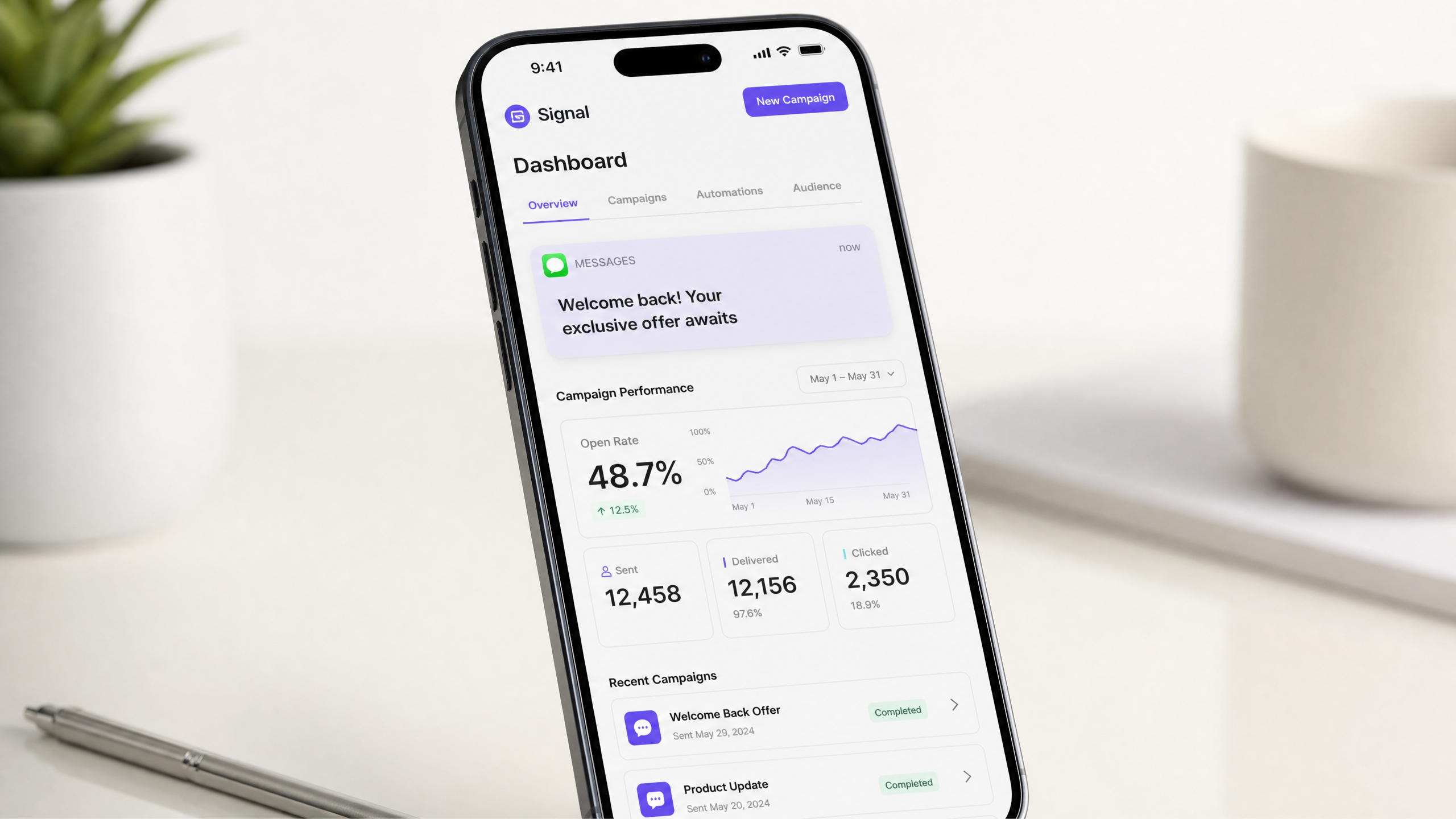
Venue operators sit on a massive, underutilised asset: the physical presence of their visitors. While most venues offer Guest WiFi, many fail to capture the verified first-party data required to drive measurable return visits. This guide details how to implement an SMS marketing architecture that captures verified phone numbers at the point of WiFi login, secures explicit consent, and automates behavioural campaigns.
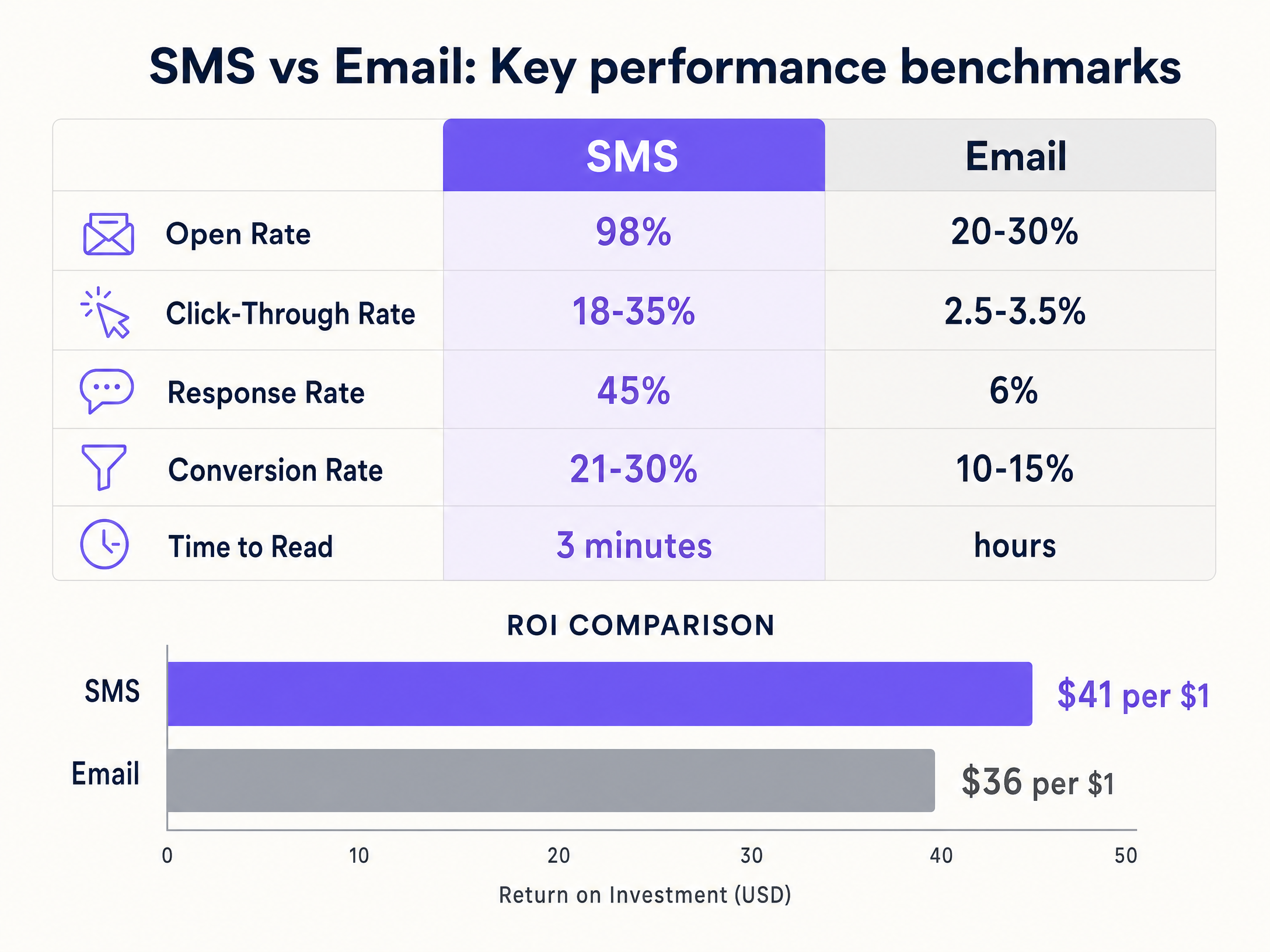
SMS delivers a 98% open rate, with 90% of messages read within three minutes. When executed correctly, SMS campaigns generate up to $41 return for every $1 spent. This technical reference provides IT managers and venue operators with the architecture, deployment steps, and compliance frameworks required to build a scalable SMS marketing programme using Purple Engage.
Technical Deep-Dive
The Data Capture Architecture
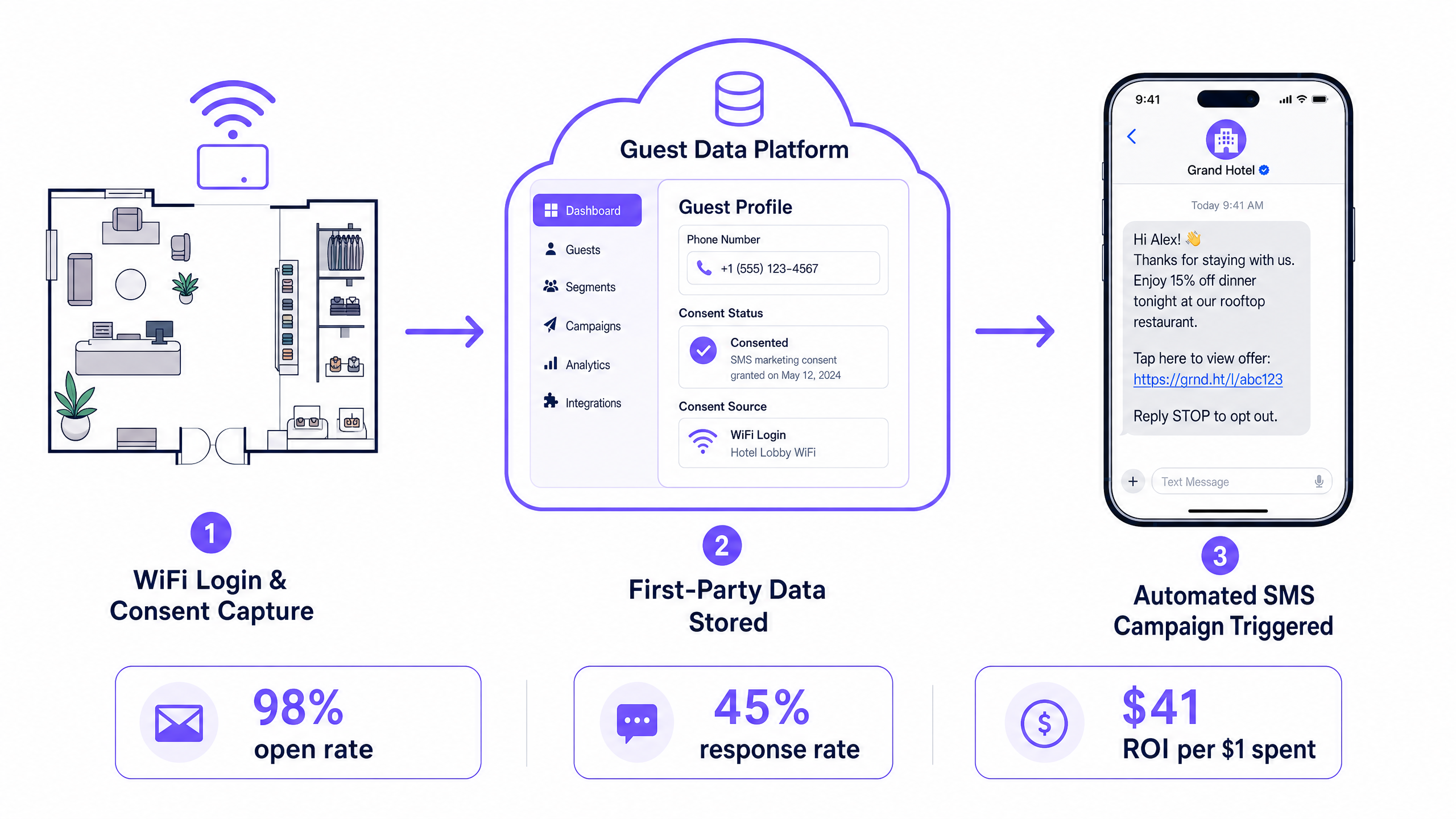
The foundation of any SMS marketing programme is verified, consented first-party data. Purchasing lists or scraping numbers violates GDPR and PECR regulations and guarantees low engagement. The most effective data capture mechanism in a physical venue is the Guest WiFi captive portal.
When a visitor connects to the network, the authentication flow requires them to enter a mobile number. To verify this number, the system sends a one-time passcode (OTP) via SMS. The visitor must enter this OTP to gain internet access. This process ensures the database contains zero fake numbers. During this flow, the portal presents a conscious-choice opt-in checkbox for SMS marketing, satisfying legal consent requirements.
Behavioural Segmentation
Once data enters the Customer data management platform: a comprehensive guide for businesses , you must segment it. Sending the same message to your entire database causes high opt-out rates. Purple's analytics engine allows operators to build dynamic segments based on network data:
- Visit Frequency: First-time visitors, occasional visitors, loyal visitors.
- Dwell Time: Visitors who stay for 10 minutes versus those who stay for three hours.
- Location Data: Visitors who enter specific zones (e.g., the hotel spa or the stadium merchandise store).
- Recency: Visitors who have not connected to the network in 30, 60, or 90 days.
SMS vs Email Performance
The technical argument for SMS over email relies on delivery speed and open rates. As shown below, SMS significantly outperforms email across all engagement metrics.
Implementation Guide
Step 1: Configure the Captive Portal
Deploy a custom captive portal across your hardware infrastructure (Cisco Meraki, HPE Aruba, Ruckus, Juniper Mist, Ubiquiti UniFi). Configure the authentication method to 'SMS OTP'. Add a clear, un-ticked checkbox for marketing consent.
Step 2: Define the Segments
Navigate to the Purple WiFi Analytics dashboard. Create three initial segments to test the architecture:
- Segment A: First-time visitors who stayed longer than 60 minutes.
- Segment B: Returning visitors who have not visited in 45 days.
- Segment C: High-frequency visitors (more than 5 visits).
Step 3: Build the Automation Rules
In Purple Engage, create a triggered campaign for Segment B (the 'Win-Back' campaign). Set the trigger condition: Days since last visit = 45. Set the delivery channel to SMS.
Step 4: Craft the Payload
Write a 160-character message. Include a clear offer, a trackable short link, and the mandatory opt-out instruction. Example: "We miss you at Grand Hotel! Enjoy 15% off dinner tonight at our rooftop restaurant. Tap to book: https://grnd.ht/abc Reply STOP to opt out."
Best Practices
- Limit Frequency: Send a maximum of two SMS campaigns per month to any individual segment. Exceeding this limit drives opt-out rates above 3%.
- Test Send Times: Analyse your Guest WiFi footfall data to determine when your audience is most active, and time your SMS delivery accordingly.
- Maintain Brand Consistency: Ensure your SMS tone matches your captive portal design. Read How to make a great first impression with your guest WiFi (and keep your brand consistent) for portal design principles.
- Isolate Networks: Keep your guest traffic logically separated from operational traffic. For network design principles, see Three SSIDs to rule them all: guest, Passpoint, and IoT WiFi .
Troubleshooting & Risk Mitigation
Failure Mode 1: High Opt-Out Rates
- Cause: Sending generic broadcast messages instead of segmented, relevant offers.
- Mitigation: Implement strict behavioural rules. Only send messages triggered by specific venue actions.
Failure Mode 2: Low Conversion on Links
- Cause: Sending campaigns at the wrong time of day.
- Mitigation: Use Purple's footfall analytics to identify peak engagement windows for your specific venue type.
Failure Mode 3: Compliance Breaches
- Cause: Bundling marketing consent with general terms and conditions.
- Mitigation: Ensure the captive portal uses a separate, explicit opt-in checkbox for SMS marketing, compliant with GDPR and PECR.
ROI & Business Impact
To measure the success of an SMS marketing deployment, track the return visit rate. Use unique redemption codes or trackable short links in the SMS payload. When the visitor returns to the venue and connects to the WiFi, Purple's analytics engine logs the visit.
By comparing the return rate of the segment that received the SMS against a control group that did not, operators can calculate the exact revenue impact of the campaign. At an average ROI of $41 per $1 spent, SMS marketing funded by WiFi data capture represents one of the highest-yield investments available to physical venues.
Key Definitions
First-Party Data
Information a company collects directly from its customers or venue visitors, such as phone numbers captured during WiFi login.
First-party data is highly accurate and legally compliant, unlike purchased third-party lists.
Captive Portal
A web page that a user must view and interact with before accessing a public WiFi network.
The captive portal is the primary mechanism for authenticating users and capturing marketing consent.
Conscious-Choice Opt-In
A clear, affirmative action by a user to consent to marketing communications, typically an un-ticked checkbox.
Required for GDPR and PECR compliance; pre-ticked boxes or bundled consent are illegal.
SMS Gateway
A telecommunications network facility for sending and receiving Short Message Service (SMS) transmissions to or from a telecommunications network.
The delivery layer that routes the automated campaigns from Purple Engage to the user's mobile carrier.
Behavioural Segmentation
Dividing a database into groups based on their actions, such as visit frequency, dwell time, or location within a venue.
Essential for ensuring SMS campaigns are relevant to the recipient, thereby maintaining high engagement rates.
PECR
Privacy and Electronic Communications Regulations; UK laws governing electronic marketing, including SMS and email.
Dictates that organisations must have explicit consent to send marketing text messages.
One-Time Passcode (OTP)
An automatically generated numeric or alphanumeric string of characters that authenticates a user for a single transaction or login session.
Used during WiFi login to verify that the phone number provided by the user is legitimate and active.
Return Visit Rate
The percentage of visitors who return to a venue within a specific timeframe after their initial visit.
The primary metric used to calculate the ROI of venue-based SMS marketing campaigns.
Worked Examples
A 200-room hotel needs to increase bookings for its on-site restaurant on Tuesday evenings. The hotel captures 500 verified phone numbers per week via its Guest WiFi.
- In Purple Engage, build a segment targeting guests currently checked in (connected to WiFi in the last 24 hours). 2. Filter this segment to exclude guests who connected to the access points located inside the restaurant. 3. Schedule an automated SMS to fire at 4:00 PM on Tuesday. 4. Message payload: 'Enjoy a complimentary glass of wine with dinner tonight at The Brasserie. Show this text to your server. Reply STOP to opt out.'
A national fashion retailer with 50 stores wants to re-engage shoppers who have not visited a physical location in 60 days.
- Access the Purple analytics platform. 2. Create a segment rule: 'Last seen > 60 days'. 3. Filter by specific store location to ensure the offer is geographically relevant. 4. Trigger an SMS campaign on Thursday at 5:00 PM. 5. Message payload: 'We haven't seen you lately! Get 20% off your entire purchase this weekend at our Manchester store. Link: https://rtl.co/abc Reply STOP to opt out.'
Practice Questions
Q1. A stadium operator wants to send an SMS campaign to all fans immediately after a match ends, offering a discount on merchandise. They plan to use a list of phone numbers purchased from a third-party data broker. Evaluate this approach.
Hint: Consider the legal requirements for SMS marketing consent.
View model answer
This approach violates GDPR and PECR regulations. The stadium operator does not have explicit, conscious-choice opt-in consent from the individuals on the purchased list. Furthermore, unsolicited SMS messages result in high opt-out rates and damage brand reputation. The operator should instead deploy a Guest WiFi captive portal to capture verified, consented first-party data from fans while they are inside the stadium.
Q2. Your hotel has captured 10,000 verified phone numbers with marketing consent via Guest WiFi. The marketing director wants to send a weekly SMS to the entire list promoting the Sunday carvery. Why is this problematic, and what is the recommended alternative?
Hint: Consider the impact of frequency and segmentation on SMS engagement.
View model answer
Sending a weekly broadcast message to the entire database will cause severe list fatigue and drive the opt-out rate above acceptable levels (typically >3%). SMS is an immediate, high-trust channel that demands relevance. The recommended alternative is behavioural segmentation. The hotel should filter the database to target only guests who have previously visited the restaurant or who are currently on-site over the weekend, and limit the frequency to a maximum of two messages per month per segment.
Q3. A retail chain has launched an SMS 'win-back' campaign targeting shoppers who have not visited in 90 days. The campaign includes the message: 'We miss you! Come back and see our new collection.' The campaign shows a 98% open rate but a 0% measurable return visit rate. Identify the missing component.
Hint: How do you track the physical or digital impact of an SMS?
View model answer
The campaign lacks an attribution layer. Without a trackable short link or a unique redemption code in the SMS payload, the retailer cannot measure whether the message drove a digital action or a physical return visit. To fix this, the payload must include a trackable element, and the retailer must use the WiFi analytics platform to correlate the SMS send with a subsequent network login by that specific user.