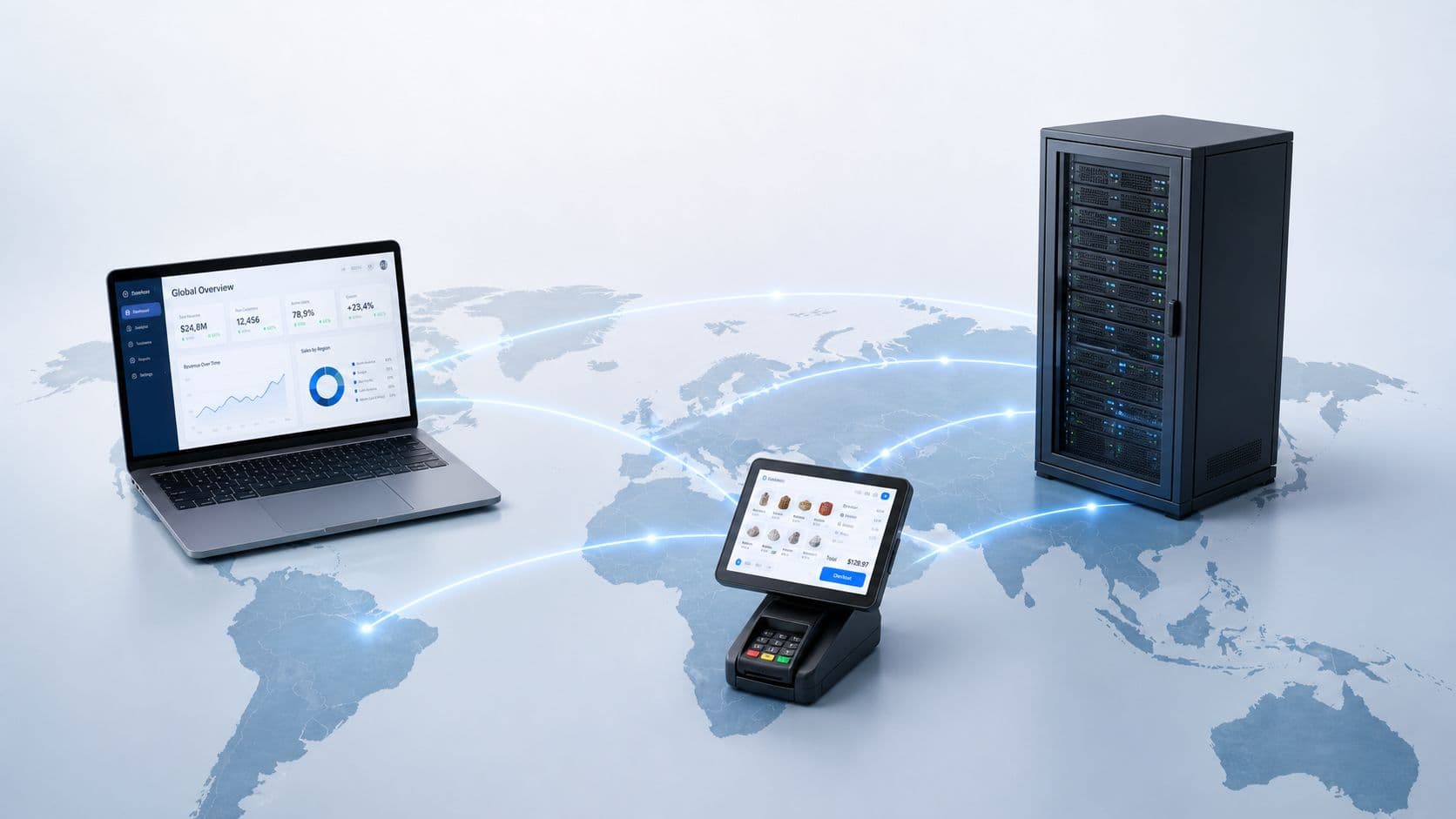
Votre réseau n'a probablement pas été conçu pour le mode de fonctionnement actuel de l'entreprise.
Il y a quelques années, la majeure partie du trafic restait à l'intérieur du périmètre de l'entreprise. Aujourd'hui, ce n'est plus le cas. Les clients des hôtels s'attendent à un WiFi fluide, les points de vente dépendent de systèmes de caisse et d'outils d'analyse basés sur le cloud, et les équipes cliniques ont besoin d'un accès fiable à des systèmes qui ne peuvent tolérer aucune interruption. Parallèlement, les équipes IT sont sous pression pour réduire les coûts des opérateurs, améliorer la résilience et renforcer le contrôle d'accès.
C'est pourquoi la décision entre SD-WAN et MPLS est cruciale. Il ne s'agit pas d'un simple comparatif de fonctionnalités pour spécialistes du réseau. C'est une décision de modèle opérationnel qui affecte les performances des applications, les déploiements de succursales, la conformité et la rapidité avec laquelle l'entreprise peut ouvrir, acquérir ou reconfigurer des sites.
Le carrefour du réseau moderne
Pendant longtemps, le MPLS a été la solution de sécurité. Devenu la référence absolue pour les réseaux WAN d'entreprise au début des années 2000, après avoir été développé à la fin des années 1990, il a dominé le marché pendant environ deux décennies en offrant une disponibilité et des performances constantes pour les applications critiques, comme le souligne l'analyse de Pure IP sur l'évolution du MPLS et du SD-WAN . Cet historique est important car de nombreuses organisations utilisent encore des conceptions de réseaux WAN basées sur ces hypothèses passées.
Le problème est que ces hypothèses ont changé.
Les plateformes cloud, les SaaS, les équipes distribuées, les services invités, les flux de travail mobiles et les opérations multisites ont déplacé les modèles de trafic hors de l'ancien modèle en étoile. Le MPLS n'a pas été conçu pour un monde où les utilisateurs se trouvent à un endroit, les applications résident ailleurs et les clients attendent des services numériques à la périphérie.
Le SD-WAN est apparu parce que les entreprises avaient besoin d'un WAN capable de s'adapter plus rapidement que les cycles d'approvisionnement des opérateurs. Il a permis aux équipes IT d'utiliser plusieurs types de transport, de piloter le trafic intelligemment et de cesser de traiter chaque application de la même manière.
Le MPLS a résolu le problème d'entreprise de son époque. Le SD-WAN résout le problème de distribution dans le cloud auquel la plupart des entreprises sont confrontées aujourd'hui.
Cela ne signifie pas que le MPLS est obsolète. Cela signifie que l'approche binaire est généralement erronée. Dans les environnements réels, en particulier dans l'hôtellerie, le commerce de détail, la santé et les opérations multisites, la bonne question n'est pas « Lequel l'emporte ? », mais plutôt « Quel trafic mérite des performances déterministes, et quel trafic bénéficie le plus de la flexibilité et d'un transport à moindre coût ? »
C'est le carrefour auquel la plupart des CTO sont confrontés aujourd'hui.
Comprendre les architectures fondamentales
À haut niveau, le MPLS et le SD-WAN résolvent différentes facettes du problème WAN.

Ce qu'est réellement MPLS
Pensez à MPLS comme à une autoroute privée exploitée par l'opérateur. Le trafic circule le long de trajets pré-établis, et le fournisseur contrôle la manière dont les paquets sont priorisés sur ce réseau. C'est pourquoi MPLS jouit d'une solide réputation dans les environnements où la prévisibilité importe plus que la flexibilité.
En pratique, MPLS est géré par l'opérateur, orienté par des politiques de routage et structuré autour de la fiabilité. Si vous avez besoin d'une connectivité entre vos succursales et vos centres de données pour des systèmes critiques, il vous offre un chemin contrôlé et un modèle de service que la plupart des responsables informatiques maîtrisent bien.
Le compromis réside dans le contrôle et la vitesse de changement. Si l'entreprise ajoute des sites, modifie les comportements des applications ou nécessite une priorisation différente, votre équipe dépend souvent des délais et du modèle opérationnel du fournisseur.
Ce qu'est réellement SD-WAN
SD-WAN est une superposition logicielle qui s'appuie sur un ou plusieurs réseaux de transport sous-jacents. Ces réseaux sous-jacents peuvent inclure du haut débit, de la LTE ou même MPLS. Le changement clé réside dans le fait que l'intelligence se déplace vers le logiciel, où les politiques de trafic peuvent être gérées de manière centralisée et ajustées en fonction des besoins des applications et des conditions réelles du réseau.
Un bon modèle mental est celui de la navigation par satellite plutôt que d'un itinéraire fixe. Au lieu de présumer d'un chemin unique optimal, SD-WAN évalue en permanence les liaisons disponibles et oriente le trafic selon la politique que vous avez définie.
Cela rend SD-WAN particulièrement attractif pour les organisations fortement axées sur le cloud, les réseaux de succursales et les entreprises qui doivent connecter de nouveaux sites rapidement sans attendre les délais d'installation des circuits privés.
Où les gens se trompent dans la comparaison
L'erreur la plus courante est de traiter sd wan vs mpls comme s'ils étaient des substituts directs dans chaque scénario. Ce n'est pas le cas.
L'un est une architecture de transport avec un contrôle opérateur privé. L'autre est une couche de contrôle logicielle capable d'utiliser plusieurs types de transport. Dans de nombreux déploiements réels, SD-WAN ne remplace pas MPLS dès le premier jour. Il orchestre autour de lui, aux côtés des liaisons internet et des voies de secours mobiles.
Une façon plus simple de comprendre le concept :
- MPLS convient lorsque l'entreprise privilégie des performances stables et garanties par l'opérateur pour un ensemble défini de flux critiques.
- SD-WAN convient lorsque l'entreprise a besoin d'agilité, d'un contrôle centralisé des politiques et d'un meilleur alignement avec la connectivité cloud et des succursales.
- Le modèle hybride convient lorsque ces deux affirmations sont vraies, ce qui est souvent le cas.
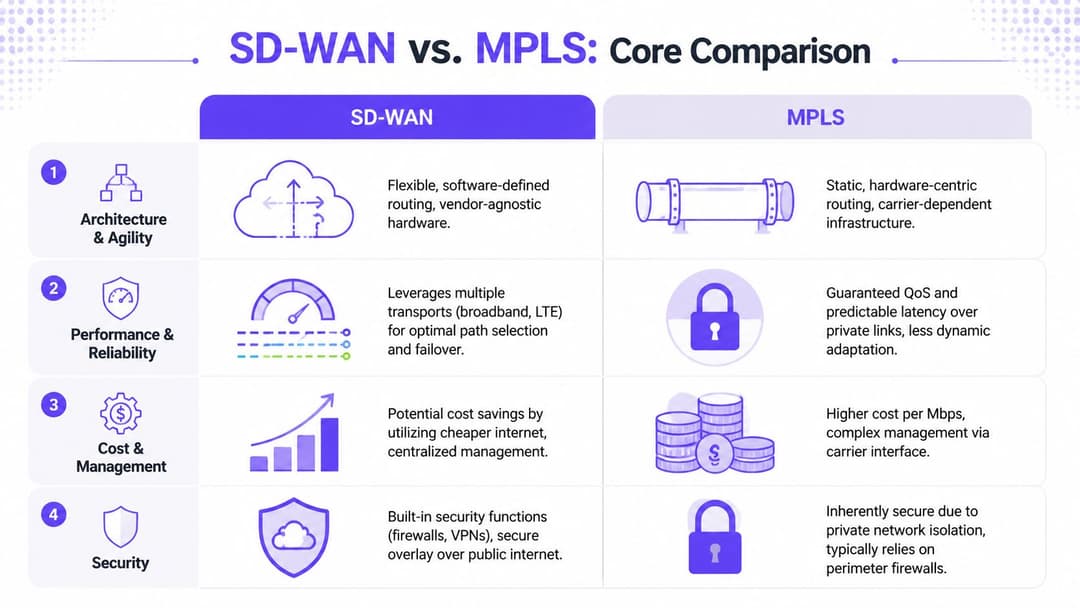
Comparatif central SD-WAN vs MPLS
Un CTO avec 300 magasins, cliniques ou sites hôteliers choisit rarement entre deux schémas théoriques parfaits. La vraie question est de savoir si le WAN supportera les applications cloud, les services aux invités, le trafic de paiement, la VoIP et les opérations locales sans transformer chaque problème de succursale en ticket d'assistance opérateur ou en exception de sécurité.
C'est le cadre pratique de la comparaison sd wan vs mpls.
| Attribut | MPLS (Multi-Protocol Label Switching) | SD-WAN (Software-Defined WAN) |
|---|---|---|
| Architecture | Chemins WAN privés, gérés par l'opérateur | Superposition logicielle sur plusieurs types de transport |
| Agilité | Plus lent à modifier, dépendant du fournisseur | Modifications de politiques et déploiement de succursales plus rapides |
| Approche de la performance | Chemins détermistes avec priorisation fixe | Sélection de chemin en temps réel basée sur l'état de la liaison |
| Adaptation au cloud | Moins naturel pour l'accès direct au cloud | Mieux aligné avec le trafic SaaS et l'accès direct internet |
| Posture de sécurité | Isolation inhérente par rapport à l'internet public | Exposition plus large, reposant sur une conception et des contrôles solides |
| Modèle de coût | Connectivité privée premium | Options de transport moins coûteuses, plus des considérations de plateforme et d'exploitation |
| Idéal pour | Applications critiques nécessitant un comportement prévisible | Parcs distribués nécessitant de la flexibilité et de la visibilité |
Architecture et agilité
Le MPLS fonctionne bien dans les environnements stables où les chemins applicatifs, les priorités des succursales et les fenêtres de maintenance sont prévisibles. Il devient restrictif lorsque l'entreprise ajoute des sites, déploie de nouveaux services cloud ou absorbe des acquisitions qui apportent des fournisseurs d'accès mixtes et une connectivité locale hétérogène.
Le SD-WAN donne à l'entreprise un contrôle plus direct. Les équipes réseau peuvent définir les politiques de manière centralisée, les déployer sur l'ensemble du parc et ajuster la sélection des chemins sans attendre qu'un opérateur réorganise les classes de service ou les circuits.
Cette différence se manifeste rapidement dans les opérations en contact avec le public :
- Le commerce de détail a besoin d'une mise en service rapide des sites, de transactions par carte fiables et de suffisamment de flexibilité pour séparer les systèmes du magasin de l'accès des invités ou des partenaires.
- L'hôtellerie gère un mélange complexe de trafic PMS, d'applications pour le personnel, de WiFi pour les invités, de streaming et de systèmes techniques du bâtiment.
- La santé, avec ses cliniques et succursales, nécessite un accès prévisible aux plateformes médicales, mais doit aussi pouvoir ajouter des sites et des connexions tierces sans passer par des mois de refonte du WAN.
Pour ce type de parc, les avantages pratiques du SD-WAN pour les entreprises distribuées comptent plus que les affirmations générales sur la modernisation du réseau.
Performance et QoS
Les discussions sur la performance se résument souvent à un raccourci erroné. Le MPLS est traité comme l'option premium et le SD-WAN comme un accès internet avec un meilleur marketing. Cela occulte la façon dont chaque modèle se comporte sous charge.
Le MPLS repose sur des classes de service définies et un comportement de transmission prévisible. Si une plateforme vocale, un flux de transactions ou une application succursale-centre de données doit rester dans une classe de priorité connue, le MPLS offre toujours aux équipes opérationnelles un environnement très contrôlé. Cela est crucial dans les parcs où quelques applications concentrent la majeure partie des risques de l'entreprise.
Le SD-WAN est plus performant lorsque les conditions de liaison changent et que les flux de trafic sont moins ordonnés. Il peut évaluer la perte de paquets, la gigue et la latence sur les chemins disponibles et orienter le trafic en fonction des politiques et de la santé réelle des liaisons. En pratique, cela aide bien plus les succursales fortement axées sur le cloud qu'une architecture statique.
La différence opérationnelle est simple. Le MPLS protège bien les priorités connues. Le SD-WAN s'adapte mieux lorsque les priorités évoluent au cours de la journée.
C'est pourquoi les entreprises en contact direct avec les utilisateurs finaux penchent souvent vers des architectures hybrides. Un hôtel peut maintenir le trafic de paiement et de voix sur des chemins hautement contrôlés tout en envoyant le trafic internet des clients et SaaS via du haut débit. Un détaillant peut protéger les flux de POS et d'inventaire tout en attribuant à la signalisation numérique, aux transferts d'analyses et aux services clients des chemins internet moins coûteux. Une clinique peut préserver un traitement strict pour les systèmes cliniques tout en ajoutant un accès résilient basé sur internet pour la collaboration et les liaisons de secours.
Modèle de sécurité
Les décisions de sécurité sont faussées lorsque les équipes considèrent le transport privé comme l'équivalent d'une architecture de sécurité.
Le MPLS réduit l'exposition à l'internet public. C'est utile, en particulier pour les applications héritées et le trafic est-ouest étroitement contrôlé entre les succursales et les centres de données. Mais le MPLS ne résout pas à lui seul les exigences d'identité, de segmentation, de confiance des appareils ou d'audit.
Le SD-WAN introduit généralement une utilisation plus directe d'internet, davantage de points de politique et une plus grande intégration avec les services de sécurité cloud. Cela donne aux équipes plus de flexibilité, mais impose également une plus grande discipline de conception. Le pare-feu des succursales, la segmentation, la gestion des certificats, la cohérence des politiques et la sécurisation des accès locaux directs doivent tous être parfaitement maîtrisés.
Comme indiqué dans l'analyse de Zscaler sur les compromis de sécurité entre SD-WAN et MPLS , le SD-WAN augmente la surface d'attaque par rapport au MPLS, même s'il peut utiliser des tunnels chiffrés et s'intégrer étroitement aux contrôles de sécurité fournis par le cloud. Cet écart est particulièrement critique dans les environnements réglementés tels que la santé et les opérations hôtelières sensibles au GDPR, où les équipes ont besoin d'auditabilité, de contrôle d'accès et d'une gouvernance d'identité solide sur de nombreux sites.
L'erreur pratique diffère selon l'architecture :
- Les parcs basés sur MPLS supposent souvent que la connectivité privée suffit et laissent la politique d'identité, la segmentation et les révisions d'accès des utilisateurs trop lâches.
- Les parcs basés sur SD-WAN peuvent se déployer rapidement sur la connectivité des succursales pour ne découvrir que plus tard des règles de pare-feu incohérentes, des breakouts locaux faibles ou un contrôle opérationnel insuffisant.
- Les parcs hybrides nécessitent une attribution claire des politiques, car l'infrastructure sous-jacente peut différer d'un site à l'autre, alors que la norme de sécurité doit rester la même.
Pour les établissements et les entreprises qui servent directement les utilisateurs finaux, la question la plus pertinente n'est pas de savoir quel transport est théoriquement le plus sûr. Il s'agit de savoir où réside la politique. Si les visiteurs, le personnel, les prestataires, les appareils IoT et les applications critiques partagent le même site physique, le modèle gagnant est celui qui applique l'identité, l'accès et la segmentation de manière cohérente pour l'ensemble d'entre eux.
C'est là que les plateformes comme Purple apportent de la valeur, quel que soit le modèle WAN choisi. Le MPLS ou le SD-WAN détermine comment le trafic circule. Une plateforme basée sur l'identité détermine comment les utilisateurs s'authentifient, quelles données sont collectées avec consentement, comment le trafic visiteur et opérationnel est séparé, et comment les exploitants de sites transforment la connectivité en résultats commerciaux mesurables. Pour l'hôtellerie, le commerce de détail et la santé, cette couche est souvent tout aussi cruciale que le transport sous-jacent.
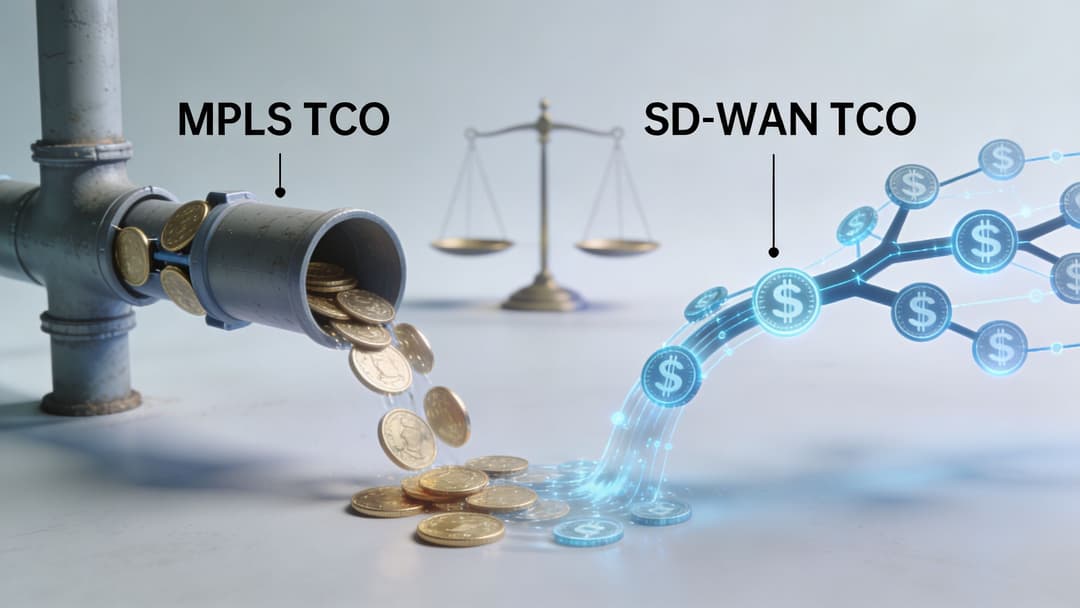
Analyse du Coût Total de Possession (TCO)
Un groupe hôtelier déployant du WiFi visiteur sur 80 sites, un détaillant ouvrant des magasins à court préavis ou un prestataire de santé connectant des cliniques se posent tous la même question en premier : combien ce réseau va-t-il réellement nous coûter une fois en service ?
C'est la bonne approche pour comparer le SD-WAN et le MPLS. Le prix du circuit est important, mais ce n'est qu'une ligne budgétaire. Le MPLS entraîne généralement des coûts récurrents plus élevés auprès des opérateurs en échange d'une connectivité privée et de garanties de service plus strictes. Le SD-WAN réduit souvent les dépenses de transport, mais les économies peuvent fondre si les équipes sous-estiment les licences, le matériel d'accès, les contrôles de sécurité, la conception des breakouts internet locaux et les opérations quotidiennes.
Où le SD-WAN permet généralement de réaliser des économies
Selon la comparaison des coûts entre le SD-WAN et MPLS de Lightyear , les fournisseurs font part d'économies de 20 à 70 % par rapport à MPLS lorsque les entreprises remplacent des architectures WAN entièrement privées par des accès hybrides associant haut débit, LTE et haut débit classique. En pratique, je constate que ces économies se concrétisent le plus rapidement dans les parcs comportant de nombreuses succursales où le trafic est orienté vers les plateformes SaaS, le cloud public et les services Internet, plutôt que d'être acheminé vers un centre de données central.
L'aspect économique du SD-WAN s'améliore généralement lorsque :
- La majeure partie du trafic des succursales est destinée au cloud
- Les sites ont besoin d'une connectivité moins coûteuse à grande échelle
- L'entreprise a besoin d'une mise en service plus rapide des sites
- Différents types d'accès peuvent être utilisés sans nuire aux performances des applications
Pour les entreprises en contact direct avec le public, il existe un autre aspect financier. L'accueil des visiteurs, le trafic du Captive Portal , la collecte d'analyses et les services d'engagement numérique nécessitent rarement un transport privé coûteux sur chaque site. Une plateforme comme Purple peut s'intégrer à l'un ou l'autre modèle WAN, mais la décision relative au transport influe sur le montant que vous dépensez pour prendre en charge les services qui influencent directement l'expérience des visiteurs, la compréhension de la fréquentation et la valeur marketing. Les équipes qui comparent les architectures le voient souvent plus clairement dans des scénarios pratiques de déploiement SD-WAN pour les sites distribués .
Là où MPLS justifie encore son coût
MPLS peut toujours s'avérer la bonne décision financière lorsque des performances irrégulières créent un problème opérationnel direct. La même analyse note que MPLS offre généralement une latence plus faible et plus prévisible, ainsi qu'une gigue plus stable grâce à une bande passante réservée et à des réseaux privés garantis par des accords de niveau de service (SLA).
Cela est important si un site ne peut tolérer des variations dans le comportement des applications. Une liaison hospitalière entre établissements, un hub régional prenant en charge des systèmes d'entreprise critiques ou un site avec un trafic opérationnel étroitement contrôlé peuvent justifier ce surcoût, car le coût d'une interruption est supérieur à celui du circuit.
Pourquoi l'approche économique hybride est souvent la plus logique
Le modèle de coût le plus solide est souvent sélectif. Utilisez une connectivité coûteuse là où de mauvaises performances créent un risque réel pour l'activité. Utilisez des liaisons moins coûteuses là où le contrôle des politiques importe plus que le transport déterministe.
Pour de nombreuses entreprises, cela signifie conserver MPLS pour les applications internes sensibles et utiliser le SD-WAN pour l'accès Internet, le SaaS, l'accès des visiteurs, la collecte d'analyses et d'autres services sur les sites distribués. La même source souligne également que les architectures hybrides peuvent réduire les coûts d'infrastructure WAN de 30 à 50 % par rapport à une approche entièrement MPLS.
C'est généralement la recommandation la plus défendable auprès d'un CTO gérant différents types de sites et de classes de trafic :
- Conservez le transport privé pour les flux de travail qui subissent une pénalité opérationnelle ou financière claire en cas de baisse des performances.
- Basculez le trafic cloud et internet vers des circuits moins coûteux pilotés par des règles.
- Évitez de payer des tarifs MPLS pour un trafic qui ne tire aucun avantage réel du MPLS.
Le contrôle des coûts s'améliore lorsque le trafic est classé par criticité métier. C'est l'aspect que de nombreux projets WAN négligent.
Cas d'usage réels et scénarios de déploiement
Un CTO gérant 300 sites a rarement un seul problème de WAN. Il en a généralement trois à la fois. Une succursale de vente au détail a besoin d'une mise en service rapide et économique. Un site hospitalier requiert un comportement prévisible pour ses systèmes cliniques. Un hôtel doit prendre en charge le WiFi pour les clients, les applications du personnel, le trafic de paiement et les standards de la marque sans suréquiper chaque emplacement.
C'est pourquoi la bonne architecture commence généralement par le modèle économique et le rôle du site, et non par une fidélité aveugle au SD-WAN ou au MPLS.
Chaîne de vente au détail avec de nombreuses succursales
Le commerce de détail est souvent le cas d'usage le plus évident pour le SD-WAN. Les magasins ouvrent dans des délais serrés, les circuits varient selon les bailleurs et la géographie, et une grande partie du trafic est destinée à internet, y compris le SaaS, les plateformes d'inventaire, la signalisation numérique et le WiFi pour les clients.
Dans ce modèle, le SD-WAN offre à l'équipe réseau un contrôle pratique. Le haut débit et les liaisons sans fil sont plus faciles à obtenir que des circuits privés dans de nombreux endroits. Le routage basé sur des politiques permet également à l'équipe de hiérarchiser le trafic de paiement et les applications métier tout en contenant l'accès des invités. Si un lien d'accès se dégrade, le trafic peut être transféré sans attendre l'intervention de l'opérateur.
Le résultat pour l'entreprise est simple. Une activation plus rapide des sites, une dépendance réduite vis-à-vis d'un seul fournisseur et un meilleur contrôle du temps de fonctionnement face aux clients.
Réseau hospitalier ou clinique
La santé tolère moins l'erreur.
Une clinique utilisant principalement du SaaS peut très bien fonctionner sur un SD-WAN avec des liaisons d'accès diversifiées. Un hôpital gérant des transferts d'imagerie, des accès aux systèmes inter-établissements ou des flux opérationnels strictement contrôlés conserve souvent le MPLS dans son architecture, car la régularité du transport reste essentielle. Les équipes de sécurité ont également tendance à préférer une séparation plus nette pour certaines classes de trafic, en particulier là où les contrôles de conformité et les exigences d'audit sont stricts.
Je ne recommanderais pas de traiter tous les sites de santé de la même manière. Les installations critiques, les hubs régionaux et les sites acheminant du trafic opérationnel sensible méritent généralement une politique de transport différente de celle des petits centres de consultation externe. En pratique, cela conduit souvent à une conception hybride où le MPLS achemine certaines applications internes sélectionnées et le SD-WAN gère l'accès internet, les services cloud et le trafic moins sensible des succursales.
Groupe hôtelier avec des parcs mixtes
L'hôtellerie met en évidence les limites des architectures WAN universelles. Un complexe hôtelier, un hôtel de centre-ville, un centre de conférence et un siège social ne génèrent pas le même trafic et ne comportent pas le même risque opérationnel.
Le WiFi invité, le streaming, les applications de fidélité et les services gérés dans le cloud sont parfaitement adaptés au SD-WAN car ils bénéficient d'une bande passante à moindre coût et d'une sélection de chemin flexible. Les systèmes de gestion immobilière, les environnements de paiement, les services vocaux et certains flux de travail de back-office peuvent justifier l'utilisation de MPLS ou d'un chemin privé protégé sur les sites de plus grande taille où les temps d'arrêt affectent immédiatement le chiffre d'affaires et l'expérience client.
C'est également là que la plateforme de superposition est essentielle. L'infrastructure achemine les paquets d'un site à l'autre. Une plateforme réseau basée sur l'identité telle que Purple se situe au-dessus de cette couche et transforme la connectivité en un service d'entreprise. Au-dessus de SD-WAN ou de MPLS, Purple peut prendre en charge les parcours d'accès des invités, l'identification des utilisateurs, l'application des politiques, les analyses et les informations au niveau du site que le marketing, les opérations et l'informatique peuvent utiliser. Pour les entreprises en contact direct avec la clientèle, cette distinction est importante. Le choix du WAN affecte l'économie et les performances du transport. La couche d'identité affecte l'expérience utilisateur, la capture de données et la valeur que l'entreprise tire de chaque emplacement.
Pour les équipes comparant des parcs comptant de nombreuses succursales, des sites critiques ou des portefeuilles de sites hybrides, ces modèles de déploiement SD-WAN d'entreprise courants constituent une référence utile.
Un parc mixte mène généralement à une réponse mixte. Il ne s'agit pas d'indécision, mais d'une bonne architecture.
Stratégies de déploiement et de migration
Une migration WAN réussie commence généralement par l'évitement de l'erreur la plus coûteuse : aborder le projet comme un simple exercice de remplacement global.

Commencer par la classification du trafic
Avant de modifier le transport, classifiez les applications et les groupes d'utilisateurs en fonction de leur importance opérationnelle.
Ne commencez pas par se demander : « À quelle vitesse pouvons-nous supprimer le MPLS ? » Commencez plutôt par des questions telles que :
- Qu'est-ce qui perturbe l'activité si la latence devient instable ?
- Quelles applications sont principalement SaaS et orientées vers Internet ?
- Quels sites sont de simples succursales par rapport aux hubs critiques ?
- Où les exigences de conformité et d'audit imposent-elles des contraintes de conception plus strictes ?
Cet exercice révèle généralement que tout le trafic ne mérite pas la même infrastructure sous-jacente.
Superposer d'abord le SD-WAN sur le parc existant
La méthode la moins risquée consiste souvent à déployer le SD-WAN en superposition tout en conservant le MPLS pour le trafic qui en dépend déjà. Cela offre à votre équipe une visibilité immédiate, un contrôle centralisé des politiques et des avantages en matière de sélection de chemin, sans imposer une transition perturbatrice.
Cela donne également à l'entreprise le temps de valider le comportement réel des applications avant de s'engager dans des modifications de contrat ou des plans de démantèlement.
Migrez par classe de site, pas par idéologie
Un déploiement pratique a tendance à suivre le type de site :
- Les succursales simples d'abord. Les petits bureaux, les magasins ou les sites à faible risque sont d'excellents candidats pour commencer.
- Les sites à trafic mixte ensuite. Les sites avec du trafic cloud et interne sont ceux où la politique hybride prouve toute sa valeur.
- Les sites critiques en dernier. Les hôpitaux, les hubs régionaux et les centres opérationnels nécessitent des fenêtres de validation plus longues.
Cette approche facilite également la coordination des fournisseurs. Vos fournisseurs d'accès Internet, votre plateforme SD-WAN, votre infrastructure de pare-feu et vos commutateurs de succursale ne migreront pas tous au même rythme.
Gardez des opérations gérables
Le plan de migration nécessite un modèle opérationnel, pas seulement une conception technique. Cela inclut la définition de qui détient la politique, qui surveille la qualité des chemins, comment le basculement est testé et comment les modifications des succursales sont approuvées.
Pour les équipes qui cherchent à réduire la complexité quotidienne, ce guide sur la gestion du SD-WAN dans les environnements opérationnels s'avère très utile. Le contrôle centralisé ne crée de la valeur que si votre équipe standardise les politiques et la gestion des incidents autour de lui.
Les migrations échouent lorsque l'architecture change mais que les opérations ne suivent pas.
Liste de contrôle décisionnelle et recommandations finales
Un groupe hôtelier qui déploie l'enregistrement numérique, le WiFi pour les clients, des terminaux portables pour le personnel et un PMS cloud n'a pas les mêmes exigences WAN qu'un fabricant reliant un petit nombre de sites fixes. C'est pourquoi la bonne réponse dans le débat sd wan vs mpls commence par la dépendance commerciale, et non par le positionnement du fournisseur.
Le choix du transport affecte les revenus, la charge de support et le risque au niveau de la succursale.
Utilisez cette liste de contrôle avant de choisir
Quel trafic importe le plus Si l'infrastructure dépend fortement du SaaS, du cloud public et des services orientés Internet, le SD-WAN offre généralement un meilleur contrôle et une meilleure rentabilité. Si le trafic présentant le risque commercial le plus élevé reste entre des sites fixes et nécessite un traitement hautement prévisible, le MPLS a encore sa place.
Quel type de sites vous gérez
Un petit nombre de bureaux stables peut très bien fonctionner sur un modèle WAN traditionnel. Les grands parcs de succursales, les portefeuilles de commerces de détail, les groupes hôteliers, les cliniques et les sites à usage mixte bénéficient généralement d'un contrôle centralisé des politiques et d'une mise en service plus rapide.À quelle fréquence l'entreprise évolue
Les changements fréquents dans les services aux clients, les systèmes de paiement, les applications du personnel, la politique de sécurité ou les outils d'expérience numérique orientent les équipes vers le SD-WAN. Les politiques définies par les opérateurs sont plus lentes à adapter et généralement plus coûteuses à modifier.Qui est responsable de la sécurité en pratique
Le MPLS n'élimine pas le besoin de segmentation, de contrôles d'identité ou d'application des politiques au niveau du site. Le SD-WAN ne résout pas non plus la conformité à lui seul. Dans les secteurs de la santé, de l'hôtellerie et du commerce de détail, la question clé est de savoir comment vous isolez les utilisateurs, prouvez les décisions d'accès et maintenez des opérations cohérentes sur chaque site.Ce que votre équipe opérationnelle peut gérer
Une architecture séduisante sur le papier peut tout de même échouer si l'équipe ne peut pas surveiller la qualité des chemins, appliquer les normes et résoudre rapidement les incidents. La meilleure architecture est celle que vos équipes réseau et sécurité peuvent exploiter efficacement au quotidien.
La question de la QoS qui fait généralement pencher la balance
Le véritable point de décision n'est pas de savoir si une technologie est plus récente qu'une autre. Il s'agit de savoir si votre WAN a besoin de classes de service fixes ou de décisions de chemin en temps réel.
Le MPLS reste adapté lorsqu'un ensemble limité d'applications doit bénéficier d'un traitement strictement contrôlé sur des sites connus. Le SD-WAN est généralement plus performant lorsque la demande applicative varie au cours de la journée, que les performances Internet diffèrent selon les succursales et que l'expérience utilisateur dépend du choix du meilleur chemin disponible à cet instant précis. Pour les établissements hôteliers, les centres commerciaux et les sites de santé, cette différence se traduit par la fiabilité de la connexion, les performances de paiement, la qualité de la voix et la réactivité des applications cloud utilisées par le personnel.
Si les deux conditions sont réunies, utilisez les deux. C'est souvent la meilleure configuration.
Recommandation finale
Utilisez le MPLS là où des performances instables représenteraient un risque commercial évident. Utilisez le SD-WAN là où la flexibilité, la visibilité et l'accès au cloud importent plus que le transport privé. Conservez le MPLS pour le trafic qui en a besoin. Transférez tout le reste vers des liaisons basées sur des politiques qui coûtent moins cher et évoluent plus rapidement.
Pour les entreprises accueillant du public, un autre aspect est à évaluer. Le réseau de transport achemine le trafic de site à site ou de site à cloud. Il ne décide pas, à lui seul, qui doit rejoindre le réseau, à quoi ils doivent accéder, ni comment séparer les accès des invités et du personnel. C'est là qu'une plateforme basée sur l'identité intervient.
Si vous gérez des hôtels, des magasins de détail, des cliniques, des résidences ou des sites multi-locataires, Purple se positionne au-dessus du choix de transport et gère la couche utilisateur et accès. Elle prend en charge l'accès sans mot de passe et basé sur l'identité pour les invités et le personnel sur différents équipements réseau, que le réseau de transport soit MPLS, SD-WAN ou hybride. Cela offre aux CTO un cadre de décision plus clair. Choisissez le WAN pour les performances de transport et le coût d'exploitation. Choisissez la plateforme d'accès pour le contrôle des utilisateurs, la segmentation et l'expérience sur site.
En 2026, la recommandation la plus éprouvée consiste à adopter une approche sélective et pratique. Structurez votre réseau en fonction du comportement des applications, du type de site et de la réalité opérationnelle. Évitez de payer des tarifs de réseau privé pour un trafic qui fonctionne déjà parfaitement sur des liaisons internet managées. Évitez également de basculer des services critiques vers des liaisons moins coûteuses, à moins que des tests ne prouvent que l'expérience utilisateur est préservée.