
Responsabilità legali e filtraggio dei contenuti sulle reti guest pubbliche
Questa guida fornisce a IT manager, network architect e CTO un quadro tecnico e legale definitivo per l'implementazione del filtraggio dei contenuti sulle reti WiFi guest pubbliche. Copre gli obblighi normativi previsti dal GDPR, dal UK Online Safety Act 2023 e dal PCI DSS, insieme a un'architettura multilivello per il filtraggio DNS, l'autenticazione tramite Captive Portal, il firewalling a livello applicativo e la segmentazione VLAN. I gestori di sedi nei settori hospitality, retail, healthcare e trasporti troveranno passaggi di implementazione pratici, casi di studio reali e framework decisionali per creare una rete guest ad alte prestazioni e legalmente difendibile.
Ascolta questa guida
Visualizza trascrizione del podcast
Sintesi esecutiva
Per gli IT manager, i network architect e i Chief Technology Officers (CTO) che gestiscono spazi pubblici, l'implementazione del Guest WiFi è un requisito operativo fondamentale. Tuttavia, fornire un accesso a internet non filtrato e privo di un solido sistema di filtraggio dei contenuti espone la struttura a gravi rischi legali, finanziari e di reputazione. Quando si fornisce un accesso pubblico a internet, la propria organizzazione assume il ruolo di un Internet Service Provider (ISP). Se traffico dannoso o illegale — come la violazione del copyright, la pirateria peer-to-peer (P2P) o l'accesso a materiali riservati — ha origine dai vostri indirizzi IP pubblici, la responsabilità ricade spesso sul gestore della struttura.
Questa guida fornisce un quadro tecnico definitivo per l'implementazione del filtraggio obbligatorio dei contenuti. Esploriamo l'architettura necessaria per mantenere le tutele di "safe harbour", garantire la conformità normativa (inclusi GDPR, il UK Online Safety Act 2023 e PCI DSS v4.0) e mantenere le prestazioni di rete su larga scala. Integrando un filtraggio robusto con WiFi Analytics , le strutture nei settori Retail , Hospitality , Sanità e Trasporti possono mitigare i rischi mantenendo un'esperienza guest fluida.
Approfondimento tecnico
Il panorama legale e il Safe Harbour
Il fattore principale che spinge al filtraggio dei contenuti è la responsabilità legale associata al WiFi pubblico. Nella maggior parte delle giurisdizioni, gli ISP e i provider di WiFi pubblico sono protetti dalle disposizioni di "safe harbour" — ad esempio, il Digital Millennium Copyright Act (DMCA) negli Stati Uniti, o la Direttiva sul commercio elettronico e i quadri normativi successivi nell'UE. Tuttavia, queste tutele sono esplicitamente condizionate. Per poterne usufruire, i provider devono dimostrare di aver adottato misure tecniche ragionevoli per prevenire attività illegali e di poter assistere le forze dell'ordine quando richiesto.
Senza un audit trail e un filtraggio attivo, una struttura non può dimostrare di aver adottato misure ragionevoli, il che annulla completamente le tutele di safe harbour. Questo è particolarmente critico per le implementazioni nel settore pubblico e nelle istituzioni educative, dove i requisiti di responsabilità sono ancora più severi. Per un contesto sulla gestione del WiFi in ambienti sensibili alla tutela dei minori, consultare WiFi nelle scuole: la guida 2026 per amministratori e IT .
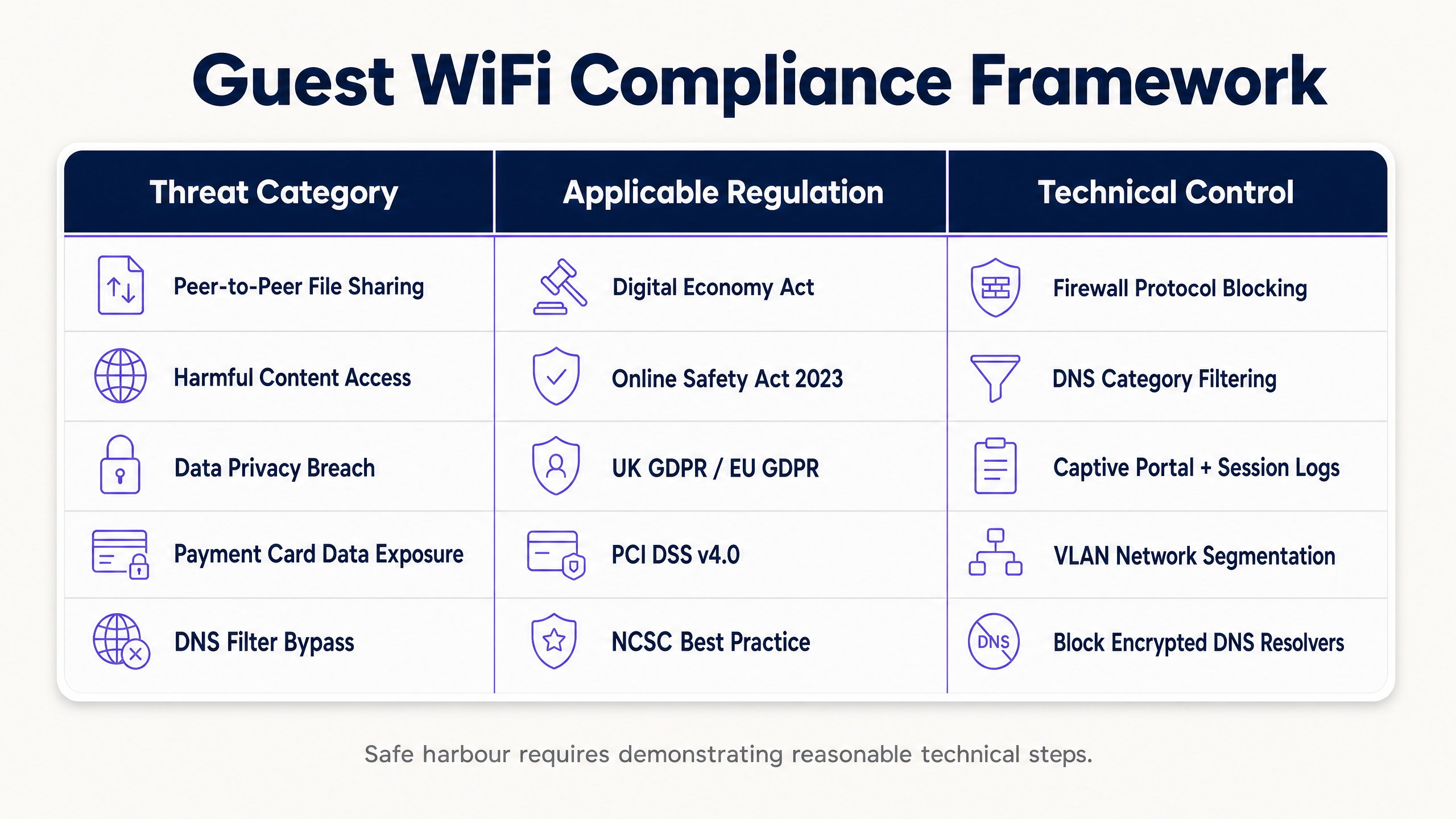
I tre principali vettori di rischio legale per le reti non filtrate sono i seguenti. Primo, violazione del copyright tramite pirateria P2P: i titolari dei diritti utilizzano il monitoraggio automatizzato per identificare gli indirizzi IP che condividono file protetti da copyright tramite protocolli torrent. In base a normative come il Digital Economy Act 2017 del Regno Unito, le violazioni ripetute associate all'IP pubblico di una struttura possono portare alla limitazione del servizio, a sanzioni civili o a controversie legali da parte dei titolari dei diritti. Secondo, accesso a contenuti dannosi o illegali: il UK Online Safety Act 2023 impone un severo dovere di diligenza ai provider di accesso a internet. Ofcom può imporre sanzioni fino a 18 milioni di sterline o al 10% del fatturato globale per violazioni gravi. Se un ospite accede a materiale illegale tramite la vostra rete e non avete implementato un blocco standard del settore (come la blocklist della Internet Watch Foundation), la vostra organizzazione rischia un severo controllo normativo. Terzo, conformità alla privacy dei dati e alla registrazione dei log: ai sensi del GDPR e del GDPR del Regno Unito, qualsiasi metadato di rete raccolto — lease IP, indirizzi MAC, timestamp — costituisce dato personale. Le strutture devono bilanciare l'obbligo legale di conservare i log di connessione per le forze dell'ordine (in genere 12 mesi secondo le normative sulle telecomunicazioni del Regno Unito) con il principio di minimizzazione dei dati del GDPR.
Architettura di sicurezza multilivello
La protezione sia degli ospiti che dell'azienda richiede un approccio di difesa in profondità (defence-in-depth). Una singola regola del firewall o un filtro DNS di base possono essere facilmente aggirati da utenti moderatamente esperti. Una solida architettura di rete guest deve implementare uno stack di sicurezza multilivello su quattro livelli di controllo distinti.
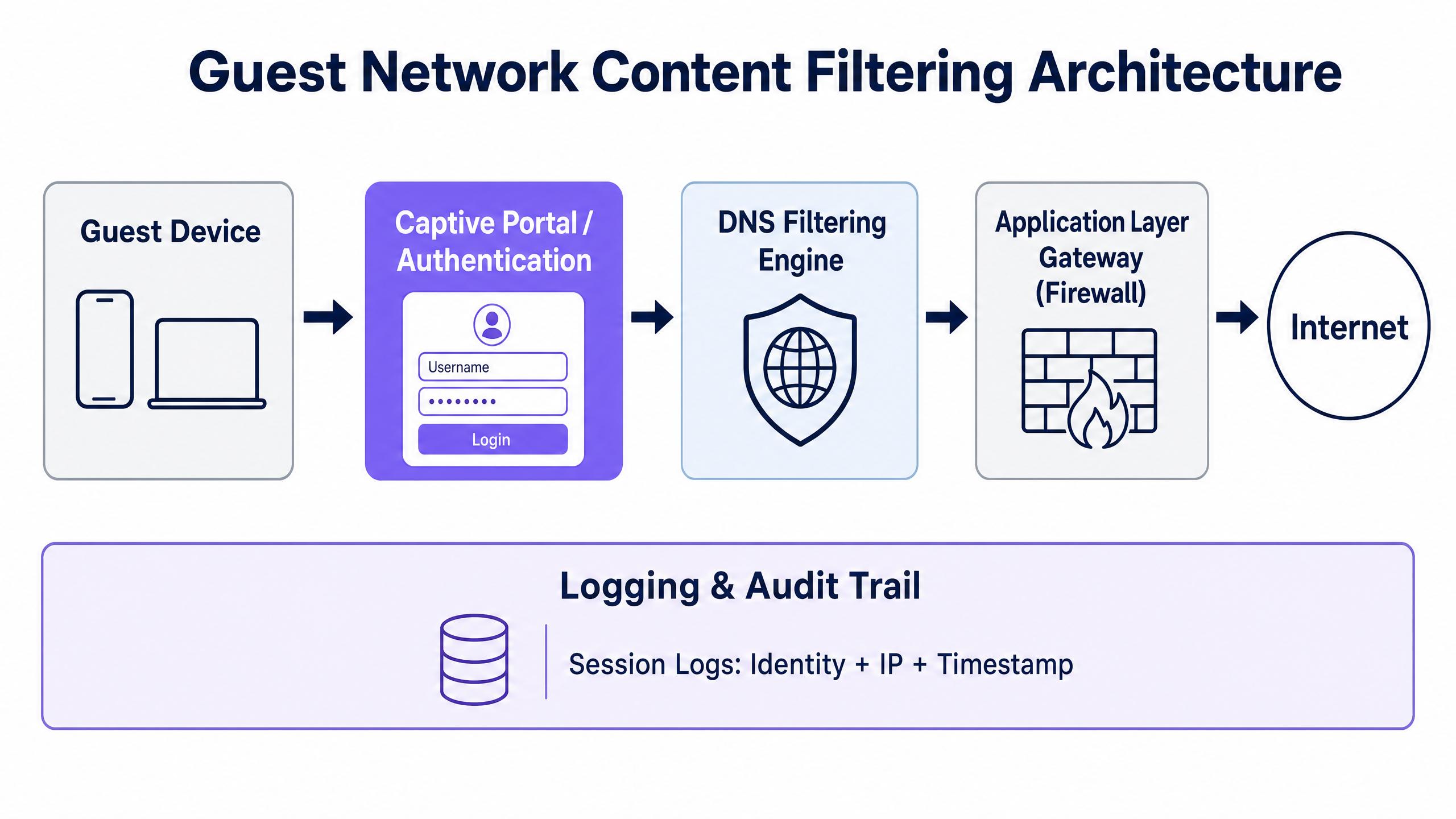
Livello 1 — Autenticazione e identità (Captive Portal): Prima che venga concesso l'accesso alla rete, gli utenti devono autenticarsi tramite un Captive Portal. Questo associa l'indirizzo MAC fisico di un dispositivo e il relativo lease IP locale assegnato a un'identità verificata, come un numero di telefono verificato tramite SMS, un indirizzo e-mail o un profilo di social media. Questo processo stabilisce l'audit trail essenziale necessario per trasferire la responsabilità legale dalla struttura al singolo utente. Per gli ambienti aziendali che richiedono maggiori garanzie di sicurezza, l'integrazione di una soluzione di Network Access Control (NAC) o l'implementazione dell'autenticazione 802.1X con Cloud RADIUS garantisce che solo i dispositivi autorizzati e conformi possano connettersi.
Livello 2 — Filtraggio a livello DNS: Il filtraggio DNS è il metodo più scalabile e a bassa latenza per bloccare i contenuti dannosi all'edge della rete. Quando un dispositivo guest richiede la risoluzione di un dominio, la richiesta viene instradata a un resolver DNS sicuro basato su cloud. Il resolver verifica il dominio rispetto a un database di threat intelligence in tempo reale categorizzato per tipo di contenuto (adulti, gioco d'azzardo, P2P, malware, phishing). Se il dominio rientra in una categoria bloccata, il resolver restituisce l'indirizzo di una pagina di blocco locale, impedendo del tutto l'attivazione della connessione. Per implementazioni ad alta capacità come stadi o grandi complessi retail, il filtraggio DNS basato su cloud con caching locale introduce una latenza trascurabile, in genere inferiore a 20 millisecondi.
Livello 3 — Gateway a livello applicativo (Next-Generation Firewall): Poiché il filtraggio DNS blocca solo i nomi di dominio, gli utenti possono aggirarlo connettendosi direttamente a indirizzi IP noti o utilizzando tunnel DNS crittografati. Il gateway di rete deve pertanto applicare il filtraggio a livello applicativo utilizzando la deep packet inspection (DPI) per identificare e bloccare protocolli specifici come BitTorrent, Tor e le firme VPN comuni, indipendentemente dalla porta o dal server DNS utilizzato. La DPI comporta un sovraccarico di throughput, pertanto dovrebbe essere applicata in modo selettivo alle categorie di protocolli ad alto rischio piuttosto che a tutto il traffico.
Layer 4 — Segmentazione della rete (VLAN): La rete guest deve essere completamente isolata dalle risorse aziendali, dai sistemi point-of-sale (POS) e dall'infrastruttura back-of-house tramite VLAN dedicate e liste di controllo degli accessi (ACL) rigorose. Ai sensi dello standard PCI DSS v4.0, se il traffico guest non è rigorosamente segmentato dall'ambiente dei dati dei titolari di carta (CDE), l'intera rete guest rientra nell'ambito dell'audit PCI, aumentando drasticamente i costi di conformità e la complessità dell'audit.
Guida all'implementazione
Fase 1: Segmentazione della rete e configurazione della VLAN
Configura una VLAN dedicata per il traffico guest su tutti gli switch core e i controller wireless. Assicurati che il routing inter-VLAN sia disabilitato tra la VLAN guest e qualsiasi VLAN aziendale interna. Sul firewall, implementa una lista di controllo degli accessi (ACL) che blocchi esplicitamente la sottorete guest dall'accesso a qualsiasi intervallo di IP privati RFC 1918, consentendo al contempo tutto l'altro traffico in uscita verso Internet. Questo singolo passaggio di configurazione esclude la rete guest dall'ambito PCI DSS e impedisce il movimento laterale in caso di compromissione di un dispositivo guest.
Fase 2: Distribuzione del filtraggio DNS e mitigazione del DoH
Per impedire agli utenti guest di aggirare i filtri a livello DNS utilizzando DNS over HTTPS (DoH) o DNS over TLS (DoT), il gateway di rete deve forzare tutto il traffico DNS attraverso i resolver sicuri designati. Configura una regola di destination NAT (DNAT) per intercettare tutte le richieste in uscita sulla porta UDP/TCP 53 dalla VLAN guest e reindirizzarle ai tuoi IP di filtraggio DNS sicuri. Per la mitigazione del DoH, blocca la porta TCP in uscita 853 (DoT) e limita l'accesso agli IP dei resolver DoH pubblici noti sulla porta 443 utilizzando la categoria di blocco delle applicazioni DNS over HTTPS integrata nel firewall o una blocklist di IP curata e gestita dal tuo provider di threat intelligence.
Fase 3: Configurazione del Captive Portal e della registrazione delle sessioni
Integra i tuoi access point wireless — come gli AP wireless Cisco — con una piattaforma di Captive Portal centralizzata. Il portale deve acquisire il consenso esplicito dell'utente per i termini di servizio e l'informativa sulla privacy prima di concedere l'accesso a Internet. Ai sensi del GDPR e del GDPR del Regno Unito, mantieni un piano di conservazione differenziato: conserva i log dei metadati di connessione (indirizzi MAC, IP assegnati, timestamp delle sessioni) per 12 mesi in un archivio crittografato e con controllo degli accessi per conformarsi ai requisiti di conservazione dei dati delle forze dell'ordine, mentre i dati del profilo di marketing devono essere eliminati tempestivamente quando un utente revoca il consenso o richiede la cancellazione.
Fase 4: Configurazione della policy di filtraggio dei contenuti
Distribuisci una policy di filtraggio dei contenuti a livelli in base al tipo di sede. Come minimo, tutte le reti guest pubbliche devono bloccare le seguenti categorie: domini di malware e phishing, protocolli di condivisione file peer-to-peer, contenuti per adulti ed espliciti e servizi noti di proxy e anonimizzazione. Le sedi che si rivolgono a famiglie o minori — come centri ricreativi, biblioteche o snodi di trasporto — dovrebbero inoltre applicare la modalità SafeSearch dei motori di ricerca riscrivendo le query DNS a livello di resolver e integrarsi con la blocklist di URL della Internet Watch Foundation (IWF) per soddisfare lo standard di certificazione Friendly WiFi.
Best Practice
Rispetto dello standard Friendly WiFi
Per le sedi aperte al pubblico che si rivolgono a famiglie, autorità locali o spazi educativi, si raccomanda vivamente di ottenere la certificazione Friendly WiFi. Sviluppato in collaborazione con l'UK Council for Child Internet Safety (UKCCIS), questo standard offre al pubblico la certezza che la tua rete guest blocchi attivamente l'accesso a materiale illegale e contenuti espliciti. La visualizzazione del simbolo Friendly WiFi Approved all'ingresso delle sedi e sulla splash page del Captive Portal aumenta direttamente la fiducia dei clienti e differenzia la struttura dai concorrenti.
Matrice delle policy di filtraggio dei contenuti
I responsabili IT dovrebbero implementare una policy di filtraggio dei contenuti a livelli in base al tipo di sede e alla capacità di larghezza di banda:
| Tipo di sede | Focus principale | Categorie di blocco obbligatorie | Controlli opzionali / della larghezza di banda |
|---|---|---|---|
| Retail e centri commerciali | Sicurezza e conformità | Malware, Phishing, Contenuti per adulti, P2P | Limitazione dello streaming video ad alta larghezza di banda |
| Hospitality e hotel | Prestazioni e responsabilità | Malware, Pirateria P2P, Contenuti per adulti | Limitazione dinamica della larghezza di banda per sessione |
| Sanità e cliniche | Privacy e tutela | Malware, Contenuti per adulti, Gioco d'azzardo, P2P | Blocco completo dei tunnel VPN |
| Scuole e università | Tutela dei minori | Contenuti per adulti, Violenza, Proxy/VPN, P2P | Controllo rigoroso delle applicazioni, limiti ai social media |
| Stadi e arene | Throughput e conformità | Malware, P2P, Contenuti per adulti | Limiti di larghezza di banda aggressivi per dispositivo |
Gestione centralizzata delle policy multi-sede
Per le organizzazioni che operano su più sedi — una catena alberghiera, un gruppo di negozi o un'autorità locale — la gestione centralizzata delle policy è imprescindibile. Un'unica console di gestione per inviare gli aggiornamenti delle policy a tutti gli access point e gateway contemporaneamente garantisce una postura di conformità coerente in tutto il patrimonio aziendale. Qualsiasi sede che operi senza una gestione centralizzata sta di fatto gestendo una rete non controllata, il che è indifendibile in caso di indagine normativa.
Risoluzione dei problemi e mitigazione dei rischi
Problema 1: Gli utenti aggirano i filtri tramite VPN
Gli utenti guest che utilizzano client VPN commerciali crittografano il proprio traffico end-to-end, aggirando sia i filtri DNS che quelli a livello applicativo. La strategia di mitigazione consiste nell'abilitare la categoria Proxy e VPN sul tuo Next-Generation Firebloccare i protocolli VPN comuni a livello di gateway. Tuttavia, vale la pena notare che se un ospite utilizza con successo una VPN, il suo traffico uscirà dall'indirizzo IP del provider VPN, non dal vostro. In molti casi, questo riduce effettivamente la vostra esposizione anziché aumentarla, poiché la responsabilità si sposta sul provider VPN.
Problema 2: Blocco eccessivo di applicazioni aziendali legittime
Le politiche di filtraggio aggressive bloccano frequentemente piattaforme SaaS aziendali legittime, causando segnalazioni di problemi di connettività da parte degli ospiti aziendali. La mitigazione consiste nel mantenere una whitelist curata di domini aziendali essenziali — Microsoft 365, Google Workspace, Zoom, Salesforce e piattaforme simili — che bypassino le categorie di filtraggio restrittive. Valutate la possibilità di implementare un SSID "Corporate Guest" separato con un filtraggio meno restrittivo per i client aziendali autenticati che richiedono l'accesso agli endpoint VPN aziendali.
Problema 3: La randomizzazione degli indirizzi MAC interrompe l'audit trail
I moderni sistemi operativi mobili (iOS 14+, Android 10+) randomizzano l'indirizzo MAC del dispositivo a ogni nuova connessione di rete, impedendo il tracciamento persistente del dispositivo. La mitigazione consiste nel basare l'audit trail sui token di sessione del Captive Portal anziché sugli indirizzi MAC hardware. Quando un utente si autentica tramite il portale, la sua identità verificata viene associata al lease DHCP attivo e all'ID di sessione. Se l'indirizzo MAC cambia, l'utente deve autenticarsi nuovamente tramite il Captive Portal, generando una nuova voce di registro valida.
Problema 4: Il fallimento della politica "Imposta e dimentica"
I database di threat intelligence si aggiornano continuamente. Una politica di filtraggio dei contenuti che era completa al momento dell'implementazione potrebbe non rilevare migliaia di domini dannosi registrati di recente nel giro di poche settimane. Assicuratevi che il vostro provider di filtraggio DNS offra aggiornamenti automatici e in tempo reale dei feed delle minacce e pianificate una revisione trimestrale della politica per valutare se le categorie bloccate e quelle in whitelist sono ancora in linea con i requisiti operativi della struttura e con l'attuale panorama delle minacce.
ROI e impatto aziendale
L'implementazione di solidi framework di filtraggio dei contenuti e di conformità legale sulle reti ospiti offre ritorni operativi e finanziari tangibili che vanno oltre la semplice mitigazione del rischio.
Ottimizzazione della larghezza di banda e risparmio sui costi: Le reti ospiti non filtrate vengono spesso abusate da utenti che utilizzano protocolli P2P o trasmettono video ad alta definizione in modo continuo. Bloccando attivamente le reti P2P e limitando i servizi di streaming non essenziali, le strutture possono recuperare fino al 40% della larghezza di banda totale della rete. Questa ottimizzazione ritarda o elimina direttamente la necessità di acquistare costosi aggiornamenti delle linee dedicate, risparmiando migliaia di sterline all'anno in costi di telecomunicazione ricorrenti.
Difesa legale e scudo di responsabilità: Le conseguenze finanziarie di una singola causa per violazione del copyright o di un'indagine normativa ai sensi dell'Online Safety Act possono essere gravi. Una rete completamente controllata e filtrata fornisce uno scudo di porto sicuro difendibile. Se viene rilevata un'attività illegale, la struttura può produrre immediatamente registri di connessione sicuri e anonimizzati per dimostrare la conformità alle richieste delle forze dell'ordine, allontanando la responsabilità dall'azienda ed evitando sanzioni GDPR fino al 4% del fatturato annuo globale.
Miglioramento della reputazione del brand e della fiducia degli ospiti: Per i consumatori moderni, la sicurezza digitale è un fattore di differenziazione chiave. Mostrare la certificazione Friendly WiFi all'ingresso della struttura o sulla splash page del Captive Portal rassicura le famiglie, i clienti aziendali e i partner del settore pubblico sul fatto che il vostro ambiente digitale è sicuro e gestito in modo professionale. Questa fiducia si traduce direttamente in un aumento del tempo di permanenza, in punteggi di soddisfazione degli ospiti più elevati e in una maggiore fedeltà al brand in tutto il vostro patrimonio retail o hospitality.
Riferimenti
[1] Parlamento del Regno Unito. Digital Economy Act 2017. Legislation.gov.uk .
[2] US Copyright Office. Digital Millennium Copyright Act (DMCA). Copyright.gov .
[3] Purple.ai. WiFi nelle scuole: la guida 2026 per amministratori e IT. /blog/wifi-in-schools .
[4] Friendly WiFi. Il tuo WiFi pubblico è sicuro? Comprendere l'Online Safety Act. FriendlyWiFi.com .
[5] Spotipo. I tuoi Captive Portal sono legali? GDPR, conservazione dei dati e regole sulla privacy per regione. Spotipo.com .
[6] Purple.ai. Come implementare l'autenticazione 802.1X con Cloud RADIUS. /guides/implementing-8021x-with-cloud-radius .
[7] TitanHQ. Filtraggio web per WiFi ospiti. TitanHQ.com .
[8] Purple.ai. AP wireless Cisco: guida 2026 ai prodotti e all'implementazione. /blog/cisco-wireless-ap .
Definizioni chiave
Safe Harbour
A legal protection that shields internet access providers from liability for illegal content or activity transmitted over their networks, provided they can demonstrate they took reasonable technical steps to prevent abuse and cooperate with law enforcement. Safe harbour is conditional, not automatic.
IT teams encounter this concept when evaluating the legal risk of deploying an unfiltered guest network. The key operational implication is that safe harbour requires both active filtering and a verifiable audit trail — neither alone is sufficient.
DNS Filtering
A network security technique that intercepts DNS resolution requests and blocks or redirects queries for domains categorised as malicious, illegal, or policy-violating before a connection is established. Operates at the DNS layer (UDP/TCP port 53) and is typically delivered as a cloud-based service.
The primary content filtering mechanism for guest WiFi deployments. IT teams should be aware that DNS filtering alone is insufficient without complementary controls to block DNS over HTTPS (DoH) bypass attempts.
DNS over HTTPS (DoH)
A protocol that encrypts DNS resolution queries within standard HTTPS traffic (TCP port 443), making them indistinguishable from regular web traffic. DoH allows devices to bypass network-level DNS filtering by sending queries directly to a public DoH resolver rather than the network's managed DNS server.
The most significant technical bypass vector for DNS-based content filtering. Network architects must explicitly block known DoH resolver IPs and TCP port 853 (DoT) at the gateway to prevent guests from circumventing content filtering policies.
Captive Portal
A web-based authentication gateway that intercepts all HTTP/HTTPS traffic from a newly connected guest device and redirects it to a login or terms-of-service acceptance page before granting full internet access. The captive portal is the primary mechanism for creating a legally defensible audit trail.
Essential for any public guest network. The captive portal ties a verified user identity to a network session, MAC address, and IP lease — the three elements required to respond to a law enforcement data request or defend against a copyright infringement claim.
VLAN Segmentation
The practice of logically separating network traffic into distinct virtual local area networks (VLANs) at the switch and router level, preventing traffic from one VLAN from reaching devices on another without explicit routing rules. Guest traffic must be isolated in a dedicated VLAN, separate from corporate, POS, and management networks.
A mandatory PCI DSS v4.0 requirement for any venue that processes payment card data. Without VLAN segmentation, the guest network falls within the PCI cardholder data environment (CDE) scope, dramatically increasing audit complexity and compliance costs.
Deep Packet Inspection (DPI)
A firewall technique that analyses the full content of network packets — including payload data — rather than just packet headers. DPI can identify and block specific application protocols (such as BitTorrent or Tor) regardless of the port number used, making it effective against protocol-level bypass attempts.
Used at the application-layer gateway to block P2P protocols and VPN tunnels that bypass DNS-layer filtering. DPI introduces measurable throughput overhead and should be applied selectively to high-risk protocol categories rather than all guest traffic.
UK GDPR / EU GDPR
The General Data Protection Regulation as retained in UK law post-Brexit (UK GDPR) and as applied across EU member states (EU GDPR). Both frameworks require lawful basis for processing personal data, data minimisation, transparent privacy notices, and the ability to respond to data subject access requests. Fines can reach £17.5 million or 4% of global annual turnover under UK GDPR.
Applies directly to any venue collecting guest WiFi connection metadata (IP addresses, MAC addresses, session timestamps) or user-provided data (email, phone number) via a captive portal. The venue is the data controller; the captive portal provider is the data processor.
PCI DSS v4.0
The Payment Card Industry Data Security Standard version 4.0, which defines security requirements for any organisation that stores, processes, or transmits payment card data. Requirement 1.3 mandates strict network segmentation between the cardholder data environment (CDE) and all other networks, including guest WiFi.
Relevant to any hospitality or retail venue where guests may use the same physical premises as payment card processing systems. Failure to segment the guest network from the CDE brings the entire guest network into PCI audit scope, requiring full compliance assessment of all guest WiFi infrastructure.
Internet Watch Foundation (IWF) Blocklist
A dynamically maintained URL blocklist produced by the UK-based Internet Watch Foundation, containing URLs confirmed to host child sexual abuse material (CSAM) and other illegal imagery. Integration with the IWF blocklist is a mandatory requirement for the Friendly WiFi certification and is considered an industry-standard minimum for any public WiFi deployment in the UK.
IT teams should verify that their DNS filtering provider maintains an active integration with the IWF URL list and that updates are applied in real time. This is a non-negotiable baseline for any UK public venue and is increasingly expected by public sector procurement frameworks.
Friendly WiFi Certification
A UK government-backed certification scheme developed in collaboration with the UK Council for Child Internet Safety (UKCCIS) that verifies a public WiFi network actively filters illegal and harmful content, including integration with the IWF blocklist and enforcement of adult content restrictions. Certified venues may display the Friendly WiFi Approved symbol.
Relevant for hospitality, retail, transport, and public sector venues. The certification provides a visible, trusted signal of compliance to guests and is increasingly referenced in public sector procurement requirements. It also provides a defensible record of due diligence in the event of a regulatory investigation.
Esempi pratici
A 350-room full-service hotel chain with 12 properties across the UK needs to deploy a compliant guest WiFi solution. Each property has a mix of leisure guests, corporate travellers, and conference delegates. The IT director has received a cease and desist letter from a rights holder regarding P2P activity traced to one of their public IPs. The chain has no current content filtering in place, no captive portal, and no session logging. What is the recommended remediation architecture?
The remediation should be executed in three phases. Phase 1 (Week 1–2): Emergency VLAN segmentation. On all 12 properties, immediately configure a dedicated guest VLAN (e.g., VLAN 200) on all core switches and wireless controllers. Apply an ACL at the gateway to block all inter-VLAN routing between guest and corporate networks. This immediately removes the guest network from PCI DSS scope and prevents any further lateral movement risk. Phase 2 (Week 2–4): Deploy cloud-based DNS filtering. Provision a cloud DNS filtering service across all 12 sites via centralised management. Configure the guest VLAN DHCP scope to assign the secure DNS resolver IPs as primary and secondary DNS servers. Enable the following blocking categories at minimum: P2P/Torrenting, Malware, Phishing, Adult Content, and Proxy/Anonymisers. Configure a DNAT rule on each site's gateway to intercept all port 53 traffic from the guest VLAN and redirect it to the managed DNS resolvers. Block outbound TCP port 853 and known DoH resolver IPs to prevent DNS bypass. Phase 3 (Week 4–6): Deploy captive portal and session logging. Integrate the wireless controllers with a centralised captive portal platform. Configure the portal to require email or SMS authentication before granting internet access. Ensure session logs capture: authenticated identity, MAC address, assigned local IP, NAT public IP, session start/end timestamps. Configure automated log retention for 12 months in an encrypted, access-controlled storage system. Produce a data processing agreement (DPA) with the portal provider to satisfy GDPR Article 28 requirements.
A national retail chain operating 85 stores wants to offer free guest WiFi as a footfall driver and marketing data capture tool. The CTO is concerned about three specific risks: (1) the network being used for illegal content access in stores near schools, (2) GDPR compliance for the data collected at the captive portal, and (3) bandwidth abuse by customers streaming video for extended periods. How should the network be architected to address all three concerns simultaneously?
The architecture should integrate three distinct control planes. For concern 1 (harmful content): Deploy a cloud DNS filtering service with the Friendly WiFi certification-compliant category set enabled across all 85 stores. This includes mandatory integration with the Internet Watch Foundation (IWF) URL blocklist, enforcement of SafeSearch on all major search engines and video platforms via DNS query rewriting, and blocking of adult content, violence, and proxy/anonymiser categories. Apply this policy uniformly across all stores regardless of proximity to schools — a consistent policy is easier to audit and defend than a location-based policy. For concern 2 (GDPR compliance): Configure the captive portal with a GDPR-compliant consent flow: a clear privacy notice displayed before authentication, an unticked marketing consent checkbox that is separate from the terms of service acceptance, and a split data retention schedule — connection metadata retained for 12 months in an encrypted log store, marketing profiles retained only while active consent is maintained. Ensure a signed Data Processing Agreement (DPA) is in place with the captive portal provider. For concern 3 (bandwidth management): Implement per-device bandwidth caps at the wireless controller level (e.g., 5 Mbps download / 2 Mbps upload per device). Configure QoS policies to deprioritise high-bandwidth streaming protocols during peak trading hours. Use the DNS filtering service to throttle or block access to high-bandwidth streaming platforms during defined peak hours (e.g., 12:00–14:00 and 17:00–19:00), while permitting access during off-peak periods as a guest benefit.
Domande di esercitazione
Q1. A conference centre hosting 5,000 delegates per day has deployed a guest WiFi network with no captive portal and no content filtering. During a major industry event, the venue's IT team receives a notification from their ISP that the venue's public IP address has been flagged for repeated copyright infringement activity. The venue's legal team asks whether the venue is liable. What is your assessment, and what immediate technical steps should be taken?
Suggerimento: Consider what 'reasonable technical steps' means in the context of safe harbour protections, and which layers of the filtering stack are absent in this scenario.
Visualizza risposta modello
The venue is in a highly exposed legal position. Without a captive portal, there is no audit trail linking any specific individual to the infringing activity — the venue cannot identify the responsible user to law enforcement or to the rights holder. Without content filtering, the venue cannot demonstrate it took reasonable technical steps to prevent infringement, which is the core condition for safe harbour protection under the Digital Economy Act. The immediate technical steps are: (1) Deploy an emergency DNS filtering policy blocking P2P tracker domains and BitTorrent protocol signatures at the application-layer gateway — this stops the active infringement within hours. (2) Enable a captive portal requiring email or SMS authentication before granting internet access — this creates an audit trail for all future sessions. (3) Configure session logging to capture identity, MAC address, assigned IP, and timestamps, retained for 12 months. (4) Issue a written response to the ISP confirming the steps taken and the date of implementation. These steps will not retroactively resolve the existing claim, but they establish a defensible compliance posture for all future activity and demonstrate good faith to the rights holder and any regulator.
Q2. A regional hotel group is deploying a new guest WiFi platform across 20 properties. The IT architect proposes using a cloud-based DNS filtering service as the sole content filtering control, arguing that it is sufficient for compliance. A security consultant disagrees. Who is correct, and what specific technical gaps does DNS filtering alone leave unaddressed?
Suggerimento: Think about how a guest could bypass DNS filtering entirely without using any specialist tools, and what protocols operate independently of DNS resolution.
Visualizza risposta modello
The security consultant is correct. DNS filtering alone is insufficient for three specific reasons. First, DNS over HTTPS (DoH) bypass: any guest using a modern browser with DoH enabled (Chrome, Firefox, Edge all support this by default) can send encrypted DNS queries directly to a public DoH resolver over port 443, completely bypassing the managed DNS filter. Without a complementary firewall rule blocking known DoH resolver IPs and TCP port 853 (DoT), the DNS filter is trivially circumvented. Second, direct IP connections: DNS filtering only blocks domain name resolution. A user who knows the direct IP address of a blocked resource (e.g., a torrent tracker) can connect directly without issuing a DNS query, bypassing the filter entirely. Third, P2P protocol operation: BitTorrent and similar P2P protocols do not rely solely on DNS for peer discovery — they use distributed hash tables (DHT) and peer exchange (PEX) mechanisms that operate independently of DNS. Only application-layer deep packet inspection at the gateway can reliably identify and block BitTorrent traffic. The correct architecture pairs cloud DNS filtering with a Next-Generation Firewall configured to block DoH resolvers, known P2P protocols, and Tor exit nodes.
Q3. A large retail chain is expanding its guest WiFi programme to include marketing data capture via a captive portal. The marketing team wants to collect email addresses and phone numbers from all connecting guests and retain them indefinitely for re-marketing campaigns. The IT team flags GDPR concerns. What specific GDPR requirements apply, and how should the data architecture be configured to achieve the marketing goal while remaining compliant?
Suggerimento: Consider the distinction between connection metadata (required for law enforcement) and marketing profile data (subject to consent and data minimisation), and the specific requirements for valid marketing consent under GDPR.
Visualizza risposta modello
Several specific GDPR requirements apply. First, lawful basis: collecting email addresses and phone numbers for marketing requires explicit, freely given consent under GDPR Article 6(1)(a). The captive portal must present an unticked marketing consent checkbox that is entirely separate from the terms of service acceptance — bundling marketing consent with WiFi access terms is explicitly prohibited under GDPR Recital 43. Second, data minimisation: the chain should only collect data it will actively use. If SMS marketing is not planned, collecting phone numbers has no lawful basis. Third, retention: marketing profile data must not be retained indefinitely. The chain must implement an automated purge process for inactive contacts (e.g., those who have not engaged with marketing communications in 12 months) and must delete any profile immediately upon a data subject deletion request (Article 17). Fourth, the split retention architecture: connection metadata (IP, MAC, session timestamps) must be retained for 12 months in a separate, access-controlled log store for law enforcement compliance. This data must not be merged with the marketing database. The compliant architecture is: captive portal with a GDPR consent screen displaying what data is collected and why, a separate unticked marketing consent checkbox, connection metadata stored in an encrypted log database with 12-month automated purge, and marketing profiles stored in a separate CRM with automated inactive-contact purge and immediate deletion capability. A signed Data Processing Agreement (DPA) must be in place with both the captive portal provider and the CRM provider.
Continua a leggere questa serie
Ridurre al minimo le distrazioni degli studenti con il blocco degli annunci a livello di rete
Questa guida tecnica di riferimento autorevole descrive in dettaglio l'architettura, l'implementazione e l'impatto aziendale del blocco degli annunci a livello di rete negli ambienti educativi. Fornisce a responsabili IT e architetti di rete strategie attuabili per recuperare larghezza di banda, rafforzare la conformità ed eliminare i rischi di malvertising.
WiFi per famiglie: Best practice per i centri commerciali
Questa guida di riferimento tecnica fornisce metodologie attuabili per l'implementazione del filtraggio URL basato su categorie sulle reti WiFi guest negli ambienti di vendita al dettaglio. Dettaglia l'architettura di rete, la definizione delle policy e le strategie di mitigazione del rischio per garantire la conformità e proteggere la reputazione del marchio.
Accesso Ospiti Sicuro: Implementazione di NAC per Dispositivi Non Gestiti
Questa guida di riferimento tecnico autorevole descrive in dettaglio l'architettura, l'implementazione e le considerazioni sulla conformità per l'implementazione del Network Access Control (NAC) per proteggere i dispositivi ospiti non gestiti. Fornisce indicazioni pratiche per i responsabili IT al fine di ottenere un accesso ospiti sicuro senza compromettere l'infrastruttura aziendale.