
Verificação por SMS vs Email para WiFi de Convidados: Qual Escolher
Uma comparação técnica abrangente e baseada em dados dos métodos de verificação por SMS e Email para captive portals de WiFi de convidados, cobrindo taxas de conversão, arquitetura, custos por verificação, requisitos de conformidade e recomendações de implantação específicas para o local. Leitura essencial para gerentes de TI, arquitetos de rede e diretores de operações de locais que projetam ou otimizam fluxos de inscrição de WiFi para convidados.
Ouça este guia
Ver transcrição do podcast
Resumo Executivo
Para gerentes de TI, arquitetos de rede e diretores de operações de locais, selecionar o método de autenticação correto para WiFi de Convidados é um equilíbrio crítico entre experiência do usuário, qualidade dos dados e custo operacional. Este guia oferece uma comparação baseada em dados dos métodos de verificação por SMS e Email para captive portals. Embora o SMS ofereça taxas de conversão superiores (85–92%) e velocidade em ambientes de alto tráfego, ele acarreta um custo distinto por mensagem. Por outro lado, a verificação por email oferece eficiências de custo significativas e um potencial de integração de CRM mais profundo, tornando-a ideal para locais que priorizam o engajamento de longo prazo em detrimento da alta vazão. Ao compreender as compensações técnicas, os requisitos de conformidade e os cenários de implantação no mundo real em Varejo , Hotelaria e locais públicos, os líderes técnicos podem arquitetar um fluxo de inscrição que maximize o ROI e minimize o atrito.
Ouça o Briefing Técnico da Purple sobre este tópico:
Análise Técnica Aprofundada: Arquitetura e Desempenho
A arquitetura subjacente do método de verificação escolhido impacta diretamente o desempenho da rede, a conversão de usuários e a qualidade dos dados de backend. Compreender esses mecanismos é essencial antes de se comprometer com uma estratégia de implantação.
Arquitetura de Verificação por SMS
A verificação por SMS depende de um fluxo de autenticação fora de banda. Quando um usuário insere seu número de celular na tela inicial do captive portal, o sistema aciona uma chamada de API para um provedor de gateway de SMS (como Twilio, AWS SNS ou Vonage), que envia uma Senha de Uso Único (OTP) para o dispositivo via rede celular. A vantagem crítica é que os sistemas operacionais modernos iOS e Android interceptam nativamente os OTPs recebidos e oferecem o preenchimento automático diretamente no campo do navegador, eliminando a necessidade de o usuário alternar entre aplicativos.
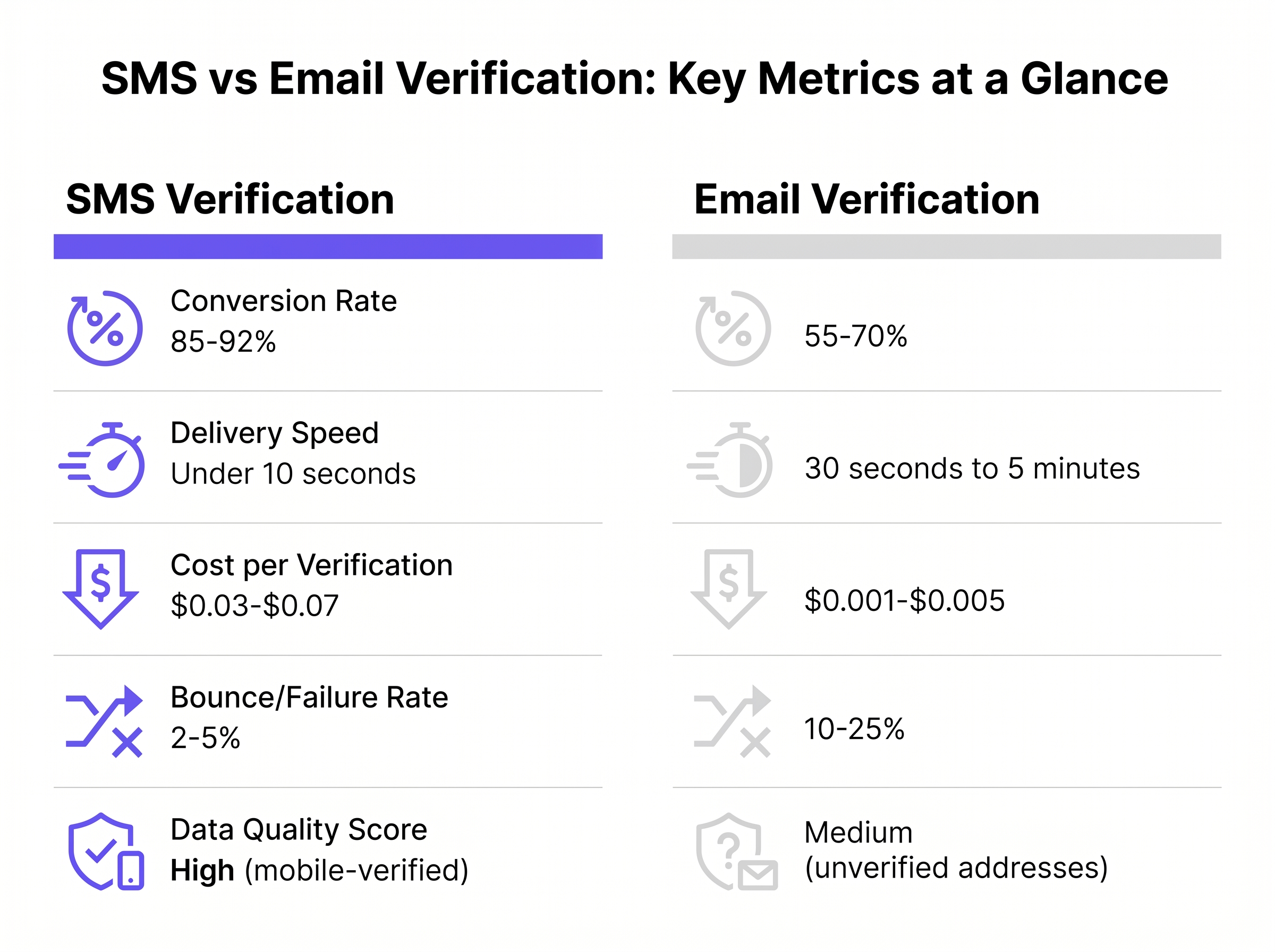
| Métrica | Verificação por SMS |
|---|---|
| Velocidade de Entrega | Menos de 10 segundos |
| Taxa de Conversão | 85–92% |
| Custo por Verificação | $0.03–$0.07 |
| Taxa de Rejeição / Falha | 2–5% |
| Qualidade dos Dados | Alta (verificado por celular) |
A principal restrição técnica da verificação por SMS em WiFi é a dependência da cobertura celular. Em ambientes com má recepção celular interna — espaços de Varejo subterrâneos, enfermarias hospitalares fortemente blindadas ou salas de conferência no subsolo — a entrega de SMS falhará, deixando o usuário preso no captive portal. Além disso, implantações internacionais exigem uma lógica robusta de validação de número de telefone no portal para garantir que os códigos de país corretos sejam aplicados antes que a chamada da API seja despachada, pois um número malformado resultará em uma falha silenciosa.
Arquitetura de Verificação por Email
A verificação por Email geralmente emprega um link mágico ou um OTP numérico entregue via SMTP para o endereço fornecido pelo usuário. O usuário deve sair da tela inicial do captive portal, abrir seu cliente de email, recuperar o código ou clicar no link e retornar ao portal para completar a autenticação. Este fluxo de trabalho multi-etapas e multi-aplicativos é a principal fonte de atrito.
| Métrica | Verificação por Email |
|---|---|
| Velocidade de Entrega | 30 segundos a 5 minutos |
| Taxa de Conversão | 55–70% |
| Custo por Verificação | $0.001–$0.005 |
| Taxa de Rejeição / Falha | 10–25% |
| Qualidade dos Dados | Média (endereços não verificados são comuns) |
Uma dependência arquitetônica crítica para a verificação por email é o Walled Garden (implementado via ACLs de pré-autenticação no controlador de rede). Esta configuração concede ao dispositivo cliente acesso limitado à internet — especificamente para alcançar provedores de email comuns como Gmail, Outlook e Apple Mail — antes que o acesso total à rede seja concedido. A má configuração dessas regras de Walled Garden é a causa mais comum de falha na verificação por email em implantações de produção.
Guia de Implementação: Recomendações de Implantação Específicas para o Local
A implantação do método de verificação ideal exige o alinhamento da tecnologia com as realidades operacionais específicas do local. A orientação a seguir é neutra em relação ao fornecedor e aplicável em todas as principais plataformas de controlador de rede.
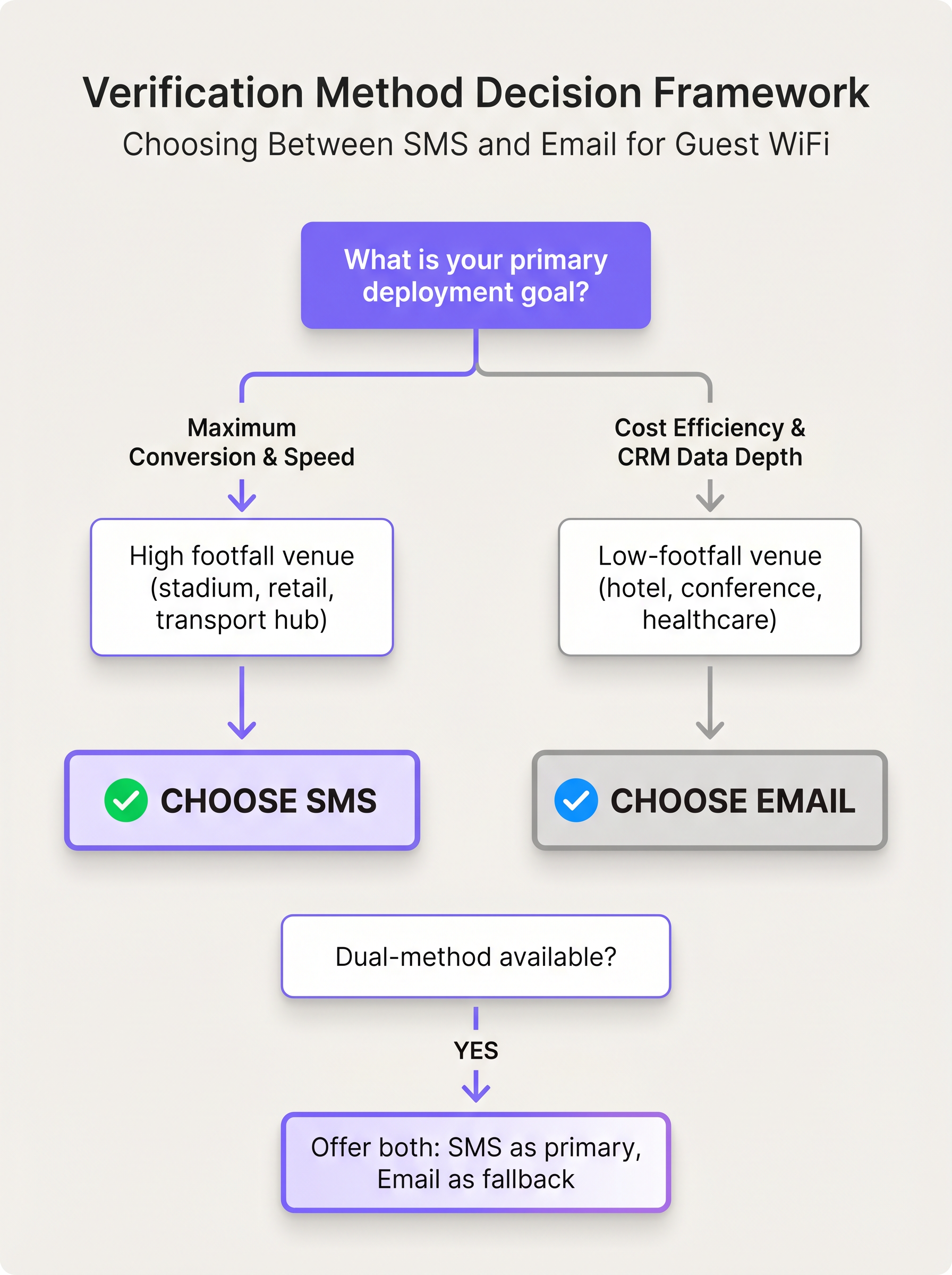
Locais de Alta Densidade e Transitórios (Estádios, Centros de Transporte, Áreas de Varejo)
Em ambientes como um saguão de estádio ou um terminal de aeroporto, o throughput é a métrica crítica. Os usuários exigem acesso imediato, e a duração média da conexão é curta. Cada segundo gasto no captive portal é um segundo de potencial abandono.
Recomendação: Implante a verificação por SMS como método principal, com o Email como fallback obrigatório.
O tempo de conclusão inferior a 10 segundos minimiza o tempo de permanência no captive portal, reduzindo a carga no servidor DHCP e na infraestrutura RADIUS. O custo mais alto por verificação é justificado pelo sucesso no onboarding de uma porcentagem significativamente maior de usuários — um input direto para WiFi Analytics e monitoramento de fluxo de multidões em tempo real. Para mais informações sobre o design de redes para esses ambientes, consulte o guia sobre Design de WiFi de Alta Densidade: Melhores Práticas para Estádios e Arenas .
Locais de Baixo Tráfego e Longa Permanência (Hotéis, Centros de Conferência, Campi Corporativos)
Em um ambiente de Hotelaria , o relacionamento com o hóspede é persistente — muitas vezes durando vários dias — e o cadastro no WiFi está frequentemente vinculado a um programa de fidelidade ou propriedadesistema de gerenciamento (PMS).
Recomendação: Implemente a verificação por Email, integrada diretamente com o PMS ou CRM via API.
A economia de custos em milhares de estadias prolongadas de hóspedes é substancial. Mais criticamente, um endereço de e-mail é o principal identificador único para a maioria dos programas de fidelidade de hotéis, tornando-o o ponto de dados comercialmente mais valioso a ser capturado no momento do onboarding. A velocidade de entrega mais lenta é aceitável neste contexto, pois os hóspedes geralmente estão acomodados em seus quartos ou em uma mesa, sem pressa em um saguão.
Implantação de Método Duplo (Melhor Prática para Todos os Locais)
A arquitetura ideal para qualquer local é oferecer ambos os métodos simultaneamente, apresentando SMS como a opção principal e Email como alternativa. Essa abordagem maximiza a acessibilidade em todas as demografias de usuários e mitiga os modos de falha de cada método individual.
Melhores Práticas e Conformidade
Independentemente do método escolhido, a adesão às regulamentações de privacidade de dados e aos padrões de segurança é inegociável.
Conformidade com GDPR e CCPA: A aceitação dos Termos e Condições da rede deve ser lógica e visualmente separada da opção de consentimento para comunicações de marketing. Forçar o consentimento de marketing como condição para o acesso ao WiFi viola os princípios do Artigo 7 do GDPR sobre consentimento livremente dado. Tanto o número de telefone quanto o endereço de e-mail coletados constituem dados pessoais sob o GDPR e devem ser tratados de acordo, incluindo bases legais documentadas para processamento e políticas claras de retenção de dados.
Manutenção do Walled Garden: Se utilizando a verificação por e-mail, as listas de IP e domínio do Walled Garden devem ser continuamente revisadas. Os principais provedores de e-mail atualizam regularmente sua infraestrutura de CDN, e uma configuração desatualizada do Walled Garden interromperá silenciosamente a entrega de e-mail para um subconjunto de usuários.
Abordando a Randomização de MAC: Sistemas operacionais móveis modernos empregam a randomização de endereço MAC para proteger a privacidade do usuário. Tanto a verificação por SMS quanto por Email mitigam diretamente o impacto disso no WiFi Analytics , vinculando a sessão a uma identidade verificada e persistente — um número de telefone ou endereço de e-mail — em vez de um endereço de hardware rotativo. Para operadores de locais que dependem da análise de fluxo de pessoas, este é um argumento operacional convincente para exigir verificação em vez de oferecer acesso aberto.
Regulamentações de Telecomunicações: A verificação por SMS está sujeita a regulamentações de nível de operadora em muitas jurisdições. Nos Estados Unidos, o TCPA rege as mensagens SMS comerciais, e no Reino Unido, o PECR do ICO se aplica. Garanta que o modelo de mensagem OTP seja claramente identificado como uma mensagem transacional (não de marketing) para permanecer em conformidade.
Solução de Problemas e Mitigação de Riscos
Modo de Falha 1 — Falha na Entrega de SMS A causa mais comum é a má cobertura de celular interna ou um código de discagem internacional formatado incorretamente. A mitigação requer a implementação de um fallback de método duplo: se o SMS não chegar em 30 segundos, o portal deve automaticamente exibir a opção de verificação por e-mail. A UI deve incluir um seletor de código de país proeminente e pré-preenchido para reduzir erros de formatação.
Modo de Falha 2 — Bloqueio do Walled Garden de E-mail Se as ACLs de pré-autenticação do Captive Portal não incluírem os intervalos de IP e domínios corretos para o provedor de e-mail do usuário, o e-mail de verificação não poderá ser recuperado. A mitigação requer auditoria e teste regulares das configurações do Walled Garden, usando entradas de domínio curinga onde o controlador de rede as suporta para contabilizar as alterações de CDN pelos provedores de e-mail.
Modo de Falha 3 — Conflito de Detecção do Captive Portal Quando um usuário em iOS ou Android muda do mini-navegador do Captive Portal para seu aplicativo de e-mail para recuperar um OTP, o sistema operacional pode interpretar a conexão WiFi como quebrada e derrubá-la. Isso é particularmente comum com o Captive Network Assistant da Apple. A mitigação é implementar uma abordagem de "link mágico" em vez de um OTP numérico para verificação por e-mail, pois o link pode ser aberto diretamente no navegador completo, ignorando completamente a sessão do mini-navegador.
ROI e Impacto nos Negócios
O caso financeiro para cada método deve ser avaliado no contexto dos objetivos comerciais do local e do valor de WiFi Analytics gerado a partir dos dados coletados.
Comparação Direta de Custos: Os custos de verificação por Email são insignificantes — tipicamente frações de um centavo por envio. A verificação por SMS acarreta um custo fixo por mensagem de $0,03–$0,07. Para um local que processa 100.000 autenticações por mês, o SMS poderia custar até $7.000 mensais, enquanto o e-mail custaria menos de $50. No entanto, a taxa de conversão de SMS de 85–92% versus a taxa de e-mail de 55–70% significa que o SMS integra aproximadamente 30% mais usuários do mesmo fluxo de pessoas — um aumento significativo para a coleta de dados de análise e marketing.
Criação de Valor a partir de Dados Verificados: O custo da verificação por SMS deve ser ponderado em relação ao valor subsequente dos dados. Números de celular verificados permitem campanhas de marketing por SMS direcionadas e baseadas em localização. Se uma campanha enviada para 10.000 números verificados gerar uma taxa de resgate de 3% em uma oferta de $10, o custo de verificação de $300–$700 é recuperado com uma margem significativa. O Análise de Mapa de Calor para Tráfego de Local: Um Guia Prático demonstra como dados de identidade verificados, combinados com WiFi Analytics , podem gerar insights acionáveis que informam diretamente as decisões de merchandising e pessoal.
Alinhamento Estratégico: Em última análise, a escolha deve se alinhar com a estratégia digital mais ampla. Se o objetivo é um onboarding rápido e Wayfinding em tempo real ou gerenciamento de multidões, o SMS é a escolha arquitetonicamente superior. Se o objetivo é o crescimento de longo prazo do banco de dados de CRM e marketing por e-mail, a verificação por Email é a decisão de implantação correta.
Definições principais
Captive Portal
A web page that a user of a public access network is obliged to view and interact with before broader network access is granted. Typically implemented via DNS redirection on the network controller.
The primary interface for Guest WiFi authentication and the point at which the SMS vs Email verification decision is implemented and experienced by the end user.
Walled Garden
A restricted network environment that controls the user's access to internet resources, allowing access to a specific, pre-approved set of IP addresses or domains prior to full network authentication.
Critical for Email verification deployments. Without a correctly configured Walled Garden permitting access to email provider infrastructure, users cannot retrieve the OTP sent to their inbox.
Out-of-Band Authentication
An authentication mechanism that uses a secondary, independent communication channel to verify a user's identity. The verification signal travels via a different network path than the primary access request.
SMS verification is an out-of-band method: the access request is made over WiFi, but the OTP is delivered via the cellular network. This independence provides a meaningful security benefit.
MAC Randomization
A privacy feature in modern mobile operating systems (iOS 14+, Android 10+) that uses a randomized, per-network MAC address when connecting to WiFi networks, rather than the device's permanent hardware MAC address.
Severely impacts device-based analytics and repeat visitor tracking. Requiring SMS or Email verification resolves this by tying the session to a persistent, verified identity.
One-Time Password (OTP)
A password that is valid for only one login session or transaction, generated algorithmically and typically time-limited to a short window (30–300 seconds).
The standard verification token used in both SMS and Email verification flows to confirm the user has access to the provided contact detail.
DHCP Pool Exhaustion
A network state in which the DHCP server has assigned all available IP addresses within its configured scope, preventing new client devices from obtaining an address and connecting to the network.
A significant operational risk in high-density venues. Slow verification methods (e.g., email) that cause clients to hold IP addresses in a pre-authenticated state for extended periods can contribute to pool exhaustion during peak periods.
Pre-Authentication ACL
Access Control Lists applied to a client device's network session before that device has successfully completed the captive portal authentication process.
The technical mechanism used on network controllers (e.g., Cisco, Aruba, Ruckus) to enforce Walled Garden policies, permitting limited access to specific resources before full authentication.
Synthetic Identity
A fabricated or disposable identity, typically constructed using temporary or randomly generated contact details, used to gain access to services without providing genuine personal information.
Email verification is susceptible to synthetic identities via temporary email services (e.g., Mailinator, Guerrilla Mail). SMS verification significantly mitigates this risk, as it requires a physical SIM card.
Exemplos práticos
A 50,000-seat stadium is upgrading its Guest WiFi network ahead of a major international tournament. The marketing team wants to collect verified contact data from every connected fan, but the network operations team is concerned about DHCP pool exhaustion during peak half-time periods if users dwell too long on the captive portal splash screen. Which verification method should they deploy, and how should they configure the fallback?
The stadium should deploy SMS verification as the primary authentication method, configured with a 30-second OTP expiry and an automatic fallback to Email verification if the SMS is not confirmed within that window. The captive portal should present a pre-populated country code selector defaulting to the host nation's dialing code, with an easy mechanism to change it. The Walled Garden must be configured to allow access to major email providers as a fallback. The DHCP lease time should be reviewed and reduced to the minimum viable duration for the expected session length to mitigate pool exhaustion risk.
A national retail chain with 500 locations wants to implement Guest WiFi to track dwell times and repeat visit rates across different stores, feeding data into their existing email marketing platform. They have a limited IT budget and a small central IT team responsible for maintaining all 500 deployments. Which verification method and integration architecture should they adopt?
The retail chain should implement Email verification as the primary method. The captive portal must be configured with a robust, centrally managed Walled Garden template that allows access to major email providers (Gmail, Outlook, Yahoo, Apple Mail) before authentication is complete. The portal should integrate via a webhook or REST API directly with their existing email marketing platform (e.g., Mailchimp, Klaviyo, Salesforce Marketing Cloud) to automatically sync verified addresses and trigger a welcome journey. A centralised network management platform should be used to push Walled Garden configuration updates to all 500 locations simultaneously, reducing the maintenance burden on the central IT team.
Questões práticas
Q1. A hospital IT director needs to implement Guest WiFi across five campuses for patients and visitors. The buildings have notoriously poor indoor cellular reception due to reinforced concrete construction and medical equipment shielding. The hospital's marketing team wants to grow their patient communications email list. Which verification strategy should they adopt, and what are the key configuration requirements?
Dica: Consider the physical limitations of the environment and the architectural dependencies of each verification method, as well as the stated business objective.
Ver resposta modelo
The hospital must prioritise Email verification. Because SMS relies on cellular networks to deliver the OTP, poor indoor reception will result in high failure rates and frustrated patients and visitors. Email verification utilises the WiFi network itself (via Walled Garden access) to deliver the OTP, bypassing the cellular reception issue entirely. Key configuration requirements include: (1) a correctly configured Walled Garden permitting access to major email providers, (2) GDPR-compliant separation of network ToS acceptance from marketing opt-in, and (3) API integration with the hospital's CRM to sync verified addresses. The marketing objective of growing the email list is also directly served by this approach.
Q2. You are configuring the Walled Garden for a new Email verification deployment at a conference centre. You have whitelisted the IP ranges for Gmail and Outlook, but users are reporting that after switching to their email app to retrieve the OTP, the captive portal page fails to load when they switch back. What is the most likely cause, and how do you resolve it?
Dica: Think about what happens to a mobile device's WiFi connection state when it switches between applications during the pre-authentication phase, and consider the role of the OS captive portal detection mechanism.
Ver resposta modelo
The most likely cause is the OS-level Captive Network Assistant (CNA) behaviour on iOS or Android. When the user switches away from the CNA mini-browser to their email app, the OS may interpret the WiFi connection as broken or the captive portal as unresponsive, and either drop the WiFi connection or close the CNA session. The resolution is to switch from a numeric OTP to a magic link approach for email verification. A magic link can be opened directly in the device's full browser (not the CNA mini-browser), bypassing the session state issue. Additionally, ensure the Walled Garden is configured to allow the captive portal's own domain to be accessible, so the link resolves correctly when clicked.
Q3. A marketing manager at a retail chain insists on using SMS verification because they heard it has a higher conversion rate. However, their primary campaign objective is to grow a database for a monthly email newsletter. How do you advise them, and what alternative architecture would you propose?
Dica: Align the verification method with the specific type of data required to fulfil the business objective, and consider whether the higher conversion rate of SMS actually serves the stated goal.
Ver resposta modelo
Advise against SMS as the sole method for this specific objective. While SMS has a higher conversion rate, it only directly captures a mobile number. If the business objective is to send a monthly email newsletter, an email address is the required data point. Using SMS as the only method would either require a secondary step to capture the email address (increasing friction and reducing the effective conversion rate), or leave the business without the data it needs. The recommended architecture is Email verification as the primary method, which directly captures the required data point in a single step. If the marketing manager is concerned about conversion rates, a dual-method approach (SMS primary, Email fallback) can be offered, but the Email capture must be a mandatory field in the SMS flow as well.
Continue a ler esta série
Como Configurar um Hotspot WiFi para o Seu Negócio
Este guia completo oferece a líderes de TI, arquitetos de rede e diretores de operações de locais um plano prático e neutro em relação a fornecedores para implantar hotspots de Guest WiFi seguros, compatíveis e que aprimoram os negócios. Ele aborda decisões arquitetônicas críticas — desde a segmentação de VLAN e configuração de Captive Portal até a conformidade com GDPR e modelagem de tráfego — e demonstra como transformar a infraestrutura de rede de um centro de custo em uma plataforma de análise geradora de receita usando os recursos de Guest WiFi e análise da Purple.
Purple vs. Cisco Spaces (DNA Spaces): Quando Escolher Cada Um
Este guia de referência técnica oferece uma comparação abrangente entre Purple e Cisco Spaces (anteriormente DNA Spaces) para implantações de portal cativo empresarial e WiFi para convidados. Ele avalia diferenças arquitetônicas, profundidade de automação de marketing e a questão crítica do aprisionamento de fornecedor de hardware para ajudar líderes de TI a tomar decisões de infraestrutura informadas.
Purple vs. GlobalReach Technology: WiFi de Nível Carrier Comparados
Este guia oferece uma comparação técnica aprofundada de Purple e GlobalReach Technology, abrangendo os recursos de Captive Portal, a prontidão para WBA OpenRoaming, a arquitetura de offload de operadora e os modelos comerciais. É destinado a gerentes de TI, arquitetos de rede e CTOs em hotéis, redes de varejo, estádios e municípios que precisam tomar uma decisão de plataforma neste trimestre. A principal conclusão é que, enquanto a GlobalReach se destaca no offload profundo de operadoras MNO e na autoria de padrões, a Purple inova no mercado com uma camada de inteligência agnóstica de hardware e um nível de Provedor de Identidade OpenRoaming genuinamente gratuito, tornando o WiFi de nível carrier acessível a qualquer local sem custos iniciais de licenciamento de software.