
WiFi na Saúde: Conformidade com HIPAA, DSPT e WiFi Explicada
Este guia fornece uma referência técnica definitiva para gestores de TI, arquitetos de rede e responsáveis pela conformidade que implementam redes sem fios em ambientes de saúde. Mapeia os requisitos específicos do HIPAA (EUA) e do NHS Data Security and Protection Toolkit (DSPT, Reino Unido) para decisões concretas de arquitetura de rede - abrangendo segmentação, acesso baseado na identidade, padrões de encriptação e gestão de dispositivos IoMT. A plataforma de WiFi para convidados e analítica da Purple é posicionada ao longo do documento como uma solução de nível empresarial em conformidade para gerir a conectividade de doentes e visitantes num ecossistema sem fios governado.
Video overview
Ouça este guia
Ver transcrição do podcast
Parte da nossa série principal: Guia de Segurança WiFi Empresarial →
Resumo Executivo
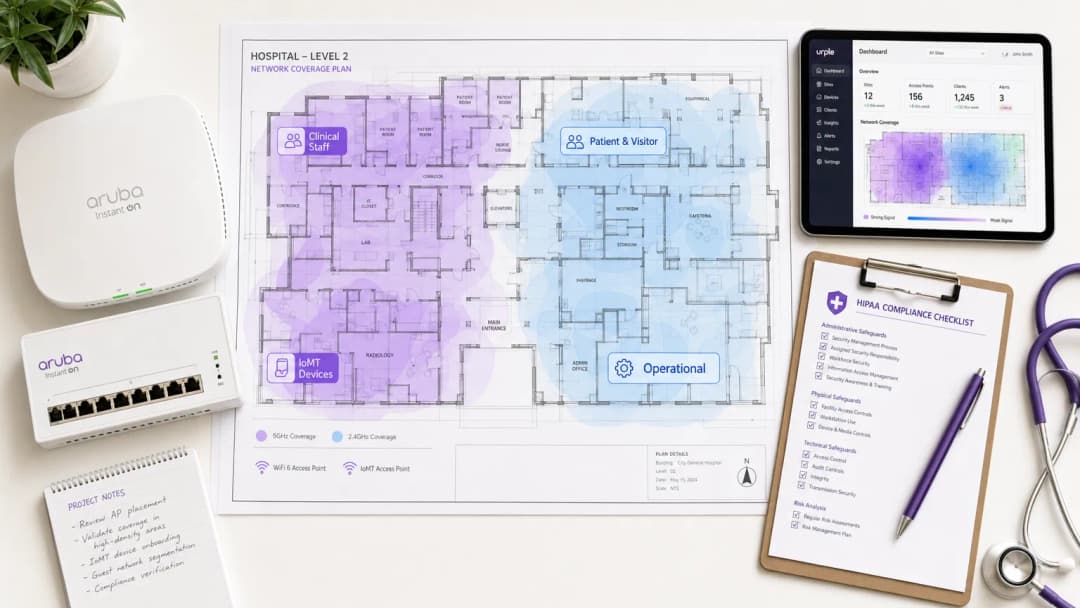
A conformidade do WiFi na área da saúde não é apenas uma definição de configuração - é uma disciplina arquitetónica. Quer a sua organização opere sob o HIPAA nos Estados Unidos ou o NHS Data Security and Protection Toolkit (DSPT) no Reino Unido, a expectativa regulamentar é a mesma: cada dispositivo, cada utilizador e cada fluxo de dados na sua rede sem fios deve ser contabilizado, controlado e auditado.
Nos EUA, o custo médio de uma violação de dados na área da saúde ultrapassa agora os 10,9 milhões de dólares por incidente, tornando-o o setor mais dispendioso para violações pelo décimo terceiro ano consecutivo. No Reino Unido, as fundações do NHS que não concluam a sua submissão anual do DSPT correm o risco de perder o acesso aos sistemas nacionais e enfrentam programas de melhoria obrigatórios. A rede sem fios é frequentemente o elo mais fraco em ambos os ambientes - não porque a tecnologia seja inadequada, mas porque as decisões de implementação são tomadas sem ter em conta a estrutura de conformidade.
Este guia aborda a arquitetura técnica, o mapeamento regulamentar e as fases de implementação necessárias para implementar uma rede sem fios de nível de cuidados de saúde que cumpra ambas as estruturas. Também aborda o desafio específico do guest WiFi para doentes e visitantes - um serviço que deve ser simultaneamente acessível, em conformidade e totalmente isolado dos sistemas clínicos.

Análise Técnica Detalhada
O Cenário Regulamentar
A Regra de Segurança do HIPAA (45 CFR Parte 164) estabelece três categorias de salvaguardas para informações de saúde eletrónicas protegidas (ePHI): administrativas, físicas e técnicas. Para redes sem fios, as salvaguardas técnicas sob a secção §164.312 aplicam-se de forma mais direta. Estas exigem controlos de acesso (§164.312(a)(1)), controlos de auditoria (§164.312(b)), controlos de integridade (§164.312(c)(1)) e segurança de transmissão (§164.312(e)(1)). Crucialmente, a Regra de Segurança é neutra em termos tecnológicos - não prescreve protocolos específicos, mas as organizações devem implementar mecanismos que cumpram as normas.
O NHS DSPT está estruturado em torno de dez Normas de Segurança de Dados da National Data Guardian (NDG). Para redes sem fios, as mais relevantes são a Norma 1 (os dados confidenciais pessoais são acessíveis apenas ao pessoal que deles necessita), a Norma 6 (todos os dados pessoais são processados de forma lícita e adequada) e a Norma 9 (os sistemas sem suporte são identificados e geridos). O DSPT também incorpora os requisitos do Cyber Essentials Plus, que exigem controlos técnicos específicos, incluindo firewalls de limite de rede, configuração segura, controlo de acesso, proteção contra malware e gestão de patches - todos com implicações diretas na rede WiFi.A principal diferença entre os dois enquadramentos é o mecanismo de fiscalização. O HIPAA é fiscalizado pelo HHS Office for Civil Rights (OCR) através de sanções financeiras que variam entre 100 $ e 50 000 $ por categoria de violação por ano. A conformidade com o DSPT é fiscalizada pelo NHS England, com as organizações não conformes a arriscarem a perda de acesso aos sistemas nacionais do NHS e planos de melhoria obrigatórios. Ambos os enquadramentos exigem uma revisão anual e a submissão de provas.
Arquitetura de Rede: Quatro Zonas de Confiança
O princípio fundamental da conformidade do WiFi na área da saúde é a segmentação da rede em zonas de confiança distintas. Uma rede plana - mesmo uma com múltiplos SSIDs - não cumpre os requisitos de controlo de acesso de nenhum dos enquadramentos se a aplicação de políticas subjacente for fraca.
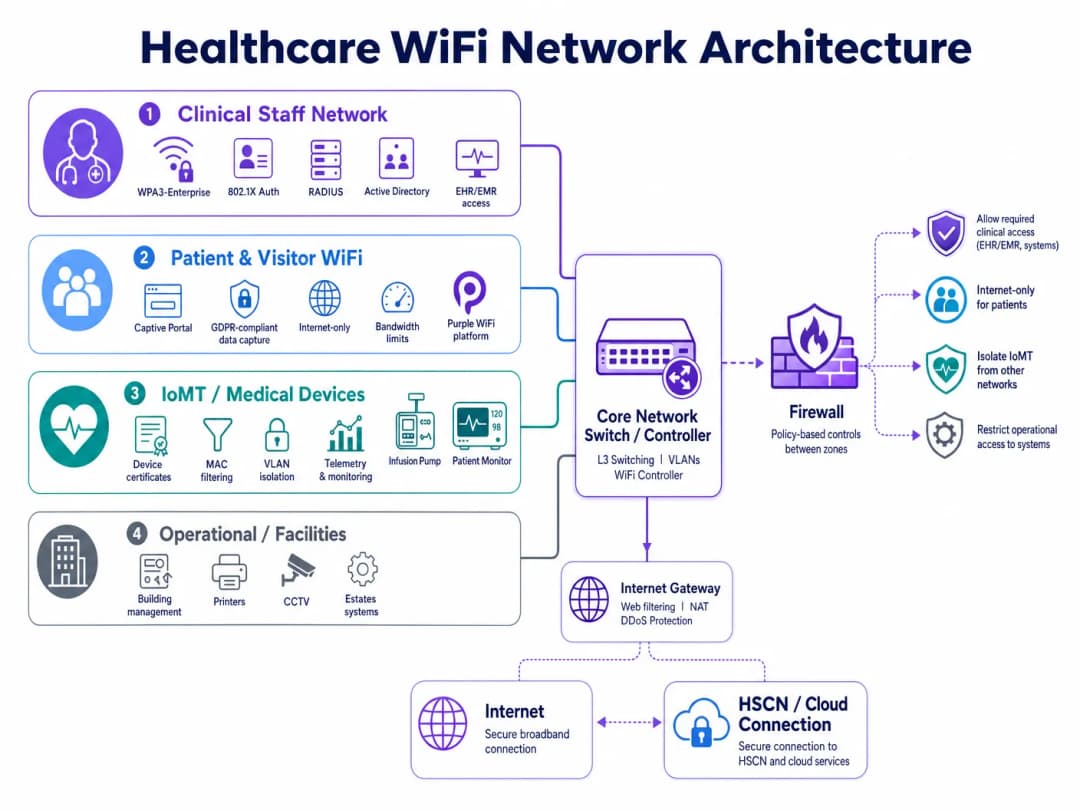
Uma infraestrutura sem fios hospitalar em conformidade exige quatro domínios de política distintos:
| Zona | Tipo de Utilizador/Dispositivo | Método de Autenticação | Âmbito de Acesso | Impulsionador de Conformidade |
|---|---|---|---|---|
| Pessoal Clínico | Médicos, enfermeiros, admin | WPA3-Enterprise, 802.1X, RADIUS | EHR/EMR, aplicações clínicas, serviços internos | HIPAA §164.312(a), DSPT Standard 1 |
| Doentes e Visitantes | Doentes, famílias, visitantes | Captive Portal (em conformidade com o GDPR) | Apenas Internet, sem encaminhamento interno | HIPAA §164.312(e), GDPR Artigo 5 |
| IoMT / Dispositivos Médicos | Bombas de infusão, monitores, telemetria | Certificados de dispositivo, filtragem de MAC | Microsegmentado por tipo de dispositivo | HIPAA Mínimo Necessário, DSPT Standard 9 |
| Operacional / Instalações | Impressoras, CCTV, BMS, património | VLAN dedicada, credenciais geridas | Apenas sistemas operacionais | DSPT Standard 6, HIPAA §164.312(a) |
A segmentação tem de ser aplicada na camada de rede - e não apenas na etiqueta do SSID. Cada zona exige a sua própria VLAN, políticas de firewall dedicadas e Listas de Controlo de Acesso (ACLs) interzonas que negam por predefinição. A zona do pessoal clínico não deve ter qualquer caminho de encaminhamento para la zona de convidados, e a zona IoMT deve ter caminhos de comunicação restritos apenas aos servidores e portas específicos necessários para cada tipo de dispositivo.
Acesso Baseado na Identidade: Ir Mais Além das PSKs Partilhadas
As Pre-Shared Keys (PSKs) partilhadas continuam a ser a falha de conformidade mais comum nas implementações sem fios na área da saúde. São operacionalmente convenientes, mas introduzem três problemas críticos: não podem ser atribuídas a um utilizador ou dispositivo específico, raramente são rodadas num calendário que acompanhe a rotação de pessoal e não oferecem qualquer mecanismo de revogação imediata quando um funcionário sai ou um dispositivo é desativado.
O IEEE 802.1X com EAP-TLS (Extensible Authentication Protocol - Transport Layer Security) é o atual padrão de excelência para o acesso sem fios baseado em identidade no setor da saúde. Sob este modelo, cada utilizador ou dispositivo gerido apresenta um certificado emitido pela PKI (Public Key Infrastructure) da organização. O servidor RADIUS valida o certificado em relação ao Active Directory ou a um diretório LDAP, atribui a VLAN e a política adequadas e regista o evento de autenticação com um carimbo de data/hora, identificador do dispositivo e identidade do utilizador. Quando uma conta de funcionário é desativada no Active Directory, o seu acesso sem fios é revogado no próximo ciclo de nova autenticação - normalmente em poucos minutos.
O WPA3-Enterprise, introduzido na especificação IEEE 802.11ax (WiFi 6), reforça ainda mais esta segurança ao exigir uma suite de segurança de 192 bits para ambientes sensíveis e ao fornecer segredo de transmissão através do handshake de Autenticação Simultânea de Iguais (SAE). Para novas implementações, o WPA3-Enterprise deve ser o padrão de referência para todas as zonas clínicas e operacionais.
Segurança de Transmissão e Padrões de Encriptação
A norma HIPAA §164.312(e)(2)(ii) exige que as organizações implementem mecanismos para encriptar ePHI em trânsito quando considerado apropriado. Na prática, qualquer transmissão sem fios de ePHI deve ser encriptada. O padrão mínimo aceitável para a encriptação na camada de aplicação é o TLS 1.2, sendo o TLS 1.3 fortemente recomendado para novas implementações. Na camada sem fios, o WPA3 fornece encriptação CCMP-256 (Counter Mode Cipher Block Chaining Message Authentication Code Protocol), substituindo os padrões legados TKIP e AES-CCMP-128.
Para as organizações do NHS, os dados em trânsito para os serviços HSCN (Health and Social Care Network) devem estar em conformidade com os requisitos de segurança HSCN, que exigem pelo menos o TLS 1.2 e restringem a utilização de SSL 3.0, TLS 1.0 e TLS 1.1. Qualquer ponto de acesso sem fios ou controlador que termine tráfego destinado à HSCN deve ser configurado para impor estas restrições de conjuntos de cifras.
Gestão de Dispositivos IoMT: O Problema Mais Difícil
A Internet das Coisas Médicas (IoMT) apresenta o desafio de conformidade tecnicamente mais complexo nas implementações sem fios de saúde. Os dispositivos médicos legados - bombas de infusão, monitores de doentes, sistemas de telemetria, equipamentos de imagiologia - executam frequentemente sistemas operativos integrados que não suportam a autenticação 802.1X ou versões modernas de TLS. Não podem ser atualizados no mesmo calendário que os terminais geridos, e os seus fabricantes proíbem frequentemente modificações que possam afetar a certificação do dispositivo.
A abordagem em conformidade consiste na micro-segmentação combinada com controlos estritos de caminhos de comunicação. Cada tipo de dispositivo ou família de dispositivos é atribuído a uma sub-VLAN dedicada. As ACL de firewall permitem apenas os pares de IP de origem/destino, protocolos e portas específicos de que o dispositivo necessita para a sua função clínica. Todo o restante tráfego é bloqueado e registado. As soluções de Network Access Control (NAC) podem aplicar o perfil do dispositivo - garantindo que um dispositivo que afirma ser uma bomba de infusão se comporta realmente como tal antes de a sua política atribuída ser aprovada.
O DSPT Standard 9 aborda especificamente os sistemas não suportados: as organizações devem manter um inventário de todos os sistemas que não podem ser atualizados para as normas de segurança atuais e implementar controlos de compensação. Para dispositivos IoMT, o controlo de compensação é o isolamento de rede combinado com uma monitorização reforçada.
WiFi para Pacientes e Visitantes: Conformidade Sem Fricção
O guest WiFi para pacientes e visitantes é uma necessidade clínica, não uma comodidade opcional. A investigação mostra de forma consistente que o acesso à conectividade reduz a ansiedade dos pacientes, melhora a comunicação familiar durante internamentos longos e contribui para as pontuações globais de satisfação dos pacientes. O desafio de conformidade é fornecer este serviço sem criar um vetor de risco para a rede clínica.
Uma implementação de WiFi para pacientes em conformidade requer três elementos. Primeiro, isolamento total da rede: o SSID de convidados deve encaminhar o tráfego diretamente para a internet através de um gateway dedicado, sem qualquer caminho para os sistemas clínicos internos, plataformas de EHR ou redes administrativas. Segundo, tratamento de dados em conformidade com o GDPR: quaisquer dados recolhidos no Captive Portal - endereços de e-mail, identificadores de dispositivos, aceitação de termos - devem ser tratados em conformidade com o UK GDPR (para organizações do NHS) ou com a norma Minimum Necessary do HIPAA (para cuidados de saúde nos EUA). Terceiro, gestão de largura de banda: as políticas de Quality of Service (QoS) devem garantir que o tráfego de visitantes não sature o meio sem fios e degrade o desempenho das aplicações clínicas.
A plataforma de guest WiFi do Purple foi concebida especificamente para este caso de utilização. Disponibiliza um Captive Portal configurável com fluxos de consentimento em conformidade com o GDPR, recolha de dados primários para comunicações com pacientes e WiFi analytics que dão às equipas de operações visibilidade sobre os tempos de permanência dos visitantes, períodos de pico de utilização e carga dos pontos de acesso - tudo sem criar qualquer caminho de dados para a rede clínica. Para os NHS Trusts, as práticas de tratamento de dados do Purple estão documentadas para apoiar a apresentação de provas do DSPT.
Para obter um guia de implementação detalhado que abranja os requisitos específicos do NHS, consulte NHS Staff WiFi: How to Deploy Secure Wireless Networks in Healthcare.
Tem dúvidas sobre a sua configuração específica?
A nossa equipa trabalha com operadores de espaços, gestores de TI e engenheiros de rede em 80.000 espaços. Agende uma chamada de 20 minutos e mostraremos como outros profissionais na sua área o resolveram.
Guia de Implementação
Fase 1: Descoberta e Avaliação de Risco (Semanas 1-3)
Comece com um levantamento abrangente do local sem fios (wireless site survey) e um inventário de dispositivos. Mapeie cada SSID atualmente ativo, cada tipo de dispositivo que se liga à rede e cada fluxo de dados que atravessa a camada sem fios. Preste especial atenção aos dispositivos médicos legados - catalogue as versões do seu sistema operativo, capacidades de autenticação e o estado de suporte do fabricante. Este inventário constitui a base do seu pacote de evidências DSPT e da sua documentação de Análise de Risco HIPAA.
Realize uma análise de lacunas (gap analysis) em relação ao seu modelo de conformidade regulamentar. Para o HIPAA, mapeie os controlos atuais em relação à lista de verificação de salvaguardas técnicas. Para o DSPT, conclua uma pré-avaliação em relação às normas NDG 10. Identifique todos os casos em que PSKs partilhadas estão em uso, onde a segmentação de rede está ausente ou incompleta e onde o registo de auditoria (audit logging) não captura detalhes suficientes.
Fase 2: Desenho da Arquitetura (Semanas 4-6)
Desenhe o modelo de segmentação de quatro zonas descrito acima. Defina atribuições de VLAN, regras de política de firewall e ACLs entre zonas. Especifique a infraestrutura RADIUS - local (Microsoft NPS, FreeRADIUS) ou alojada na nuvem (RADIUS-as-a-Service). Desenhe a estrutura PKI para autenticação baseada em certificados, incluindo a gestão do ciclo de vida dos certificados e os processos de revogação.
Para a zona de WiFi de convidados, selecione e configure uma plataforma de Captive Portal. Defina os campos de recolha de dados, a linguagem de consentimento e as políticas de retenção de dados. Certifique-se de que o aviso de privacidade do portal cumpre os requisitos do Artigo 13 do GDPR (para implementações no Reino Unido/UE) ou os requisitos do Aviso de Práticas de Privacidade do HIPAA (para implementações nos EUA).
Fase 3: Implementação e Migração (Semanas 7-12)
Implemente as zonas sequencialmente: primeiro as zonas operacionais e IoMT (menor risco para as operações clínicas), seguidas pela zona de funcionários e depois convidados. Para cada zona, valide a segmentação tentando tráfego entre zonas a partir de dispositivos de teste - confirme que as ACLs do firewall bloqueiam o tráfego inesperado. Valide a autenticação testando a revogação de certificados - desative uma conta de teste no Active Directory e confirme que o acesso sem fios é negado dentro da janela de reautenticação esperada.
Migre os dispositivos dos funcionários para a autenticação 802.1X através de uma transição faseada. Implemente certificados de dispositivos em terminais geridos através da sua plataforma MDM (Mobile Device Management). Para dispositivos BYOD, implemente um SSID de integração separado que oriente os utilizadores através da instalação de certificados antes de conceder acesso à zona de funcionários.
Fase 4: Registo de Auditoria e Monitorização (Contínuo)
Configure o seu servidor RADIUS e os controladores sem fios para encaminhar os registos de autenticação (logs) para a sua plataforma SIEM (Security Information and Event Management). Certifique-se de que os registos capturam: carimbo de data/hora, identidade do utilizador, endereço MAC do dispositivo, SSID, atribuição de VLAN, duração da sessão e bytes transferidos. Para conformidade com o HIPAA, retenha os registos por pelo menos seis anos. Para o DSPT, garanta que os registos são revistos regularmente e que o processo de revisão é documentado.
Implemente alertas automatizados para comportamentos anómalos: dispositivos que se ligam fora do horário de expediente, volumes de dados invulgares, tentativas de autenticação falhadas que excedem os limites e dispositivos que aparecem em VLANs inesperadas.
Melhores Práticas
Adote o WPA3-Enterprise como a norma de referência para todas as novas implementações de pontos de acesso. O WPA3 fornece uma encriptação significativamente mais forte e segurança de encaminhamento (forward secrecy) em comparação com o WPA2, sendo obrigatório para dispositivos certificados para WiFi 6 e WiFi 6E. As implementações legadas de WPA2 devem ser programadas para migração dentro de um prazo definido.
Nunca utilize PSKs partilhados em redes clínicas ou operacionais. Se os dispositivos legados não puderem suportar o 802.1X, implemente a autenticação baseada em MAC como um controlo de compensação, combinada com uma micro-segmentação rigorosa de firewall. Documente o controlo de compensação no seu registo de riscos.
Implemente o RADIUS-as-a-Service para pequenos Trusts do NHS e clínicas de clínica geral que não dispõem de infraestrutura para executar servidores RADIUS locais. O RADIUS alojado na nuvem elimina os riscos de ponto único de falha e simplifica a gestão do ciclo de vida dos certificados.
Realize testes de intrusão sem fios trimestrais direcionados para as fronteiras de segmentação. Teste especificamente o VLAN hopping, a deteção de pontos de acesso não autorizados e as vulnerabilidades de desvio de Captive Portal. Documente os resultados e as etapas de mitigação no seu pacote de provas DSPT ou na Análise de Risco HIPAA.
Mantenha um inventário de dispositivos em tempo real integrado na sua plataforma NAC. Cada dispositivo no parque sem fios deve ter um proprietário conhecido, uma política definida e uma data de revisão documentada. Os dispositivos desconhecidos devem acionar um alerta automatizado e ser colocados em quarentena até à investigação.
Para princípios de segurança de WiFi empresarial mais amplos, aplicáveis a vários setores, as orientações no WiFi in Auto: The Complete 2026 Enterprise Guide abrangem vários padrões de arquitetura diretamente aplicáveis a ambientes de saúde.
Resolução de Problemas e Mitigação de Riscos
Modo de Falha Comum 1: Fuga de VLAN
A falha de segmentação mais frequente é a configuração incorreta da VLAN na camada de acesso. Uma porta trunk incorretamente configurada para passar todas as VLANs, ou uma regra de firewall com um destino demasiado permissivo, pode permitir silenciosamente o tráfego entre zonas. Mitigação: Valide a segmentação com testes de intrusão ativos após cada alteração de configuração. Utilize ferramentas de varrimento de rede automatizadas para detetar caminhos inter-VLAN inesperados.
Modo de Falha Comum 2: Interrupção Clínica Devido à Expiração de Certificados
Quando os certificados dos dispositivos expiram sem renovação automatizada, os dispositivos clínicos perdem o acesso sem fios - potencialmente a meio de um turno. Mitigação: Implemente a renovação automatizada de certificados através da sua plataforma MDM com uma janela de renovação mínima de 30 dias. Configure alertas para certificados que expirem nos 60 dias seguintes. Mantenha um PSK de recurso para acesso de emergência de dispositivos clínicos, associado a um registo de acessos rigoroso.
Modo de Falha Comum 3: Desvio de Captive Portal em iOS/Android
Os sistemas operativos móveis modernos utilizam o Captive Network Assist (CNA) - um navegador leve que intercepta redirecionamentos do Captive Portal. Alterações no comportamento do CNA em iOS ou Android podem quebrar o fluxo do portal. Mitigação: Teste o fluxo do Captive Portal nas versões atuais de iOS e Android após cada ciclo de atualização do SO. Utilize uma plataforma como a Purple que mantém ativamente a compatibilidade do portal entre versões de SO.
Modo de Falha Comum 4: Falha do Dispositivo IoMT Após Alterações na Rede
Os dispositivos médicos legados são altamente sensíveis a alterações na rede. A renumeração de VLAN, atualizações de políticas de firewall ou alterações no escopo do DHCP podem quebrar a conectividade do dispositivo. Mitigação: Mantenha janelas de congelamento de alterações para VLANs de IoMT durante o horário clínico. Teste todas as alterações num ambiente de laboratório com tipos de dispositivos representativos antes da implementação em produção. Envolva as equipas de engenharia clínica dos fabricantes dos dispositivos antes de qualquer alteração na rede que afete as VLANs de IoMT.
Modo de Falha Comum 5: Retenção Inadequada de Registos de Auditoria
A HIPAA exige seis anos de retenção de registos. Muitos controladores sem fios predefinem a retenção de registos para 30 ou 90 dias. Mitigação: Configure toda a infraestrutura sem fios para encaminhar registos para um SIEM centralizado com políticas de retenção adequadas. Valide as configurações de retenção anualmente como parte da sua Análise de Risco HIPAA ou autoavaliação DSPT.
Retorno do Investimento (ROI) e Impacto no Negócio
O caso de negócio para um WiFi de saúde em conformidade é simples quando medido em relação ao custo do incumprimento. O custo total médio de uma única violação da HIPAA numa organização de saúde é de 10,9 milhões de dólares - incluindo multas regulamentares, honorários jurídicos, remediação e danos à reputação. Uma falha no DSPT que resulte na perda de acesso aos sistemas nacionais do NHS pode interromper as operações clínicas por dias ou semanas, com implicações diretas na segurança do paciente.
Além da mitigação de riscos, uma infraestrutura sem fios bem desenhada proporciona retornos operacionais mensuráveis. O pessoal clínico passa menos tempo com soluções temporárias de conectividade - um inquérito digital do NHS de 2023 revelou que 67% do pessoal clínico apontou a fraca conectividade como uma barreira à produtividade. A integração automatizada de dispositivos via MDM reduz os pedidos ao suporte de TI relativos a problemas de acesso sem fios. E um serviço de WiFi para convidados em conformidade e bem gerido - disponibilizado através de uma plataforma como o WiFi Analytics da Purple - gera dados primários de pacientes que podem apoiar comunicações, inquéritos de satisfação e planeamento operacional.
Para as Fundações do NHS, uma submissão DSPT bem-sucedida também abre o acesso ao quadro de Serviços de Negócios Partilhados do NHS e a rotas de contratação pública nacional, reduzindo o custo de futuras aquisições tecnológicas. O investimento numa arquitetura sem fios em conformidade traz dividendos a toda a infraestrutura digital.
-
Para apoio na implementação e implementação de WiFi para convidados em conformidade no seu ambiente de saúde, explore as soluções de WiFi para Saúde da Purple ou reveja o guia detalhado de implementação de WiFi para funcionários do NHS.
Definições Principais
ePHI (Electronic Protected Health Information)
Qualquer informação de saúde individualmente identificável que seja criada, recebida, mantida ou transmitida em formato eletrónico. Ao abrigo da HIPAA, isto inclui nomes de doentes, datas de serviço, números de registo clínico e quaisquer outros dados que possam ser utilizados para identificar um doente em relação ao seu estado de saúde ou cuidados recebidos.
As equipas de TI deparam-se com isto ao desenhar políticas de segmentação de rede e de tratamento de dados. Qualquer sistema ou caminho de rede que possa transmitir ePHI - incluindo redes wireless utilizadas por pessoal clínico - está sujeito aos requisitos das Salvaguardas Técnicas da HIPAA.
DSPT (Data Security and Protection Toolkit)
Uma estrutura anual de autoavaliação exigida pelo NHS England para todas as organizações que acedem a dados de doentes do NHS ou se ligam a sistemas do NHS. Baseada nos dez Padrões de Segurança de Dados do National Data Guardian (NDG), exige que as organizações demonstrem que os dados pessoais são tratados de forma segura e que existem controlos técnicos e organizacionais adequados.
Os NHS Trusts, consultórios de clínica geral e fornecedores terceiros com acesso aos sistemas do NHS devem submeter anualmente o DSPT. Para redes wireless, as normas mais relevantes são a Norma 1 (controlo de acessos), a Norma 6 (tratamento lícito de dados) e a Norma 9 (gestão de sistemas não suportados).
802.1X
Uma norma IEEE para controlo de acesso à rede baseado em portas. Fornece uma estrutura de autenticação que exige que os dispositivos apresentem credenciais válidas (normalmente um certificado ou utilizador/palavra-passe) a um servidor RADIUS antes de lhes ser concedido acesso à rede. Em implementações wireless, o 802.1X é utilizado com EAP (Extensible Authentication Protocol) para autenticar utilizadores e dispositivos individuais.
A alternativa à partilha de PSKs em ambientes empresariais e de saúde. Quando a conta de um colaborador é desativada no Active Directory, o seu acesso wireless autenticado por 802.1X é automaticamente revogado - fornecendo a responsabilidade de controlo de acessos exigida tanto pela HIPAA como pelo DSPT.
WPA3-Enterprise
A atual certificação de segurança da Wi-Fi Alliance para redes wireless empresariais, introduzida com o Wi-Fi 6 (802.11ax). Impõe o modo de segurança de 192 bits utilizando encriptação GCMP-256 e HMAC-SHA-384 para autenticação, proporcionando uma proteção significativamente mais forte do que o WPA2-Enterprise. Também oferece confidencialidade perfeita de encaminhamento (forward secrecy), o que significa que o comprometimento de uma chave de longo prazo não expõe o tráfego de sessões passadas.
O padrão de encriptação de base para novas implementações de redes wireless na área da saúde. Necessário para equipamentos certificados com Wi-Fi 6 e Wi-Fi 6E. As implementações WPA2 legadas devem ser agendadas para migração como parte do programa de atualização tecnológica da organização.
RADIUS (Remote Authentication Dial-In User Service)
Um protocolo de rede que fornece autenticação, autorização e contabilização (AAA) centralizadas para acesso à rede. Em implementações sem fios, o servidor RADIUS valida as credenciais 802.1X, atribui a VLAN e a política com base na identidade do utilizador ou do dispositivo, e regista todos os eventos de autenticação com uma marca temporal e um identificador de dispositivo.
O componente de infraestrutura central para o acesso wireless baseado em identidade. Pode ser implementado no local (Microsoft NPS, FreeRADIUS) ou como um serviço na nuvem (RADIUS-as-a-Service). O registo de autenticação RADIUS é uma fonte primária de evidência para os controlos de auditoria da HIPAA e para os requisitos de responsabilidade de acesso do DSPT.
IoMT (Internet of Medical Things)
O ecossistema de dispositivos médicos ligados que comunicam através de redes IP, incluindo bombas de infusão, monitores de doentes, sistemas de telemetria, equipamentos de imagiologia e sensores vestíveis. Os dispositivos IoMT executam normalmente sistemas operativos incorporados com capacidades de segurança limitadas e ciclos de substituição longos, criando desafios específicos para a conformidade da rede de cuidados de saúde.
O desafio de conformidade tecnicamente mais complexo em implementações de WiFi para cuidados de saúde. Os dispositivos IoMT frequentemente não conseguem suportar a autenticação 802.1X ou versões modernas de TLS, exigindo controlos de compensação, tais como autenticação baseada em MAC, microsegmentação e monitorização avançada. A Norma 9 do DSPT exige especificamente que os sistemas não suportados (o que inclui muitos dispositivos IoMT) sejam inventariados e geridos com controlos de compensação documentados.
Segmentação de Rede / VLAN
A prática de dividir uma rede física em múltiplas redes lógicas (Virtual Local Area Networks, ou VLANs) que são isoladas umas das outras na camada de rede. O tráfego entre VLANs é controlado por políticas de firewall e listas de controlo de acesso. Nos cuidados de saúde, a segmentação é utilizada para isolar o tráfego clínico, de convidados, de IoMT e operacional em domínios de política distintos.
O controlo técnico fundamental para a conformidade do WiFi em ambientes de cuidados de saúde. Tanto a HIPAA como o DSPT exigem que o acesso a dados sensíveis seja restrito a utilizadores e sistemas autorizados. A segmentação de rede impõe isto na camada de infraestrutura, garantindo que um dispositivo de convidado no WiFi de visitantes não consegue encaminhar tráfego para os sistemas clínicos, mesmo que os controlos da camada de aplicação falhem.
Captive Portal
Uma página web que intereceta o pedido HTTP/HTTPS inicial de um utilizador quando este se liga a uma rede WiFi, exigindo que conclua uma ação (aceitar os termos de serviço, introduzir credenciais ou fornecer dados de contacto) antes de lhe conceder acesso total à rede. Nos cuidados de saúde, os Captive Portals são utilizados para gerir a integração de doentes e visitantes no WiFi, recolher consentimento em conformidade com o GDPR e aplicar políticas de utilização aceitável.
O principal componente voltado para o utilizador de uma implementação de WiFi para convidados em conformidade. Um Captive Portal por si só não torna uma rede de convidados conforme - a rede subjacente deve ainda ser devidamente segmentada e isolada. No entanto, um portal bem configurado (como a plataforma da Purple) lida com a gestão de consentimento do GDPR, minimização de dados e registo de auditoria para a camada de acesso de convidados.
HSCN (Health and Social Care Network)
O serviço de rede gerido do NHS que fornece conectividade entre organizações de saúde e de assistência social e os sistemas nacionais do NHS. A HSCN substituiu a N3 em 2019 e fornece uma rede IP segura e gerida para aceder a serviços nacionais, incluindo o NHS Spine, o NHSmail e sistemas de informação clínica. As organizações que se ligam à HSCN devem cumprir requisitos de segurança específicos.
Relevante para organizações do NHS cuja infraestrutura sem fios fornece acesso a sistemas ligados à HSCN. Os pontos de acesso ou controladores sem fios que terminam tráfego destinado a serviços HSCN devem ser configurados para aplicar os requisitos de segurança da HSCN, incluindo o mínimo de TLS 1.2 e conjuntos de cifras aprovados.
Exemplos Práticos
Um NHS Trust de 450 camas está a preparar a sua submissão anual do DSPT e identificou que o pessoal clínico está atualmente a utilizar uma WPA2 PSK partilhada no SSID da equipa. O diretor de TI necessita de migrar para um acesso baseado na identidade sem interromper as operações clínicas. O parque informático inclui 280 portáteis Windows geridos, 120 dispositivos iOS inscritos no Jamf e cerca de 60 dispositivos médicos legados (bombas de infusão e monitores de cabeceira) que não suportam 802.1X.
Faseie a migração em quatro fluxos de trabalho executados em paralelo. Primeiro, implemente um serviço RADIUS alojado na nuvem (ou configure o Microsoft NPS nos controladores de domínio existentes) e integre-o com o Active Directory. Segundo, utilize o Jamf para enviar perfis EAP-TLS e certificados de dispositivo para todos os 120 dispositivos iOS - isto pode ser concluído silenciosamente sem intervenção do utilizador. Terceiro, implemente certificados nos 280 portáteis Windows através de Política de Grupo, configurando o perfil sem fios para utilizar EAP-TLS com o novo servidor RADIUS. Execute o SSID PSK legado e o novo SSID 802.1X em simultâneo durante a janela de migração, utilizando um SSID de ativação dedicado para dispositivos que necessitem de instalação manual de certificados. Quarto, coloque os 60 dispositivos médicos legados numa VLAN IoMT dedicada utilizando autenticação baseada em MAC como controlo de compensação, com ACLs de firewall a restringir cada tipo de dispositivo apenas aos seus caminhos de comunicação necessários. Documente a autenticação baseada em MAC como controlo de compensação no registo de riscos DSPT, com uma data de revisão associada ao programa de substituição de dispositivos. Assim que todos os dispositivos geridos estiverem migrados, desative o SSID PSK partilhado e documente a migração no pacote de evidências do DSPT.
Um sistema de saúde dos EUA que opera três hospitais comunitários necessita de implementar um WiFi em conformidade para doentes e visitantes em todas as instalações. Cada local tem entre 150 e 300 camas, com volumes elevados de visitantes em áreas de espera, clínicas de ambulatório e refeitórios. O CIO pretende utilizar o WiFi para convidados para recolher dados de contacto de doentes para inquéritos de satisfação pós-visita, mas a equipa jurídica sinalizou preocupações de HIPAA sobre a recolha de dados numa rede de saúde.
Implemente um SSID de WiFi de convidados dedicado numa VLAN separada em cada local, com o tráfego encaminhado diretamente para a internet através de um gateway dedicado - sem rota de encaminhamento para sistemas clínicos internos, plataformas de EHR ou redes administrativas. Implemente uma plataforma de Captive Portal (como a Purple) que gira o fluxo de integração de utilizadores. O portal deve apresentar um aviso de privacidade claro que explique quais os dados recolhidos, como serão utilizados e como os utilizadores podem optar por não participar - isto cumpre o requisito do Aviso de Práticas de Privacidade da HIPAA para qualquer recolha de dados. Crucialmente, os dados recolhidos no portal (endereço de email, identificador do dispositivo, carimbo de data/hora da ligação) não constituem ePHI porque não estão associados a qualquer informação de saúde - são simplesmente dados de contacto recolhidos de um visitante. Configure o portal para recolher apenas os dados mínimos necessários para o caso de utilização do inquérito de satisfação: endereço de email e nome opcional. Certifique-se de que os dados são armazenados no ambiente de nuvem da plataforma de WiFi de convidados, e não em qualquer sistema ligado à rede clínica. Implemente políticas de QoS de largura de banda para limitar o tráfego de convidados a 10 Mbps por dispositivo e 100 Mbps agregados por local, evitando que a utilização dos visitantes afete o desempenho das aplicações clínicas. Documente a arquitetura de isolamento de rede e as práticas de tratamento de dados na análise de risco da HIPAA.
Um grupo de hospitais privados no Reino Unido está a implementar Wi-Fi 6E numa instalação recém-construída. O arquiteto de rede precisa de desenhar a infraestrutura sem fios para suportar a conformidade com a DSPT e a preparação para inspeções da CQC (Care Quality Commission), ao mesmo tempo que proporciona uma experiência de WiFi premium para pacientes que apoie o modelo de pagamento privado do hospital.
Desenhe uma arquitetura de quatro zonas conforme descrito na secção de Aprofundamento Técnico, tirando partido da banda de 6 GHz do Wi-Fi 6E para as zonas clínicas e de IoMT (menos interferência, maior débito) e das bandas de 5 GHz e 2.4 GHz para a cobertura de pacientes/visitantes. Implemente WPA3-Enterprise nas zonas clínicas com autenticação EAP-TLS integrada com o Active Directory do hospital. Para a zona de WiFi de pacientes, implemente um Captive Portal premium com integração personalizada da marca, autenticação baseada no número do quarto (permitindo ao hospital associar sessões de WiFi aos registos dos pacientes para fins de faturação e comunicações, com consentimento explícito em conformidade com o GDPR) e pacotes de largura de banda em níveis. Implemente a plataforma de WiFi de convidados da Purple para gerir o Captive Portal, a gestão de consentimento em conformidade com o GDPR e a análise de dados. O painel de análise de dados fornece à equipa de operações visibilidade em tempo real sobre a carga dos pontos de acesso, taxas de conectividade dos pacientes e períodos de pico de utilização - dados que suportam tanto o planeamento operacional como a evidência para a CQC sobre a experiência do paciente. Certifique-se de que os dados de WiFi dos pacientes são tratados ao abrigo de um acordo de processamento de dados em conformidade com o GDPR com o fornecedor da plataforma. Documente a arquitetura de rede, controlos de segmentação e práticas de tratamento de dados no pacote de evidências de autoavaliação da DSPT.
Perguntas de Prática
Q1. A equipa de segurança de TI do seu NHS Trust acabou de concluir um levantamento local da rede sem fios e descobriu que o departamento de radiologia está a utilizar uma WPA2 PSK partilhada para todos os dispositivos sem fios no departamento, incluindo as estações de trabalho Windows geridas e três estações de trabalho legadas de imagem DICOM que executam Windows 7 (sem suporte). A submissão do DSPT deve ser feita em seis semanas. Qual é o seu plano de ação imediato e como documenta isto para o DSPT?
Dica: Considere que a Norma 9 do DSPT aborda especificamente sistemas não suportados. Tem dois problemas distintos aqui: a PSK partilhada (controlo de acesso) e o SO não suportado (gestão de sistemas). Estes exigem abordagens de remediação diferentes e entradas de evidência de DSPT diferentes.
Ver resposta modelo
Ações imediatas: (1) Migrar as estações de trabalho Windows geridas para autenticação 802.1X utilizando os certificados de domínio existentes - isto pode ser concluído dentro do prazo de seis semanas através de Group Policy. (2) Colocar as três estações de trabalho Windows 7 DICOM numa VLAN de IoMT dedicada com autenticação baseada em MAC e ACLs de firewall rigorosas que permitam apenas tráfego DICOM para o servidor PACS. (3) Documentar os sistemas Windows 7 no registo de riscos do DSPT sob a Norma 9 como "sistemas não suportados com controlos compensatórios", especificando o isolamento de rede como o controlo compensatório e incluindo uma data de substituição planeada. (4) Desativar o SSID de PSK partilhada assim que todos os dispositivos geridos estiverem migrados. Para o pacote de evidências do DSPT: fornecer o diagrama de arquitetura de rede que mostra a nova segmentação, os registos de autenticação RADIUS que mostram a autenticação de utilizadores nomeados para dispositivos geridos, a entrada no registo de riscos para os sistemas Windows 7 e a configuração de ACL da firewall para a VLAN de IoMT. A principal perspetiva do DSPT é que a Norma 9 não exige a substituição imediata de sistemas não suportados - exige que estes sejam identificados, avaliados quanto ao risco e geridos com controlos compensatórios documentados.
Q2. O CISO de um sistema de saúde dos EUA recebeu um pedido da equipa de marketing para utilizar os dados do WiFi de pacientes do hospital para enviar emails promocionais sobre novos serviços aos pacientes que se ligaram durante a sua visita. A equipa de marketing argumenta que os pacientes forneceram o seu endereço de email ao ligarem-se ao WiFi de convidados, pelo que o consentimento já foi dado. Isto está em conformidade com a HIPAA? Que controlos precisam de estar implementados?
Dica: Considere a distinção entre os dados recolhidos no portal WiFi (dados de contacto) e o contexto em que foram recolhidos (uma instalação de cuidados de saúde). Considere também se o endereço de email, combinado com o facto de a pessoa estar num hospital, constitui ePHI.
Ver resposta modelo
Esta é uma questão HIPAA complexa. Um endereço de email recolhido num portal de WiFi de convidados não é, por si só, ePHI. No entanto, combinar esse endereço de email com o facto de o indivíduo estar presente numa instalação de cuidados de saúde numa data específica pode constituir ePHI - porque revela que a pessoa recebeu ou procurou serviços de saúde. Este é o problema da "visita à instalação" na HIPAA: o mero facto de estar num hospital é informação de saúde. Para que o caso de utilização de marketing esteja em conformidade: (1) A linguagem de consentimento do Captive Portal deve indicar explicitamente que o endereço de email será utilizado para comunicações de marketing sobre serviços hospitalares - a aceitação genérica dos "termos de serviço" não é suficiente. (2) O consentimento deve ser separado da concessão de acesso ao WiFi - os pacientes devem poder aceder ao WiFi sem consentir com emails de marketing (opt-in, não opt-out). (3) O tratamento de dados deve ser documentado no Aviso de Privacidade HIPAA. (4) Se os emails de marketing fizerem referência à visita do paciente ou aos serviços de saúde, poderá ser necessária uma autorização HIPAA (e não apenas um consentimento). A arquitetura mais segura é tratar qualquer endereço de email recolhido num portal de WiFi de uma instalação de saúde como potencialmente ePHI e manuseá-lo em conformidade - com um BAA com o fornecedor da plataforma WiFi e consentimento explícito de opt-in para utilização em marketing.
Q3. É o arquiteto de rede de um novo hospital privado de 200 camas a ser construído no Reino Unido. O diretor clínico deseja implementar uma "ala inteligente" com 45 dispositivos IoMT por ala (bombas de infusão, monitores de sinais vitais, sistemas de chamada de enfermeiros e camas inteligentes), todos sem fios. A equipa de instalações também pretende ligar os sistemas de gestão de edifícios (BMS), CCTV e controlo de acessos à mesma infraestrutura sem fios para reduzir os custos de cablagem. Como projeta a infraestrutura WiFi para cumprir os requisitos do DSPT e, ao mesmo tempo, acomodar todos estes casos de utilização?
Dica: Pense cuidadosamente sobre o número de domínios de política distintos de que necessita. As camas inteligentes e os sistemas de chamada de enfermeiros têm perfis de segurança diferentes das bombas de infusão. O BMS e o CCTV têm perfis de risco diferentes dos dispositivos clínicos. Considere se a partilha de infraestrutura física (pontos de acesso) mantendo a separação lógica (VLANs) é suficiente, ou se alguns tipos de dispositivos exigem separação física.
Ver resposta modelo
Projete uma arquitetura de seis zonas para este ambiente: (1) Pessoal Clínico - WPA3-Enterprise, 802.1X, integração com Active Directory. (2) Pacientes e Visitantes - captive portal, apenas internet, em conformidade com o GDPR. (3) IoMT Crítico (bombas de infusão, monitores de sinais vitais) - VLAN dedicada, certificados de dispositivo onde suportado, ACLs estritas, monitorização melhorada, sem infraestrutura partilhada com zonas não clínicas. (4) IoMT Não Crítico (camas inteligentes, chamada de enfermeiros) - VLAN separada do IoMT crítico, ACLs menos restritivas mas ainda assim isoladas do pessoal clínico e das zonas de convidados. (5) Sistemas de Gestão de Edifícios (BMS) - VLAN dedicada, fisicamente separada das zonas clínicas sempre que possível, sem encaminhamento para as redes clínicas. (6) CCTV / Controlo de Acessos - VLAN dedicada, considere se esta deve estar numa rede fisicamente separada dada a sensibilidade de segurança dos dados de controlo de acessos. A principal consideração do DSPT é que os dados de CCTV e controlo de acessos são dados pessoais ao abrigo do UK GDPR, e os dados do BMS podem ser dados operacionais sensíveis - estes não devem ser acessíveis a partir da zona de WiFi de pacientes ou de sistemas clínicos que processem dados de pacientes. Para a zona de IoMT crítica, considere se a densidade de 45 dispositivos por ala justifica pontos de acesso dedicados para essa zona em vez de APs partilhados com separação por VLAN - isto proporciona um isolamento físico mais forte e elimina o risco de erros de configuração criarem caminhos entre zonas. Documente a arquitetura de zonas, a fundamentação de cada decisão de design e os controlos compensatórios para quaisquer dispositivos que não consigam suportar autenticação moderna no pacote de evidências do DSPT.
Continue a ler esta série
Conformidade com a CIPA: lista de verificação de conformidade para operadores de locais públicos
Poderá decidir se a CIPA se aplica ao seu WiFi, depois segmentar redes, encaminhar o DNS através do Purple Shield e fechar caminhos de desvio. Saberá também quais as provas a conservar para a certificação do Form 486 ou Form 479. A lista de verificação atribui um proprietário a cada requisito, para que não falte nada na certificação do seu próximo ano de financiamento.
Falhas de ligação em modo de transição WPA3: uma checklist de implementação para Cisco Meraki, HPE Aruba e Ruckus
Utilize esta checklist para diagnosticar por que razão os dispositivos falham num SSID em modo de transição WPA3 SAE e resolva o problema em Cisco Meraki, HPE Aruba ou Ruckus. Irá associar códigos de estado 802.11 a causas, isolar problemas de PMF, 802.11r e 6GHz, e decidir quando mudar para um SSID exclusivo WPA3.
Melhor filtragem DNS: um guia abrangente para empresas
Este guia de referência técnica explica como a filtragem DNS empresarial protege as redes públicas ao bloquear domínios maliciosos na camada de resolução - antes de uma ligação ser estabelecida. Oferece aos diretores de TI, arquitetos de rede e equipas de operações de locais a arquitetura de implementação, configuração de firewall e o contexto de conformidade necessários para proteger o WiFi de convidados em ambientes de hotelaria, retalho e setor público. O Purple Shield bloqueia malware, botnets e conteúdo inadequado ao nível do DNS em mais de 80.000 locais ativos.
Tem dúvidas sobre a sua configuração específica?
A nossa equipa trabalha com operadores de espaços, gestores de TI e engenheiros de rede em 80.000 espaços. Agende uma chamada de 20 minutos e mostraremos como outros profissionais na sua área o resolveram.