

Porque a Sua Empresa Deve Oferecer WiFi Gratuito aos Clientes
Este guia de referência técnica abrangente descreve a lógica comercial e arquitetónica para oferecer WiFi de convidado em espaços físicos. Fornece a líderes de TI e operadores de espaços informações acionáveis sobre estratégias de implementação, segmentação de rede, conformidade e medição de ROI.
🎧 Ouça este Guia
Ver Transcrição
Resumo Executivo
Para espaços físicos modernos — seja no Retalho , Hotelaria ou Saúde — o WiFi de convidado transitou de uma comodidade passiva para um ativo comercial crítico. Este guia explora a arquitetura técnica, considerações de segurança e o impacto comercial da implementação de uma solução robusta de WiFi de convidado. Ao alavancar plataformas como Guest WiFi e integrá-las com uma plataforma de WiFi Analytics , os líderes de TI podem transformar o tráfego anónimo de pessoas em dados acionáveis de primeira parte, ao mesmo tempo que melhoram a experiência do cliente. O caso comercial é claro: um WiFi de convidado bem arquitetado aumenta o tempo de permanência, impulsiona o aumento de gastos e fornece a inteligência comportamental necessária para otimizar as operações do espaço.
Análise Técnica Detalhada
Arquitetura e Segmentação de Rede
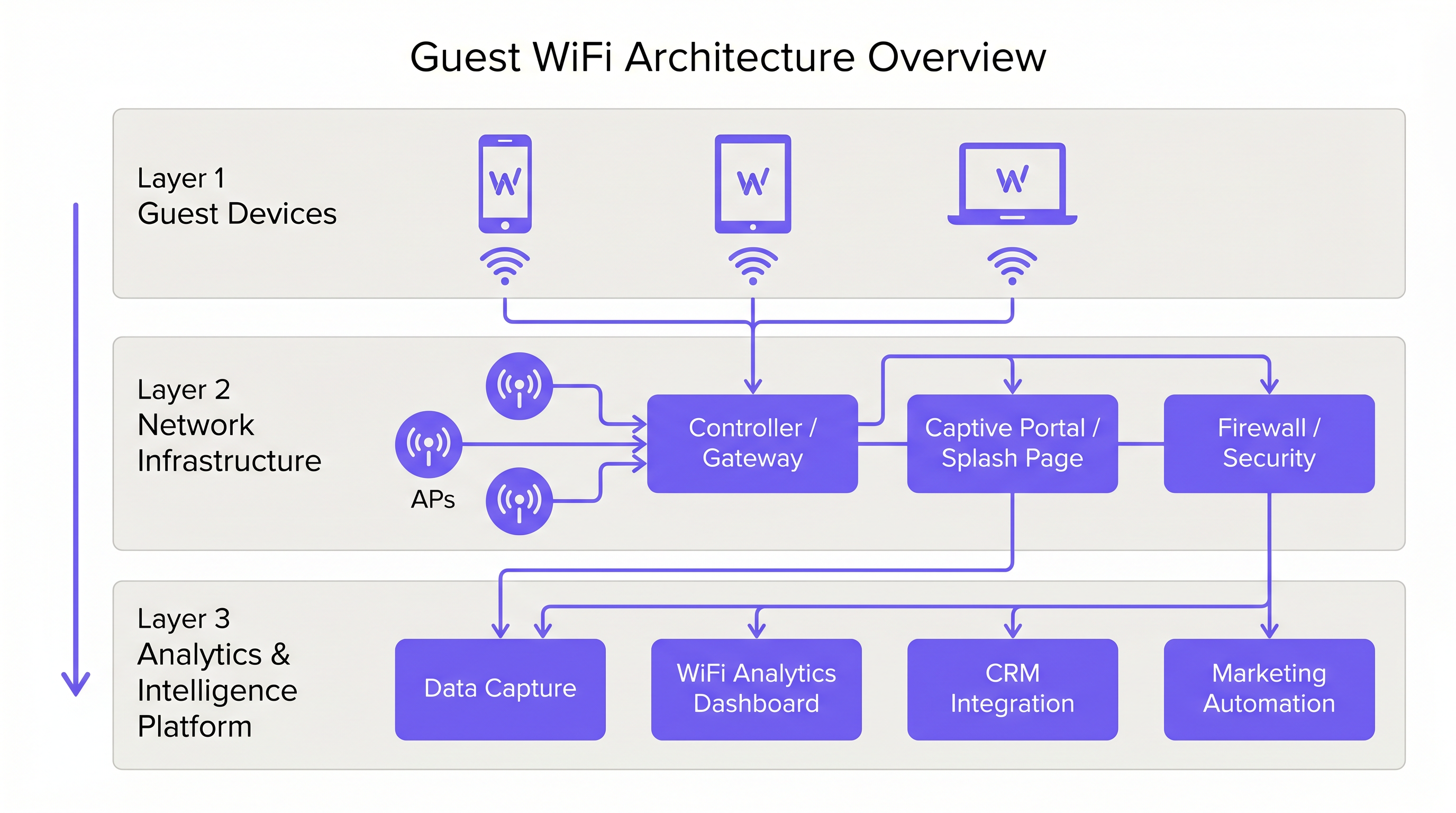
Uma implementação profissional de WiFi de convidado requer uma estrita separação lógica da infraestrutura corporativa. Isso é alcançado através da segmentação de VLAN e de um Service Set Identifier (SSID) dedicado. O tráfego de convidados deve ser encaminhado diretamente para a internet através de um Captive Portal, garantindo que nunca se intersete com sistemas internos, como terminais de Ponto de Venda (POS) ou servidores de back-office. Esta arquitetura é fundamental tanto para a segurança quanto para a conformidade com PCI DSS.
Implementação e Padrões de Access Point
A camada de rádio forma a base da rede de convidados. A colocação do Access Point (AP) deve ser ditada por um levantamento de local abrangente, considerando a área de cobertura, o número esperado de dispositivos concorrentes e a atenuação estrutural. Para ambientes de alta densidade, como estádios ou grandes centros de Transporte , o IEEE 802.11ax (Wi-Fi 6) é o padrão mínimo recomendado, fornecendo a capacidade e eficiência necessárias. Ambientes com densidade extrema de dispositivos devem considerar o Wi-Fi 6E para utilizar a banda de 6 GHz.
Segurança e Criptografia
A segurança deve ser aplicada em todas as camadas. WPA3 é o padrão atual para criptografia sem fios e deve ser implementado em todas as novas implementações. Crucialmente, o isolamento de cliente deve ser ativado no SSID de convidado para evitar que os dispositivos comuniquem entre si, mitigando o risco de movimento lateral por parte de atores maliciosos. Ao nível do gateway, a filtragem de DNS é recomendada para bloquear o acesso a domínios maliciosos conhecidos e conteúdo inadequado.
O Captive Portal como Gateway de Inteligência
O Captive Portal, ou página de splash, serve um duplo propósito: é o gateway para o acesso à rede e o principal mecanismo para a recolha de dados de primeira parte. Quando os utilizadores se autenticam via e-mail, login social ou SMS, a plataforma captura dados de identidade verificados. Estes dados, quando processados através de uma plataforma de WiFi Analytics , fornecem informações sobre a demografia dos visitantes, tempos de permanência e frequências de retorno.
Guia de Implementação
Passo 1: Recolha de Requisitos e Levantamento de Local
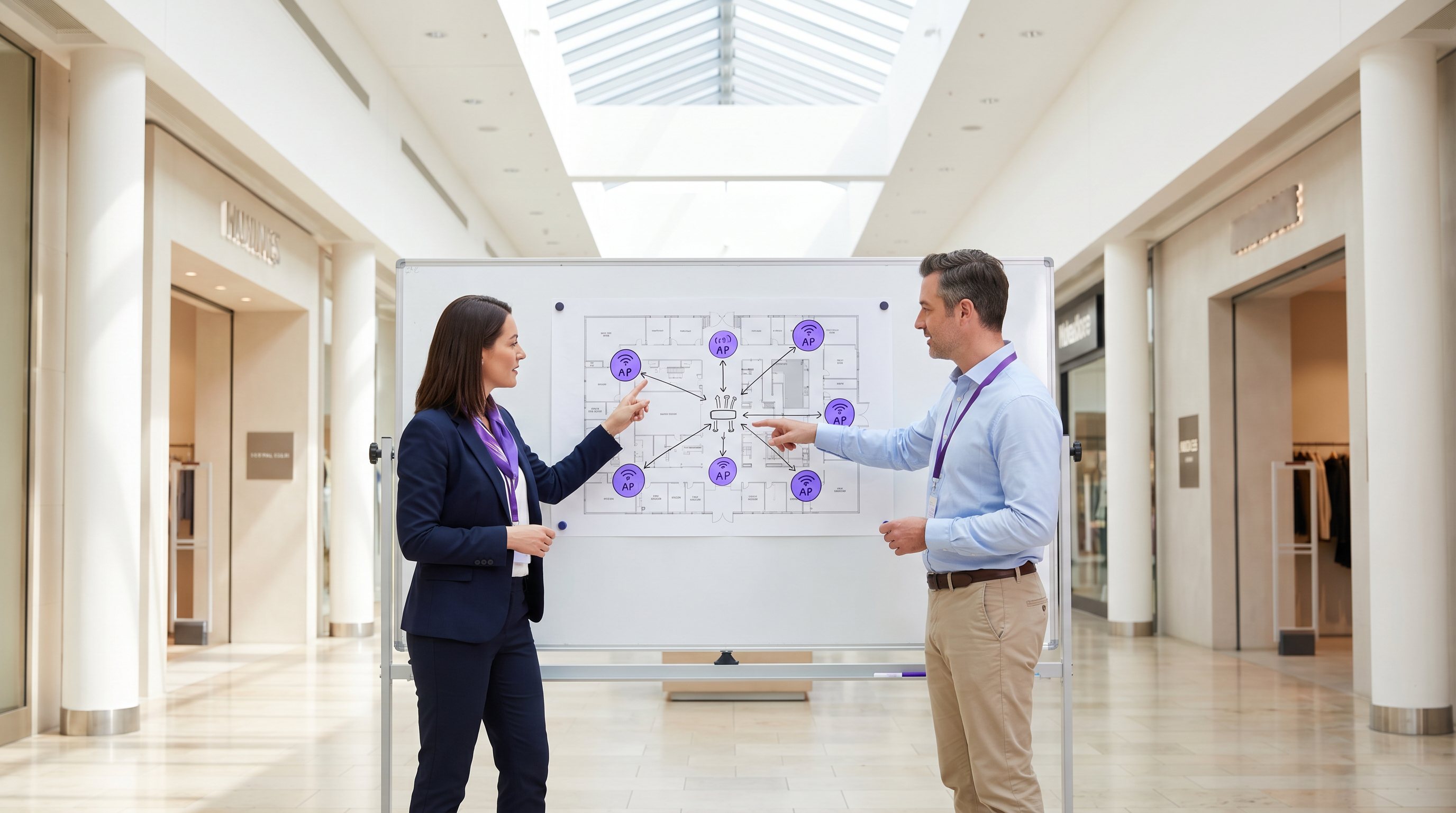
Comece por definir os objetivos comerciais e os requisitos técnicos. Realize um levantamento de local preditivo e físico para determinar a colocação ideal do AP. Um hotel de 200 quartos requer uma estratégia de implementação diferente de um estádio com 40.000 lugares.
Passo 2: Design e Segmentação de Rede
Configure a infraestrutura de rede para garantir um isolamento rigoroso. Implemente VLANs para separar o tráfego de convidados do tráfego corporativo e operacional (por exemplo, dispositivos IoT, câmaras de segurança). Aplique políticas de Qualidade de Serviço (QoS) para priorizar o tráfego operacional crítico sobre o acesso à internet dos convidados.
Passo 3: Configuração e Conformidade do Captive Portal
Desenhe o Captive Portal para refletir a identidade da marca do espaço. Crucialmente, garanta a conformidade com as regulamentações regionais de proteção de dados, como o GDPR no Reino Unido e na UE. A página de splash deve incluir um aviso de privacidade claro e um mecanismo de consentimento explícito para a recolha de dados. Para orientação sobre a criação de um portal eficaz, consulte recursos como Comment créer une page de connexion WiFi invité ou So erstellen Sie eine Guest WiFi Login Page .
Passo 4: Integração de Análises
Integre a plataforma de WiFi de convidado com o stack mais amplo de marketing e CRM da organização. Defina os fluxos de trabalho de dados para garantir que a inteligência capturada seja acionável para automação de marketing e iniciativas de envolvimento do cliente.
Melhores Práticas
- Imponha o Isolamento de Cliente: Ative sempre o isolamento de cliente no SSID de convidado para proteger os utilizadores uns dos outros.
- Implemente a Gestão de Largura de Banda: Aplique limites de largura de banda por dispositivo para evitar que utilizadores individuais monopolizem a ligação e degradem a experiência para os outros.
- Priorize o QoS: Garanta que o tráfego operacional, como processamento de pagamentos e VoIP, tenha precedência sobre o acesso à internet dos convidados.
- Mantenha a Conformidade: Revise regularmente as políticas de retenção de dados e os mecanismos de consentimento para garantir a conformidade contínua com o GDPR e outras regulamentações relevantes.
- Aproveite o SD-WAN: Para implementações multi-local, considere os benefícios do SD-WAN para gestão centralizada e encaminhamento otimizado. Consulte Os Principais Benefícios do SD-WAN para Empresas Modernas (ou Die zentralen SD-WAN-Vorteile für moderne Unternehmen ) para mais detalhes.
Resolução de Problemas e Mitigação de Riscos
Modos de Falha Comuns
- Cobertura Inadequadae: Zonas mortas causadas por má colocação de APs ou falha em considerar interferências estruturais. Mitigação: Realize inquéritos de site pós-implementação completos e ajuste a colocação dos APs ou a potência de transmissão conforme necessário.
- Esgotamento de Endereços IP: O pool de DHCP está esgotado devido a um alto volume de dispositivos transitórios. Mitigação: Implemente tempos de concessão de DHCP mais curtos (por exemplo, 30-60 minutos) para a rede de convidados e garanta que a sub-rede tenha o tamanho apropriado.
- Bypasses do Captive Portal: Dispositivos a contornar a página inicial devido a walled gardens mal configurados ou spoofing de MAC address. Mitigação: Audite regularmente as configurações de walled garden e implemente mecanismos de autenticação robustos.
ROI e Impacto nos Negócios
O retorno do investimento para o WiFi de convidados é alcançado através de um maior envolvimento do cliente e da aquisição de dados acionáveis.
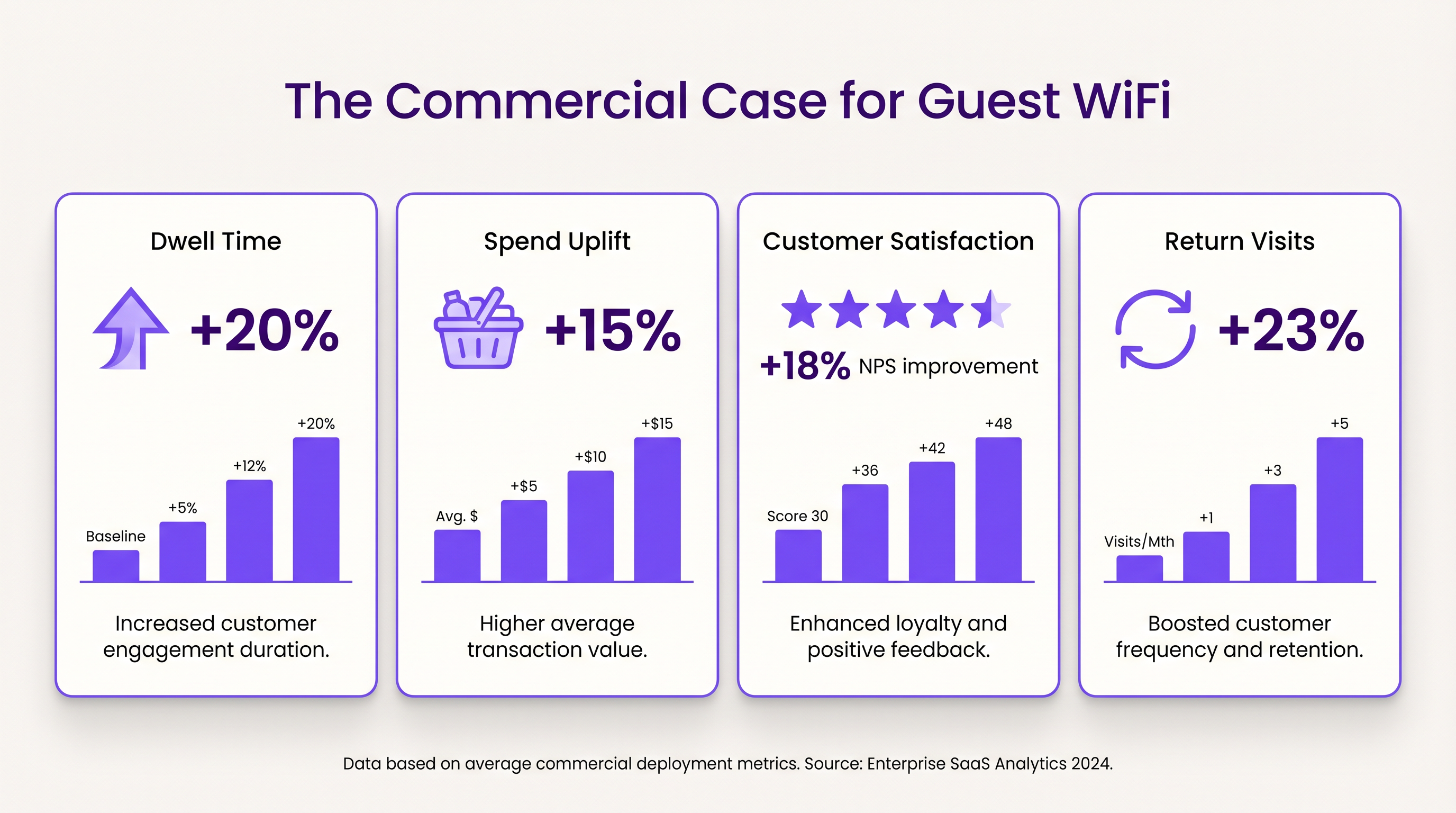
- Tempo de Permanência e Aumento de Gastos: Fornecer conectividade fiável incentiva os clientes a permanecerem mais tempo no local. Em ambientes de retalho, o aumento do tempo de permanência correlaciona-se fortemente com valores médios de transação mais elevados.
- Satisfação do Cliente: Na hotelaria, o acesso WiFi contínuo é um fator principal para avaliações positivas e reservas repetidas.
- Valor dos Dados de Primeira Parte: Os dados capturados através do Captive Portal permitem campanhas de marketing direcionadas, reduzindo os custos de aquisição de clientes e aumentando o valor vitalício. A abordagem da Purple, incluindo autenticação baseada em perfil, facilita o acesso contínuo e seguro, ao mesmo tempo que enriquece a base de dados de clientes.
Termos-Chave e Definições
Captive Portal
A web page that the user of a public-access network is obliged to view and interact with before access is granted.
Used for authentication, presenting terms of service, and capturing first-party data.
VLAN (Virtual Local Area Network)
A logical subnetwork that groups a collection of devices from different physical LANs.
Essential for isolating guest WiFi traffic from corporate networks to maintain security.
Client Isolation
A security feature that prevents devices connected to the same AP from communicating with each other.
Critical for public networks to prevent malicious actors from scanning or attacking other guests' devices.
SSID (Service Set Identifier)
The primary name associated with an 802.11 wireless local area network (WLAN).
The network name guests select on their devices to connect.
QoS (Quality of Service)
The use of mechanisms or technologies that work on a network to control traffic and ensure the performance of critical applications.
Used to prioritize operational traffic (e.g., POS transactions) over guest internet browsing.
WPA3 (Wi-Fi Protected Access 3)
The latest generation of mainstream security for wireless networks, offering improved encryption.
The recommended security standard for all new wireless deployments to protect data in transit.
Dwell Time
The amount of time a visitor spends in a specific location or venue.
A key commercial metric; offering free WiFi typically increases dwell time, which often correlates with increased spend.
First-Party Data
Information a company collects directly from its customers and owns.
Captured via the captive portal, this data is highly valuable for targeted marketing and personalization.
Estudos de Caso
A 200-room hotel needs to deploy guest WiFi while ensuring that corporate traffic (e.g., PMS, POS) remains secure and bandwidth is distributed fairly among guests.
- Deploy IEEE 802.11ax APs in hallways and common areas based on a site survey. 2. Configure a dedicated guest SSID on a separate VLAN, isolated from the corporate VLAN. 3. Enable client isolation on the guest SSID. 4. Implement a captive portal for authentication and terms of service acceptance. 5. Apply a per-device bandwidth limit (e.g., 5 Mbps down / 2 Mbps up) to prevent network saturation. 6. Configure QoS to prioritize corporate traffic.
A large retail chain wants to implement guest WiFi across 50 locations to capture customer data for marketing purposes, ensuring GDPR compliance.
- Standardize the network architecture across all sites, utilizing SD-WAN for centralized management. 2. Deploy a centralized captive portal integrated with a WiFi Analytics platform. 3. Design the splash page to offer multiple authentication methods (email, social). 4. Implement explicit opt-in checkboxes for marketing communications, distinct from the terms of service acceptance. 5. Define and enforce a data retention policy within the analytics platform.
Análise de Cenários
Q1. A venue operator reports that their guest WiFi network frequently drops connections during busy periods, despite having strong signal strength throughout the building.
💡 Dica:Consider the difference between coverage (signal strength) and capacity (ability to handle concurrent devices), as well as IP addressing.
Mostrar Abordagem Recomendada
The issue is likely capacity-related rather than coverage-related. Potential causes include: 1) APs being overwhelmed by too many concurrent connections (requires upgrading to high-density APs like Wi-Fi 6). 2) DHCP pool exhaustion (requires reducing lease times or expanding the subnet). 3) Insufficient backhaul bandwidth to the ISP.
Q2. The marketing team wants to collect guest email addresses, phone numbers, and dates of birth via the captive portal to build customer profiles.
💡 Dica:Consider data minimization principles and the impact of friction on the user experience.
Mostrar Abordagem Recomendada
While technically possible, requiring excessive information increases friction, leading to higher drop-off rates at the portal. Furthermore, under GDPR, data collection must be proportionate to the service provided. The recommended approach is to offer multiple authentication methods (e.g., email or social login) and only mandate the minimum data necessary, using progressive profiling to gather more details on subsequent visits.
Q3. During a network audit, it is discovered that guest devices can ping the IP addresses of the venue's point-of-sale (POS) terminals.
💡 Dica:Focus on logical network separation and access control.
Mostrar Abordagem Recomendada
This indicates a critical failure in network segmentation. The guest SSID must be placed on a dedicated VLAN that is completely isolated from the corporate/operational VLAN. Firewall rules or Access Control Lists (ACLs) must be implemented at the gateway to explicitly deny traffic from the guest subnet to any internal subnets.




