跳至主要内容

The Compliance Playbook: GDPR and Guest WiFi Data Privacy

本全面指南为 IT 经理和场所运营商提供了一个构建符合 GDPR 规范的宾客 WiFi 网络的技术框架。它详细介绍了同意机制、网络分段、自动化数据保留,以及如何将合规性从监管负债转化为可防御的第一方数据资产。

📖 6 分钟阅读📝 1,419 🔧 2 应用实例3 练习题📚 8 关键定义

收听本指南

查看播客转录
Welcome to the Purple Technical Briefing. I'm a Senior Technical Content Strategist here at Purple, and today we're covering something that every IT manager, network architect, and venue operations director needs to get right: GDPR compliance for guest WiFi. Let me set the scene. You run a hotel, a retail chain, a stadium, or a conference centre. You offer guest WiFi. The moment a visitor connects, you become a Data Controller under the General Data Protection Regulation. That is a specific legal designation. It comes with real obligations, real fines, and real reputational risk if you get it wrong. The Information Commissioner's Office is explicit on this: MAC addresses, IP addresses, session timestamps, and location data are all personal data if they can be linked to an identifiable individual. In a guest WiFi environment, they almost always can be. The moment a guest types their email address into your splash page, every other data point you collect about that device becomes personal data. So let's get into the technical architecture. This is where the detail lives. Your captive portal - the splash page guests see before they get online - is your primary compliance interface. It is also where most venues make their most serious errors. The most common mistake is bundling. This is where a venue requires a guest to accept marketing emails as a condition of getting online. Under GDPR Article 7, consent must be freely given. If you bundle network access with marketing consent, that consent is not freely given. It is therefore invalid. Full stop. Your captive portal must present at minimum two separate consent elements. The first is mandatory: acceptance of your terms of service for network access. The second is optional, unticked by default: consent to receive marketing communications. A guest must be able to connect to your WiFi without agreeing to marketing. If they cannot, you are in breach. GDPR Recital 32 explicitly prohibits pre-ticked boxes. Beyond consent structure, your portal must serve a clear privacy notice before the user submits any data. Under GDPR Article 13, this notice must explain what data you collect, why you collect it, how long you keep it, and who you share it with. It must link to your full privacy policy. And critically, your system must log every consent event: who consented, when they consented, what they consented to, and the exact version of the privacy notice they saw at that moment. That consent audit trail is your proof of compliance if a regulator comes knocking. Now let's talk about the four categories of data your guest WiFi network actually collects, because this is broader than most teams realise. First: registration data. Name, email address, phone number, social login credentials. This is the data guests actively provide on your captive portal. The lawful basis is consent, and it must be granular. Second: device and session data. MAC addresses, IP addresses, connection and disconnection timestamps, session duration, data transferred. This is collected automatically the moment a device associates with your network. Legitimate interest can cover basic session logging for network security and troubleshooting - but only if you have conducted a Legitimate Interest Assessment and can demonstrate your interests do not override the user's privacy rights. Third: location data. If you use WiFi analytics to track footfall, measure dwell time, or generate heatmaps, you are processing location data. Even if it is aggregated in your dashboard, the initial collection from an individual device is personal data. This requires explicit disclosure in your privacy notice, and in many cases, explicit consent. Fourth: usage data. Browsing behaviour, application usage patterns, bandwidth consumption. If you are inspecting or logging traffic content, you need a very clear lawful basis and robust security controls around that data. From a network architecture perspective, segmentation is non-negotiable. Your guest WiFi traffic must be isolated on a dedicated VLAN - a Virtual Local Area Network - completely separate from your corporate network. Use access control lists to block guest devices from accessing any internal subnets. Enable client isolation so guest devices cannot communicate with each other. This is not just a GDPR requirement; it is basic security hygiene. For authentication, integrate your wireless LAN controller with a cloud RADIUS server. Remote Authentication Dial-In User Service - RADIUS - is the protocol that handles authentication, authorisation, and accounting on enterprise networks. When a user completes the captive portal flow, the platform sends a RADIUS Access-Accept message to the controller, granting access. This creates a clean separation between the authentication layer and the data collection layer. On encryption: your guest SSID should use WPA3 where your hardware supports it. WPA3 uses Simultaneous Authentication of Equals, which eliminates the vulnerabilities present in WPA2's four-way handshake. At a minimum, enforce WPA2 with AES encryption. And your captive portal must be served over HTTPS with a valid TLS certificate. Serving a form that collects personal data over HTTP is a serious security failure. Purple's platform works across Cisco Meraki, HPE Aruba, Ruckus, Juniper Mist, Ubiquiti UniFi, Cambium, Extreme, and Fortinet hardware. That hardware-agnostic approach means you can enforce consistent compliance controls regardless of what access points you have on the ceiling. Let's move to data retention, because this is where organisations accumulate risk silently over time. GDPR's storage limitation principle - Article 5(1)(e) - requires that personal data is kept no longer than necessary for the purpose for which it was collected. A defensible baseline looks like this. Session logs - IP addresses, MAC addresses, connection timestamps - should be purged after 30 days. Network security logs can be retained for up to 12 months. Consent records must be kept for the duration of the service relationship plus typically two years after the last interaction. Marketing profiles should be retained only as long as the user's consent is valid. The moment a user withdraws consent, their marketing profile must be deleted. Not archived. Deleted. The challenge is enforcing these policies at scale. If you are managing guest WiFi across dozens or hundreds of venues, manual data deletion is not viable. You need a platform that automates retention enforcement. Purple applies configurable retention rules to each data category, automatically purging records when they reach the end of their retention period. Across 80,000 live venues and 350 million unique users, that automation is the only way to stay compliant at scale. Now let me walk you through two real-world scenarios where these principles come together. Scenario one: a 200-room hotel. The property team wants to collect guest emails to drive loyalty programme sign-ups. Their current system requires guests to accept marketing to get online. That is a clear GDPR violation. The fix is straightforward: deploy a compliant captive portal with separate consent checkboxes. The mandatory checkbox covers terms of service. The optional, unticked checkbox covers marketing consent. The hotel will likely see a lower raw volume of marketing opt-ins compared to the bundled approach - but the quality and legality of the list improves dramatically. Guests who actively opt in are significantly more likely to engage with subsequent communications. And critically, the hotel is no longer exposed to ICO enforcement action. Scenario two: a stadium IT team. They want to use WiFi analytics to monitor crowd density and manage safety at events. The concern from the legal team is that tracking device locations without consent is a GDPR violation. The solution is two-fold. First, update the captive portal privacy notice to explicitly disclose that location data is processed for crowd management and safety purposes. Second, implement MAC address pseudonymisation at the edge - on the access points themselves - before the data reaches the cloud analytics platform. This means the analytics system works with pseudonymous identifiers rather than raw MAC addresses, significantly reducing the privacy risk and the regulatory exposure. Now let's cover implementation pitfalls and risk mitigation - the things that trip teams up even when they think they have it covered. Pitfall one: consent fatigue. If your portal is too complex, users will either abandon the connection or blindly click through everything. Keep it simple. Use plain language. Explain the value exchange clearly: fast, free WiFi in exchange for an email address and the option to hear from you occasionally. Pitfall two: failing to honour data subject rights. Under GDPR Articles 15 through 22, users have the right to access, rectify, erase, and port their data. You must have a process for this. A self-service preference centre where users can manage their consent and submit Data Subject Access Requests - DSARs - is the gold standard. Purple's platform provides the tools to facilitate exactly this, making it straightforward to respond to DSARs without manual intervention. Pitfall three: unsigned vendor agreements. Your guest WiFi platform provider is a Data Processor. Before any personal data flows to them, you must have a signed Data Processing Addendum in place. This applies to your WiFi analytics provider, your CRM, and your email marketing platform. No DPA, no data sharing. Pitfall four: no breach response plan. Under GDPR Article 33, the 72-hour notification clock starts the moment you become aware of a personal data breach. You must notify the ICO within 72 hours, even if your investigation is not complete. Build this timeline into your incident response plan now, before you need it. Right - rapid-fire questions. These are the ones we get most often. Do we need consent if we are only collecting MAC addresses for analytics? Yes. If those analytics can be tied back to a device and its user's behaviour, it is personal data. You need either explicit consent or a robust anonymisation process that occurs immediately upon collection. Is a social media login GDPR compliant? It can be, but you must be transparent about what data you receive from the social platform, and you must obtain separate consent for any use of that data beyond basic authentication. Does GDPR apply if we are a small venue? Yes. GDPR applies regardless of organisation size. One complaint to the ICO can trigger an investigation. The scale of any fine may be proportionate to your size, but the obligation to comply is absolute. Do we need a Data Protection Impact Assessment? If your guest WiFi deployment involves large-scale location tracking, behavioural profiling, or processing data from vulnerable groups, a DPIA is legally mandatory under GDPR Article 35. Even where it is not mandatory, it is good practice and demonstrates accountability to a regulator. Let me close with your next steps. Four actions you can take this week. One: audit your current captive portal. Check whether marketing consent is bundled with network access terms. If it is, fix it before your next ICO audit. Two: review your data retention settings. If you do not have automated deletion policies in place, you are accumulating risk with every passing day. Three: check your vendor agreements. Ensure you have a signed Data Processing Addendum with every third-party platform that processes guest data on your behalf. Four: implement a preference centre. Give your guests a self-service way to manage their consent and submit data subject access requests. This dramatically reduces the operational burden of handling DSARs manually. Purple holds ISO 27001 certification, is GDPR and CCPA compliant, and operates across 80,000 venues globally. We have processed 440 million logins in 2024 alone and collected 29 billion data points - all under a compliance architecture designed to protect both venues and their visitors. Our platform automates consent logging, data retention enforcement, and DSAR management, so you can focus on running your network rather than managing compliance spreadsheets. Thank you for joining this Purple Technical Briefing. For more resources on guest WiFi compliance, visit purple.ai. Stay compliant, and stay secure.

header_image.png

执行摘要

宾客 WiFi 是一个受监管的数据收集终端。任何提供公共网络访问的酒店、零售连锁店、体育场和会议中心,在宾客连接的那一刻,就会根据《通用数据保护条例》(GDPR)成为数据控制者(Data Controller)。英国信息专员办公室(ICO)可对违规行为处以高达 2000 万欧元或全球年营业额 4% 的罚款。

本指南为 IT 经理、网络架构师和运营总监提供了一个实用且可操作的框架,以确保其宾客 WiFi 服务完全合规。我们将探讨通过宾客 WiFi 收集的具体数据类型、关于同意和数据处理的法律要求,以及实施合规解决方案的厂商中立最佳实践。

您将学习如何通过构建安全系统(从 Captive Portal 的设计到数据保留策略的自动化)来降低与违规相关的法律和财务风险。通过遵循这些原则,企业可以将宾客 WiFi 从潜在的合规负债转变为在尊重用户隐私的同时推动业务增长的战略资产。

技术深度解析

理解宾客 WiFi 的 GDPR 合规性始于对所处理数据的清晰评估。根据该条例,个人数据的定义非常广泛,指与已识别或可识别的自然人相关的任何信息。在宾客 WiFi 网络的背景下,这涵盖了比许多企业预想的更广泛的数据点。未能正确分类这些数据是合规战略中的根本性错误。

宾客 WiFi 中的数据类别

通过宾客 WiFi 网络收集的数据可以细分为四个主要类别。每个类别对 GDPR 合规性都有不同的影响,特别是在处理的法律依据和所需的保留期限方面。

  1. 注册数据:姓名、电子邮件地址、电话号码和社交媒体个人资料数据。这是宾客在您的 Captive Portal 上主动提供的信息。主要的法律依据是同意,且必须是自由给予、具体、知情且明确的。
  2. 设备和会话数据:MAC 地址、IP 地址、连接时间戳和会话时长。这是自动收集的。法律依据通常是用于网络管理和安全的正当利益,前提是您已进行了正当利益评估(Legitimate Interest Assessment)。
  3. 位置数据:通过 WiFi 接入点三角定位获取的物理位置坐标、停留时间和移动路径。这由 WiFi 分析 系统处理。由于位置追踪可能具有侵入性,因此需要明确披露,并且通常需要明确同意,特别是在用于画像分析(profiling)时。
  4. 使用数据:应用使用情况、浏览行为和带宽消耗。如果您正在检查流量内容,您需要一个非常明确的合法依据。有关安全管理此类流量的指导,请参阅我们的 带宽管理:2026 年实用指南

Captive Portal 合规架构

Captive Portal 是您的主要合规界面。这是您建立数据处理法律依据的地方。

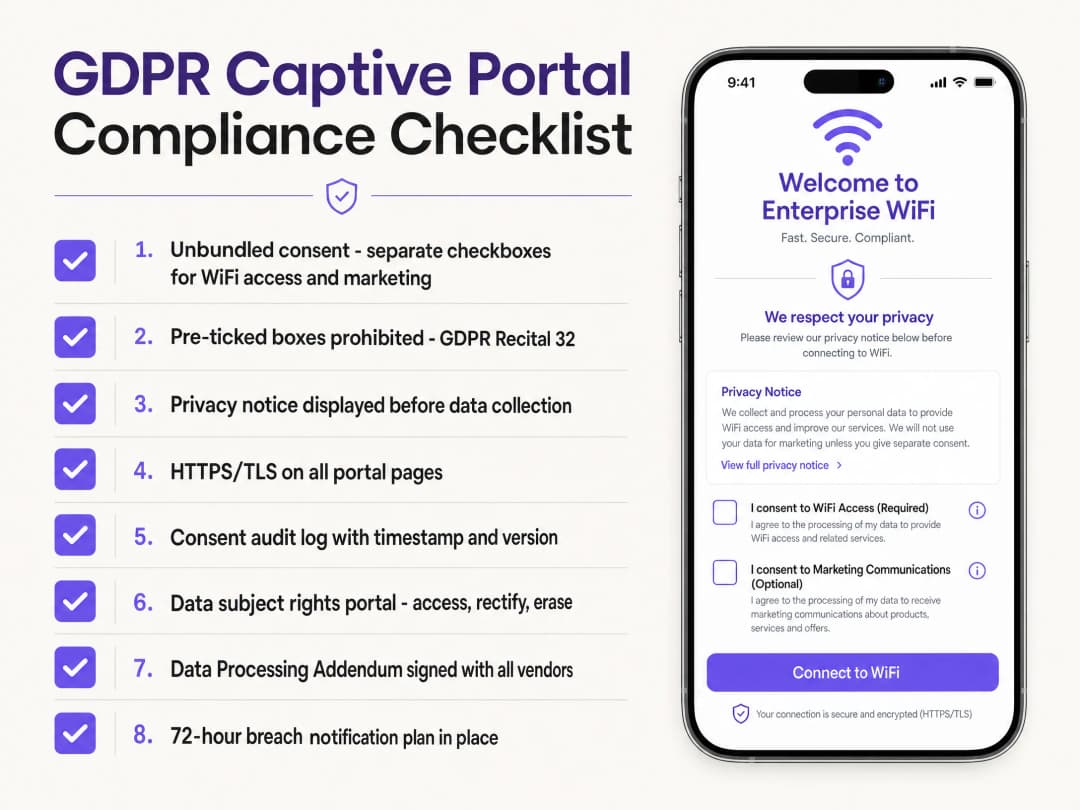
最常见的架构失败是捆绑(bundling)。如果您要求宾客必须接受营销邮件才能访问网络,那么该同意就不是自由给予的,根据 GDPR 第 7 条,这是无效的。您必须实施非捆绑式同意

您的 Captive Portal 必须至少呈现两个独立的同意要素:

  • 一个用于接受网络访问服务条款的必选复选框。
  • 一个用于营销沟通同意的可选且默认未勾选的复选框。

GDPR 前言第 32 条明确禁止预先勾选的框。此外,根据第 13 条,您的门户必须在用户提交任何数据之前提供清晰的隐私声明。该声明必须解释您收集哪些数据、原因、保留多长时间以及与谁共享。

至关重要的是,您的系统必须维护一个同意审计日志。该日志必须记录谁同意了、何时同意、同意了什么内容,以及他们查看的隐私声明的确切版本。这是您的合规性证明。

consent_checklist_infographic.png

网络分段与安全

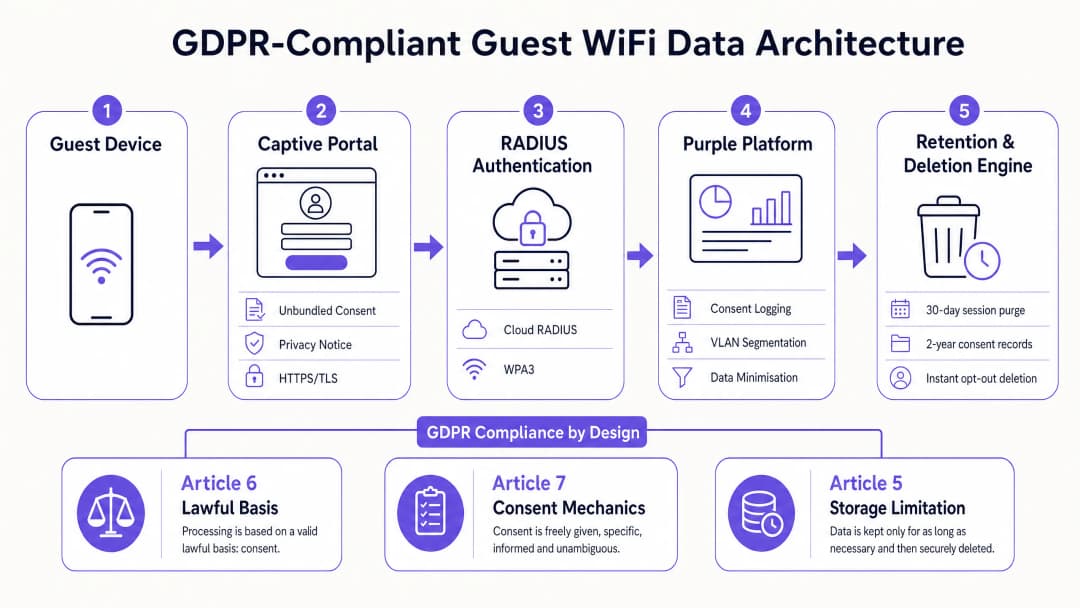
从网络架构的角度来看,分段是不可妥协的。您的宾客 WiFi 流量必须隔离在专用的 VLAN(虚拟局域网)上,与您的企业网络完全分开。使用访问控制列表(ACL)阻止宾客设备访问内部子网,并启用客户端隔离,使宾客设备之间无法相互通信。这既保护了宾客,也保护了您的企业资产。要深入了解这些原则,请参阅 什么是安全 WiFi:2026 年企业基本指南

对于身份验证,请将您的无线局域网控制器与云 RADIUS 服务器集成。当用户完成 Captive Portal 流程时,平台会向控制器发送 RADIUS Access-Accept 消息,从而授予访问权限。这在身份验证层和数据收集层之间创建了清晰的隔离。

在加密方面,如果您的硬件支持,您的宾客 SSID 应使用 WPA3。至少应强制执行采用 AES 加密的 WPA2。并且 您的 Captive Portal 必须通过带有有效 TLS 证书的 HTTPS 进行服务。通过 HTTP 提供收集个人数据的表单是严重的安全漏洞。

gdpr_data_flow_architecture.png

实施指南

部署合规的访客 WiFi 网络需要跨硬件、软件和策略层面的结构化方法。

  1. 硬件选择:确保您的接入点支持 VLAN 标记、客户端隔离和 WPA3。Purple 的平台与硬件无关,可与 Cisco Meraki、HPE Aruba、Ruckus、Juniper Mist、Ubiquiti UniFi、Cambium、Extreme 和 Fortinet 无缝集成。请勿使用消费级硬件;请参阅 为什么消费级 WiFi 设备不属于您的访客网络
  2. Captive Portal 设计:构建一个包含非捆绑式同意的欢迎页面。确保在提交任何数据之前即可访问隐私声明。如果您在需要特定社交登录的地区运营,请确保数据交换是透明的。例如,请参阅我们的指南 集成 WeChat WiFi 身份验证:亚太地区客户的 Captive Portal 引导
  3. 数据保留自动化:配置您的平台,根据您的保留策略自动清除数据。大规模手动删除是不可行的。
  4. 供应商协议:确保您与您的访客 WiFi 提供商、CRM 供应商以及处理此数据的任何其他第三方签署了数据处理补遗 (DPA)。

最佳实践

为了保持合规并建立信任,请遵循以下行业标准最佳实践:

  • 数据最小化:仅收集您严格需要的数据。如果您没有针对电话号码的明确业务使用场景,请勿在 Captive Portal 上索取该信息。
  • 自动存储限制:实施严格的数据保留期。会话日志应在 30 天后清除。同意记录的保存期限应为服务关系存续期外加两年。一旦撤回同意,必须立即删除营销画像。
  • 启用数据主体权利:提供一个自服务偏好中心,访客可以在其中管理他们的同意、请求访问其数据或请求删除(被遗忘权)。这大大减轻了处理数据主体访问请求 (DSAR) 的运营负担。
  • 进行 DPIA:如果您的部署涉及大规模位置追踪或行为画像,根据 GDPR 第 35 条,进行数据保护影响评估是法律强制要求的。

故障排除与风险缓解

即使拥有强大的架构,风险依然存在。主动应对这些常见的失效模式:

  • 同意疲劳:如果您的门户过于复杂,用户将放弃连接或盲目点击通过。保持价值交换清晰明了:用快速、免费的 WiFi 换取电子邮件地址和可选的营销信息。
  • 未签署 DPA:您的访客 WiFi 平台提供商是数据处理者。如果您在未签署 DPA 的情况下与他们共享个人数据,即属违规。确保在任何数据流动之前合同已签署到位。
  • 延迟的数据泄露通知:根据 GDPR 第 33 条,从您获悉个人数据泄露那一刻起,您有 72 小时的时间通知 ICO。将此时间线纳入您的事件响应计划中;不要等到调查结束才进行通知。

投资回报率 (ROI) 与业务影响

合规不仅是一个监管障碍,更是一个战略赋能工具。符合 GDPR 的 访客 WiFi 平台不仅能保护您免受高达全球营业额 4% 的罚款,还能带来可衡量的 ROI。

通过实施非捆绑式、有意识选择的加入(opt-in),您可以构建一个高质量的第一方数据库。虽然营销加入的原始数量可能低于非合规的捆绑方式,但参与率(打开率、点击率和转化率)要高得多,因为受众是主动选择接收您的消息的。

此外,合规平台还提供符合道德规范的商业智能。在 零售酒店服务 等行业,这些数据推动了运营改善,从根据客流量优化员工配置到个性化访客体验。Purple 的平台已通过 ISO 27001 标准认证,处理了 4.4 亿次登录并收集了 290 亿个数据点,这证明了规模化与严格合规可以实现盈利共存。

关键定义

Data Controller

The entity that determines the purposes and means of processing personal data. When a venue offers guest WiFi, it acts as the Data Controller and holds the primary legal responsibility.

IT managers must understand that outsourcing the WiFi platform does not outsource the legal liability.

Data Processor

An entity that processes personal data on behalf of the Data Controller. Purple, as the WiFi platform provider, acts as a Data Processor.

Requires a formal Data Processing Addendum (DPA) to legally handle the venue's guest data.

Captive Portal

The splash page or web page that a user must view and interact with before being granted access to a public network.

This is the primary interface where venues present privacy notices and capture lawful consent.

Unbundled Consent

The practice of separating requests for consent from other terms and conditions. Marketing consent cannot be a condition of service.

Essential for captive portal design to ensure consent is deemed 'freely given' under GDPR.

MAC Address

Media Access Control address; a unique identifier assigned to a network interface controller. Under GDPR, this is considered personal data when linked to a user.

Even if a user does not provide an email, logging their MAC address constitutes processing personal data.

VLAN Segmentation

Dividing a physical network into multiple logical networks. Guest WiFi traffic must be isolated from corporate traffic.

A foundational security control to prevent guest devices from accessing internal company assets.

RADIUS

Remote Authentication Dial-In User Service; a networking protocol that provides centralized Authentication, Authorization, and Accounting management.

Used to securely authenticate users who have completed the captive portal flow before granting network access.

DSAR

Data Subject Access Request; a mechanism for individuals to request a copy of their personal data, or ask for it to be rectified or erased.

Venues must have a process to handle these within 30 days. Self-service preference centres automate this burden.

应用实例

A 200-room hotel wants to collect guest emails to drive loyalty programme sign-ups. Their current system requires guests to accept marketing emails as a condition of getting online.

The hotel must deploy a compliant captive portal with unbundled consent. They must implement two separate checkboxes: a mandatory one for accepting the terms of service for network access, and an optional, unticked checkbox for marketing consent. The privacy notice must be clearly linked before the data submission button.

考官评语: The original approach is a clear GDPR violation as consent is not freely given. By unbundling the consent, the hotel ensures legal compliance. While the raw volume of opt-ins may decrease, the quality and engagement rate of the resulting marketing list will improve dramatically because guests actively chose to participate.

A stadium IT team wants to use WiFi analytics to monitor crowd density and manage safety at events. The legal team is concerned that tracking device locations without explicit consent violates GDPR.

The solution is two-fold. First, the captive portal privacy notice must be updated to explicitly disclose that location data is processed for crowd management and safety purposes under legitimate interest. Second, the IT team must implement MAC address pseudonymisation at the edge (on the access points) before the data reaches the cloud analytics platform.

考官评语: This approach balances operational requirements with privacy rights. By pseudonymising the MAC addresses at the edge, the analytics system works with pseudonymous identifiers rather than raw personal data, significantly reducing the privacy risk and regulatory exposure while still enabling crowd density monitoring.

练习题

Q1. Your marketing team wants to increase the size of their email database. They propose making the marketing opt-in checkbox on the guest WiFi captive portal pre-ticked by default to increase conversion. How do you advise them?

提示:Consider the GDPR definition of unambiguous consent and Recital 32.

查看标准答案

You must reject this proposal. GDPR Recital 32 explicitly states that silence, pre-ticked boxes, or inactivity does not constitute consent. Consent must require a clear affirmative action. Implementing pre-ticked boxes invalidates the consent and exposes the organisation to regulatory fines.

Q2. A guest connects to your WiFi but does not provide an email address, logging in via a 'skip' option. Your system logs their device MAC address, connection time, and the access point they connected to. Are you processing personal data?

提示:Consider the ICO's guidance on identifiers and the potential to single out an individual.

查看标准答案

Yes. Even without a name or email, a MAC address combined with location and time data can be used to single out an individual device and track its movements over time. The ICO considers this personal data. You must ensure you have a lawful basis (typically legitimate interest for basic network logging) and transparently disclose this processing in your privacy notice.

Q3. During a routine audit, you discover that your guest WiFi platform has been retaining detailed session logs (IP addresses, MAC addresses, connection times) for the past four years. What action should you take?

提示:Refer to the GDPR principle of storage limitation (Article 5).

查看标准答案

You must immediately implement an automated data deletion policy. Under the storage limitation principle, data must be kept no longer than necessary. Four years of session logs is excessive for network troubleshooting. You should purge historical session data older than 30 days and configure the platform to automatically delete future session logs at the 30-day mark.