
Captive Portal 最佳实践:高转化率与合规性设计
本技术指南为 IT 经理、网络架构师和场所运营总监提供了部署 Captive Portal 的完整蓝图,旨在平衡网络安全与高用户转化率。内容涵盖了从 VLAN 划分、RADIUS 认证到符合 GDPR 的同意设计以及认证方式选择的完整架构。结合 Purple 在 2024 年覆盖 80,000 多个场所、4.4 亿次登录的运营经验,每项建议均基于真实的部署数据。
收听本指南
查看播客转录

执行摘要
Captive Portal 是公共 WiFi 的登录页面。它也是您最重要的网络安全决策;如果您正在运行营销计划,它还是您最有价值的数据捕获界面。安全与转化这两个目标并不冲突,它们只需要不同的配置决策,本指南将对这两者进行详细介绍。
核心架构在认证完成前将每个访客设备置于隔离 VLAN 中。RADIUS 服务器管理会话,并通过授权变更(CoA)消息将设备释放到生产 VLAN。网络划分可确保访客流量绝不会到达企业基础设施或 POS 系统。在支付终端与访客 WiFi 共享物理基础设施的任何环境中,这种隔离是 PCI DSS 的强制要求,而非仅仅是建议。
在转化方面,每增加一个表单字段,选择加入率就会降低 8% 到 12%。选择合适的认证方式取决于您的场所类型和数据目标。邮箱捕获可带来 65% 至 80% 的转化率,并能获取直接拥有的数据。通过 OAuth 2.0 进行社交登录可减少摩擦,但会引入第三方依赖。本指南结合 Purple 在 2024 年覆盖 80,000 多个场所、4.4 亿次登录的运营经验(Purple 内部数据),为您平衡这些需求提供技术蓝图。
有关相关网络架构决策的更深层背景,请参阅我们的指南: 如何优化 captive portals 以实现最大网络安全和用户转化 。
技术深度解析
Captive Portal 会拦截与您的 SSID 关联的设备发出的 HTTP 或 HTTPS 请求,在授予互联网访问权限之前将用户重定向到展示页面。其底层机制依赖于网络划分和 RADIUS 认证的协同工作。
当设备连接时,接入点(无论是 Cisco Meraki、HPE Aruba、Ruckus、Juniper Mist、Ubiquiti UniFi、Cambium、Extreme 还是 Fortinet)会将其置于隔离 VLAN 中。在此状态下,防火墙会阻止除 DNS 查询以及对特定允许目标列表(称为“围墙花园”/walled garden)的访问之外的所有流量。围墙花园必须包含 Portal URL 和任何外部认证服务(例如 Google Workspace 或 Microsoft Entra ID)。如果围墙花园配置错误,导致系统自带的 Captive 探测(例如 iOS 上的 captive.apple.com)被阻止,Portal 将无法加载。这是实际部署中最常见的单一故障模式。
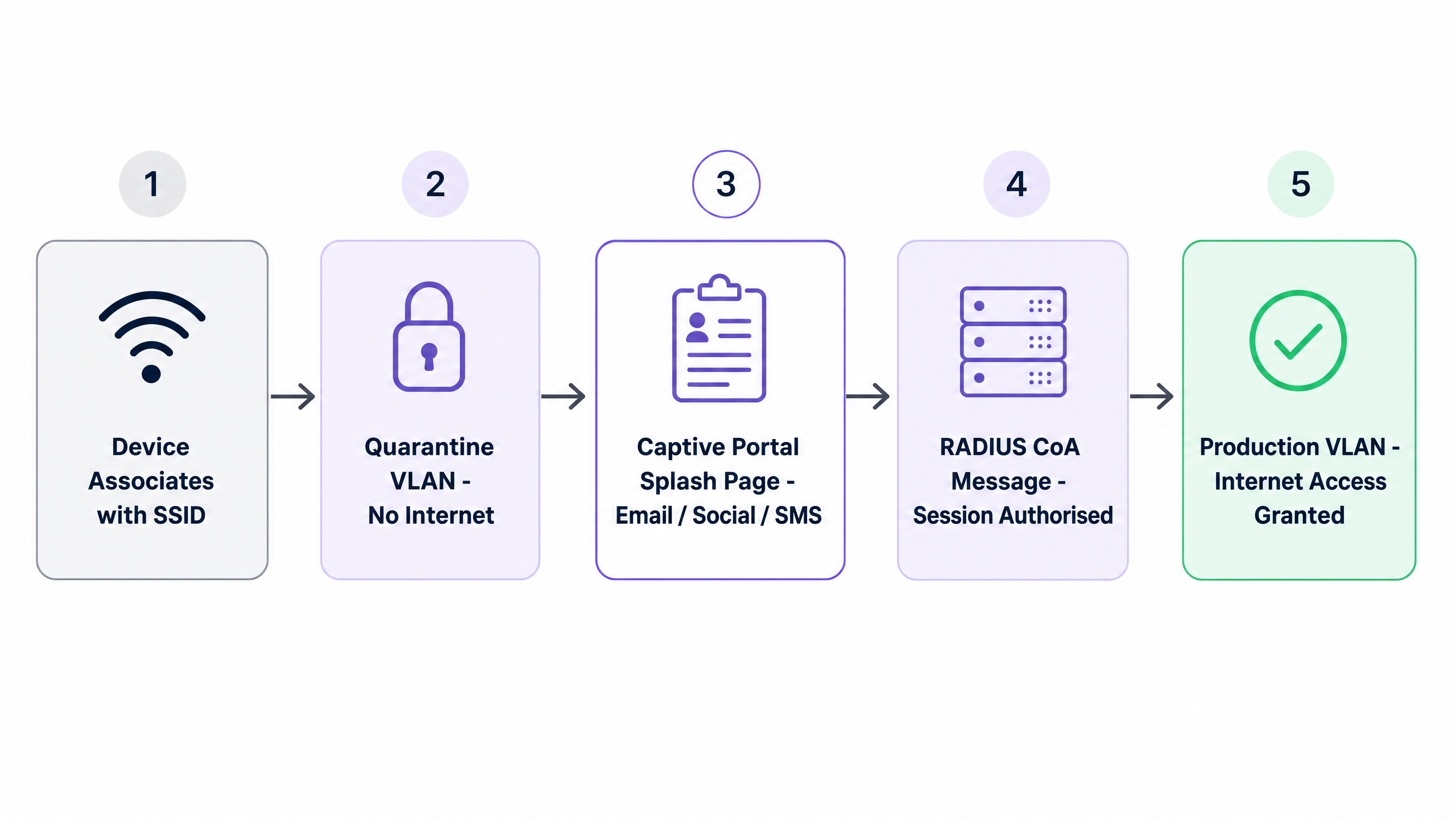
一旦用户完成登录流程,Portal 就会与您的 RADIUS 服务器进行通信。服务器向接入控制器发送授权变更(CoA)消息,指示其解除隔离状态并将设备移至生产 VLAN。这种隔离至关重要:在扁平网络中,受损的访客设备可以探测内部系统。VLAN 划分可确保未授权的设备无法访问 POS 系统或企业数据库。
认证方式对比
五种主要的 Captive Portal 认证方式在转化率、数据质量和合规成本方面各有权衡。下表总结了关键变量。
| 认证方式 | 转化率 | 数据质量 | GDPR 成本 | 最佳适用场景 |
|---|---|---|---|---|
| 仅限点击通过 / 服务条款 | 90-95% | 极少(MAC + 时间戳) | 低 | 公共部门、图书馆、NHS |
| 邮箱捕获 | 65-80% | 高(直接拥有) | 中 | 酒店餐饮、零售、活动 |
| 社交登录 (OAuth 2.0) | 55-70% | 中(依赖提供商) | 中至高 | 拥有 Google/Apple 用户的消费场所 |
| 短信验证码 (SMS OTP) | 45-60% | 极高(已验证手机号) | 中 | 侧重忠诚度:快餐店 (QSR)、体育场馆、零售 |
| 完整表单注册 | 30-45% | 最高(丰富的画像) | 高 | 酒店、医疗保健、高端零售 |
来源:Purple 运营数据,2024 年 4.4 亿次登录。
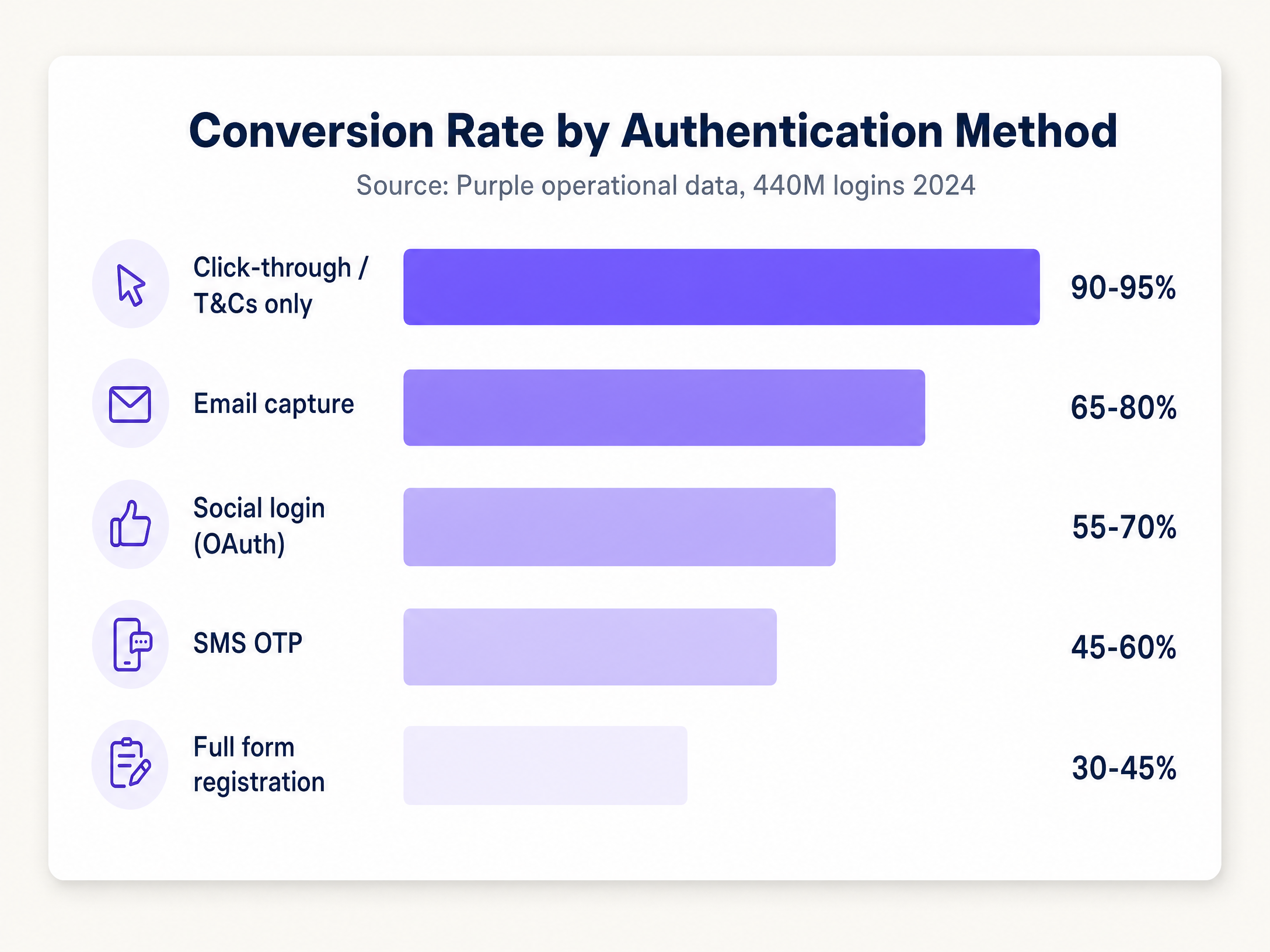
对于大多数场所运营商而言,最佳的起点是双重方式 Portal:以邮箱捕获作为主要选项,Google 登录作为次要选项。这种组合通常可以实现 65% 至 75% 的转化率,同时建立直接拥有的邮箱数据库。您不会完全依赖第三方 OAuth 提供商,但能为偏好该方式的用户提供便捷选项。
对于运行忠诚度计划的 酒店餐饮 场所,可以加入短信验证码 (SMS OTP) 作为第三种选择,或将其作为主要方式。较低的转化率是可以接受的,因为数据质量证明了其价值。CRM 中已验证的手机号码价值明显高于未验证的邮箱地址。
对于公共部门部署(地方议会、NHS 信托基金、图书馆),点击通过并接受条款是正确的选择。在公共部门背景下收集个人数据的合规成本很高,而且其目标是提供连接,而不是构建 CRM。
合规架构
在 GDPR 框架下,您必须将连接与数据收集分开。您可以基于英国 GDPR 第 6(1)(f) 条的合法利益授予网络访问权限。您不能使用同样的理由发送营销电子邮件。根据第 6(1)(a) 条,营销需要明确、肯定的同意。
您的门户必须包含独立的、未勾选的复选框。一个用于 WiFi 访问的服务条款。第二个独立的复选框用于营销同意。预先勾选的框不是有效的同意。系统必须记录每一次同意事件,记录谁同意了、何时同意的以及他们查看的具体隐私声明版本。在监管机构查询时,此审计轨迹就是您的合规证明。
对于在现场设有刷卡支付终端的 零售 运营商,PCI DSS 要求将持卡人数据环境与所有其他网络流量隔离。合理的 VLAN 划分可将 PCI DSS 审计范围缩小 60% 至 80%(Specgravity,2024 年),并降低年度合规成本。
实施指南
部署一个既安全又高转化率的 captive portal 需要结构化的方法。以下五阶段框架适用于各种硬件平台。
阶段 1 - 流量分类。 在动用任何一个交换机端口之前,记录您环境中的每种设备类型和流量类别:访客设备、员工设备、物联网(IoT)、支付终端、楼宇管理系统、闭路电视(CCTV)。每个类别都需要一个专用的 VLAN。
阶段 2 - VLAN 设计。 为每个流量类别分配一个 VLAN ID 和 IP 子网。将访客 VLAN 保持在完全独立的子网中,且不路由到您的内部地址空间。您的防火墙必须在访客 VLAN 与所有内部网络之间设置一条明确的“拒绝所有”规则,仅允许访问外部互联网。
阶段 3 - Walled Garden 配置。 明确允许门户 URL、身份提供商域名(Google Workspace、Microsoft Entra ID、Okta)以及操作系统的 captive 探测 URL。在上线前,在 iOS、Android 和 Windows 设备上进行测试。
阶段 4 - 防火墙策略。 明确记录每个允许的 VLAN 间流向。默认拒绝其他所有内容。这是大多数部署出现不足的地方:VLAN 架构的强度完全取决于执行它的防火墙规则。
阶段 5 - 监控与验证。 部署网络监控并验证隔离是否正常工作。定期进行渗透测试,或者至少使用访客设备上的扫描工具来确认您无法访问内部子网。
Purple 的 Guest WiFi 平台通过标准 RADIUS 和 VLAN 标记与所有主流企业无线厂商集成。您无需更换现有的接入点。该平台可在 Cisco Meraki、HPE Aruba、Ruckus、Juniper Mist、Ubiquiti UniFi、Cambium、Extreme 和 Fortinet 部署中处理 captive portal 渲染、同意管理以及下游的 WiFi Analytics 。
最佳实践
以下建议反映了在 Purple 超过 80,000 个场所中观察到的运营模式。
尽量减少表单字段。 您在登录表单中添加的每个字段都会降低您的转化率。只索取您实际使用的数据。对于大多数营销场景,电子邮件地址和名字就足够了。只有当您的 CRM 工作流确实需要时,才应出现出生日期、邮政编码和电话号码。
将访问与营销同意分开。 确保您的 captive portal 具有独立的、未勾选的复选框,分别用于 WiFi 条款和营销选择性加入(opt-ins)。将两者混为一谈是我们在实际应用中看到的最常见的 GDPR 合规错误。
启用客户端隔离。 配置接入控制器,以防止访客 SSID 上的设备之间直接进行通信。这消除了访客网络上的点对点攻击媒介。
管理带宽。 在访客 VLAN 上实施针对每个客户端的速率限制(通常为下行 5 至 20 Mbps)。这可以防止单个用户占用全部上行链路,从而降低其他所有人的体验。
为 MAC 随机化做好准备。 现代 iOS 和 Android 设备默认使用随机 MAC 地址。再次光临的访客会显示为新用户,门户会重新对他们进行验证。通过鼓励用户安装 Passpoint 配置文件,或使用依赖身份令牌而非 MAC 地址的基于应用程序的身份验证流程,可以缓解这一问题。
保持较低的 SSID 数量。 您广播的每个额外 SSID 都会消耗信标帧的空口时间。在拥有数百个接入点的高密度场所中,每个射频广播超过四个 SSID 会明显降低吞吐量。三个是实际的目标:访客、企业、物联网(IoT)。
有关身份验证标准的更广泛视角,请参阅我们的指南: EAP Method WiFi:安全网络访问指南 。
故障排除与风险缓解
实际应用中最常见的问题是门户无法显示。这几乎总是 Walled Garden 配置错误。如果防火墙阻止了设备的操作系统 captive 探测,操作系统就无法检测到 captive 网络,门户也就永远不会启动。每次请首先检查您的 Walled Garden 条目。
第二种常见的故障模式是 DHCP 地址池耗尽。在体育场或会议中心等高密度环境中,数千台设备会同时连接。如果您的 DHCP 地址池用尽了地址,身份验证流程就会在提供门户服务之前停滞。请根据峰值并发连接数(而非平均负载)来规划您的基础设施规模。
第三个风险是无备用方案的 OAuth 依赖。如果您将社交登录部署为唯一的身份验证方法,而提供商更改了其 API 条款,您的身份验证流程就会中断。Facebook 的 Graph API 就发生过这种情况。在社交登录的同时,请务必部署至少一种直接拥有的方法。
对于 交通 枢纽和大型活动场所,第四个风险是 DNS 解析器过载。在大规模应用中,高峰连接事件期间的 DNS 查询量可能会使规模不足的解析器瘫痪。部署专用的 DNS 基础设施 f或访客 VLAN 并监控查询率。
对于 医疗保健 环境,第五个考虑因素是临床设备隔离。根据 NHS Digital 指南,临床设备必须位于与通用访客 WiFi 隔离的独立 VLAN 上。captive portal 架构绝不能允许访客设备访问任何承载临床设备流量的子网。
ROI 与业务影响
架构合理的 captive portal 将访客 WiFi 从成本中心转变为战略资产。通过捕获第一方数据,您可以构建一个经过验证的 CRM 数据库,从而推动忠诚度计划和精准营销活动。
衡量成功的两个主要指标是:转化率(完成认证的连接设备百分比)和选择加入率(同意接受营销的已认证用户百分比)。收集电子邮件地址的零售连锁店可以追踪 WiFi 用户向忠诚度会员的转化情况,并衡量随之带来的客流量和消费额的增长。
对于一个拥有 500 家门店、电子邮件获取转化率为 70% 的零售集团而言,整个集团每天 10,000 次 WiFi 会话将每天产生 7,000 个新增或回访的 CRM 联系人。按照营销活动中保守的 2% 邮件到店转化率计算,每天可为门店带来 140 次归因于 WiFi 渠道的增量到店访问。
此外,合理的网络分段可以缩小 PCI DSS 审计的范围。合理的分段可将 PCI DSS 审计范围缩小 60% 至 80%(Specgravity,2024 年),从而降低年度合规成本并规避数据泄露的财务风险。违反 GDPR 的罚款最高可达全球年营业额的 4%,这使得合规的门户架构成为一种直接的财务风险规避措施。
Purple 的平台已通过 ISO 27001、GDPR、CCPA 和 Cyber Essentials 认证,可提供您的法务 and 采购团队所需的合规性文件。凭借在 80,000 多个场所中实现的 99.999% 可用性,该基础设施的规模完全能够满足企业级部署的需求。
如需阅读有关相关网络概念的更多信息,请参阅我们的 WAN 计算机定义:2026 年实用指南 。
关键定义
Captive portal
A web page that intercepts network traffic and requires user interaction - authentication or terms acceptance - before granting full internet access. Defined in IETF RFC 8952.
The primary interface for guest onboarding, security enforcement, and first-party data capture at any public or semi-public WiFi venue.
VLAN (Virtual Local Area Network)
A logical grouping of network devices that behave as if they are on a single isolated LAN, regardless of physical location. Defined in IEEE 802.1Q.
Used to segment guest traffic from corporate infrastructure. Required by PCI DSS to isolate the cardholder data environment.
Walled garden
A restricted network environment that allows access only to specific approved URLs and IP addresses before authentication completes.
Must include the portal URL, identity provider domains, and OS captivity probe URLs. Misconfiguration is the leading cause of portal failures.
RADIUS
Remote Authentication Dial-In User Service. A networking protocol providing centralised authentication, authorisation, and accounting for network access.
The backend system that verifies credentials and instructs the access point to grant or deny network access. Required for enterprise captive portal deployments.
Change of Authorisation (CoA)
A RADIUS message that dynamically alters the authorisation state of an active user session without requiring re-authentication.
Used to move a device from the quarantine VLAN to the production VLAN after successful portal login, or to revoke access when a session policy changes.
Client isolation
A wireless controller feature that prevents devices connected to the same SSID from communicating directly with each other at Layer 2.
Essential for guest networks to prevent peer-to-peer attacks and lateral movement between guest devices.
Passpoint (Hotspot 2.0)
An IEEE 802.11u-based protocol that enables devices to automatically and securely connect to WiFi networks using credentials from a service provider, without requiring manual portal interaction.
Used to overcome MAC address randomisation and provide seamless roaming across venues. Relevant for loyalty-focused deployments where session persistence matters.
PCI DSS
Payment Card Industry Data Security Standard. An information security standard for organisations that handle branded credit cards from major card schemes.
Requires strict network segmentation to isolate the cardholder data environment from guest WiFi traffic. Non-compliance carries financial penalties and loss of card processing rights.
OAuth 2.0
An open authorisation framework that enables third-party applications to obtain limited access to user accounts on an HTTP service, such as Google Workspace or Microsoft Entra ID.
Used for social login on captive portals. Reduces friction but introduces dependency on the identity provider's API terms and availability.
应用实例
A 200-room hotel using HPE Aruba access points needs to provide tiered WiFi: basic free access for standard guests and high-speed access for loyalty members, without broadcasting multiple SSIDs.
Deploy a single guest SSID integrated with the Property Management System (PMS) via API. The portal presents two options: log in with room number and surname, or log in with loyalty programme credentials. When a loyalty member authenticates, the portal queries the PMS via API, verifies the tier, and sends a RADIUS Change of Authorisation (CoA) to the Aruba controller with a vendor-specific attribute (VSA) assigning the high-bandwidth role. Standard guests receive a rate-limited default role. One SSID, dynamic policy enforcement at the RADIUS layer, clean user experience with no additional RF overhead.
A national retail chain with 500 locations wants to capture email addresses for marketing across all sites, but the legal team has flagged GDPR compliance concerns about the existing portal design.
Redesign the portal with a single email input field and two distinct checkboxes. The first checkbox is mandatory and reads: 'I accept the Terms of Service and Privacy Policy for network access.' The second checkbox is optional, unticked by default, and reads: 'I consent to receive marketing communications and special offers from [Brand].' The backend logs the timestamp, IP address, portal version, and consent event for each user. The lawful basis for WiFi access is legitimate interest. The lawful basis for marketing is explicit consent. These are recorded separately in the CRM.
练习题
Q1. A stadium IT director reports that during halftime, users can associate with the guest SSID but the captive portal fails to load for thousands of devices simultaneously. The walled garden has been verified as correct. What is the most likely architectural failure?
提示:Consider the infrastructure resources required before a device can route HTTP traffic to the portal - specifically, what happens before DNS resolution.
查看标准答案
DHCP pool exhaustion or DNS resolver overload. In high-density environments, if the DHCP pool cannot assign IP addresses fast enough, or the DNS resolver cannot handle the query volume from thousands of simultaneous connections, the authentication flow stalls before the portal can be served. The infrastructure must be sized for peak concurrent connections, not average load. Separate DHCP and DNS infrastructure for the guest VLAN is the recommended mitigation.
Q2. A retail marketing team wants to collect customer dates of birth via the captive portal to send birthday offers. They plan to make the DOB field mandatory to access the WiFi. Is this compliant with UK GDPR? If not, how should it be redesigned?
提示:Review the principles of data minimisation (Article 5(1)(c)) and the requirement for consent to be freely given.
查看标准答案
No. Making marketing data mandatory for service access violates the principle that consent must be freely given - a user cannot freely consent if refusal means losing access to a service. Furthermore, collecting DOB when it is not strictly necessary for network access violates the data minimisation principle. The correct design: DOB is an optional field, clearly labelled as optional, with a separate unticked checkbox for birthday marketing consent. The lawful basis for WiFi access remains legitimate interest. The lawful basis for birthday marketing is explicit consent.
Q3. A hotel's security audit reveals that a device connected to the guest WiFi can ping the IP address of a point-of-sale terminal in the restaurant. The IT team confirms that the guest network and POS network are on separate VLANs. What configuration step was missed?
提示:VLANs provide logical separation, but traffic between VLANs must pass through a routing device. What governs what that device allows?
查看标准答案
Inter-VLAN routing rules on the firewall are misconfigured or absent. While the guest traffic and POS traffic are on separate VLANs, the firewall must enforce a default-deny policy between them with explicit permit rules for only the required flows. The guest VLAN should have rules permitting only outbound internet access - no routes to any internal subnet, including the POS VLAN. The fix is to audit and correct the inter-VLAN firewall policy, then validate by attempting to reach internal subnets from a guest device.
Q4. A conference centre deploys social login (Google OAuth) as its only captive portal authentication method. Three months after launch, Google updates its OAuth API and the portal breaks for all users. How should the deployment have been architected to prevent this?
提示:Consider the single point of failure and what a resilient multi-method design looks like.
查看标准答案
The deployment should have included at least one non-OAuth authentication method as a fallback - email capture being the most practical choice. A dual-method portal with email capture as primary and Google OAuth as secondary would have maintained continuity when the OAuth flow broke. The email capture method has no third-party dependency and provides a directly owned data asset. OAuth providers should always be treated as convenience options, not primary authentication infrastructure.
继续阅读本系列
如何在 Starlink 上设置 Captive Portal:偏远地区与海上场所指南
本指南详细介绍了如何绕过原生 Starlink 硬件,并使用企业级路由设备集成云端托管的 Captive Portal。您将学习如何克服 CGNAT 限制、强制执行 VLAN 隔离、管理卫星带宽限制并确保合规性。
酒店访客 WiFi 管理:整合 PMS、门户与品牌标准
本技术指南详细介绍了如何构建企业级酒店 WiFi 网络,重点关注 VLAN 划分、用于自动化会话管理的 PMS 整合,以及用于符合 GDPR 合规要求的数据捕获的 captive portal 优化。
如何优化 Captive Portal 以实现最大网络安全与用户转化
本指南为企业场所优化 Captive Portal 提供了完整的技术蓝图,涵盖网络分段架构、身份验证方式选择、符合 GDPR 的合规同意设计以及转化率优化。本书面向酒店、连锁零售、体育场馆和公共部门机构的 IT 经理、网络架构师和 CTO,帮助他们在网络安全与第一方数据获取之间取得平衡。Purple 在全球 80,000 多个场所运营 Captive Portal 基础设施,并在 2024 年处理了 4.4 亿次登录,本指南中的框架正是这些运营经验的结晶。