
Was ist ein WLC (Wireless LAN Controller) und brauchen Sie noch einen?
Dieser umfassende Leitfaden beleuchtet die Entwicklung von Wireless LAN Controllern (WLCs) und bietet einen technischen Rahmen zur Bestimmung der richtigen Architektur im Jahr 2026. Er behandelt traditionelle Hardware-, Cloud-Managed- und Controller-lose Modelle und beschreibt deren Auswirkungen auf Compliance, Skalierbarkeit und das Gästeerlebnis.
Diesen Leitfaden anhören
Podcast-Transkript ansehen
Zusammenfassung für Führungskräfte
Für IT-Manager und Netzwerkarchitekten, die drahtlose Unternehmensnetzwerke bereitstellen, war der Wireless LAN Controller (WLC) historisch gesehen das zentrale Nervensystem der drahtlosen Infrastruktur. Die architektonische Landschaft hat sich jedoch erheblich verändert. Mit dem Aufkommen von Cloud-Managed-Architekturen und verteilten Datenebenen lautet die grundlegende Frage bei jeder neuen Bereitstellung oder jedem Aktualisierungszyklus nicht mehr einfach „welchen Controller sollen wir kaufen“, sondern vielmehr „benötigen wir überhaupt noch einen Hardware-Controller?“
Dieser Leitfaden bietet eine umfassende technische Analyse der WLC-Architekturen im Jahr 2026. Wir untersuchen die Entwicklung von traditioneller zentralisierter Hardware hin zu modernen Cloud-Managed- und Controller-losen Topologien. Durch die Abbildung dieser technischen Architekturen auf reale Compliance-Anforderungen (wie PCI DSS und GDPR), Skalierbarkeitsbedürfnisse und Ergebnisse des Gästeerlebnisses ermöglicht diese Referenz technischen Entscheidungsträgern die Auswahl der geeigneten Control-Plane-Strategie.
Darüber hinaus untersuchen wir, wie Plattformen wie Purple agnostisch über dieser Infrastrukturschicht operieren und Rohkonnektivität in umsetzbare Informationen umwandeln, unabhängig vom zugrunde liegenden Hardware-Anbieter.
Technischer Deep-Dive: Den WLC verstehen
Die Entwicklung der Steuerungsebene
Ein Wireless LAN Controller (WLC) ist ein Netzwerkgerät, das für die zentralisierte Verwaltung, Konfiguration und Durchsetzung von Sicherheitsrichtlinien über mehrere Wireless Access Points (APs) hinweg verantwortlich ist. Bei frühen drahtlosen Bereitstellungen arbeiteten APs autonom, erforderten eine individuelle Konfiguration und konnten RF-Umgebungen oder Roaming-Übergaben nicht koordinieren. Als drahtlose Netzwerke von einem Komfortnetzwerk zu einer geschäftskritischen Infrastruktur wurden, wurde der administrative Aufwand autonomer APs untragbar.
Der WLC löste dies durch die Einführung der Split-MAC-Architektur. In diesem Modell übernimmt der AP (oft als „Lightweight“ AP bezeichnet) die Echtzeit- und zeitsensiblen 802.11-Physikschichtfunktionen, wie Beacon-Übertragung und Probe-Antworten. Der Controller übernimmt die Verantwortung für nicht-echtzeitfähige MAC-Schichtfunktionen, einschließlich RF-Management, Durchsetzung von Sicherheitsrichtlinien und Client-Authentifizierung. Die Kommunikation zwischen dem Lightweight AP und dem Controller ist typischerweise in einem CAPWAP (Control and Provisioning of Wireless Access Points)-Tunnel gekapselt.
Die Rolle von CAPWAP
CAPWAP ist grundlegend für den traditionellen WLC-Betrieb. Es etabliert einen sicheren Tunnel zwischen dem AP und dem Controller, der sowohl Steuerungsdaten (Management und Konfiguration) als auch Nutzdaten (Client-Payloads) transportiert.
Bei einer zentralisierten Datenebene Bereitstellung wird der gesamte Client-Verkehr zum Controller zurückgeleitet, bevor er an das kabelgebundene Netzwerk weitergeleitet wird. Dies ermöglicht eine zentralisierte Richtliniendurchsetzung, Deep Packet Inspection und ein vereinfachtes VLAN-Management. Es kann jedoch in Umgebungen mit hoher Dichte einen erheblichen Engpass darstellen.
Um dies zu mindern, nutzen viele moderne Bereitstellungen FlexConnect (Cisco) oder ähnliche Local-Switching-Architekturen. Hier bleibt die Steuerungsebene am WLC zentralisiert, aber die Datenebene ist verteilt, sodass der Client-Verkehr lokal am Edge-Switch ausgeleitet werden kann. Dies reduziert die Verarbeitungslast auf dem WLC drastisch und verbessert den Durchsatz, insbesondere über WAN-Verbindungen.
Nahtloses Roaming und Client-Management
Einer der wichtigsten technischen Gründe für die Bereitstellung eines WLC ist das nahtlose Client-Roaming. In einer Multi-AP-Umgebung muss ein Client, der sich durch den Abdeckungsbereich bewegt, von einem AP zum anderen wechseln. Ohne Controller trifft der Client diese Entscheidung völlig unabhängig, was oft zum „Sticky Client“-Syndrom führt, bei dem das Gerät eine schwache Verbindung zu einem entfernten AP aufrechterhält und die gesamte Kanalkapazität beeinträchtigt.
Ein WLC orchestriert diesen Prozess. Durch die Aufrechterhaltung einer zentralisierten Ansicht der RF-Umgebung und des Authentifizierungsstatus des Clients (besonders kritisch für 802.1X-Bereitstellungen) kann der Controller das Roaming-Ereignis vorab inszenieren. Er erleichtert die Übertragung des PMK (Pairwise Master Key)-Caches des Clients an den Ziel-AP und ermöglicht so einen nahtlosen Übergang in Millisekunden, wodurch VoIP-Anrufe und Streaming-Sitzungen ununterbrochen bleiben. Dies ist entscheidend für die Aufrechterhaltung einer hohen Gästezufriedenheit an Orten wie Hospitality und Retail .
Implementierungsleitfaden: Die richtige Architektur wählen
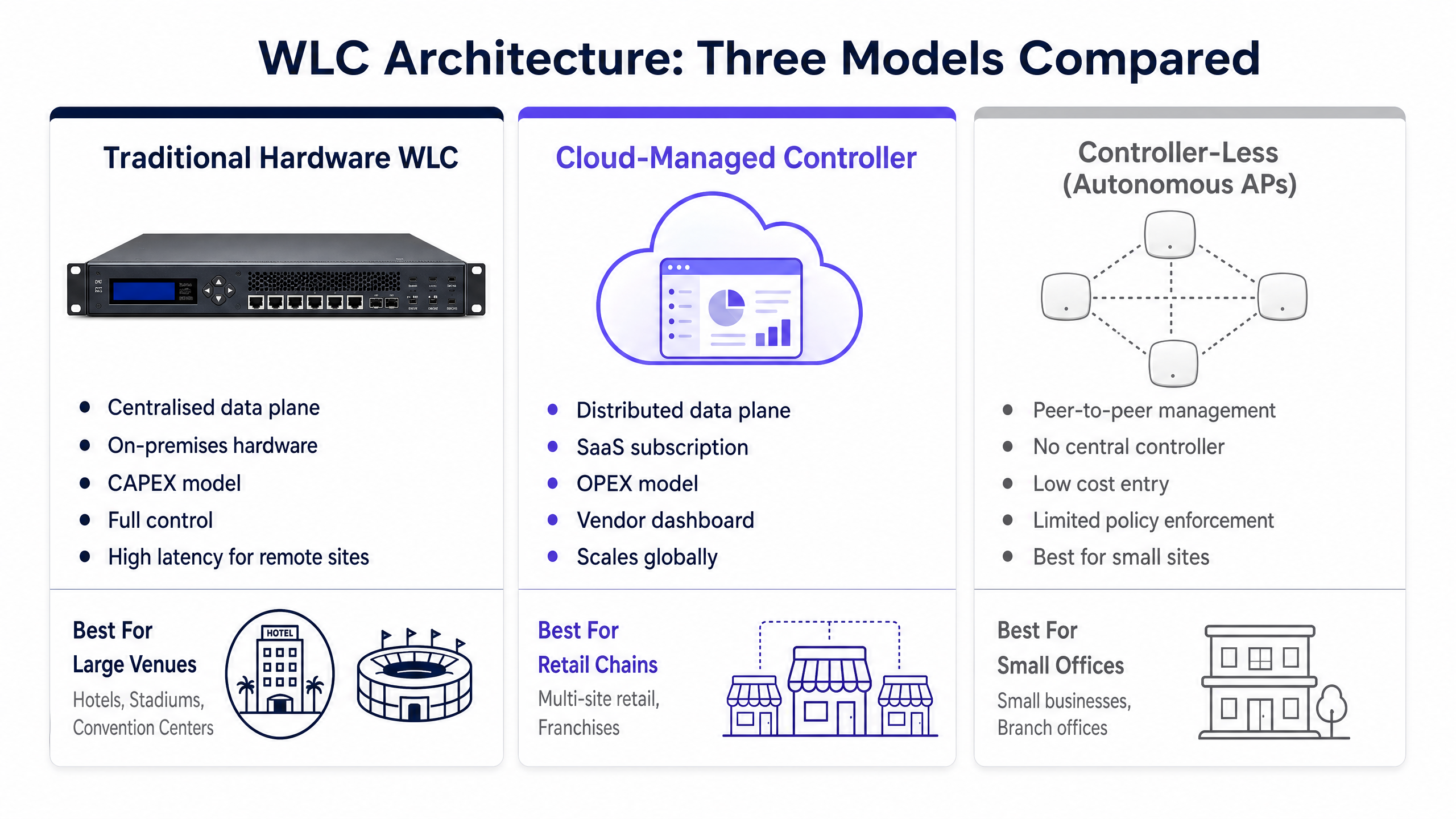
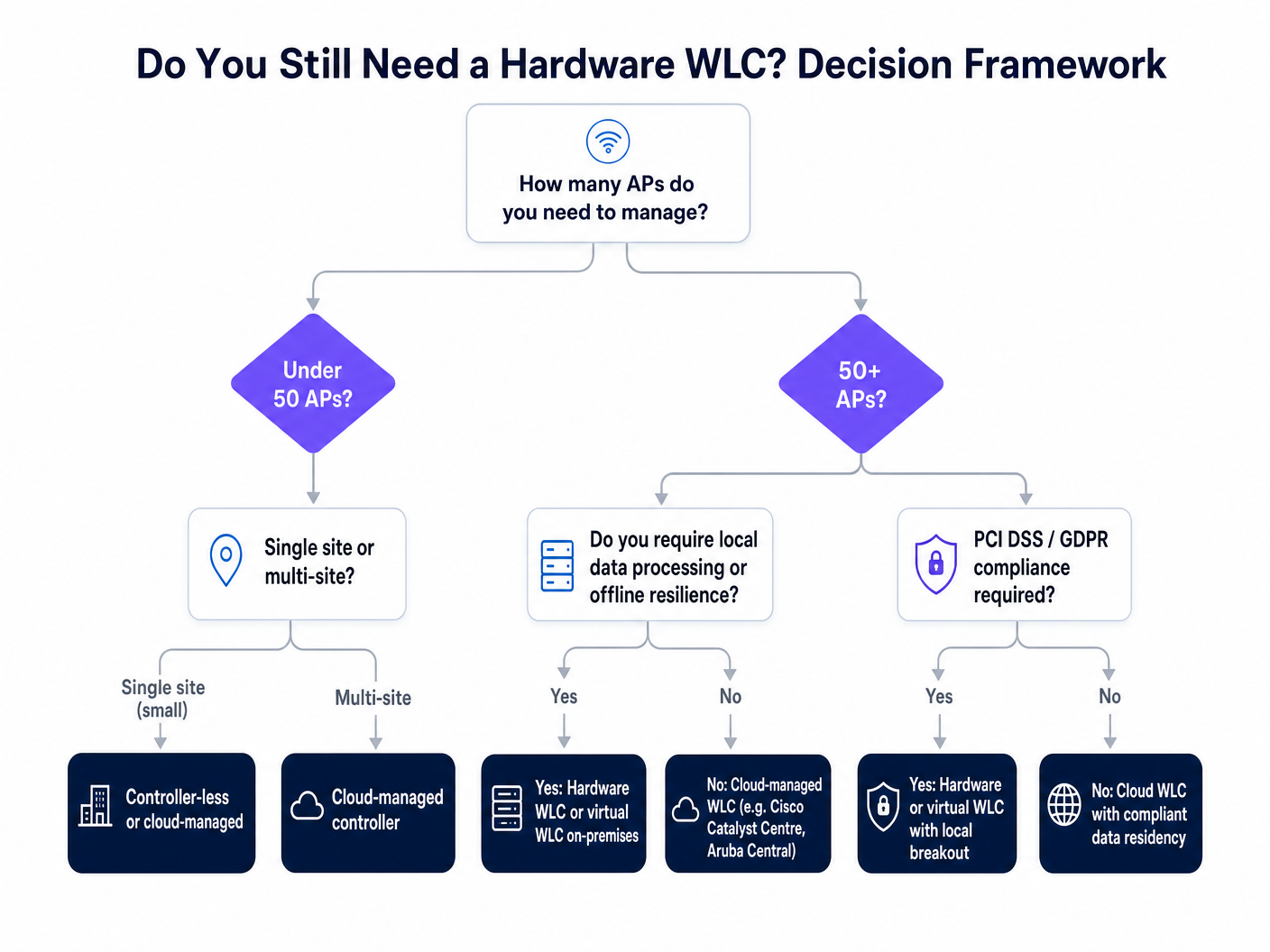
Im Jahr 2026 müssen Netzwerkarchitekten drei verschiedene Bereitstellungsmodelle bewerten. Die Entscheidung hängt von Skalierung, Compliance, Latenztoleranz und CAPEX- vs. OPEX-Budgetstrukturen ab.
1. Traditioneller Hardware-WLC (On-Premises)
Das traditionelle Modell umfasst eine physische Appliance, die in einem lokalen Rechenzentrum oder Serverraum bereitgestellt wird.
- Architektur: Zentralisierte Steuerungs- und Datenebenen (typischerweise).
- Vorteile: Vollständige Kontrolle über die Datenresidenz, Offline-Resilienz (übersteht WAN-Ausfälle) und hochgradig granulare Richtliniendurchsetzung.
- Nachteile: Hohe anfängliche CAPEX, endliche Kapazitätsgrenzen, die einen Hardwareaustausch für eine signifikante Skalierung erfordern, und komplexe Redundanzkonfigurationen (N+1 oder Aktiv/Standby).
- Optimal geeignet für: Große Einzelstandort-Bereitstellungen (z.B. Stadien, große Krankenhäuser, Universitätscampus), bei denen die lokale Datenverarbeitung durch Compliance oder Latenz vorgeschrieben isty-Einschränkungen.
2. Cloud-Managed Controller
Das Cloud-Managed-Modell abstrahiert die Steuerungsebene auf eine vom Anbieter gehostete SaaS-Plattform, während die Datenebene am Edge verteilt bleibt.
- Architektur: Zentralisierte Cloud-Steuerungsebene, verteilte lokale Datenebene.
- Vorteile: Schnelle Skalierbarkeit, OPEX-Abonnementmodell, Zero-Touch-Provisioning und ein einheitliches Management-Dashboard über geografisch verteilte Standorte hinweg.
- Nachteile: Erfordert eine zuverlässige WAN-Konnektivität für die Verwaltung (obwohl lokales Daten-Switching Ausfälle übersteht) und potenzielle Bedenken hinsichtlich der Datenresidenz, abhängig von der Cloud-Region des Anbieters.
- Optimal geeignet für: Multi-Site-Umgebungen wie Einzelhandelsketten, verteilte Unternehmensniederlassungen und Franchise-Betriebe.
3. Controller-Less (Autonom/Mesh)
In diesem Modell kommunizieren Access Points Peer-to-Peer und wählen untereinander einen virtuellen Controller, um die grundlegende Koordination zu übernehmen.
- Architektur: Verteilte Steuerungs- und Datenebenen.
- Vorteile: Geringste Einstiegskosten, einfache Bereitstellung, keine dedizierte Controller-Hardware oder Cloud-Abonnement erforderlich.
- Nachteile: Begrenzte Skalierbarkeit, grundlegende Roaming-Fähigkeiten und Mangel an erweiterten Unternehmenssicherheitsfunktionen.
- Optimal geeignet für: Kleine Einzelstandort-Bereitstellungen (z. B. kleine Einzelhandelsgeschäfte, Boutique-Cafés) mit geringer Client-Dichte und minimalen Compliance-Anforderungen.
Best Practices für die Bereitstellung
Unabhängig von der gewählten Architektur ist die Einhaltung branchenüblicher Best Practices entscheidend für die Gewährleistung der Netzwerkstabilität und -leistung.
- Dimensionierung für Spitzenlast, nicht Durchschnitt: Die WLC-Kapazität ist streng lizenziert und wird basierend auf gleichzeitigen APs und gleichzeitigen Client-Sitzungen durchgesetzt. Bei der Planung für Umgebungen mit hoher Dichte wie Transport -Hubs oder Stadien müssen Sie die Kapazität basierend auf der Spitzenlast bei Veranstaltungen und nicht auf dem durchschnittlichen täglichen Gebrauch berechnen. Andernfalls führt dies dazu, dass der WLC Client-Assoziierungsanfragen während kritischer Perioden ablehnt.
- Design für Redundanz: Ein Hardware-WLC ist ein Single Point of Failure. Bereitstellungen müssen Hochverfügbarkeit (HA) integrieren. Moderne Plattformen unterstützen Stateful Switchover (SSO), wodurch sichergestellt wird, dass Client-Sitzungen und AP-Assoziierungen nahtlos auf einen Standby-Controller übergehen, ohne eine erneute Authentifizierung zu erfordern.
- Implementierung von Local Breakout für hohe Bandbreite: In zentralisierten WLC-Architekturen sollte vermieden werden, Gast-Traffic mit hoher Bandbreite (z. B. Video-Streaming) über den CAPWAP-Tunnel zum Kernnetzwerk zurückzuführen. Nutzen Sie lokales Switching am Edge, um diesen Traffic direkt ins Internet auszulagern und so die WLC-Verarbeitungskapazität für Steuerungsfunktionen und sicheren Unternehmens-Traffic zu erhalten.
- Durchsetzung strenger Sicherheitsrichtlinien: Nutzen Sie den WLC als zentralen Durchsetzungspunkt für Sicherheit. Stellen Sie sicher, dass WPA3 Enterprise dort eingesetzt wird, wo es unterstützt wird, und erzwingen Sie eine robuste Client-Isolation in Guest WiFi -Netzwerken, um Peer-to-Peer-Kommunikation zwischen nicht vertrauenswürdigen Geräten zu verhindern.
Fehlerbehebung & Risikominderung
Wenn WLC-Bereitstellungen fehlschlagen, sind die Auswirkungen oft systemisch. Das Verständnis gängiger Fehlerursachen ist für eine schnelle Behebung unerlässlich.
Asymmetrisches Routing und CAPWAP-Fragmentierung
Risiko: Bei der Bereitstellung eines zentralisierten WLC über ein komplexes WAN können MTU (Maximum Transmission Unit)-Diskrepanzen dazu führen, dass CAPWAP-Pakete fragmentiert werden. Dies beeinträchtigt die AP-Leistung erheblich und kann zu intermittierenden AP-Verbindungsabbrüchen führen. Minderung: Stellen Sie sicher, dass die MTU über den gesamten Pfad zwischen dem AP und dem WLC konsistent ist. Wenn eine Fragmentierung unvermeidlich ist, konfigurieren Sie den WLC so, dass er die TCP MSS (Maximum Segment Size) anpasst, um Paketverluste zu verhindern.
AP-Dichte vs. Kanalinterferenz
Risiko: Das Hinzufügen weiterer APs zu einem WLC erhöht die Kapazität nicht linear, wenn die Kanalplanung ignoriert wird. Das automatisierte RF-Management des WLC (z. B. Ciscos RRM oder Arubas ARM) kann in übermäßig dichten Bereitstellungen instabil werden, ständig Kanäle und Leistungsstufen ändern, was zu einer verschlechterten Client-Erfahrung führt. Minderung: Führen Sie gründliche prädiktive und aktive Standortbegehungen durch. Stimmen Sie die RF-Algorithmen des WLC manuell ab und definieren Sie strenge minimale und maximale Sendeleistungsschwellen, um Gleichkanalinterferenzen zu verhindern.
Compliance und Datenresidenz
Risiko: Die Bereitstellung eines Cloud-Managed Controllers ohne Überprüfung der Rechenzentrumsstandorte des Anbieters kann zu sofortigen GDPR- oder PCI DSS-Verstößen führen, insbesondere wenn Gast-MAC-Adressen oder Authentifizierungsprotokolle außerhalb konformer Gerichtsbarkeiten verarbeitet werden. Minderung: Überprüfen Sie die Datenresidenzarchitektur des Cloud-WLC-Anbieters. Stellen Sie sicher, dass Datenverarbeitungsvereinbarungen (DPAs) vorhanden sind und dass der Anbieter eine lokalisierte Datenspeicherung für europäische Bereitstellungen unterstützt.
ROI & Geschäftsauswirkungen
Die Entscheidung, eine WLC-Architektur bereitzustellen, zu aktualisieren oder zu migrieren, muss durch messbare Geschäftsergebnisse gerechtfertigt sein. Der ROI wird typischerweise anhand von drei Vektoren bewertet:
- Betriebliche Effizienz: Cloud-Managed WLCs reduzieren den Betriebsaufwand für die Verwaltung verteilter Netzwerke erheblich. Zero-Touch-Provisioning ermöglicht den direkten Versand von APs an entfernte Standorte, die bei Verbindung automatisch die Konfiguration aus der Cloud herunterladen. Dies eliminiert die Notwendigkeit teurer technischer Vor-Ort-Besuche.
- Risikoreduzierung: Ein zentralisierter Hardware-WLC mit robuster HA bietet die Offline-Resilienz, die für geschäftskritische Operationen, wie z. B. in Healthcare -Umgebungen, erforderlich ist. Die Kosten für einen redundanten WLC sind oft vernachlässigbar im Vergleich zu den finanziellen und reputativen Schäden eines systemischen Netzwerkausfalls.
- Ermöglichung fortschrittlicher Analysen: Der WLC bietet die grundlegende Konnektivität, aber der wahre Geschäftswert wird auf der Anwendungsebene freigeschaltet. Durch die Integration eines WLC mit einer Plattform wie Purple's WiFi Analysen , werden Rohdaten von Verbindungen in umsetzbare Erkenntnisse umgewandelt. Purple fungiert als kostenloser Identitätsanbieter (IdP) für Dienste wie OpenRoaming und erfasst wertvolle Erstanbieterdaten. Dies ermöglicht es Veranstaltungsorten, die Verweildauer zu messen, Besucherströme zu verstehen und gezielte Marketingkampagnen voranzutreiben, was direkt zur Umsatzgenerierung beiträgt.
Wie in unserer jüngsten Ankündigung, Purple ernennt Iain Fox zum VP Growth , erörtert, liegt der Fokus zunehmend auf digitaler Inklusion und Smart-City-Innovationen. Eine robuste WLC-Architektur, gepaart mit den Analysen von Purple, bildet das Fundament dieser Initiativen und ermöglicht nahtlose, sichere und aufschlussreiche Konnektivität in großen öffentlichen Räumen. Darüber hinaus basiert die Einführung moderner Authentifizierungsmethoden, wie sie in Wie ein Wi-Fi-Assistent passwortlosen Zugang im Jahr 2026 ermöglicht beschrieben sind, vollständig auf der sicheren, zentralisierten Richtliniendurchsetzung, die von der WLC-Infrastruktur bereitgestellt wird.
Schlüsseldefinitionen
CAPWAP
Control and Provisioning of Wireless Access Points. The standard protocol used to encapsulate communication between a lightweight AP and a WLC.
Understanding CAPWAP is crucial for troubleshooting connectivity issues between APs and the controller across WAN links.
Split-MAC Architecture
A design where the functions of the 802.11 MAC layer are divided between the access point (real-time functions) and the WLC (management functions).
This is the foundational concept that enables centralized control of a large wireless estate.
Local Switching (FlexConnect)
A configuration where the control plane remains at the WLC, but client data traffic is routed directly onto the local wired network at the AP or edge switch.
Essential for reducing bandwidth bottlenecks on the WLC and WAN links in distributed environments.
Stateful Switchover (SSO)
A high-availability feature where a standby WLC maintains the state of all client sessions, allowing for seamless failover without client re-authentication.
Critical for mission-critical deployments where dropped VoIP calls or streaming sessions are unacceptable during a hardware failure.
Sticky Client
A wireless device that remains connected to a distant AP with a weak signal, rather than roaming to a closer AP with a stronger signal.
WLCs mitigate this by orchestrating roaming decisions based on a centralized view of the RF environment.
802.1X
An IEEE standard for port-based network access control, providing an authentication mechanism to devices wishing to attach to a LAN or WLAN.
The standard for enterprise wireless security, requiring a WLC to act as the centralized authenticator.
Zero-Touch Provisioning (ZTP)
The ability to deploy network devices (like APs) without manual configuration on-site; the device automatically connects to a cloud controller to download its configuration.
The primary operational advantage of cloud-managed WLC architectures for multi-site deployments.
Data Plane vs. Control Plane
The data plane carries user traffic (payloads), while the control plane carries management and routing information.
Modern WLC architectures often separate these, keeping the control plane in the cloud while distributing the data plane to the edge.
Ausgearbeitete Beispiele
A national retail chain with 400 locations is planning a network refresh. Each location averages 3 APs. The current infrastructure relies on aging, autonomous APs, leading to inconsistent security policies and zero visibility into network health from head office. They need a solution that minimizes CAPEX, requires no on-site IT staff for deployment, and provides centralized analytics.
The optimal solution is a Cloud-Managed Controller architecture. Deploying 400 hardware WLCs is financially unviable, and managing 1,200 autonomous APs is operationally impossible. The cloud model allows APs to be drop-shipped to stores (Zero-Touch Provisioning). Upon connection, they securely tunnel to the vendor's cloud dashboard to download their configuration. The data plane remains local (handling point-of-sale traffic directly), while the control plane is centralized in the cloud. Purple's analytics platform is integrated via the cloud controller's API to provide footfall and dwell time metrics across the entire estate.
A major teaching hospital is deploying a new wireless network across a sprawling campus to support critical VoIP communications for clinical staff and secure access to electronic health records (EHR). The environment is highly sensitive to latency, requires strict HIPAA/GDPR compliance, and must remain operational even if the external internet connection fails.
A Traditional Hardware WLC deployed on-premises in a High Availability (Active/Standby) pair is required. The strict requirement for offline resilience (surviving a WAN outage) eliminates cloud-managed controllers as the primary control plane. All clinical traffic should be locally switched at the edge to minimize latency, while management and authentication traffic is centralized at the WLC. The WLC enforces 802.1X authentication uniformly across the campus.
Übungsfragen
Q1. A university campus is upgrading its wireless network. They require seamless roaming for students moving between lecture halls, robust 802.1X authentication, and all user traffic must be inspected by an on-premises firewall before reaching the internet. Which WLC architecture is most appropriate?
Hinweis: Consider the requirement for all traffic to be inspected by an on-premises appliance.
Musterlösung anzeigen
A Traditional Hardware WLC with a centralized data plane. The requirement to route all traffic through an on-premises firewall dictates that client traffic should be backhauled to a central point (the WLC) before being handed off to the core network and firewall. A cloud-managed controller with local breakout would bypass the central firewall.
Q2. A boutique hotel with 20 rooms needs a basic wireless network for guest internet access. They have no dedicated IT staff and a minimal budget. Compliance requirements are low. What is the most cost-effective approach?
Hinweis: Focus on the lack of IT staff and minimal budget for a very small deployment.
Musterlösung anzeigen
A Controller-Less (Autonomous/Mesh) architecture. For a small deployment of likely under 10 APs, the cost of a hardware WLC or the recurring subscription of a cloud controller is not justified. The APs can elect a virtual controller to handle basic configuration and roaming.
Q3. You are designing a network for a stadium with 60,000 seats. The design calls for 800 access points. The vendor's WLC datasheet states a maximum capacity of 1,000 APs and 10,000 concurrent clients. Is this WLC suitably sized?
Hinweis: Look beyond the AP count and consider the density of the venue.
Musterlösung anzeigen
No. While the WLC supports the 800 APs, the concurrent client limit of 10,000 is vastly insufficient for a 60,000-seat stadium. During an event, concurrent connections will likely exceed 30,000. The WLC must be sized based on peak concurrent clients, requiring a significantly larger controller or a cluster of controllers.