Design and test a custom captive portal
See how leading venues capture guest data, enforce compliance, and deliver branded login splash pages in real time.
Retail and malls Captive Portal Specification
Ready to deploy an enterprise-grade captive portal?
Purple enables guest WiFi capture, automated venue analytics, and hardware integration across 80,000+ global sites.
Request captive portal access and a trial
Cafe and restaurant guest WiFi ROI and network architecture advisor
Model contact capture rates, repeat dining revenue, review acceleration, and PCI-DSS compliant network sizing for hospitality venues.
Hospitality guest WiFi ROI breakdown and data asset valuation
A splash portal transforms guest WiFi from an overhead utility bill into a direct sales driver. By capturing GDPR and CCPA compliant guest profiles during network onboarding, hospitality brands build first-party customer databases with zero third-party ad spend.
- 2,455 opted-in portal sessions per month, including returning regulars
- 839 distinct customers behind those covers, at 6.5 visits each per month
- 83 of them are first-time contacts the CRM has not seen before
- 996 new contacts over 12 months, counting each customer once
- 135 extra monthly dining covers generated
- £743 monthly incremental till revenue
- £8,916 additional top-line revenue over 12 months
- First-year net position: £7,436 against £1,480 of hardware and subscription
Fast, reliable, and secure WiFi supports your customers. Good WiFi turns your cafe or restaurant into a venue where remote professionals work, families relax, and guests enjoy coffee or meals. When managed through a cloud-based guest WiFi splash page, WiFi shifts from a cost center into a reliable first-party data capture engine.
Key takeaways: Guest WiFi for cafes & restaurants
- First-party guest data capture: Transform complimentary guest WiFi into an automated marketing engine that captures verified email addresses and phone numbers during login. Learn more in our WiFi marketing guide.
- PCI-DSS network security: Strictly isolate guest WiFi onto a separate secondary VLAN to prevent unauthorized access to point-of-sale (POS) systems and payment terminals. Review our guest WiFi guide.
- Fair-use & session management: Implement 60-to-120 minute session limits and bandwidth controls during peak meal shifts to encourage table turnover and prevent network clogging.
- Automated review & CRM sync: Sync guest profiles automatically with hospitality CRMs (Mailchimp, HubSpot, Salesforce, Toast) to trigger automated post-visit review requests and birthday rewards. Explore our captive portal guide.
- Hardware integration & analytics: Purple overlays seamlessly onto existing access points (Cisco Meraki, HPE Aruba, Ruckus, Juniper Mist, Ubiquiti UniFi) to drive up to 28% higher repeat visit frequency. Calculate your return with our captive portal ROI calculator.
The rise of guest WiFi in hospitality
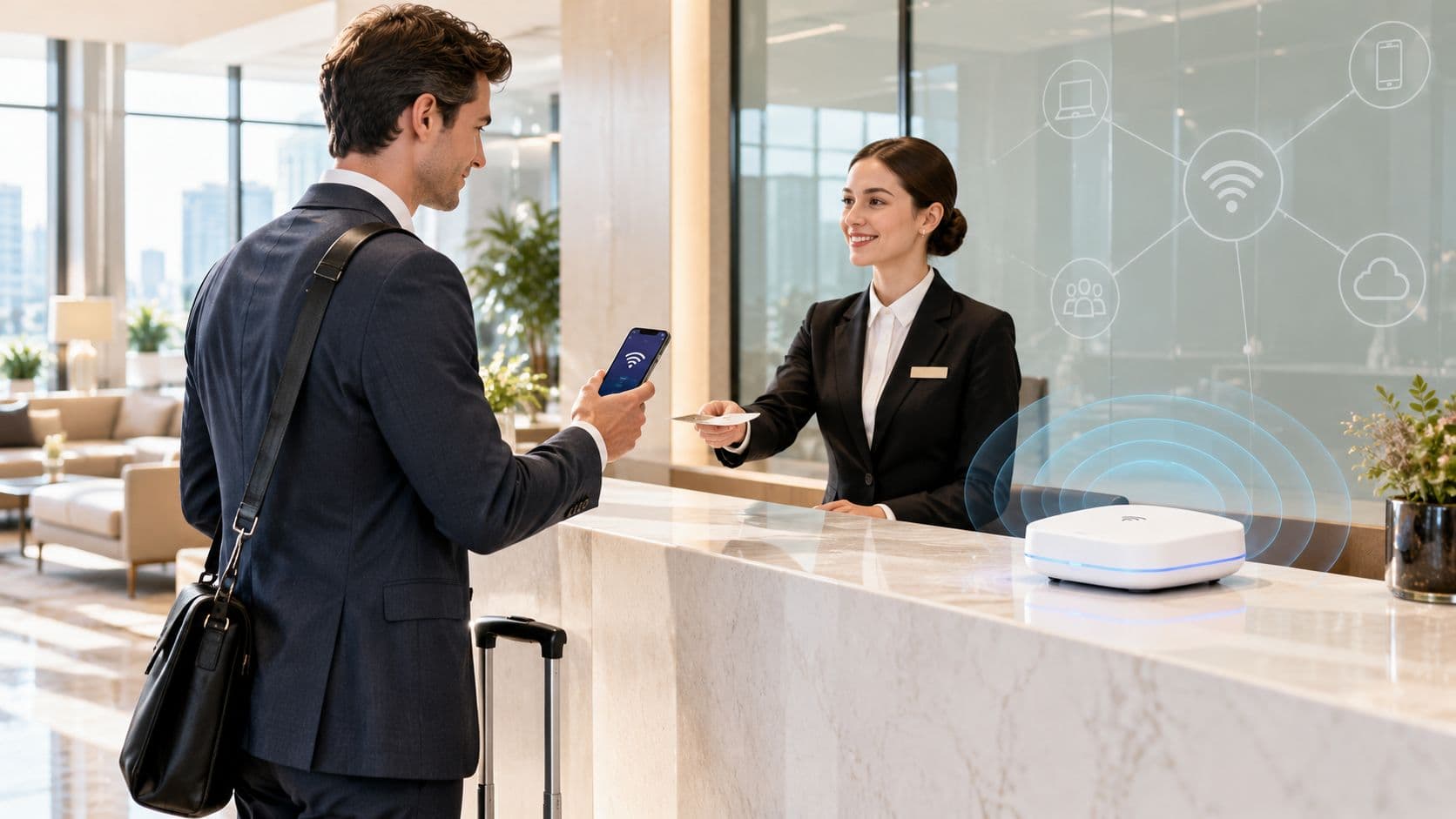
Unmanaged guest WiFi or shared pre-shared keys (PSKs) miss key commercial opportunities. Modern guest WiFi portals provide a seamless login experience, letting customers access your network via single-click email sign-in, SMS verification, or social authentication. For cafes, restaurants, and pubs, this keeps guests connected while collecting verified contact data to build long-term customer loyalty.
A structured guest WiFi setup gives customers convenient connectivity while enabling compliant data collection for marketing automation. This represents the standard for physical hospitality networks.
Guest login for WiFi: one-tap connectivity
Guest WiFi login transforms your wireless network from a passive utility into a customer relationship management (CRM) acquisition channel. Modern patrons appreciate an effortless sign-in process and tailored experiences such as digital menu recommendations, exclusive discounts, and automated loyalty rewards.
As a restaurant or cafe operator, you gain first-party profile data to engage guests effectively across multi-channel email and SMS campaigns.
How to implement guest login
Implementing guest WiFi is straightforward when leveraging cloud-managed software across your existing hardware:
- Choose a hardware-agnostic platform: Select a cloud software overlay like Purple that integrates across Cisco Meraki, HPE Aruba, Ruckus, Juniper Mist, and Ubiquiti UniFi.
- Configure network VLANs: Isolate guest traffic on a secondary VLAN separated from point-of-sale (POS) terminals to preserve PCI-DSS compliance.
- Design your splash page: Customize your captive portal splash page with brand colors, promo banners, and clear consent checkboxes.
- Establish data compliance: Present unbundled opt-in terms adhering to GDPR, CCPA, and global privacy standards.
- Sync with marketing CRMs: Automatically push captured profiles into Mailchimp, HubSpot, Salesforce, or Toast.
Comparing cafe & restaurant WiFi deployment models
Hospitality venues evaluate different network access models to balance guest convenience, data collection, and payment system security.
| Deployment Method | Target Application | Data Capture Ability | PCI-DSS Security Profile | Best Suited For |
|---|---|---|---|---|
| Branded Captive Portal | Diners, cafe patrons, and casual visitors | High (Email, SMS, Social opt-in) | Isolated Guest VLAN (Fully Compliant) | Full-service dining, cafes, pubs, and QSR chains |
| Open Unmanaged WiFi | Legacy basic internet provision | None (Zero contact data collected) | Unsecured (Shared password risk) | Not recommended for commercial venues |
| Passpoint (802.11u) | VIP loyalty diners & repeat members | High (Automated Profile Sync) | WPA3-Enterprise Encrypted | Multi-site restaurant groups & hotel dining |
| Staff & POS Network | Ordering tablets, POS terminals, KDS systems | N/A (Internal operational traffic) | High (802.1X / Hidden WPA3 PSK) | Internal hospitality operations |
Cafe WiFi policies: setting boundaries and bandwidth controls
A clear cafe or restaurant WiFi policy creates a comfortable digital environment while protecting your venue operations. Bandwidth management prevents network congestion and encourages fair access during peak dining hours.
Your network policy sets clear boundaries. Implementing 60-to-120 minute session caps or bandwidth throttling deters single-coffee patrons from camping on high-density tables during busy lunch shifts, ensuring new dining parties access fast connectivity.
Network security and PCI-DSS compliance
Security and transparency are essential when serving public guests. Protect your business by deploying WPA2 or WPA3 enterprise encryption, enforcing client isolation on guest VLANs, and maintaining compliance with ISO 27001, GDPR, and CCPA standards. Purple provides built-in compliance safeguards for single-site and enterprise chain operators.
Customer data collection: a strategic marketing asset
Guest WiFi provides cafe and restaurant owners with a privacy-compliant data collection engine. When guests log into your venue network, you gain actionable profile insights including:
- Contact details: Verified email addresses and phone numbers for follow-up marketing sequences.
- Demographic data: Age, gender, and social profile insights provided during opt-in.
- Real-world venue behaviour: Peak visit hours, average dwell times, and repeat visit frequency.
This data enables data-driven decisions regarding menu items, promotional timing, cafe seating layouts, and loyalty incentives.
Frequently asked questions about cafe and restaurant WiFi
How does guest WiFi impact POS system security and PCI-DSS compliance?
Guest WiFi must be isolated onto a dedicated secondary VLAN separate from point-of-sale (POS) systems, kitchen display units, and staff hardware. This prevents guest devices from scanning or communicating with payment terminals, preserving full PCI-DSS compliance.
How can cafes prevent guests from camping on tables all day?
Cafes set fair-use policies via cloud WiFi software, including automated session timeouts (e.g. 60 or 120 minutes) and per-device bandwidth limits during peak hours. Splash pages can also require a quick re-authentication or purchase code for extended access.
Does Purple require buying new wireless hardware for restaurants?
No. Purple is hardware-agnostic and overlays directly onto existing enterprise access points and WLCs from vendors like Cisco Meraki, HPE Aruba, Ruckus, Juniper Mist, and Ubiquiti UniFi.
Is guest data collection legal under GDPR and CCPA?
Yes. Purple ensures full privacy compliance by providing clear, unbundled consent checkboxes on splash pages, storing explicit consent records, and supporting automated opt-out workflows.
Turn your restaurant WiFi into a powerful customer acquisition engine
Capture compliant first-party guest data, analyze footfall analytics, and automate review requests across your hospitality venues.