-08eec4200864.webp&w=1920&q=75)
Size an iPSK guest network for your hotel
Enter your property and see the device load, key churn, isolation design and front-desk time a per-reservation passphrase saves.
High turnover of business travellers who need video calls, VPNs and a laptop that just connects.
Starting points only. Replace them with your own front-desk log for a figure you can defend.
One VLAN per room is workable (160 of the 4,094 usable 802.1Q IDs), though per-key group isolation avoids trunking them all to every AP.
- Occupied rooms = rooms × occupancy. Devices = occupied rooms × 2.8 per room for this property type.
- Keys a year = occupied rooms × 365 ÷ average stay, because each reservation gets one key.
- Requests = occupied room-nights × your rate per 100, then reduced by the share you expect iPSK to remove.
Every reservation gets its own WPA2 passphrase on a single SSID. The RADIUS server looks the key up at association and returns the room's VLAN or group, so phones, laptops and casting devices in one room share a private network and cannot see the room next door.
Oracle OPERA Cloud or OPERA V5 sends the check-in event (ohip business events for check-in, room move and check-out (opera cloud), or the fias interface on opera v5). A unique passphrase is generated and bound to the reservation.
The guest types the passphrase once on each device. The AP places every device using that key in the room’s VLAN or group, with mDNS kept inside it for casting.
The check-out event deletes the key, so departed guests and neighbours cannot keep using hotel bandwidth. A room move re-maps the same key.
# Access-Accept for MAC authentication on the iPSK SSID
# (Cisco Meraki and Catalyst 9800 syntax)
Tunnel-Type             = VLAN (13)
Tunnel-Medium-Type      = IEEE-802 (6)
Tunnel-Private-Group-ID = "room-304"
Cisco-AVPair            = "psk-mode=ascii"
Cisco-AVPair            = "psk=<unique per-reservation passphrase>"
Session-Timeout         = 86400   # re-check the key daily
# Key valid for 1.8 nights + 2 h grace = 162,720 s,
# revoked early on the PMS check-out event.
# HPE Aruba uses the Aruba-MPSK-Passphrase VSA instead of psk=.
Purple's hospitality team can review your numbers, confirm iPSK support on your controller and show the PMS key flow live.
In hospitality, guest satisfaction hinges on invisible amenities. While a comfortable bed and clean room are baseline expectations, fast, reliable WiFi is consistently rated as the single most influential factor in hotel reviews and repeat bookings. However, traditional hotel WiFi architectures create friction for guests and security vulnerabilities for hotel operators.
Identity Pre-Shared Keys (iPSK) solve these challenges by replacing legacy captive portals with a secure, personalised wireless network. By assigning a unique passphrase to each guest or room, iPSK delivers enterprise-grade encryption alongside a seamless "home-away-from-home" connection.
Key takeaways: iPSK for hotel guest WiFi
- Captive portal elimination: Replace repetitive login web pages with a single WPA2/WPA3 key that connects guest devices automatically upon arrival.
- Private Area Networks (PAN): Isolate every room's wireless traffic so guests can cast to in-room TVs without exposing devices to other hotel guests.
- Headless device support: Connect streaming sticks, gaming consoles, and smart speakers that lack web browsers.
- Automated PMS integration: Sync WiFi credentials directly with Property Management Systems for instant onboarding at check-in and revocation at check-out.
- Enterprise hardware compatibility: Deploy seamlessly across existing Cisco Meraki, HPE Aruba, and Ruckus wireless infrastructures.
Why legacy hotel captive portals frustrate guests and IT teams
For over two decades, hotels have relied on captive portals for guest WiFi authentication. Guests connect to an open network, wait for a splash page to pop up, and enter their room number and surname. While this system provided basic identification, modern guest expectations have outgrown it.
Standard captive portal deployments present several persistent operational challenges:
- Frequent disconnection timeouts: Security policies force captive portals to re-authenticate guests every 24 hours. Guests returning to their room after dinner find their smartphones disconnected, missing important notifications.
- Incompatibility with headless devices: Guests routinely travel with streaming sticks (Chromecast, Roku, Fire TV), smartwatches, and gaming consoles. These devices lack a built-in web browser, making it impossible to pass captive portal web forms.
- Lack of room isolation: On standard open guest networks, client isolation prevents devices from discovering each other. While this stops malicious sniffing, it also prevents guests from casting video from their tablet to their in-room television.
- Unencrypted wireless traffic: Open WiFi networks without pre-shared keys leave unencrypted data frames exposed to local packet sniffing on concourses and in corridors.
How iPSK works for hotel guest WiFi
Identity Pre-Shared Key (iPSK) technology bridges the gap between simple home WiFi passphrases and enterprise-grade 802.1X security. On a standard home network, every family member shares the exact same password. On a legacy enterprise network, every user requires individual certificate credentials.
iPSK enables a single hotel SSID to accept thousands of unique passphrases. When a guest enters their dedicated passphrase into their smartphone, laptop, or streaming stick, the wireless access point passes the passphrase to a RADIUS authentication server. The server verifies the key, associates the device with the guest's profile, and applies room-specific VLAN policies.
To learn more about identity-based architecture, read our detailed multi-tenant WiFi guide.
Comparing hotel WiFi authentication models
The table below compares open guest networks, traditional captive portals, and PMS-integrated hotel iPSK deployments across key technical and operational requirements:
| Feature / Requirement | Open Guest WiFi | Captive Portal | Hotel iPSK (Purple) |
|---|---|---|---|
| Data Encryption | None (Unencrypted) | Web-only SSL | Full WPA2/WPA3 Enterprise |
| Guest Experience | Instant connection, zero privacy | Frequent timeouts & re-login forms | Seamless "home-like" auto-connect |
| Smart TV / Device Casting | Fails (Shared subnet risk) | Fails (No web browser) | Supported via Private Area Network |
| PMS Automation | None | Room number & name check | Automated check-in & check-out sync |
| Device Isolation (PAN) | No (Peer-to-peer risk) | Client isolation blocks casting | Isolated private room VLAN / bubble |
Private Area Networks (PAN): In-room streaming without security risks
Modern travellers expect to mirror their personal content to the hotel room display. However, enabling device discovery on a traditional hotel subnet means Guest A in Room 204 could accidentally cast their personal phone screen to Guest B's television in Room 205.
iPSK solves this through Private Area Networks (PANs). When a guest enters their room-specific iPSK key across multiple personal devices (phone, laptop, Chromecast), the network places all those devices into a private, isolated virtual subnet. The guest's devices communicate seamlessly with each other while remaining completely shielded from every other room in the property.
This delivers the exact convenience of home networking alongside enterprise security compliance. For detailed network isolation architecture, consult our enterprise WiFi security guide.
Automating the guest lifecycle with Property Management System (PMS) integration
Managing individual WiFi credentials for hundreds of daily arrivals and departures must be completely automated. Purple's iPSK platform integrates directly with major Property Management Systems (PMS), including Oracle Opera, Mews, Stayntouch, RMS, and Protel.
1. Pre-arrival credential generation
When a reservation is confirmed or checked in within the PMS, Purple automatically generates a unique iPSK passphrase. This key is delivered to the guest via their digital confirmation email, SMS welcome message, or printed on their key card sleeve.
2. Seamless multi-device onboarding
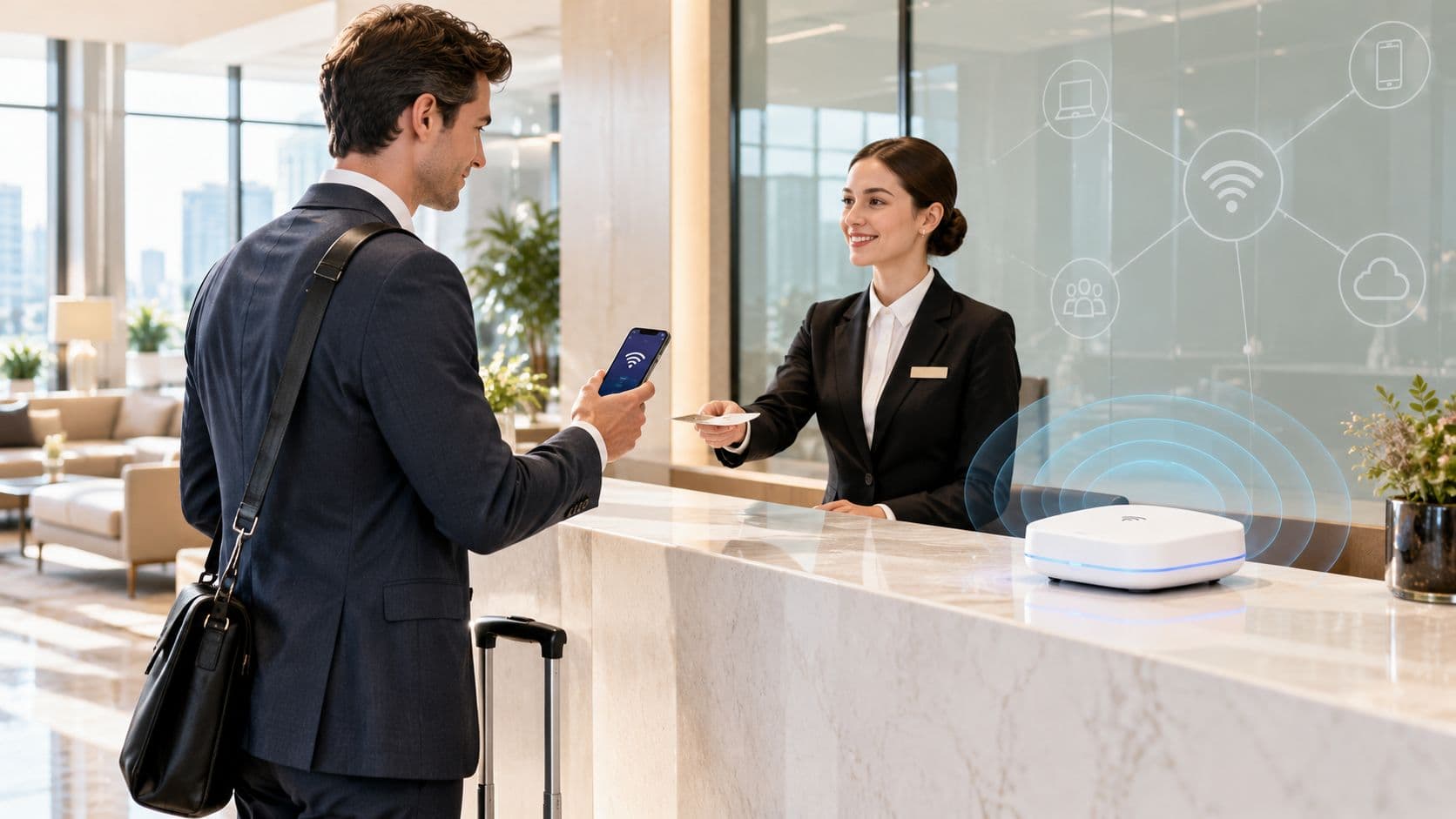
Upon arrival, the guest selects the hotel's WiFi network and enters their passphrase once. Their smartphone, laptop, and tablet connect instantly without requiring web login screens or email verifications.
3. Automatic check-out revocation
When the front desk processes check-out in the PMS, the guest's unique iPSK is automatically deactivated across the RADIUS infrastructure. This prevents former guests from accessing the network from the carpark or adjacent facilities after departure.
Hardware compatibility and multi-vendor support
Upgrading to iPSK does not require replacing existing hotel wireless hardware. Purple's cloud management layer is hardware-agnostic, supporting leading enterprise network vendors:
- Cisco Meraki: Native IPSK authentication with identity policy tagging.
- HPE Aruba Networks: ePSK integration via Cloud Auth and ClearPass.
- Ruckus Wireless: Dynamic PSK (dPSK) lifecycle management.
- Juniper Mist: Multi-PSK passphrase generation via Cloud API.
To explore how location insights and marketing opt-ins enhance guest retention, visit our WiFi marketing guide.
Frequently asked questions about hotel iPSK WiFi
Direct answers to technical questions regarding Identity Pre-Shared Keys in hotel environment deployments.
What is iPSK in hotel WiFi?
Identity Pre-Shared Key (iPSK) is a wireless security protocol that assigns a unique WPA2/WPA3 passphrase to each hotel guest or room on a single SSID. It provides enterprise data encryption and private room networking without forcing guests through web browser captive portals.
How does iPSK improve guest satisfaction scores?
iPSK eliminates login timeouts, re-authentication forms, and failed connections on smart devices. Guests connect once at check-in and stay connected across the entire property, matching their home WiFi experience.
Can guests cast Chromecast and Netflix content to room TVs with iPSK?
Yes. iPSK creates a Private Area Network (PAN) that allows a guest's smartphone or tablet to discover and stream to their in-room smart TV or Chromecast securely, without exposing their device to other rooms.
How does Purple automate iPSK credential management?
Purple integrates directly with hotel Property Management Systems (PMS) like Oracle Opera and Mews. Unique keys are generated automatically upon check-in, sent via email/SMS or key card sleeves, and revoked automatically at check-out.
Does iPSK require replacing existing hotel access points?
No. Purple's iPSK solution is hardware-agnostic and works with existing enterprise wireless infrastructure from vendors including Cisco Meraki, HPE Aruba, Ruckus Wireless, and Juniper Mist.
Transform your hotel WiFi with zero-friction iPSK
Eliminate captive portal complaints, automate PMS check-in onboarding, and deliver secure in-room streaming with Purple's hospitality WiFi platform.