
Managing IoT Device Security with NAC and MPSK
This technical guide details how enterprise venues can secure headless IoT devices using Multiple Pre-Shared Key (MPSK) architecture and Network Access Control (NAC). It provides actionable implementation steps for achieving micro-segmentation, containing security blast radii, and maintaining compliance without sacrificing scalability.
Video overview
Listen to this guide
View podcast transcript
Part of our core series: Enterprise WiFi Security Guide →

Executive Summary
Enterprise networks in Retail, Hospitality, and Transport venues are experiencing a massive expansion of headless IoT devices - from environmental sensors and smart thermostats to IP cameras and point-of-sale terminals. The fundamental challenge for IT managers and network architects is that most of these devices do not support enterprise-grade IEEE 802.1X authentication.
Historically, organisations have relied on a single, global pre-shared key (PSK) for their entire IoT SSID. This creates an unacceptable security posture where a single compromised device or leaked password breaches the entire IoT network segment.
This technical reference guide details how deploying a Multiple Pre-Shared Key (MPSK) architecture with a robust Network Access Control (NAC) policy engine solves this challenge. By issuing unique credentials per device and leveraging dynamic VLAN assignment, network teams can achieve micro-segmentation, limit the blast radius, and maintain strict compliance (such as PCI DSS) without compromising on the scalability required for thousands of endpoints. When integrated with platforms like Purple's Guest WiFi and WiFi Analytics, this approach ensures seamless, secure, and highly visible network operations.
Technical Deep Dive
Limitations of Traditional PSK and 802.1X
In a standard enterprise environment, devices authenticate via IEEE 802.1X using device certificates (EAP-TLS) or credentials (PEAP). However, headless IoT devices typically lack the supplicant software required for 802.1X. Traditionally, the alternative has been WPA2/WPA3-Personal using a single PSK.
The operational reality of a global PSK is severe:
- Zero Segmentation: All devices on the PSK share the same broadcast domain unless they are manually mapped by MAC address, which is operationally unsustainable.
- High Blast Radius: A single compromised smart bulb provides lateral movement access to the entire VLAN.
- Key Rotation Challenge: Revoking access for a compromised device requires changing the global PSK and manually updating every other device on the network.
MPSK and NAC Architecture
MPSK (also known as identity PSK or iPSK by some vendors) fundamentally shifts this paradigm. It allows a single SSID to accept thousands of unique passwords. However, its intelligence lies in its integration with a NAC or RADIUS server.
When a device connects to the MPSK SSID, the Wireless LAN Controller (WLC) forwards the authentication request to the NAC. The NAC engine evaluates the specific password used, correlates it with the device identity (MAC address, profiling data), and returns a RADIUS Access-Accept message containing specific attributes - in particular, the VLAN ID and Access Control List (ACL) policies.
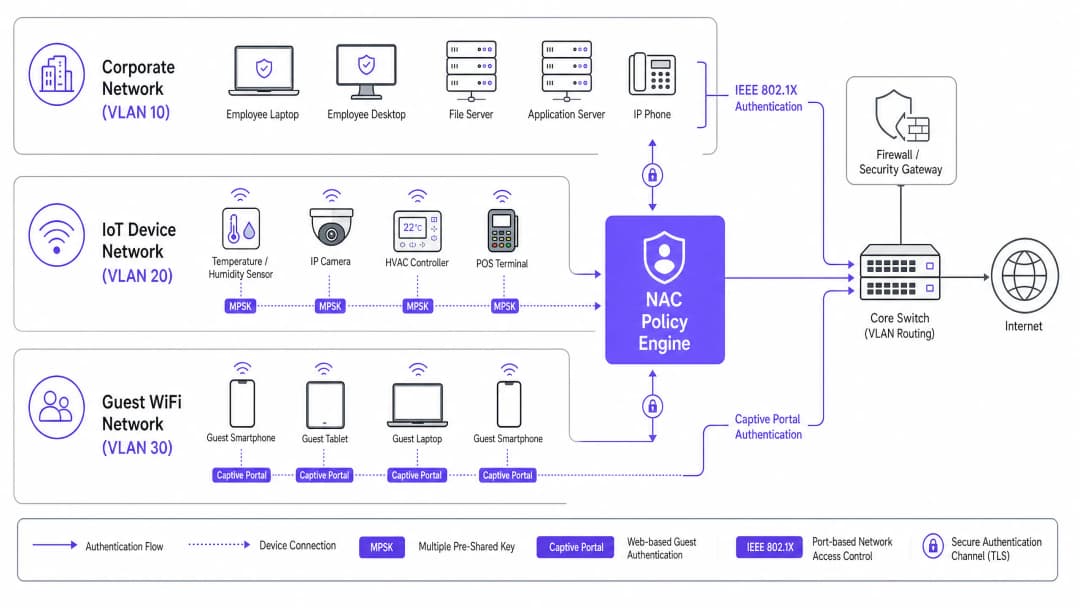
This architecture enables Dynamic VLAN Assignment. A smart thermostat and an IP camera can connect to the exact same SSID using different passwords, and the network infrastructure will place the thermostat into VLAN 50 (restricted to cloud gateway access) and the camera into VLAN 40 (restricted to the local NVR server).

Audio Briefing
Listen to a technical briefing on this architecture from our Senior Consultant:
Got questions about your specific setup?
Our team works with venue operators, IT managers, and network engineers across 80,000 venues. Book a 20-minute call and we will show you how others like you solved it.
Implementation Guide
Deploying MPSK with NAC requires careful planning to ensure scalability and security. Follow these steps for a successful rollout.
Step 1: Infrastructure Readiness Assessment
Ensure that your wireless controllers and access points support MPSK/iPSK. Most modern enterprise networking vendors (Cisco, Aruba, Meraki, Ruckus) support this natively, provided the firmware is up to date. Verify that your NAC solution can handle the expected load of RADIUS requests and supports dynamic VLAN assignment based on password matching.
Step 2: Define Micro-Segmentation Policies
Before generating a single key, define your VLAN architecture. Group IoT devices based on their function and required access.
- VLAN 40 (Security Cameras): Only allow traffic to the local NVR IP and specific NTP servers. Block internet access.
- VLAN 50 (Environmental Sensors): Allow outbound HTTPS traffic to specific vendor cloud endpoints. Block inter-VLAN routing.
- VLAN 60 (Point of Sale): Strict PCI DSS compliance. Deny all inbound traffic; only allow outbound traffic to the payment gateway.
Step 3: Device Profiling and Key Generation
Do not generate keys manually. Use the NAC's APIs or self-service portal to generate unique keys per device. Bind each key to the device's MAC address. This ensures that even if an MPSK is extracted from a thermostat, it cannot be used by a rogue laptop spoofing the network.
Step 4: Integration with Analytics and Guest Network
Although IoT networks are isolated, overall management should be unified. Ensure your NAC deployment aligns with your broader network strategy, including Guest WiFi provisioning. Platforms that provide WiFi Analytics can offer valuable insights into device density and network health across all segments. To learn more about network fundamentals, review WiFi Frequencies: A Guide to WiFi Frequencies in 2026.
Best Practices
- Enforce MAC Binding: Always bind the MPSK to the device's specific MAC address. If a different MAC attempts to use the key, the NAC must reject the authentication.
- Implement DHCP Fingerprinting: Use DHCP profiling within the NAC to verify device types. If an MPSK assigned to a 'Smart TV' is suddenly used by a device fingerprinting as 'Windows 11', trigger an automatic quarantine.
- Automate Lifecycle Management: Integrate MPSK generation with your IT Service Management (ITSM) platform. When a device is decommissioned in the asset register, the associated MPSK should be automatically revoked via API.
- Regular Auditing: Conduct quarterly audits of active MPSKs against your asset inventory to identify and remove orphaned keys.
Troubleshooting and Risk Mitigation
Common Failure Modes
- RADIUS Timeout Issues: If there is an excessive load on the NAC engine or latency is high, headless devices may time out and fail to connect.
- Mitigation: Ensure high availability and localised RADIUS proxies if dealing with highly distributed environments like large retail chains.
- MAC Spoofing: An attacker clones the MAC address of an authorised IoT device and extracts its MPSK.
- Mitigation: Rely on deep packet inspection and behavioural profiling. If a "thermostat" suddenly begins scanning the network on port 22 (SSH), the NAC or IDS should immediately isolate the port.
- Roaming Disconnects: Some poorly designed IoT devices drop connections when roaming between APs using MPSK.
- Mitigation: Adjust minimum basic rates and ensure proper RF cell overlap. For in-depth wireless design considerations, see BLE Low Energy Explained for Enterprise.
ROI and Business Impact
Transitioning to an MPSK/NAC architecture delivers measurable business value:
- Reduced Operational Expenditure (OpEx): Eliminates hundreds of hours spent by IT teams manually updating global PSKs when a single device is compromised or replaced.
- Compliance Assurance: For retail and hospitality venues, strict micro-segmentation is a core requirement of PCI DSS. MPSK provides a proven, auditable mechanism to isolate payment terminals, avoiding costly compliance fines.
- Risk Mitigation: By limiting the blast radius of any compromised device to its specific micro-segment, the potential financial and reputational damage of a lateral-movement ransomware attack is significantly reduced.
- Future-Proofing: As enterprise networks evolve, integrating IoT security with broader WAN strategies becomes critical. For context on broader network architectures, see SD WAN vs MPLS: The 2026 Enterprise Network Guide and The Role of SCEP and NAC in Modern MDM Infrastructure.
Key Definitions
MPSK (Multiple Pre-Shared Key)
A wireless security feature allowing multiple unique passwords to be used on a single SSID, with each password capable of triggering different network policies.
Crucial for securing headless IoT devices that cannot support enterprise 802.1X authentication.
NAC (Network Access Control)
A security solution that enforces policy on devices attempting to access the network, ensuring they meet security requirements before granting access.
Acts as the intelligence engine behind MPSK, determining VLAN assignment based on the password used.
Dynamic VLAN Assignment
The process where a network switch or wireless controller assigns a device to a specific VLAN based on authentication credentials rather than the physical port or SSID.
Enables micro-segmentation of IoT devices broadcasting on the same wireless network.
Blast Radius
The extent of damage or lateral movement an attacker can achieve after compromising a single device or system.
MPSK and NAC drastically reduce the blast radius by isolating compromised IoT devices within strict micro-segments.
Headless Device
A computing device, typical in IoT deployments, that operates without a monitor, keyboard, or user interface.
These devices cannot prompt a user for credentials, making traditional 802.1X authentication impossible.
MAC Binding
A security control that restricts the use of a specific credential (like an MPSK) to a single, authorised MAC address.
Prevents an attacker from stealing an MPSK from a smart bulb and using it on a malicious laptop.
DHCP Fingerprinting
A profiling technique used by NAC systems to identify a device's operating system and type based on the specific sequence of DHCP options it requests.
Used to verify that a device connecting with an IoT MPSK is actually an IoT device and not a spoofed endpoint.
Micro-segmentation
A security technique that divides the network into granular, isolated zones to maintain strict access control and limit lateral movement.
The primary architectural goal of deploying MPSK and NAC for IoT security.
Worked Examples
A 300-room hotel is deploying new smart TVs, IP-based door locks, and environmental sensors. The current infrastructure uses a single global PSK for all non-corporate devices. How should the network architect redesign this for optimal security and manageability?
The architect should deploy an MPSK SSID ('Hotel-IoT'). The NAC policy engine must be configured with three distinct device profiles. Smart TVs receive unique MPSKs and are dynamically assigned to VLAN 100 (Internet only, client isolation enabled). Door locks receive unique MPSKs, are bound to their specific MAC addresses, and assigned to VLAN 110 (restricted access only to the local security server). Sensors receive unique MPSKs and are assigned to VLAN 120 (access only to the HVAC management cloud). All keys are generated via API during device onboarding.
A large retail chain needs to connect hundreds of wireless Point-of-Sale (POS) scanners and digital signage displays across 50 locations. How can they ensure PCI DSS compliance while minimising IT overhead?
Implement a centralised NAC architecture with MPSK. The POS scanners are issued unique MPSKs and profiled into a highly restricted PCI-compliant VLAN that denies all lateral traffic and only permits outbound connections to the payment processing gateway. Digital signage displays use separate MPSKs and are dropped into a different VLAN with internet-only access for content updates. Key lifecycle management is integrated with the central asset management system.
Practice Questions
Q1. A stadium IT team needs to deploy 200 new wireless point-of-sale terminals. They plan to use MPSK. To ensure maximum security, what two profiling checks must the NAC perform before assigning the POS terminal to the secure VLAN?
Hint: Consider how to prevent a stolen MPSK from being used on a non-POS device.
View model answer
The NAC must perform MAC Binding (verifying the specific MPSK is being used by the authorised MAC address) and DHCP Fingerprinting (verifying the device requesting an IP address exhibits the characteristics of the expected POS terminal OS, not a generic laptop or smartphone).
Q2. During an audit, it is discovered that an MPSK assigned to a smart thermostat was successfully used by a contractor's laptop to gain network access. The NAC assigned the laptop to the thermostat's VLAN. What configuration failure allowed this?
Hint: Think about the relationship between the key and the device identity.
View model answer
The primary failure was a lack of MAC Binding. The MPSK was not restricted to the specific MAC address of the thermostat. Additionally, the NAC failed to enforce device profiling (e.g., DHCP fingerprinting), which would have identified the contractor's laptop as an anomalous device type for that specific key and VLAN.
Q3. A retail chain is migrating from a global PSK to MPSK. They have 5,000 legacy barcode scanners that support WPA2-Personal but cannot be updated to support newer protocols. Can MPSK be used to secure these devices, and if so, how?
Hint: Consider the client-side requirements for MPSK.
View model answer
Yes, MPSK can be used. From the perspective of the client device (the barcode scanner), MPSK is identical to standard WPA2-Personal PSK. The intelligence and differentiation happen entirely on the infrastructure side (WLC and NAC). The scanners simply need to be configured with their newly assigned, unique passwords.
Continue reading in this series
How to Securely Segment Staff and Guest WiFi Networks: Best Practices for Enterprise LANs
This guide provides IT managers and network architects with a vendor-neutral, technical blueprint for securing enterprise LANs by properly segmenting staff and guest WiFi traffic. It covers 802.1X authentication, cloud RADIUS, VLAN isolation, and the credential lifecycle management required to eliminate shared passphrases and protect corporate assets.
Best DNS filtering: a comprehensive guide for businesses
This technical reference guide explains how enterprise DNS filtering secures public networks by blocking malicious domains at the resolution layer - before a connection is ever established. It gives IT directors, network architects, and venue operations teams the deployment architecture, firewall configuration, and compliance context they need to protect Guest WiFi across hospitality, retail, and public-sector environments. Purple Shield blocks malware, botnets, and inappropriate content at the DNS level across 80,000+ live venues.
Understanding Cisco SUDI: Hardware-Anchored Identity in Secure Network Access Control
This guide explains how Cisco SUDI provides hardware-anchored, cryptographically secure identity for enterprise network infrastructure. Learn how to replace spoofable MAC addresses with immutable 802.1AR certificates to secure your venue's network access control.
Got questions about your specific setup?
Our team works with venue operators, IT managers, and network engineers across 80,000 venues. Book a 20-minute call and we will show you how others like you solved it.