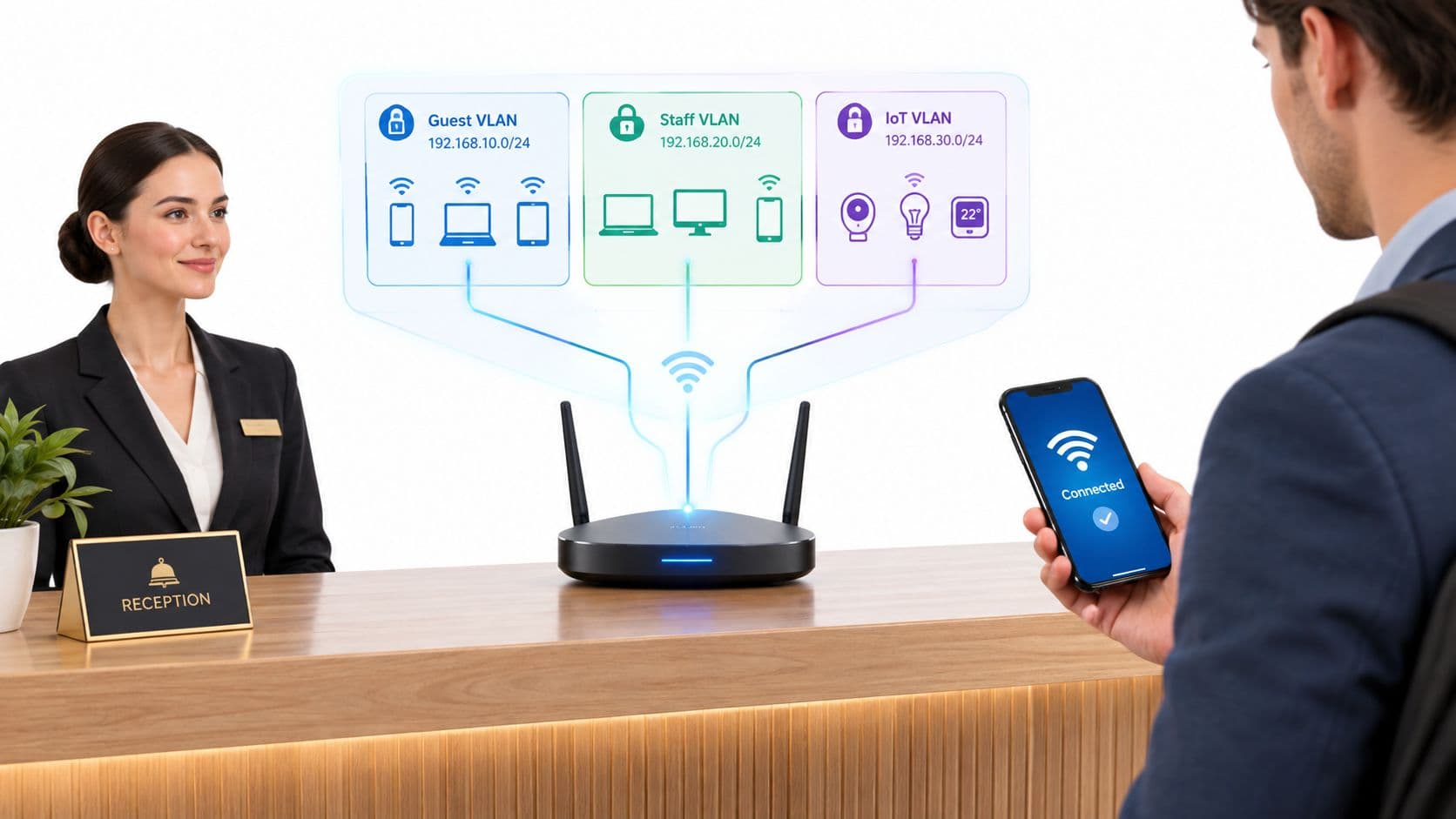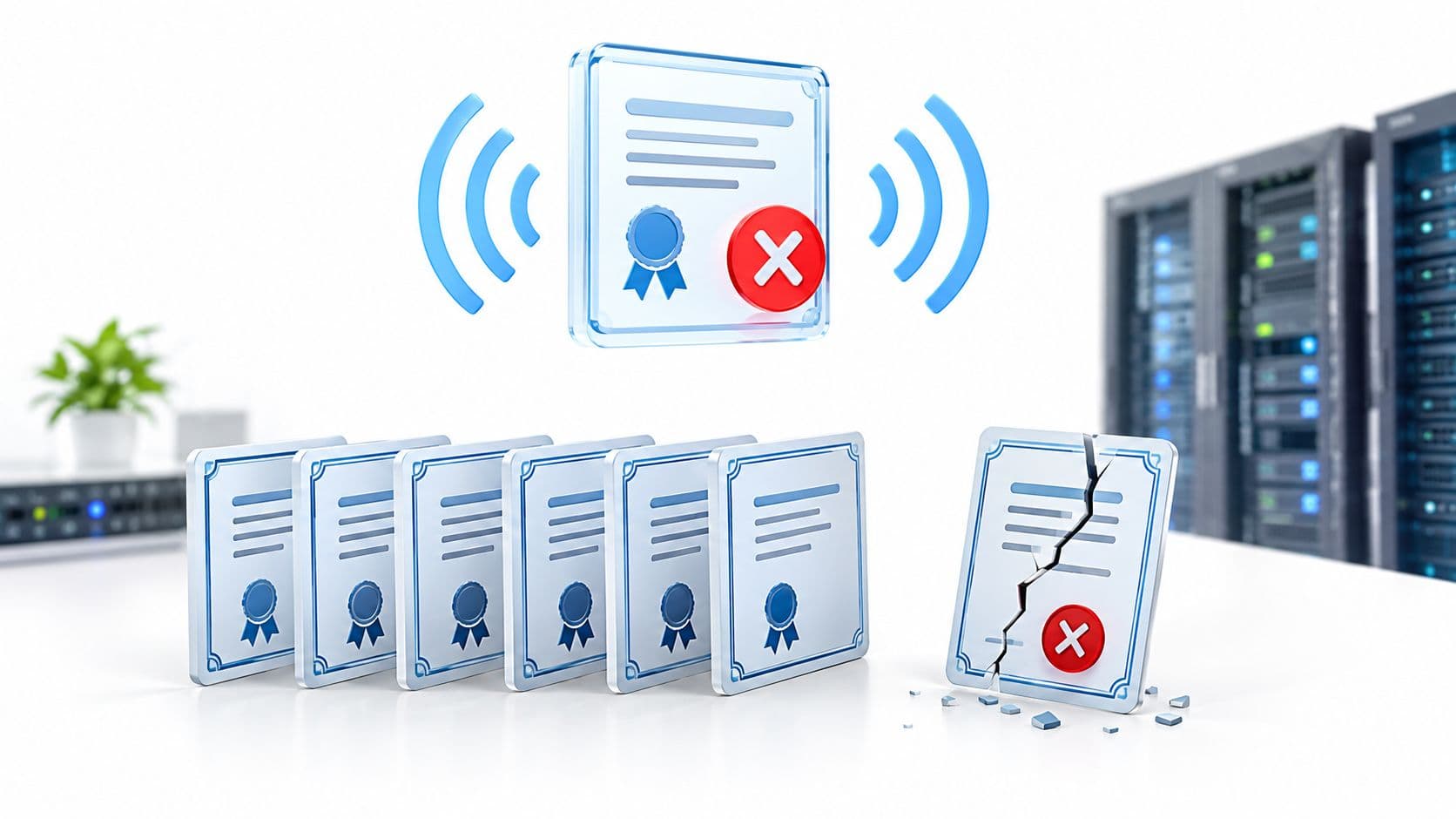
A company laptop is stolen on the train. The helpdesk disables the employee's Active Directory account, the device disappears from the asset register, and everyone assumes the risk has been removed. Two days later, the laptop still appears on the corporate SSID because its 802.1X supplicant holds a client certificate that hasn't expired and nobody has revoked it.
That's the gap a revocation list certificate process is designed to close. Certificate expiration sets the outer limit of trust, while revocation cuts trust off earlier when a key is compromised, a device is lost, or a user leaves. For an enterprise WiFi administrator, the important question isn't whether certificates exist. It's whether RADIUS and related network controls learn about a revoked certificate quickly and fail safely.
The WiFi Access That Would Not Go Away
A certificate-based WiFi deployment often looks secure from the outside. The client uses EAP-TLS, the RADIUS service validates the certificate chain, and shared passwords aren't passed around between staff. But that design still depends on a working lifecycle. Issuing a certificate is only the start. You must also know who owns it, when it expires, and what happens if the device or private key is no longer trusted.
In the stolen-laptop example, removing the account from Active Directory may stop future directory authentication, but it doesn't necessarily invalidate a certificate already installed on the device. If the WiFi service trusts the certificate based on its chain and validity dates alone, the laptop can continue presenting apparently valid credentials. The certificate's notAfter date says it remains within its scheduled lifetime. It doesn't say that the issuing organization still wants to trust it.
Practical rule: Treat certificate expiration and certificate revocation as separate controls. Expiration is planned lifecycle management. Revocation is the emergency brake.
The US public-sector PKI model makes that distinction explicit. A Certificate Revocation List, or CRL, is a signed list of certificate serial numbers revoked before expiry, which tells relying parties that those certificates should no longer be trusted. US public-key infrastructure guidance also identifies CRLs as one of the common revocation methods and expects clients to check whether a presented certificate appears on the issuing CA's list.
This matters on WiFi because authentication decisions happen at the network edge, often across many controllers, access points, RADIUS servers, and cached validation stores. A manual CRL update can leave a security gap, while a poorly designed fail-closed policy can create an outage if the CRL distribution point becomes unavailable.
The working mental model is straightforward: the CA issues and signs status information, the relying party checks it, and the network denies a certificate that has been revoked. The rest of this guide examines how that process works, where CRL and OCSP differ, and how directory-driven access controls can remove much of the manual revocation bottleneck.
What a Revocation List Certificate Actually Is
In plain language, a Certificate Revocation List is an official “no longer trust these certificates” notice from a certificate authority. It identifies certificates by their serial numbers, not by a friendly device name or an employee's email address. A client that finds the presented certificate's serial number on the relevant list must reject it, even if the certificate's expiry date is still in the future.
The definition is formal. It describes a CRL as a signed list of certificate serial numbers revoked before expiration, so relying parties should no longer trust those certificates. The signature matters because a RADIUS server or other validator must confirm that the list came from the expected issuer and hasn't been altered in transit. A plain text blocklist maintained by an administrator doesn't provide that cryptographic assurance.
Three parties make the process useful:
- The certificate authority: The CA, or an authorized CRL issuer, creates the list and signs it using a private key associated with the issuing trust hierarchy.
- The relying party: A RADIUS server, supplicant, controller, operating system, or administrative tool downloads the list, validates its signature and validity information, then searches for the certificate serial number.
- The certificate holder: The person, device, or service whose certificate has been revoked. Its serial number remains on the list so validators can identify it as untrusted.
A CRL isn't normally a certificate in the same sense as a user or device certificate. It's a signed PKI artifact that carries issuer, validity, and publication information. People sometimes use “revocation list certificate” as shorthand for the certificate-revocation mechanism, but the operational object being checked is the signed CRL.
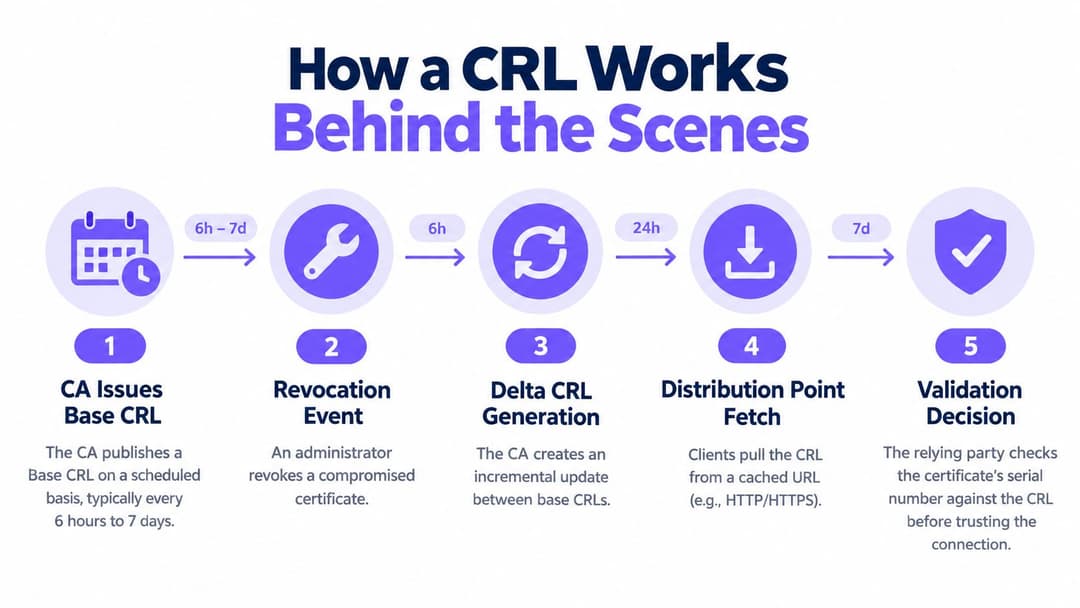
The relying party doesn't usually ask the CA to explain why a user should be denied. It follows the certificate's revocation information, retrieves the issuer's current CRL, verifies the CRL, and checks the serial number. If there's a match, the certificate is revoked. If there isn't, the result is still bounded by the CRL's freshness and the relying party's own cache.
That last point causes many incidents. A certificate may be absent from an old cached list and present on a newer one. The network's decision therefore depends on both what the CA published and when the authenticator last obtained it.
How a CRL Works Behind the Scenes
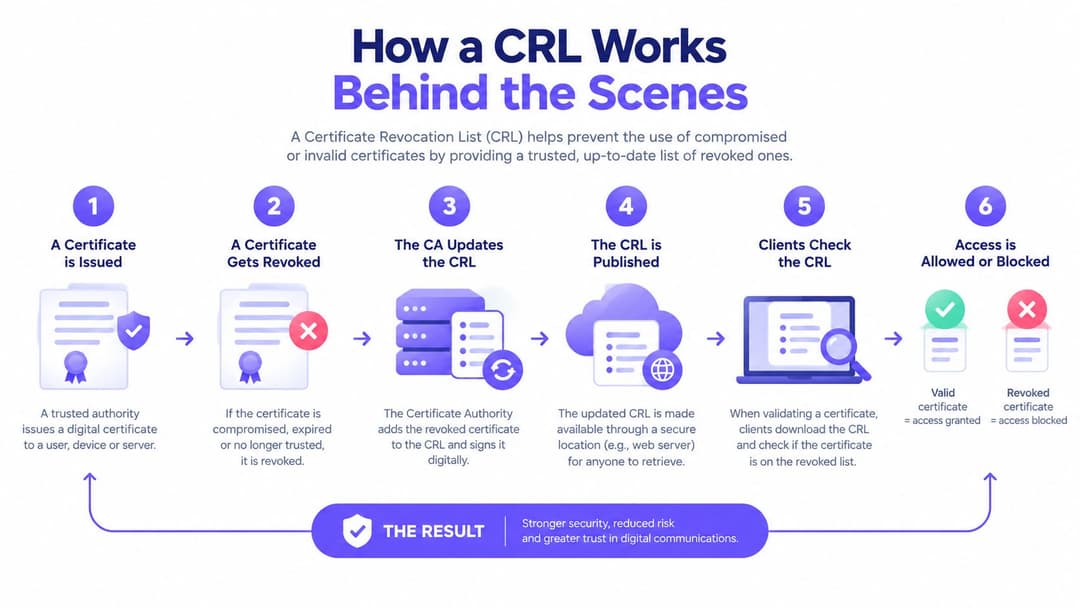
A CRL lifecycle follows a predictable chain of events. First, the CA generates a base list according to its certificate policy. It signs the list, adds publication and validity fields, and makes it available through a distribution point. Issued certificates commonly refer to those locations through the CRL Distribution Points extension, allowing a validator to discover where status information belongs.
When an administrator revokes a device certificate, the CA records its serial number and reason information. The certificate won't necessarily appear in every relying party's cache immediately. The next published CRL must contain the entry, and each RADIUS server or controller must retrieve a current copy before it can make the correct decision.
Some PKI environments also use delta CRLs. A delta contains changes since a base CRL, which can reduce transfer and processing work when the full list is large. That efficiency doesn't remove the need to manage the base list, validate signatures, track freshness, or make sure every network component understands the chosen publication model.
The freshness window
US policies provide useful reference points for thinking about propagation. For instance, federal PKI standards require CRLs to be issued at regular intervals, and require a revoked certificate to appear in the relevant CRL within 72 hours of revocation. Those limits are described in the federal certificate policy guidelines.
Other policies use different service expectations. HM Land Registry states that its revocation list for revoked and suspended certificates must be updated at least once per day, while Eastern Michigan University's certificate practice statement gives a maximum latency of 10 days between revocation and CRL issuance. These examples, including the federal PKI trust anchors, show why an administrator must read the issuing CA's actual policy rather than assume every CRL behaves identically.
At authentication time, the RADIUS server checks the certificate serial against its locally available CRL. It also checks whether the CRL is within its validity period, whether the signature chains to the expected issuer, and whether the distribution point can be reached when a refresh is due. The server then caches the result according to its implementation and the CRL's nextUpdate value.
That produces a practical risk equation without needing complicated math: revocation latency includes CA publication time, distribution delay, cache duration, and authentication frequency. A policy can publish quickly, but a disconnected or stale RADIUS cache can still delay enforcement.
CRL vs OCSP and Why It Matters on WiFi
CRL and OCSP solve the same basic problem in different ways. A CRL gives the validator a signed batch of revoked serial numbers. OCSP asks an authorized responder for the status of one certificate at the time it's being checked.
For an enterprise WiFi administrator, the choice affects more than PKI elegance. It changes how a controller behaves across a congested WAN, what the CA infrastructure must handle, and whether an authentication attempt can complete when a responder or distribution point is unreachable.
| Criterion | CRL | OCSP |
|---|---|---|
| Freshness | Periodic. A newly revoked certificate waits for publication and client refresh. | Per-certificate query can provide more current status when the responder is reachable. |
| Infrastructure load | Clients download and process a list, which may be efficient for repeated checks against a managed estate but can create distribution traffic. | The responder handles individual status requests, which avoids full-list downloads but adds request volume. |
| Privacy | The relying party obtains a list and doesn't need to reveal each certificate check to the CA. | A direct query can reveal which certificate is being checked to the responder. |
| Failure mode | An unreachable or expired CRL can prevent reliable status validation. Local caches may continue to operate until their freshness limit. | An unreachable responder affects the individual status query, and the configured soft-fail or hard-fail behavior determines the WiFi outcome. |
A controller serving a large campus might prefer a locally cached CRL because it can check many certificate serial numbers without sending a separate request for every authentication. That model works well when distribution points are reachable, updates are monitored, and the RADIUS policy handles an expired list deliberately.
OCSP can suit a design where the operator needs a per-certificate response and accepts the dependency on a responder. It can reduce the need to transfer a complete list, but it introduces a live network dependency during authentication. Stapling can move the responder interaction elsewhere in some protocols, yet the WiFi design still needs a clear answer for unavailable or stale status data.
The US guidance is useful here because it doesn't present CRL as the only method. Federal policy describes CRLs as one of the common revocation mechanisms, while justice-sector guidance treats them as a primary offline mechanism and highlights availability requirements for revocation services in the PKI disclosure statement.
For managed 802.1X devices, CRL is usually practical for periodic batch validation, especially when the fleet has reliable internal distribution. OCSP is preferable where tighter status freshness is essential and responder availability is engineered accordingly. High-assurance networks may run both, but only if the fallback behavior is documented and tested rather than assumed.
Revocation in Practice on a Purple WiFi Network
The operational difference appears when WiFi access is tied to a live identity directory instead of a manually maintained certificate list. A directory integration can make the user's current account state part of the authentication decision, so disabling an account becomes an access-control event rather than a ticket that someone must later translate into a CA revocation.
A typical flow looks like this:
- The directory records the identity state. An account is created, changed, suspended, or disabled in Active Directory, Entra ID, or Google Workspace.
- The WiFi identity service receives the change. The service maps the directory state to the authentication policy for the organization.
- The next authentication is evaluated against that state. A disabled identity no longer satisfies the access rule, even if a previously issued credential remains within its certificate lifetime.
- The network denies access. The RADIUS decision prevents a new 802.1X session from being authorized under the inactive identity.
That model addresses a weakness in CRL-only operations. A CRL depends on CA publication, distribution points, cache refreshes, and relying-party checks. Directory-driven enforcement makes the identity system the operational source of truth for account status, reducing the need for an administrator to find every certificate serial associated with a departing user.
Operational distinction: A CRL answers whether a certificate is revoked. Directory-driven authentication can answer whether the identity is currently authorized to use the network.
Purple provides managed RADIUS and certificate-based enterprise WiFi controls with directory integrations such as Entra ID and Google Workspace. Its RADIUS as a Service offering is relevant where an organization wants to connect identity status to 802.1X authentication without maintaining every on-premises RADIUS and revocation component itself.
This doesn't make PKI lifecycle work disappear. Certificates still need issuance, renewal, trust-chain management, and revocation checks where the architecture requires them. It does, however, remove a manual bottleneck from the offboarding path. The IT help desk can disable the identity through the established directory workflow, while the network authentication layer applies that state at the next access decision.
Operational Best Practices for Enterprise WiFi
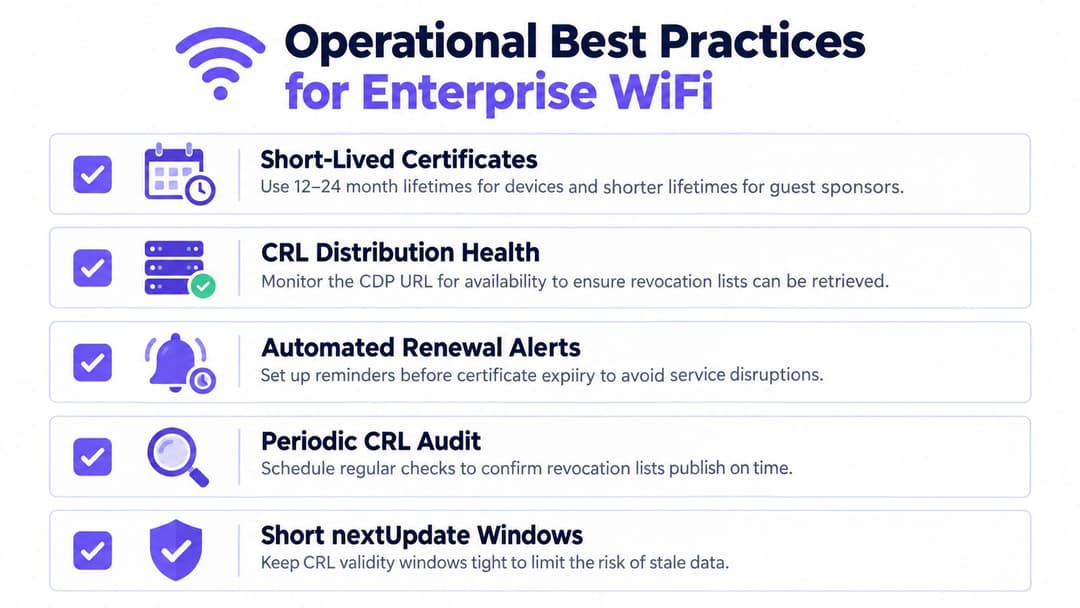
A reliable revocation design combines cryptographic controls with ordinary operational discipline. Start with the certificate lifetime. For managed WiFi devices, a 12 to 24 month certificate lifetime is a common operational reference in the supplied deployment guidance, but the right choice depends on device ownership, renewal capability, and the damage an exposed private key could cause. Guest sponsor certificates should generally have shorter lifetimes because their access context changes more often.
Build renewal into the device lifecycle
Use SCEP, an MDM platform, or another automated enrollment path to renew certificates before they expire. Manual renewal works during a pilot and becomes fragile across a distributed estate. Test renewal on sleeping laptops, remote devices, rebuilt devices, and devices that haven't connected to the corporate network recently.
Monitor the CRL distribution points from the same network paths used by RADIUS and controllers. Check reachability, signature validity, issuer identity, and nextUpdate, not just whether a web request returns content. A reachable but expired CRL is still a failed revocation control.
Keep the RADIUS side clean
RADIUS server certificates need current validity, a trusted issuing chain, and a renewal process that doesn't depend on a last-minute maintenance window. Review the trust stores on servers, controllers, and managed clients so an old CA certificate doesn't create inconsistent decisions across sites.
Document the revocation playbook in the language an on-call engineer can follow:
- Identify the credential: Record the user, device, certificate serial, and issuing CA.
- Disable the identity: Apply the approved directory or HR offboarding action.
- Revoke when required: Update the CA status and confirm publication.
- Refresh the relying parties: Force or schedule CRL retrieval where supported.
- Test the denial: Attempt authentication with the affected credential and preserve the result.
Align HR triggers with directory changes. If the service desk must wait for a separate PKI ticket, the network can continue trusting an identity that the organization has already marked inactive. Automated provisioning and renewal reduce that mismatch, while a documented manual path remains important for stolen devices and suspected key compromise.
For passwordless staff access, review how these controls fit with WPA-Enterprise deployment, including certificate enrollment, RADIUS validation, and offboarding ownership.
Troubleshooting Common Revocation Problems
Most CRL incidents fall into three categories: the validator has old information, it can't find the right publication point, or the revocation store has become difficult to operate. Diagnose the decision path rather than starting by reissuing certificates.
A stale local cache
A RADIUS server or controller may still hold a CRL that predates the revocation. Confirm the CRL's thisUpdate and nextUpdate fields, validate its signature against the issuing CA, and inspect the cached copy on the authenticator. Compare the serial number presented by the client with the entries in the newly published CRL.
The immediate fix is to force a CRL refresh if the platform supports it, then repeat an authentication test with the affected certificate. If the cache keeps returning old data, inspect proxy behavior, distribution-point caching, and the validator's refresh policy.
A missing distribution point
Read the issued certificate's CDP and AIA extensions. The CDP tells the relying party where to find revocation information, while the AIA can help it identify issuer information needed for chain validation. Confirm that the URL is correct, reachable from the RADIUS network, and serving a CRL signed by the expected issuer.
If the CA template contains the wrong location, correct the template and issue replacement certificates. Updating the endpoint alone won't repair certificates that already contain an unusable distribution point.
An unwieldy revocation store
Old entries can complicate administration and increase processing work. Prune entries only under the CA's retention policy and only after the relevant certificate lifetime and audit requirements have been considered. Never remove a serial number just because the incident ticket is closed.
US policy examples show why “fresh” must be defined locally. Some local authorities require daily updates, while federal policies require publication within 72 hours for a revoked certificate and set a maximum issuing period of 90 days. Treat those as policy baselines, not permission to accept stale enterprise data.
A certificate analysis tool can help inspect issuer, validity, CDP, and chain details. Purple's SSL certificate checker is one option for examining certificate health, while directory-driven enforcement can avoid relying solely on a delayed CRL refresh for user offboarding.
Putting It All Together This Week
Turn revocation into assigned work rather than a policy paragraph. Put these actions into the next change window and give each one a named owner.
- PKI team, audit the certificate paths: Inventory every WiFi client certificate template, issuing CA, CDP, and RADIUS trust relationship. Confirm that each distribution point is reachable from every authentication site.
- PKI and endpoint teams, set a defensible lifetime: Move WiFi client certificates toward 12 months or less where the device renewal process can support it. The shorter lifetime reduces dependence on emergency revocation, but only if renewal is automated and tested.
- Endpoint team, automate renewal: Use MDM or SCEP to enroll and renew certificates without user intervention. Test the process after a device rebuild, a long period offline, and a change of user.
- Service desk and identity team, connect offboarding to access denial: Make the HR or service-desk inactive state flow directly into the directory control used by WiFi authentication. Verify that a disabled identity can't establish a new 802.1X session.
- Network team, monitor revocation dependencies: Alert on unavailable distribution points, expired CRLs, invalid signatures, and failed status checks. Subscribe to CA change notifications so a publication change doesn't go unnoticed and degrade authentication.
Measure two outcomes during the following review period. First, record the latency between a directory disable event and the termination or denial of a new WiFi session. Second, measure how many RADIUS authentications completed a successful CRL check rather than continuing through a soft-fail path. Those measures tell you whether the design works under pressure, not just whether the certificates look correct in a spreadsheet.
If your team wants to reduce manual PKI administration while keeping identity-based enterprise WiFi, Purple can provide managed certificate-grade authentication, directory-connected access decisions, and RADIUS services that support revocation checking. Visit Purple to assess how its approach could fit your WiFi offboarding and certificate lifecycle workflow.