Personal area network (PAN) & IoT security advisor
Model transmission range limits, benchmark throughput, and identify security vulnerabilities across Bluetooth, Zigbee, WiFi Direct, and wired PAN topologies.
Identified Threat Vectors & Enterprise Safeguards
Unencrypted legacy Bluetooth keyboards or unauthenticated pairing allows rogue sniffers to capture corporate credentials.
Buffer overflow vulnerabilities in device Bluetooth stacks permit remote code execution without user pairing prompts.
Need zero trust segmentation for wireless and IoT networks?
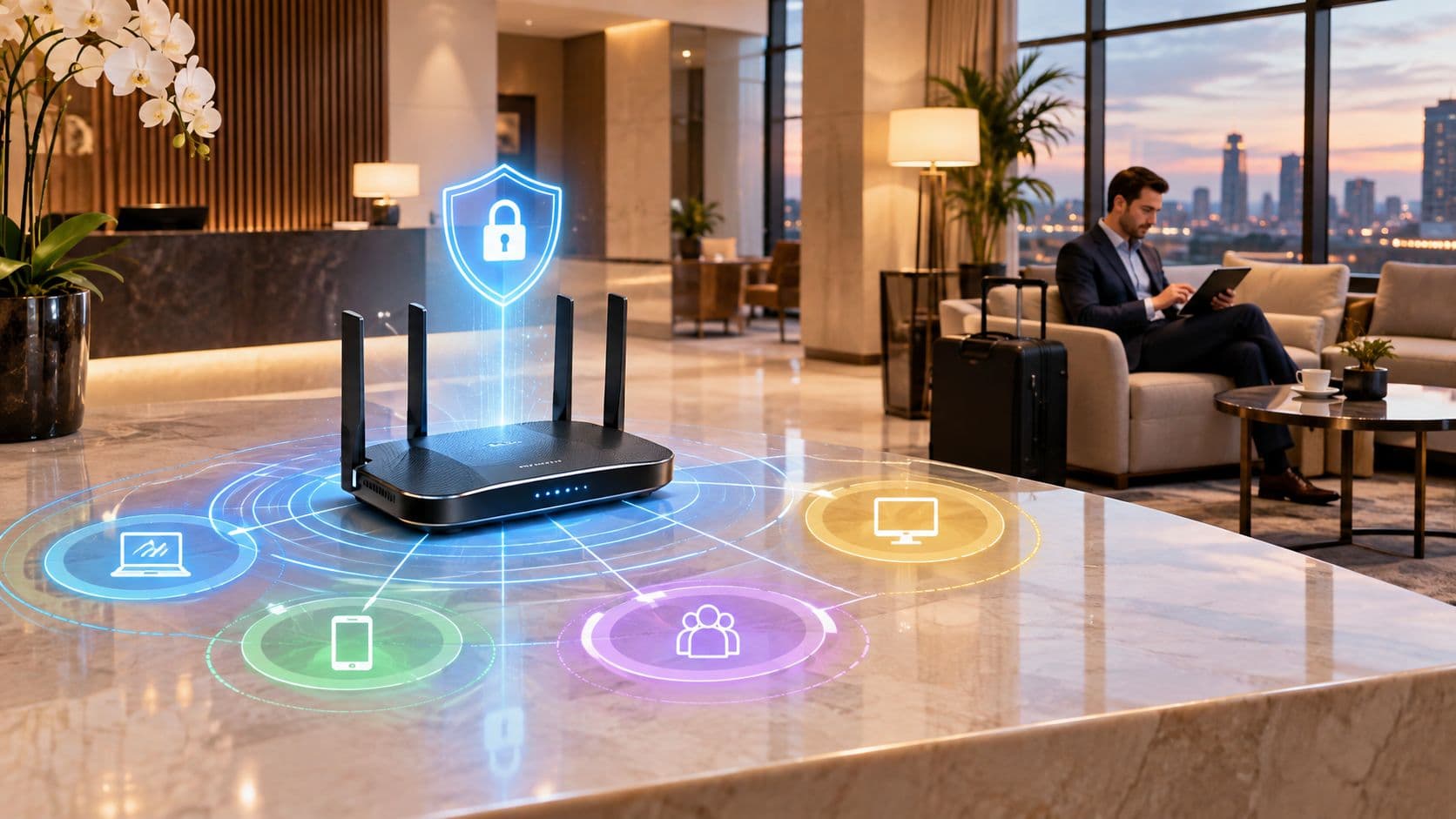
Purple isolates IoT sensors, medical telemetry, and guest devices with dynamic VLAN micro-segmentation, 802.1X Cloud RADIUS, and automated threat mitigation.
- ✓Dynamic VLAN assignment and endpoint profiling
- ✓Zero trust microsegmentation for Bluetooth & Zigbee gateways
- ✓Compatible with Cisco Meraki, HPE Aruba, Ruckus, and Mist
Request an IoT security assessment
Get a tailored blueprint to isolate rogue WPAN devices and protect enterprise infrastructure.
A Personal Area Network (PAN) is a short-range computer network designed to connect electronic devices around an individual workspace, typically within a radius of 10 meters (33 feet). PANs enable cell phones, laptops, wearables, tablets, and wireless peripherals to exchange data, synchronize files, and share internet access efficiently without complex network cabling.
Key takeaways: Personal Area Networks (PAN) explained
- Short-range scope: Operating within 33 feet (10 meters), a PAN interconnects personal electronics, smart wearables, and desktop peripherals.
- Wired vs wireless (WPAN): Wired PANs rely on USB or FireWire, while Wireless PANs (WPANs) use Bluetooth (IEEE 802.15.1), Zigbee (IEEE 802.15.4), and Ultra-Wideband (UWB).
- PAN vs WLAN & LAN: Unlike Local Area Networks (LANs) that span entire buildings or venues over 328+ feet (100+ meters), PANs focus strictly on personal device proximity and low power consumption.
- Security controls: WPAN security relies on cryptographic pairing, frequency hopping, and AES encryption to prevent unauthorized eavesdropping.
- Enterprise IoT integration: In commercial venues and smart offices, isolating PAN/WPAN traffic (like Bluetooth beacons and IoT sensors) from corporate WiFi prevents frequency congestion and security breaches.
What is a Personal Area Network (PAN) and how does it work?
A Personal Area Network (PAN) connects electronic devices located in close proximity to a single user. First conceptualized by Thomas Zimmerman and MIT Media Lab researchers, PAN technology provides a streamlined mechanism for localized device communication.
Whether you pair a Bluetooth headset with your cell phone, synchronize a smartwatch with a tablet, or connect a wireless mouse to a laptop via a USB dongle, you are using a Personal Area Network. A PAN can function autonomously for local data transfers or link to larger infrastructure networks - such as a Local Area Network (LAN), Wireless LAN (WLAN), or Wide Area Network (WAN) - to access the internet.
Wired PAN vs Wireless PAN (WPAN)
Personal Area Networks are divided into two distinct transmission categories: wired and wireless.
1. Wired Personal Area Networks
Wired PANs establish physical hardware connections between peripheral devices using physical cables. Key characteristics include:
- USB (Universal Serial Bus): The most common wired PAN interface, connecting keyboards, external storage drives, and printers to a primary host computer.
- High-speed throughput: Delivers gigabit-per-second transfer rates with zero wireless radio interference.
- Physical security: Because data travels through copper or optical wiring, unauthorized intercept requires direct physical access to the cable interface.
2. Wireless Personal Area Networks (WPAN)
Wireless PANs (WPANs) eliminate cable clutter by transmitting data across low-power radio frequencies. WPAN technologies form the backbone of modern wearable technology and smart home automation:
- Bluetooth & BLE (IEEE 802.15.1): Operating in the 2.4 GHz ISM band, Bluetooth and Bluetooth Low Energy (BLE) provide short-range device pairing with minimal battery drain.
- Zigbee (IEEE 802.15.4): Designed for low-data-rate mesh networking, Zigbee connects smart lighting, environmental sensors, and building automation hardware.
- Ultra-Wideband (UWB / IEEE 802.15.4z): Uses high-bandwidth radio pulses to deliver precise spatial awareness, indoor positioning, and secure keyless access.
- Infrared (IrDA): A legacy line-of-sight technology previously used for television remote controls and basic device transmission.
PAN vs WLAN vs LAN vs WAN: key differences
Network engineers categorize networks by geographic coverage, data throughput, and architectural purpose. The matrix below outlines how a PAN compares to broader network topologies:
| Feature | Personal Area Network (PAN) | Wireless LAN (WLAN / WiFi) | Local Area Network (LAN) | Wide Area Network (WAN) |
|---|---|---|---|---|
| Primary Standard | IEEE 802.15 (Bluetooth / Zigbee) | IEEE 802.11 (WiFi 6 / 6E / 7) | IEEE 802.3 (Ethernet) | IP / MPLS / 5G / Fiber |
| Typical Coverage Range | Up to 33 feet (10 m) | Up to 330 feet (100 m) | 330 ft per cable segment (Building) | Global / Cities / Countries |
| Data Transfer Rate | 1 Mbps - 24 Mbps (Wireless) | 100 Mbps - 9.6 Gbps | 1 Gbps - 100 Gbps | Variable (10 Mbps - 100 Gbps) |
| Power Consumption | Ultra-low (optimized for battery) | Moderate to High | Low (PoE supported) | High (Infrastructure powered) |
| Primary Use Case | Personal peripherals & wearables | Wireless venue & office access | Wired enterprise infrastructure | Inter-site routing & internet |
For more detailed technical analysis on larger venue networks, explore our in-depth guides to Wireless Local Area Networks (WLAN), Campus Area Networks (CAN), and Metropolitan Area Networks (MAN).
Real-world applications of PANs in enterprise environments
While personal area networks were originally associated with consumer electronics, enterprise venues and commercial facilities utilize WPAN technologies extensively:
- Healthcare & Patient Monitoring (BAN): Body Area Networks (BANs) integrate medical sensors on patients to transmit vital metrics to central hospital dashboards via WPAN gateways.
- Smart Venue & Retail Beacons: Retail stores and airports deploy Bluetooth Low Energy (BLE) location beacons that interact with visitor mobile apps for indoor wayfinding and contextual notifications.
- Asset Tracking & Inventory Management: Logistics hubs use handheld WPAN scanners to manage stock, updating inventory databases via local gateway uplinks.
- Smart Building Automation: Office buildings use Zigbee and Thread sensors to automate HVAC temperature controls, occupancy monitoring, and lighting efficiency.
Security considerations for Personal Area Networks
Because WPAN signals propagate through walls and open air, unencrypted personal area networks present security risks, including bluesnarfing, man-in-the-middle eavesdropping, and unauthorized tracking. Essential security measures include:
- Secure Device Pairing: Enforcing Secure Simple Pairing (SSP) with numeric comparison prevents unauthorized Bluetooth eavesdropping.
- AES Encryption: Modern WPAN protocols employ AES-128 cryptographic algorithms to secure payload data in transit.
- VLAN Network Segmentation: Enterprise venues isolate IoT WPAN gateways onto dedicated Virtual LANs (VLANs), ensuring compromised sensors cannot access sensitive corporate databases. Read our comprehensive guide on WiFi network segmentation best practices.
- Passwordless Authentication: Deploying 802.1X certificate-based authentication for corporate laptops and cell phones prevents credential theft on shared enterprise frequencies. Explore our enterprise WiFi security guide for details.
Frequently asked questions about Personal Area Networks
What is the maximum range of a Personal Area Network (PAN)?
The operational range of a typical wireless PAN is up to 10 meters (33 feet). However, extended Class 1 Bluetooth devices and specialized Ultra-Wideband (UWB) equipment can reach up to 100 meters under clear line-of-sight conditions.
What is the difference between a PAN and a LAN?
A PAN connects personal devices in close proximity to a single user - within 33 feet (10 meters) - whereas a LAN connects multiple computers, servers, and network devices across an entire office, building, or venue - up to 328 feet (100 meters) per cable segment.
Is Bluetooth considered a Personal Area Network?
Yes. Bluetooth is the primary radio standard for Wireless Personal Area Networks (WPAN). Governed by IEEE 802.15.1, Bluetooth facilitates short-range wireless communication between mobile devices, audio equipment, and smart peripherals.
How do enterprises secure IoT devices running on WPAN protocols?
Enterprise IT teams isolate WPAN gateways (such as Zigbee or BLE hubs) on dedicated VLANs using firewall rules and cloud RADIUS authentication, preventing IoT endpoints from communicating with internal staff or financial databases.