A guest arrives at a mid-market business hotel, selects the network with the property's name, and reaches a polished captive portal. It asks for a room number and email address, so the request feels routine. Later, the guest discovers that loyalty points have been drained and a corporate mailbox has been targeted with a convincing Microsoft 365 sign-in page.
The problem isn't that the guest failed a security test. The property presented the network, operated the portal, and controlled the gateway that carried the guest's traffic. Hotel WiFi security is therefore an operator responsibility, covering identity, routing, filtering, monitoring, and the boundaries between guest access and hotel systems.
A practical program doesn't require replacing every access point. It requires a defensible control model, sensible authentication choices, and disciplined integration with the Meraki, Aruba, Ruckus, or Mist estate already installed.
The Real Risk Facing Hotel WiFi Today
The scenario above can begin without a dramatic wireless intrusion. A lookalike access point in a corridor or conference area may imitate the official SSID, or a compromised captive-portal appliance may redirect a legitimate connection after the guest joins. The guest sees familiar branding and follows a normal hotel workflow, while the attacker collects credentials, tokens, or payment-related information.
Four attacker objectives appear repeatedly in this type of environment:
- Credential theft: Fake portal forms can capture email passwords, loyalty credentials, or work logins.
- Malware delivery: A manipulated redirect can send a device toward a malicious download or exploit page.
- Payment-data harvesting: Booking confirmations and travel emails often contain information criminals can use to target payment accounts.
- Operational access: Weak isolation can let an attacker move from a guest network toward PMS, payment, door-lock, building-management, or corporate systems.
The last objective creates the greatest operator-side concern. A hotel network isn't just an internet service. It connects people, endpoints, access-control systems, staff devices, conference users, IPTV equipment, cameras, and third-party maintenance platforms. Shared infrastructure can turn a local wireless weakness into a property-wide incident.
The US government's security research and industry reports indicate that 43% of businesses experienced a breach or cyber attack in the previous 12 months, equivalent to roughly 612,000 organizations. Phishing was involved in 38% of incidents and was the most disruptive breach type for 69% of affected organizations, according to the hotel WiFi security analysis of the survey. Hospitality networks deserve attention because guest access, staff access, and third-party devices share a large attack surface.
Operator rule: If the hotel owns the SSID and portal, the hotel owns the security outcome. Guest advice is useful, but it isn't a substitute for secure architecture.
A practical starting point is to review the fundamentals in how to secure wireless networks, then apply them to hospitality-specific traffic flows. The priority isn't a fashionable encryption label. It's preventing a guest login from becoming a route into systems that run the property.
Modern Threats Operators Must Plan For
Hotel teams still worry about packet snooping and a guest connecting to an evil-twin access point. Those risks haven't disappeared, but they compete with more consequential failures in the captive-portal and gateway layers.
An attacker can place a rogue AP near a conference room, copy the hotel SSID, and present a portal that looks genuine. WPA2-Personal creates another operational weakness when one password is printed on door hangers or repeated across rooms. Once that key spreads beyond the intended audience, the hotel loses meaningful control over who can associate. Karma-style attacks exploit a different behavior, responding when devices probe for networks they remember.
The modern attack path often starts after association. A compromised gateway or portal appliance can forge DNS responses, redirect a guest to a lookalike booking or Microsoft sign-in page, or assign a rogue gateway through DHCP. The attacker doesn't need to compromise every handset individually. Control of the shared gateway can affect everyone using that venue's service.
The US-facing report on captive-portal attacks describes this risk as a portal-layer problem involving forged DNS answers, attacker-controlled pages, and credential or token harvesting. That changes the defensive question from “Is the guest using a VPN?” to “Can the property's gateway, DNS path, and administrative interfaces be trusted?”
Prioritize the controls that stop scale
Budget-limited properties should address the controls that prevent one compromise from reaching every guest or an operational network:
- Protect captive-portal integrity. Remove internet exposure from management interfaces, enforce strong unique administrator credentials, patch supported appliances, and monitor configuration changes.
- Protect DNS integrity. Use a controlled resolver, prevent unauthorized DHCP services, and alert when clients receive unexpected DNS or gateway settings.
- Enforce guest-to-operational segmentation. A guest VLAN must not have an implicit route to PMS, POS, payment, staff, or building systems.
| Threat | How it shows up in a hotel | Operator priority |
|---|---|---|
| Evil-twin AP | A copied SSID appears near elevators, meeting rooms, or reception | High, especially where guests receive little connection guidance |
| Shared WPA2-Personal key | One password is reused across rooms, staff, or printed materials | High, replace with identity or per-device access |
| Karma-style attack | A rogue AP answers device probes for remembered SSIDs | Medium, reduce exposure through endpoint and wireless policy |
| Captive-portal compromise | The portal serves a forged login or malicious redirect | Critical, protect the gateway and portal administration |
| DNS tampering | Legitimate domains resolve to attacker-controlled pages | Critical, secure resolver and gateway paths |
| Rogue DHCP | Clients receive an unauthorized gateway or resolver | High, enforce DHCP snooping and switch controls where supported |
| Guest-to-operational movement | A guest device reaches PMS, POS, cameras, or BMS services | Critical, apply default-deny firewall policy between VLANs |
The Four-Layer Control Model for Hotel WiFi
A reliable hotel WiFi security design uses four layers. Each layer answers a different question, and none should be treated as a replacement for the others.
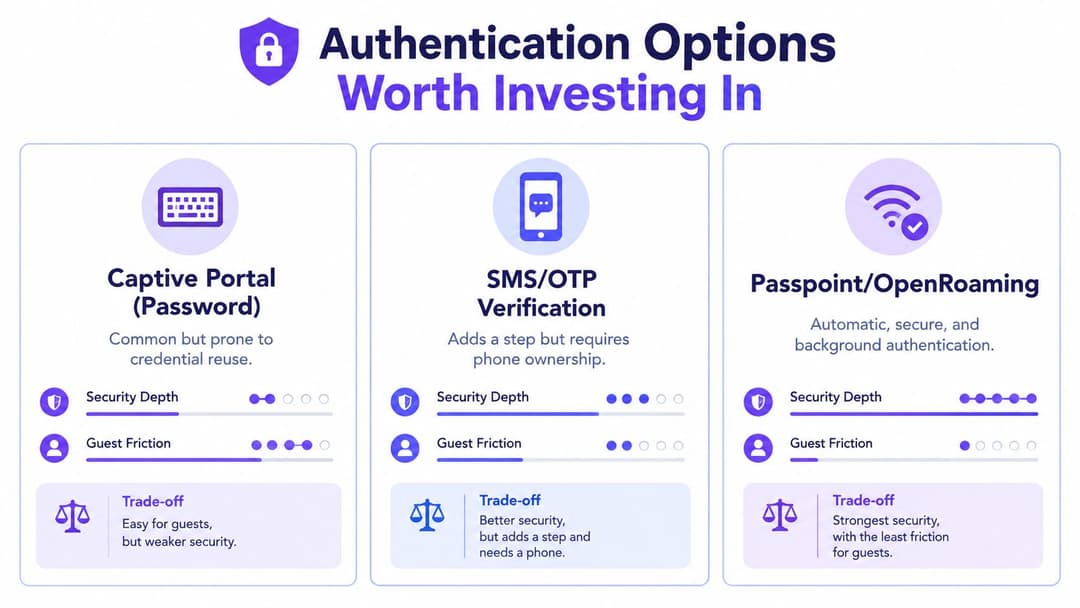
Layer one, authentication and identity, establishes who or what is joining. Options include OpenRoaming, Passpoint, passwordless email links, vouchers, and room-key binding. The choice affects both security and the amount of personal data the hotel collects. The key outcome is traceable, revocable access rather than an unaccountable shared password.
Layer two, DNS filtering, blocks known malicious and inappropriate destinations at the resolver. US operators can evaluate filtering services aligned with the Friendly WiFi standard, which frames public WiFi safety as a venue obligation across hospitality. DNS logs also help investigators understand whether connected devices repeatedly request suspicious domains, although logs must be governed under a clear retention and privacy policy.
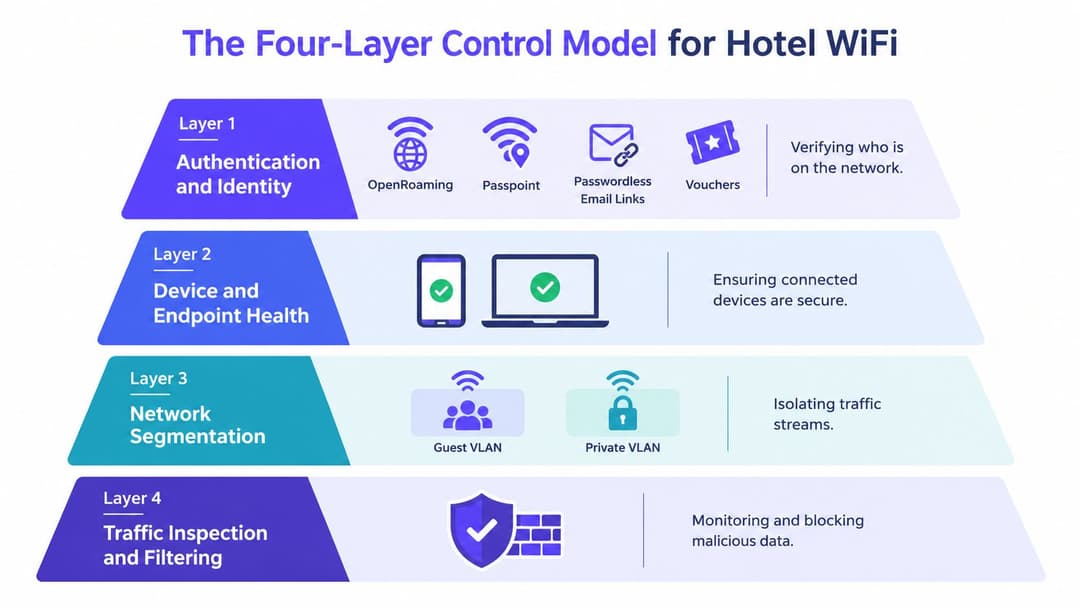
Layer three, application-layer control, uses firewall policy and layer-7 visibility to restrict torrenting, P2P activity, known command-and-control traffic, and applications that have no legitimate place on a guest network. This isn't a license to inspect everything guests do. It's a way to apply a clear acceptable-use policy and contain predictable abuse.
Layer four, segmentation, separates guest, staff, operational, and IoT networks. VLANs are only the starting point. Firewall rules must explicitly deny guest access to PMS, payment, cameras, door systems, and internal services, while allowing only the internet and tightly defined dependencies.
The model is defense in depth. If a portal control fails, segmentation should still block operational systems. If a malicious domain bypasses filtering, application controls and endpoint protections should reduce the impact. If a guest identity is misused, logs and revocation should limit the investigation window.
Guest, Staff, and Operational Network Design
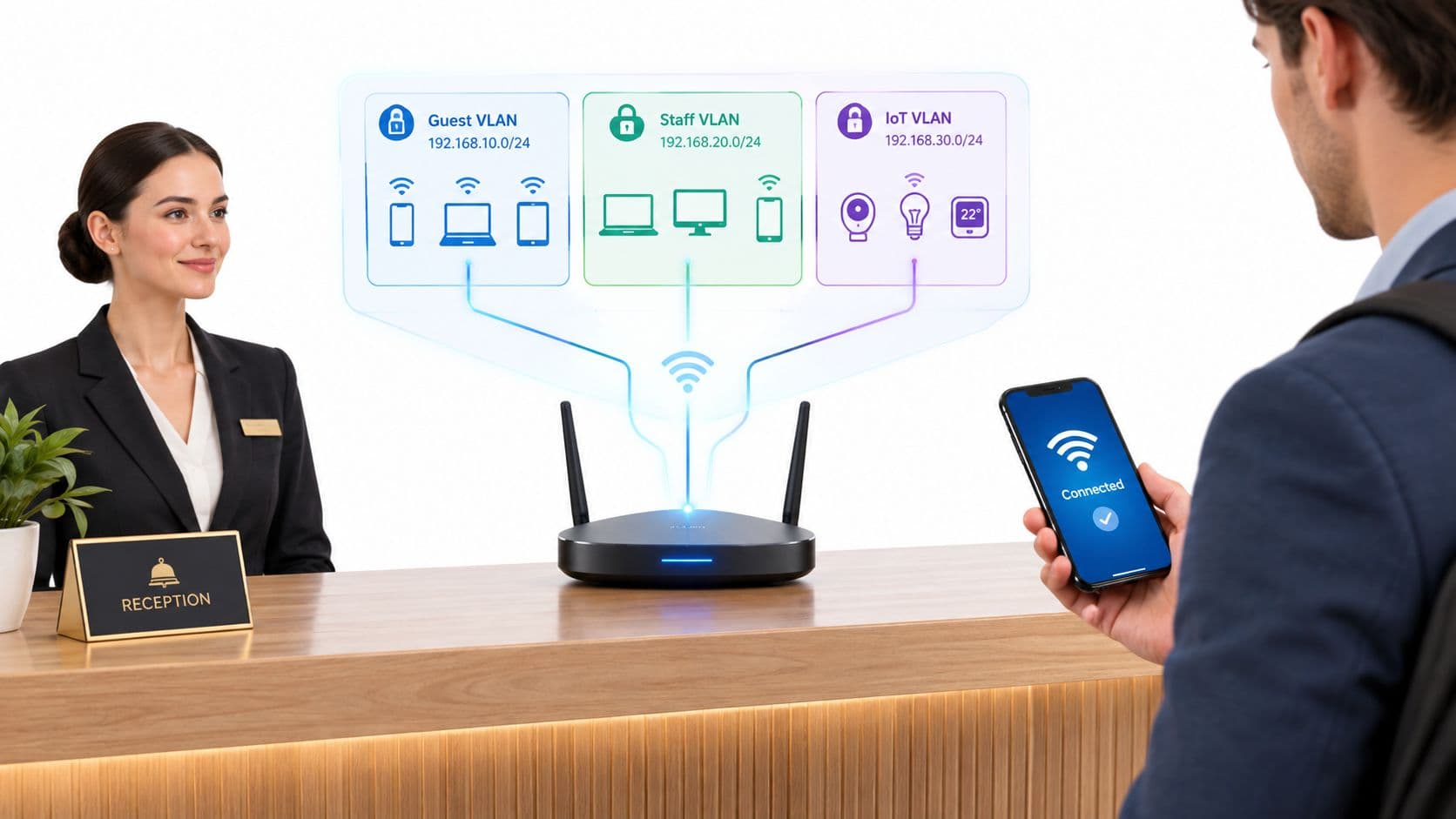
A hotel needs three distinct trust zones, even when the wireless hardware presents them through the same controller. Treating them as three SSIDs without validating routing and firewall policy is cosmetic segmentation.
The guest network should provide internet access, client isolation, and no route to staff or operational resources. Guests are anonymous or lightly identified, so the network should be low trust by design. Guest-to-guest isolation matters too, particularly where devices use discovery protocols or expose local services.
The staff network needs stronger identity. Domain-joined laptops can use certificate-based EAP-TLS through 802.1X, while mixed estates often include handhelds, printers, tablets, and inherited devices that cannot complete a full certificate workflow. iPSK can give each approved device or room a distinct key, reducing the blast radius when one credential is exposed.
The operational network carries PMS terminals, door locks, IPTV, BMS equipment, and cameras. It should use strict ACLs and device-based assignment, ideally with RADIUS returning the appropriate VLAN for each class. A door-lock controller shouldn't share an unrestricted broadcast domain with a reception laptop just because both need wireless connectivity.
| Network Type | Authentication | VLAN / Isolation | Best Fit Devices | Risk if Compromised |
|---|---|---|---|---|
| Guest | Passwordless link, voucher, Passpoint, or OpenRoaming | Dedicated guest VLAN, client isolation, internet-only policy | Cell phones, tablets, laptops, visitor devices | Credential theft, abuse, scanning, and attempted movement |
| Staff | 802.1X with EAP-TLS, or identity-backed iPSK for mixed estates | Staff VLAN with policy-based access to approved services | Managed laptops, handhelds, approved staff devices | Access to internal workflows and sensitive applications |
| Operational | Device identity, RADIUS assignment, or tightly controlled certificate access | Separate operational VLANs with explicit ACLs | PMS, POS, IPTV, BMS, cameras, door systems | Disruption, surveillance, safety, or property-system compromise |
| Shared PSK legacy access | One password for many users or devices | Basic VLAN separation only | Temporary or unsupported equipment | Poor attribution and broad compromise if the key leaks |
Shared PSKs remain easy to deploy, but they're difficult to revoke cleanly. Full 802.1X offers stronger accountability, yet it can expose compatibility gaps. iPSK is often the practical bridge for legacy equipment, provided the property documents ownership and rotation.
Authentication Options Worth Investing In
Authentication changes more than the login screen. It determines whether the hotel can revoke access, identify a session, reduce credential reuse, and offer returning guests a consistent connection.
A passwordless email link is a useful improvement over a shared portal password. It reduces the temptation to reuse a corporate or loyalty credential, but the guest's email address still enters the hotel's marketing and customer-data workflows. Keep the form minimal, separate service access from marketing consent, and explain the distinction in plain English.
Passpoint and OpenRoaming provide a smoother model for compatible devices. Certificate-based onboarding can let a guest connect without repeatedly submitting a splash-page form, which is particularly relevant to hotel groups that want a consistent experience across properties. Coverage and device behavior aren't uniform, so a fallback portal remains necessary.
Social login reduces friction for some guests, but it trades convenience for data-sharing decisions. A hotel should understand what the identity provider returns, what the CRM stores, how consent is recorded, and how a guest can access the service without surrendering unnecessary profile data.
For staff, connect the WLAN to the identity system already governing employment access. Entra ID, Google Workspace, and Okta can support SSO-led workflows, conditional access, automatic provisioning, and revocation when a worker leaves. The wireless policy should reflect role and device state rather than treating every employee as equally trusted.
Identity platforms such as Purple can integrate with Meraki, Aruba ClearPass, Ruckus Cloudpath, and Juniper Mist, but the operational trade-off is real. A cloud platform may simplify deployment and provide a consistent guest journey, while proprietary APIs and policy objects can make a controller change harder later. Review export options, failure behavior, certificate ownership, and the process for removing the platform before signing a multi-property agreement. The Purple enterprise WiFi security guide is a useful reference when comparing identity-led designs.
Procurement test: Ask the vendor what remains functional if its cloud service, API, or identity connector is unavailable. A secure fallback is part of the design, not an afterthought.
Monitoring, Logging, and Incident Response
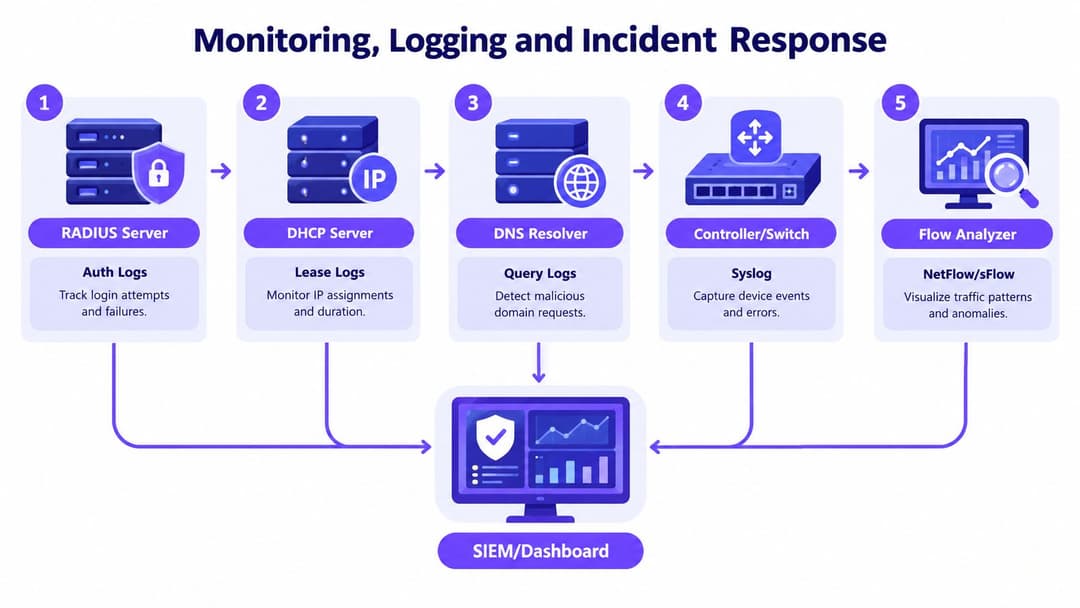
Controls without detection leave the duty manager dependent on guest complaints. A hotel should collect enough telemetry to reconstruct who authenticated, what address they received, which resolver answered their request, and how traffic moved between zones.
Capture RADIUS authentication events, DHCP leases, DNS query logs, controller and switch syslog, and NetFlow or sFlow samples for east-west traffic. Send the feeds to a SIEM or operational dashboard with access controls that distinguish IT investigation from marketing analytics. Retention must be justified by incident-response, legal, and privacy requirements rather than copied from a vendor default.
Useful detection signals include:
- Portal anomalies: Duplicate SSIDs, certificate warnings, unexpected portal content, or configuration changes outside the change window.
- Controller events: Unplanned AP reboots, rogue BSSIDs, altered security settings, and administrator logins from unfamiliar locations.
- DNS indicators: Sudden requests to unfamiliar resolvers, unusual failure clusters, or legitimate services resolving in unexpected ways.
- Lateral movement: Guest clients probing staff, PMS, payment, camera, or building-management addresses.
The incident runbook should be executable by the on-call team. Preserve the controller configuration, export the relevant RADIUS, DHCP, and DNS events, disable or quarantine the suspect BSSID, revoke affected identities, and involve the hotel's data-protection lead. If the incident involves personal data, the organization must assess its CCPA/CPRA notification duties rather than promise a fixed response without investigating the facts.
Integrate alerts with the PMS where appropriate. A room-level signal that reaches only a network engineer may sit unnoticed, while a concise alert routed to the duty manager can trigger guest support and escalation quickly.
Privacy, Compliance and Venue Obligations
A general manager doesn't need to configure RADIUS, but they do need clear ownership for the decisions behind it. The hotel should document why it collects an email address or room number, what service requires that information, who can access it, and when the record is deleted.
For many deployments, the lawful basis may involve contract or legitimate interests, but the correct basis depends on the actual processing. Data minimization means the portal shouldn't request a full marketing profile merely to grant internet access. Keep service authentication, loyalty enrollment, analytics, and promotional consent separate.
Friendly WiFi certification gives operators a practical venue framework for filtering inappropriate and illegal content. Filtering isn't a complete compliance program, however. The hotel still needs an acceptable-use notice, escalation process, supplier agreement, and a way to respond when law enforcement or a legitimate investigation requires records.
Staff monitoring needs separate care. Guest consent to network terms doesn't automatically authorize unrestricted monitoring of employees. Employment, privacy, and workplace policies should define what the hotel records, why it records it, and who can review it.
| Obligation | Technical Control | Owner |
|---|---|---|
| Guest data transparency | Short portal notice, separate marketing consent, documented retention | General manager and privacy lead |
| Appropriate-content filtering | DNS filtering, application controls, vendor monitoring | IT manager and managed service provider |
| Network accountability | RADIUS, DHCP, DNS, and controller logs with restricted access | Network team |
| Security incident response | Escalation playbook, evidence preservation, identity revocation | IT security lead and duty manager |
| Staff privacy | Employment notice, proportionate monitoring, access governance | HR and privacy lead |
| Vendor assurance | Contractual controls, breach notification, subprocessor review | Procurement and legal |
The Purple guest WiFi data privacy guidance can help structure questions about portal data, consent, and guest identity. It shouldn't replace the hotel's own data-mapping exercise or legal review.
Publish a short, readable acceptable-use notice. Guests should understand that the venue filters harmful content, isolates clients, records limited connection information, and may suspend access for abuse. Clear communication is easier to operate than a policy buried in dense terms that no guest or front-desk colleague can interpret.
Deployment Checklist and Vendor Integration
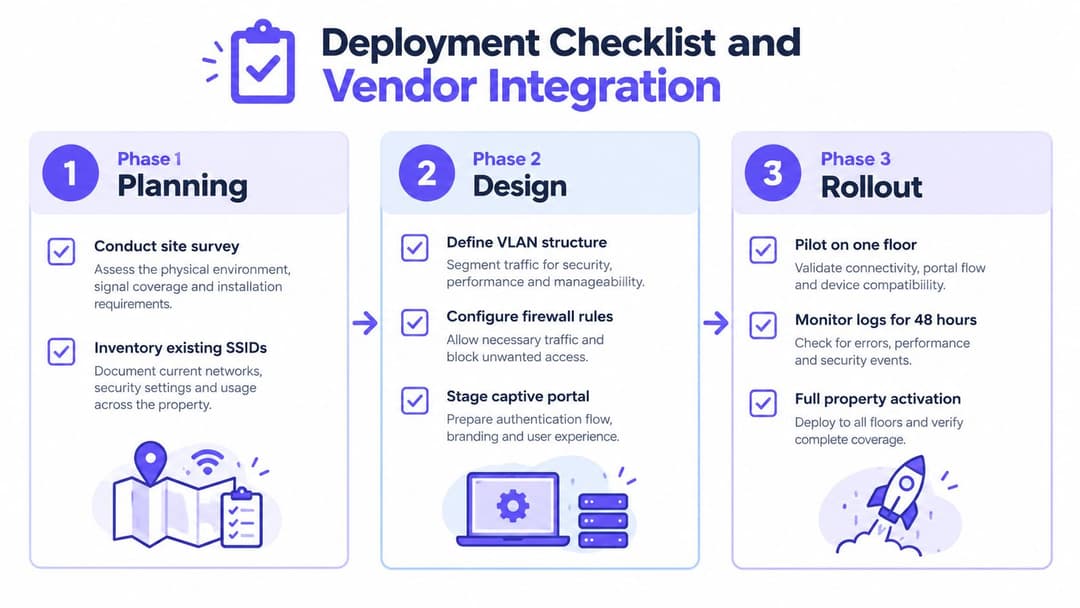
A safe rollout is usually measured in controlled phases, not a heroic overnight cutover. Start with a site survey, an SSID inventory, and a map of every path from wireless clients to internet, PMS, POS, BMS, cameras, and third-party services.
Next, build the policy before enabling the portal. Define VLANs, firewall rules, DHCP ownership, DNS routing, identity flows, logging, failure states, and rollback. Stage the captive portal against a test SSID, then use a small pilot group on one floor or a staff-only area before expanding.
Vendor fit depends on the estate:
- Meraki is often quick for a single property with a straightforward design. Large portfolios can require more careful policy and template work than the sales demonstration suggests.
- Aruba ClearPass offers strong policy granularity and mature 802.1X workflows, but the design and operation benefit from engineers who understand certificates, profiling, and enforcement.
- Ruckus Cloudpath suits identity and onboarding workflows in Ruckus environments, while legacy devices still need deliberate profiling and iPSK planning.
- Juniper Mist can provide useful cloud visibility and policy integration, but validate how external identity, portal failure, and multi-vendor dependencies behave.
- Purple can provide passwordless guest and staff identity workflows across Meraki, Aruba, Ruckus, and Mist, with the RADIUS as a Service offering relevant where the hotel wants to reduce on-premises RADIUS administration.
Test the integration under failure, not just success. Disconnect the identity connector, block the portal dependency, revoke a staff account, rotate an iPSK, and verify that a guest still cannot reach operational subnets. Check that front-desk staff know how to handle a portal outage without issuing a shared password that remains in circulation.
A practical handover checklist
- Survey and inventory: Record AP locations, SSIDs, switches, VLANs, uplinks, portals, and undocumented dependencies.
- Policy validation: Test guest isolation, staff access, operational ACLs, DNS enforcement, and rogue DHCP protection.
- Pilot acceptance: Measure connection success, support calls, authentication failures, and guest feedback with a defined baseline.
- Rollback readiness: Keep the prior WLAN configuration available and document who can restore it.
- Operational handover: Train reception, duty managers, facilities, and IT on symptoms, escalation, and evidence preservation.
- Post-go-live review: Recheck firewall logs and controller events for unintended guest-to-staff paths before declaring the project complete.
Hotel WiFi security improves when ownership is visible. Assign the general manager, network lead, data-protection lead, and service provider a named responsibility, then review the controls after changes to the PMS, portal, ISP, or wireless controller.
Purple can help operators replace shared guest passwords with passwordless identity workflows, integrate staff access with existing directories, and apply consistent policies across Meraki, Aruba, Ruckus, and Mist environments. Visit Purple to assess how its identity and RADIUS capabilities could fit your hotel WiFi security rollout.