
Cisco ISE vs. Purple WiFi: How They Compare and Work Together
This guide explains how Cisco ISE and Purple WiFi serve distinct but complementary roles in enterprise networks. It details how to use Cisco ISE for secure 802.1X corporate access while leveraging Purple for CCPA/CPRA-compliant guest WiFi, marketing analytics, and CRM integration.
Video overview
Listen to this guide
View podcast transcript
Part of our core series: Enterprise WiFi Security Guide →
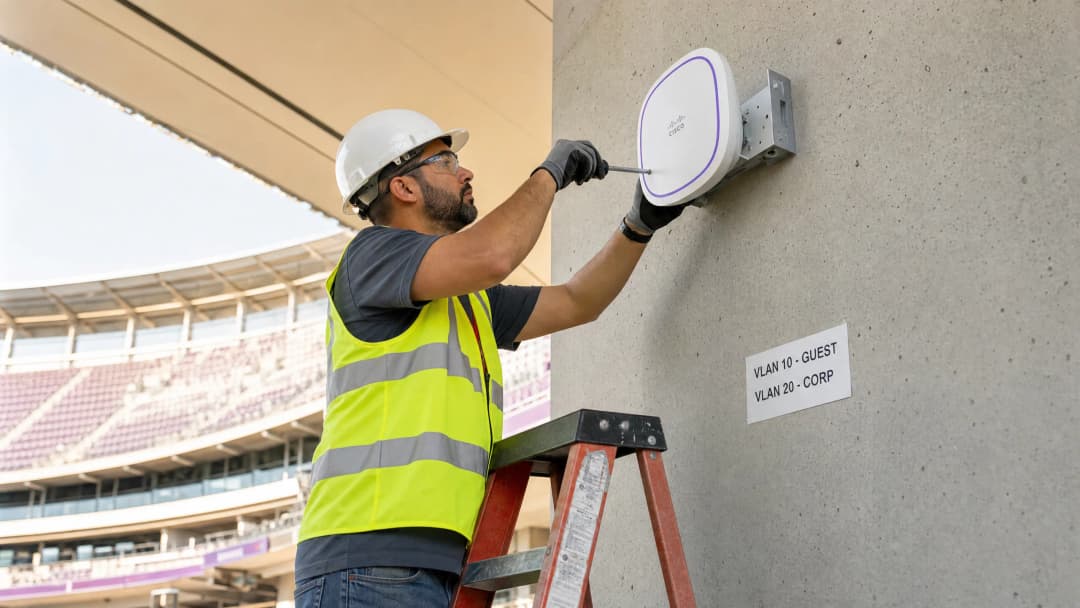
Executive Summary
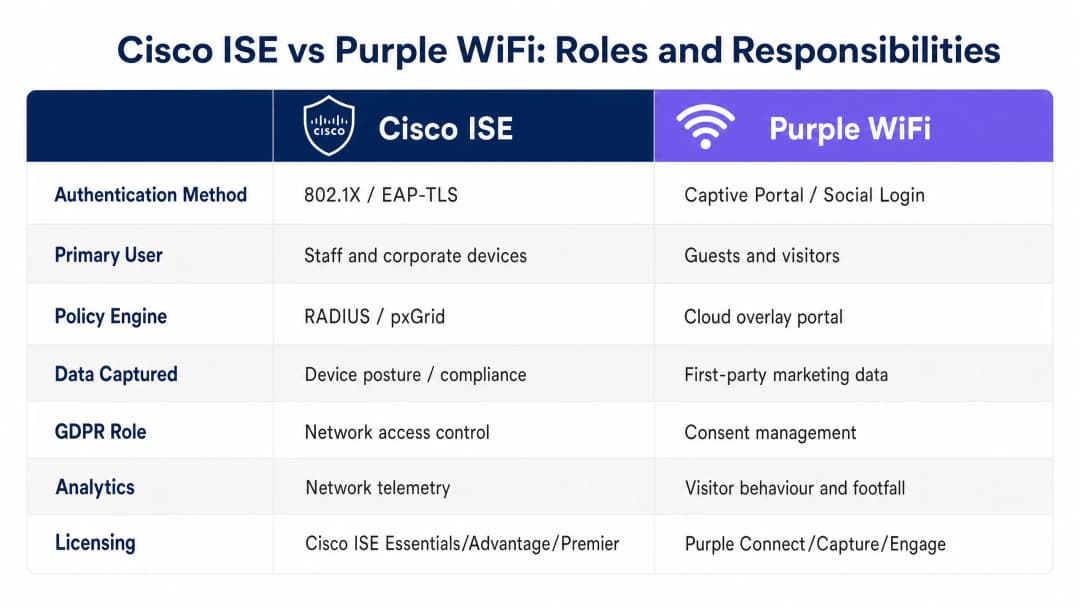
Enterprise network architecture demands a clear separation of concerns between corporate security and commercial guest engagement. When evaluating Cisco ISE vs Purple WiFi, the mistake many IT leaders make is viewing them as competing platforms. They are not. Cisco Identity Services Engine (ISE) is an industry-standard Network Access Control (NAC) and 802.1X policy engine for securing workforce and corporate devices. Purple is a cloud-based overlay platform built to handle guest Captive Portals, visitor marketing consent, and operational analytics.
Attempting to force Cisco ISE to serve as a cisco ise guest portal alternative for commercial marketing introduces unnecessary complexity and fails to deliver actionable data. Conversely, deploying Purple WiFi alongside Cisco ISE allows each platform to do what it does best. Purple integrates natively with Cisco infrastructure to offload complex guest experience logic while leaving core enterprise security policies with Cisco ISE. This guide breaks down how they coexist in a modern enterprise network topology, providing practical deployment strategies for retail, hospitality, and large public venues.
Technical Deep-Dive
The Role of Cisco ISE: Corporate Network Access Control
Cisco ISE is the gold standard for enterprise NAC. Its primary function is to authenticate and authorize known devices and users connecting to the corporate network, relying heavily on the port-based network access control standard IEEE 802.1X.
When a corporate laptop connects to a switch port or a corporate SSID, ISE acts as a RADIUS server. It validates device certificates via EAP-TLS or user credentials via PEAP against Active Directory or Microsoft Entra ID. ISE then assesses the device's security posture. If compliant, ISE assigns the correct VLAN and applies the appropriate Security Group Tag (SGT). If the device fails the posture assessment, ISE can quarantine it using RADIUS Change of Authorization (CoA). For a deeper look at client configuration, review our guide on What is an 802.1X Supplicant? Client Types & Device Configuration. ISE also manages Bring Your Own Device (BYOD) onboarding, where personal devices are enrolled with certificates for secure and password-free access. Additionally, it integrates with Cisco's pxGrid framework, allowing firewalls and SIEM platforms to utilize real-time identity context. ISE is licensed in three tiers: Essentials, Advantage, and Premier, which scale from basic 802.1X to advanced threat integration.
Purple's Role: Guest Experience and Analytics
While ISE excels at securing corporate assets, its built-in guest portal is more utilitarian than commercial. It can provide basic internet access for contractors, but it cannot capture CCPA/CPRA-compliant marketing consent, run branded splash pages with social login, or push visitor data into CRM platforms like Salesforce. Purple fills precisely this gap.
Purple is a hardware-agnostic cloud overlay. It operates on top of your existing WiFi infrastructure, including Cisco Meraki, HPE Aruba, Ruckus, Juniper Mist, Ubiquiti UniFi, Cambium, Extreme and Fortinet. Purple essentially owns the guest experience layer. When a visitor connects to your guest SSID, Purple presents a branded Captive Portal. This portal offers social login via Facebook, Google, or LinkedIn, custom data capture forms, and seamless options like Passpoint.
Every login captures first-party data with clear, active-choice opt-ins. Purple processes this data through its analytics engine, creating footfall heatmaps and visitor demographics, and then pushes it directly to your marketing stack. Purple operates across 80,000+ live venues and processed 440 million logins in 2024. We hold ISO 27001 certification and comply with GDPR and CCPA, ensuring enterprise-grade stability with 99.999% uptime. For a deeper dive into the commercial benefits, see our WiFi Analytics platform overview.
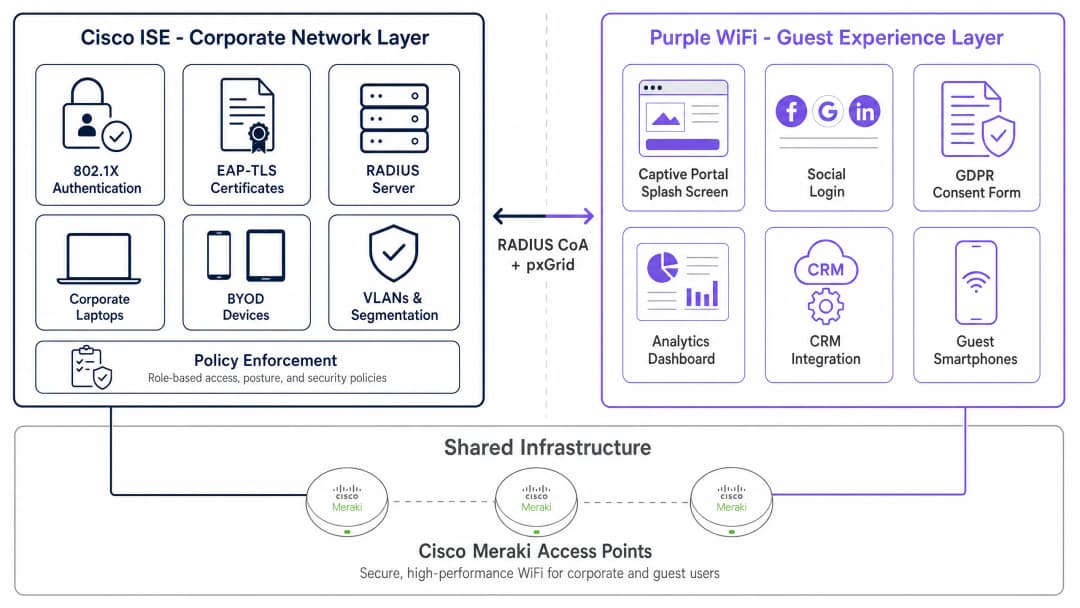
Architectural Coexistence
When you separate the SSIDs, the architecture becomes remarkably simple. You run two or three SSIDs on the same access points. For a detailed breakdown of this design, read Three SSIDs to rule them all: guest, Passpoint, and IoT WiFi.
The corporate SSID uses WPA3-Enterprise with 802.1X, and ISE is the RADIUS server. ISE assigns the device to the correct VLAN and enforces policy. Purple plays no part here.
The guest SSID uses an open network for initial association or WPA3-Personal with a pre-shared key. Traffic is redirected to Purple's cloud portal. Purple manages authentication, consent capture and analytics. The access point enforces a walled garden until Purple signals authorization, then enables internet access. ISE has no role here.
For venue IoT devices, such as point-of-sale terminals, Purple's SecurePass feature can manage Identity Pre-Shared Keys (iPSK), or ISE can manage corporate IoT.
Got questions about your specific setup?
Our team works with venue operators, IT managers, and network engineers across 80,000 venues. Book a 20-minute call and we will show you how others like you solved it.
Implementation Guide
Deploying Purple alongside Cisco ISE requires careful configuration of your wireless LAN controllers or cloud dashboards.
Step 1: SSID Segmentation
Create separate SSIDs for corporate and guest traffic. Configure the corporate SSID for WPA3-Enterprise and point RADIUS authentication to your Cisco ISE nodes. Configure the guest SSID for open access with MAC filtering or WPA3-Personal.
Step 2: VLAN Isolation
Ensure guest traffic is isolated from corporate traffic at Layer 2. The guest SSID must be mapped to a dedicated VLAN that bypasses internal routing tables and routes directly to the internet firewall. ISE enforces VLAN assignment for the corporate SSID based on policies.
Step 3: Walled Garden Configuration
For the guest SSID, configure Captive Portal redirection to point towards Purple's cloud infrastructure. You must configure a walled garden (pre-authorization ACL) on your access points to allow DNS and HTTP/HTTPS traffic to Purple's required IP ranges and domains. If the walled garden is too restrictive, the Captive Portal will fail to load.
Step 4: RADIUS Integration for Guest WiFi
Configure your wireless controller to use Purple's RADIUS servers for the guest SSID. This allows Purple to authorize the user and track session duration and bandwidth usage.
Best Practices
- Never mix guest and corporate traffic on the same SSID. This creates significant security and compliance risks. Always use dedicated SSIDs mapped to isolated VLANs.
- Use Purple for commercial guest access. Do not use ISE's built-in guest portal if you require marketing analytics, CRM integration or branded social login.
- Enforce tiered bandwidth. Offer a free, baseline service on the guest SSID, and offer a premium, paid option for higher speeds using Purple's Connect, Capture or Engage plans.
- Leverage Passpoint. Use Passpoint (Hotspot 2.0) through Purple to allow returning guests to connect automatically and securely without seeing the Captive Portal repeatedly.
Troubleshooting & Risk Mitigation
- Captive Portal fails to load: This is almost always a walled garden issue. Verify that all required Purple domains and IP addresses are allowed in your Cisco hardware's pre-authentication ACL.
- Guest devices are accessing internal resources: This indicates a failure in VLAN isolation. Verify that the guest VLAN cannot route to corporate subnets at the firewall or core switch layer.
- RADIUS Timeouts: If the wireless controller cannot reach Purple's RADIUS servers, guest authentication will fail. Ensure your firewall permits outbound UDP ports 1812 and 1813 to Purple's infrastructure.
ROI and Business Impact
The business impact of separating network access control Cisco ISE from guest experience management is highly significant. By offloading guest WiFi responsibilities to Purple, IT teams can reduce the operational burden of managing temporary accounts and troubleshooting portal issues.
More importantly, Purple turns the guest network into a revenue-generating asset. By collecting first-party data and integrating it with CRM platforms, venues can run highly targeted marketing campaigns. For example, Harrods used a simple question on their splash page to drive sign-ups for their loyalty program, directly contributing to a 3x ROI from that cohort alone. AGS Airports saw an 842% return on investment by implementing tiered bandwidth. Combining Cisco ISE for security and Purple for engagement delivers both peace of mind and measurable commercial value.
Key Definitions
Network Access Control (NAC)
A security architecture that restricts network availability to compliant and authenticated endpoint devices. Cisco ISE is a NAC platform.
IT teams use NAC to prevent unauthorized devices from accessing corporate data.
IEEE 802.1X
An IEEE standard for port-based network access control, providing an authentication mechanism to devices wishing to attach to a LAN or WLAN.
Used by Cisco ISE to secure corporate SSIDs using certificates or credentials rather than shared passwords.
Captive Portal
A web page that the user of a public-access network is obliged to view and interact with before access is granted.
Purple provides highly customizable captive portals to capture marketing consent and first-party data.
VLAN (Virtual Local Area Network)
A logical subnetwork that groups a collection of devices from different physical LANs.
Crucial for separating guest traffic (managed by Purple) from corporate traffic (managed by ISE).
Walled Garden
A restricted environment that controls a user's access to web content and services before they have fully authenticated.
Must be configured correctly on Cisco hardware to allow devices to reach Purple's servers to load the captive portal.
RADIUS
Remote Authentication Dial-In User Service. A networking protocol that provides centralized Authentication, Authorization, and Accounting management.
Both ISE and Purple use RADIUS, but for different purposes: ISE for 802.1X corporate access, Purple for guest session accounting.
Passpoint (Hotspot 2.0)
A standard that enables mobile devices to automatically discover and connect to WiFi networks securely without user intervention.
Purple supports Passpoint to provide a frictionless, cellular-like roaming experience for returning guests.
pxGrid
Platform Exchange Grid. A Cisco framework that enables multivendor, cross-platform network system collaboration.
Allows Purple to share guest session context with the Cisco ISE ecosystem for unified security visibility.
Worked Examples
A 200-room hotel needs to provide secure WiFi for back-of-house staff (housekeeping, management) and a branded, data-capturing WiFi experience for hotel guests. They currently use Cisco Catalyst access points.
Deploy two SSIDs. 'Hotel_Corp' uses WPA3-Enterprise. Cisco ISE acts as the RADIUS server, authenticating staff devices via EAP-TLS certificates and assigning them to the management VLAN. 'Hotel_Guest' uses an open SSID redirected to Purple. Purple presents a branded captive portal offering social login or PMS integration. The guest traffic is placed on an isolated VLAN routed directly to the internet.
A large retail chain wants to track shopper footfall and dwell time across 50 stores using their existing Cisco Meraki infrastructure, without compromising their internal point-of-sale (POS) network security.
The POS terminals connect to a hidden SSID secured by WPA3-Enterprise and Cisco ISE. A public 'Free_Store_WiFi' SSID is broadcast for shoppers. The Meraki dashboard is configured to integrate with Purple via API. Purple captures anonymized presence data from probing devices to generate heatmaps, and captures explicit first-party data when shoppers log in to the captive portal.
Practice Questions
Q1. Your marketing director wants to capture email addresses and demographics from visitors using the guest WiFi in your retail stores. The network engineering team suggests enabling the guest portal feature built into your existing Cisco ISE deployment. Is this the correct approach?
Hint: Consider the commercial capabilities of the ISE guest portal versus a dedicated overlay platform.
View model answer
No. The Cisco ISE guest portal is designed for functional access (e.g., contractors), not commercial marketing. It lacks native CRM integrations, CCPA/CPRA consent management workflows, and detailed visitor analytics. The correct approach is to implement Purple on the guest SSID to handle the data capture and analytics, while leaving ISE to manage the corporate network.
Q2. A guest connects to the Purple-managed SSID but their browser displays a timeout error instead of the captive portal splash page. Corporate users on the ISE-managed SSID are unaffected. What is the most likely cause?
Hint: Think about what must happen before authentication is complete on a captive portal network.
View model answer
The most likely cause is an incorrectly configured walled garden (pre-authentication ACL) on the wireless access point or controller. The device is being blocked from reaching Purple's cloud infrastructure to load the portal. You must ensure the specific Purple domains and IP ranges are whitelisted.
Q3. You are designing a network for a new corporate headquarters. You need to support staff laptops, staff personal cell phones (BYOD), and visiting clients. How should you architect the SSIDs and authentication?
Hint: Separate the populations based on device ownership and required access levels.
View model answer
Deploy two SSIDs. The corporate SSID uses WPA3-Enterprise. Cisco ISE handles 802.1X authentication for staff laptops and manages certificate enrollment for staff BYOD devices, assigning them to internal VLANs. The guest SSID is open and redirected to Purple. Purple handles captive portal authentication for visiting clients, placing them on an isolated internet-only VLAN.
Continue reading in this series
iOS and macOS 802.1X troubleshooting: a deployment checklist for Intune, Jamf and Entra ID
Use this checklist to diagnose why iPhones, iPads and Macs fail 802.1X on Intune or Jamf Pro. Each failure maps to one of four causes: server trust, identity certificate, macOS mode or Entra ID group scoping. You will confirm the cause from eapolclient and RADIUS logs, apply the fix and stage future certificate rotations.
Intune WiFi profile server trust: certificate server names and root CA checklist for Entra ID
You will be able to configure the server validation half of an Intune WiFi profile so EAP-TLS and PEAP connect on Windows, Apple and Android. You will match certificate server names to the RADIUS certificate, deploy the correct root CA, align Entra ID group assignments, and stage certificate renewals before they silently break connections.
Android 802.1X and EAP-TLS troubleshooting: a deployment checklist for Intune and Entra ID
You will be able to pinpoint why managed Android cell phones fail EAP-TLS on your staff SSID and fix it in Intune. Match each symptom to the four usual causes - missing CA or domain, client certificate in the wrong profile, a mismatched RADIUS server names value, or an undelivered trusted root. Then apply a rollout checklist that stops repeat outages.
Got questions about your specific setup?
Our team works with venue operators, IT managers, and network engineers across 80,000 venues. Book a 20-minute call and we will show you how others like you solved it.