
Cómo implementar NAC posadmisión para la monitorización continua de la confianza
Esta guía proporciona un modelo técnico autorizado para implementar el control de acceso a la red (NAC) posadmisión con monitorización continua de la confianza en entornos empresariales, incluidos el sector hostelero, el comercio minorista, la sanidad y el sector público. Detalla el cambio de arquitectura de las comprobaciones estáticas preadmisión a la aplicación dinámica y adaptada a la sesión mediante RADIUS CoA, el establecimiento de líneas de base de comportamiento y la integración de telemetría. Los arquitectos de TI y los equipos de operaciones de red encontrarán directrices de despliegue prácticas, casos de estudio del mundo real, notas de adecuación del cumplimiento normativo y marcos de ROI mensurables.
Escuchar esta guía
Ver transcripción del podcast
📚 Parte de nuestra serie principal: Enterprise WiFi Security Guide →
Resumen Ejecutivo
Para las redes empresariales en entornos de alta densidad - sector hotelero, retail, estadios y espacios del sector público - el control de acceso a la red (NAC) tradicional previo a la admisión ya no es suficiente. Las verificaciones estáticas en un momento puntual no pueden hacer frente a los dispositivos que se ven comprometidos o que comienzan a mostrar un comportamiento malicioso después de que se les haya concedido acceso a la red. Un dispositivo puede superar una autenticación limpia del motor de políticas 802.1X y, minutos más tarde, empezar a escanear subredes internas o a exfiltrar datos.
El NAC posterior a la admisión cambia el paradigma de seguridad de "autenticar y confiar" a la Monitorización Continua de Confianza. Al evaluar continuamente el estado del dispositivo, los patrones de tráfico y el contexto de la sesión frente a las líneas de base de comportamiento establecidas, los equipos de TI y de operaciones de red pueden aplicar dinámicamente las políticas a mitad de sesión utilizando RADIUS Change of Authorization (CoA). Esta guía proporciona un plan práctico y agnóstico respecto al fabricante para implementar NAC posterior a la admisión. Cubre consideraciones de arquitectura, la integración con plataformas de Guest WiFi y WiFi Analytics , y estrategias de despliegue viables que reducen el riesgo sin comprometer la experiencia del usuario.
Análisis Técnico Detallado
El Paso de la Admisión Previa a la Admisión Posterior
El NAC tradicional se basa en IEEE 802.1X, MAC Authentication Bypass (MAB) o Captive Portals para verificar la identidad y el estado antes de conceder el acceso. Una vez admitido, un dispositivo suele tener acceso sin obstáculos a su VLAN o microsegmento asignado durante la duración de la sesión. Este modelo tiene un fallo fundamental: trata la admisión como un evento binario y único. El panorama de las amenazas no funciona de esa manera.
El NAC posterior a la admisión introduce un motor de políticas dinámico que monitoriza continuamente las sesiones activas. Si un dispositivo comienza a escanear subredes internas, a generar tráfico anómalo o a intentar comunicarse con servidores de comando y control (C2) conocidos, la solución NAC altera dinámicamente los privilegios de red de ese dispositivo. Esto se logra a través de solicitudes RADIUS Change of Authorization (CoA) (RFC 5176), integración de API con controladores de LAN inalámbricos (WLC) o integración directa con arquitecturas SD-WAN, un tema analizado en profundidad en SD WAN vs MPLS: The 2026 Enterprise Network Guide .

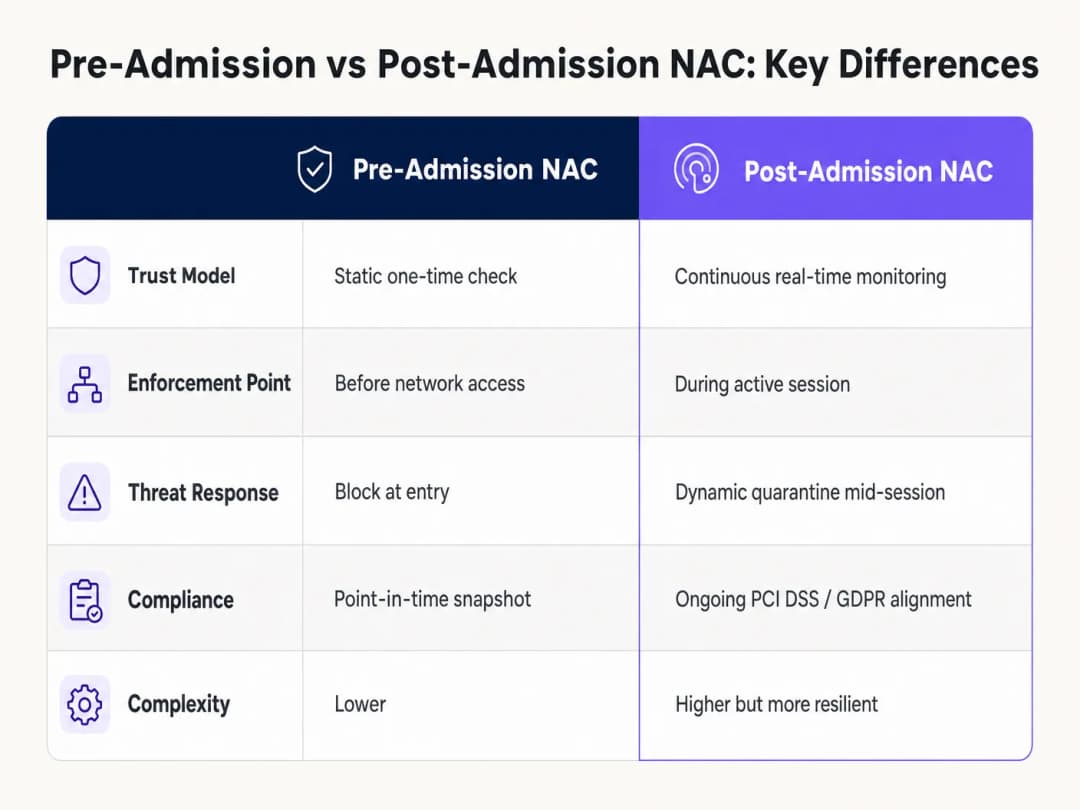
Componentes Clave de una Arquitectura de Monitorización Continua de Confianza
Una implementación de NAC Post-Admission de nivel de producción requiere cuatro componentes integrados que funcionen de manera conjunta.
La ingesta de telemetría es la base. El sistema debe ingerir datos en tiempo real de WLCs, switches, firewalls y agentes de detección y respuesta en endpoints (EDR). Esto incluye datos de NetFlow/IPFIX, registros de contabilidad de RADIUS, registros de solicitudes DNS y métricas de visibilidad de aplicaciones de motores de inspección profunda de paquetes (DPI). Sin una telemetría completa, el motor de políticas opera a ciegas.
El motor de análisis de comportamiento procesa los flujos de telemetría y los compara con las líneas de base establecidas. Los modelos de aprendizaje automático se utilizan cada vez más para automatizar la construcción de líneas de base y la puntuación de anomalías, lo que reduce la carga de la configuración manual. Para profundizar en cómo la IA está transformando este espacio, consulte The Future of Wi-Fi Security: AI-Driven NAC and Threat Detection y su equivalente en español El Futuro de la Seguridad Wi-Fi: NAC Impulsado por IA y Detección de Amenazas .
El cumplimiento dinámico de políticas es el resultado operativo. La capacidad de enviar RADIUS CoA en tiempo real para reiniciar un puerto, cambiar una asignación de VLAN o aplicar una lista de control de acceso (ACL) restrictiva es lo que distingue al NAC Post-Admission de un sistema de monitorización pasivo. Sin un CoA fiable, todo lo que tiene es un sistema de alerta, no un sistema de cumplimiento.
La capa de integración conecta el motor NAC con el ecosistema de seguridad más amplio: plataformas SIEM para la correlación de eventos, fuentes de inteligencia de amenazas para el enriquecimiento de IP conocidas como maliciosas y proveedores de identidad para el enriquecimiento del contexto del usuario. En entornos orientados a invitados, una plataforma de WiFi Analytics proporciona un contexto a nivel de sesión que enriquece significativamente las decisiones de políticas.
Referencia de estándares y protocolos
| Estándar | Relevancia para el NAC Post-Admission |
|---|---|
| IEEE 802.1X | Base de la autenticación basada en puertos; proporciona el enlace de identidad al que hacen referencia las políticas de NAC |
| RFC 5176 (RADIUS CoA) | El mecanismo de protocolo para el cumplimiento de políticas a mitad de sesión |
| WPA3-Enterprise | Proporciona una protección criptográfica más sólida para el intercambio de autenticación 802.1X |
| PCI-DSS v4.0 | Requiere una monitorización continua del acceso a la red con capacidad de respuesta automatizada |
| GDPR Artículo 32 | Exige medidas técnicas adecuadas para garantizar la confidencialidad e integridad continuas |
| NIST SP 800-207 | El marco de Arquitectura Zero Trust que el NAC Post-Admission implementa directamente |
¿Tiene preguntas sobre su configuración específica?
Nuestro equipo trabaja con operadores de recintos, responsables de TI e ingenieros de redes en 80 000 espacios. Reserve una llamada de 20 minutos y le mostraremos cómo lo han solucionado otros profesionales como usted.
Guía de implementación
La implementación de un NAC Post-Admission requiere un enfoque por fases para evitar interrupciones de red a gran escala. Intentar habilitar el cumplimiento activo de inmediato es la causa más común de fallo en la implementación.
Fase 1: Visibilidad y establecimiento de líneas de base (Semanas 1 a 4)
Despliegue la solución NAC en modo de solo monitorización. No se deben configurar acciones de aplicación durante esta fase.
En primer lugar, asegúrese de que todos los Network Access Devices (NAD) envían datos de contabilidad RADIUS y telemetría de flujo al motor de políticas de NAC. Configure la exportación de NetFlow o IPFIX en todos los switches gestionados y WLC. Verifique que el motor NAC recibe y analiza correctamente los registros antes de continuar.
Permita que el sistema observe los patrones de tráfico a través de los diferentes perfiles de dispositivos. Esto es especialmente crítico en entornos de sanidad , donde los dispositivos IoT médicos tienen patrones de tráfico muy predecibles, y en entornos de retail , donde los terminales de punto de venta (POS) tienen requisitos de comunicación bien definidos. El periodo de establecimiento de la línea base debe cubrir al menos un ciclo comercial completo (normalmente cuatro semanas) para capturar la variación entre los fines de semana y los días laborables.
Fase 2: Desarrollo y prueba de políticas (Semanas 5 - 6)
Una vez establecidas las líneas base, desarrolle políticas basadas en el riesgo. Defina activadores de cuarentena explícitos basados en el riesgo empresarial en lugar de indicadores puramente técnicos.
Para un entorno de retail, un activador crítico podría ser: cualquier tráfico de la VLAN de invitados que intente enrutarse a las subredes de la VLAN de POS. Para el sector hotelero, podría ser: cualquier dispositivo que genere más de 500 intentos de conexión SMB por minuto. Para el sector sanitario: cualquier dispositivo autenticado por MAB que se comunique con direcciones IP externas fuera de su lista de destinos aprobados.
Pruebe cada política en un entorno de laboratorio simulando las condiciones de activación. Verifique que el motor NAC identifica correctamente la anomalía, genera la solicitud de CoA y que el NAD aplica la nueva política dentro de un intervalo de tiempo aceptable (normalmente menos de 500 milisegundos para los activadores críticos).
Fase 3: Implantación gradual de la aplicación de políticas (Semanas 7 - 10)
Habilite primero la aplicación activa de políticas en los segmentos de red de bajo riesgo. Una VLAN de IoT exclusiva para el personal suele ser un buen punto de partida, ya que los falsos positivos tienen un impacto operativo limitado en comparación con las redes de invitados o clínicas.
Comience con respuestas de aplicación graduales. En lugar de desconectar los dispositivos inmediatamente, aplique una ACL restrictiva que permita el acceso básico a Internet (HTTP/HTTPS a destinos aprobados) pero bloquee todo el enrutamiento interno. Esto reduce el impacto de los falsos positivos al tiempo que contiene las amenazas. Supervise la cola de cuarentena diariamente y ajuste los umbrales según sea necesario.
Amplíe progresivamente la aplicación de políticas a otros segmentos, validando cada uno de ellos antes de continuar. Asegúrese de que RADIUS CoA funciona de forma fiable: el puerto UDP 3799 debe estar abierto entre el motor NAC y todos los NAD, y las claves compartidas deben ser consistentes. En despliegues de centros de transporte , donde los segmentos de red pueden abarcar múltiples ubicaciones físicas, verifique los tiempos de respuesta de CoA a través de los enlaces WAN.
Fase 4: Producción total y optimización continua
Una vez que todos los segmentos estén bajo una aplicación activa, establezca una cadencia de optimización continua. Revise los eventos de cuarentena semanalmente, identifique los falsos positivos recurrentes y ajuste las líneas de base en consecuencia. Integre el flujo de eventos NAC con su SIEM para realizar una correlación cruzada con los eventos de seguridad de endpoints y del perímetro.
Para implementaciones en el sector de la Hostelería , considere realizar ajustes estacionales en las líneas de base: la red de un hotel en plena temporada de verano presenta patrones de tráfico sustancialmente diferentes a los de la misma red en enero. Sin actualizaciones, las líneas de base estáticas generarán un mayor número de falsos positivos durante los periodos de máxima actividad.
Buenas prácticas
Estandarice en 802.1X siempre que sea posible. Aunque MAB es necesario para dispositivos IoT sin interfaz de usuario, 802.1X proporciona una vinculación de identidad criptográfica más sólida. Asegúrese de utilizar WPA3-Enterprise donde sea compatible. Comprender el entorno de RF subyacente es esencial: consulte Wi Fi Frequencies: A Guide to Wi-Fi Frequencies in 2026 para asegurarse de que el diseño de su espectro soporte la sobrecarga de gestión de la monitorización continua.
Utilice la microsegmentación como control complementario. Combine el NAC postadmisión con la microsegmentación de red. Si un dispositivo se ve comprometido y la respuesta CoA se retrasa por cualquier motivo, la microsegmentación limita el radio de impacto al propio segmento del dispositivo. Ambos controles son complementarios, no redundantes.
Ainee la política de aplicación con los mandatos de cumplimiento. Asegúrese de que sus procedimientos de monitorización continua y respuesta automatizada estén documentados para los auditores. El requisito 10 de PCI-DSS v4.0 exige que se registre y monitorice todo el acceso a los recursos de red. El artículo 32 de GDPR exige medidas continuas de confidencialidad e integridad. El NAC postadmisión satisface directamente ambos requisitos, pero solo si se conservan los registros de auditoría y los procedimientos de respuesta automatizada están documentados formalmente.
Considere BLE para el enriquecimiento del contexto físico. En entornos donde la presencia física es importante, como centros de conferencias o plantas comerciales, la integración de datos de balizas BLE puede enriquecer el contexto del motor de políticas de NAC. Un dispositivo que está autenticado en la red pero ubicado físicamente en una zona restringida representa una señal de mayor riesgo que el mismo dispositivo en una zona pública. Consulte BLE Low Energy Explained for Enterprise para obtener orientación sobre la implementación.
Resolución de problemas y mitigación de riesgos
Fallos de CoA
El problema más común en las implementaciones de NAC postadmisión es que los NAD no procesan las solicitudes CoA de RADIUS. Los síntomas incluyen: el motor NAC registra una transmisión CoA exitosa, pero el dispositivo cliente permanece en la red con el acceso inalterado. Realice el diagnóstico capturando el tráfico en el puerto UDP 3799 en el NAD. Las causas comunes incluyen reglas de firewall que bloquean el puerto CoA, discrepancias en los secretos compartidos de RADIUS o que CoA no esté habilitado explícitamente en la configuración del NAD. Valide siempre el funcionamiento de CoA en una prueba controlada antes de la puesta en marcha.
Falsos positivos e interrupción operativa
Los perfiles de comportamiento excesivamente estrictos pondrán en cuarentena dispositivos legítimos. Esto resulta especialmente problemático en entornos de hostelería, donde el comportamiento de los dispositivos de los invitados es impredecible: el streaming de vídeo, el uso de VPN y las operaciones de copia de seguridad en la nube pueden superar los umbrales de anomalía si los perfiles son demasiado reducidos. Utilice siempre un enfoque de aplicación gradual y mantenga un proceso de lista blanca para los dispositivos de confianza conocidos que activen alertas con frecuencia.
Escala y rendimiento
La monitorización continua genera un volumen sustancial de telemetría. En un estadio o en un gran centro de conferencias con 10 000 sesiones simultáneas, el motor de políticas NAC y la infraestructura de registro deben escalarse para gestionar las tasas de escritura sin perder registros. La pérdida de telemetría crea puntos ciegos. Dimensione la infraestructura para picos de sesiones simultáneas, no para promedios, e implemente un búfer de telemetría en la capa del recopilador para absorber los picos de tráfico.
Dependencia de un único proveedor
Algunos proveedores de NAC implementan extensiones de CoA propietarias que solo funcionan con su propio ecosistema de hardware. Antes de finalizar la arquitectura de despliegue, asegúrese de que su motor de políticas NAC sea compatible con el estándar RFC 5176 CoA y de que sus NAD figuren en la matriz de compatibilidad probada del proveedor.
ROI e impacto empresarial
La implementación de un NAC posterior a la admisión aporta un valor empresarial cuantificable que va mucho más allá del cumplimiento de la seguridad.
Reducción del tiempo medio de respuesta (MTTR): la cuarentena automatizada reduce el MTTR de horas - o días en entornos sin un equipo de SOC dedicado - a milisegundos. Para una cadena de tiendas con 500 establecimientos, esto significa que un dispositivo comprometido en una sucursal se contiene antes de que pueda acceder a la red del TPV, independientemente de si hay o no un ingeniero de redes sobre el terreno.
Eficiencia operativa: los equipos de operaciones de red dedican mucho menos tiempo a buscar manualmente los dispositivos comprometidos. La cuarentena automatizada con un registro de auditoría detallado reduce la carga de investigación y acelera la elaboración de informes posteriores al incidente.
Protección de la marca y de los ingresos: en entornos abiertos al público, evitar que el dispositivo de un invitado se convierta en el trampolín para una brecha de seguridad mayor protege la reputación del establecimiento. Una brecha de datos en un hotel o en un comercio minorista conlleva no solo sanciones regulatorias de la GDPR, sino también un daño reputacional material que afecta directamente a los ingresos.
Menores costes de conformidad: la monitorización continua y automatizada con un registro de auditoría completo reduce el coste y el esfuerzo de las auditorías de conformidad. Demostrar una capacidad de respuesta automatizada en tiempo real a un QSA de PCI es sustancialmente más sencillo que presentar documentación sobre procesos manuales.
Definiciones clave
NAC posterior al acceso
La supervisión continua y la aplicación dinámica de políticas de seguridad en un dispositivo después de que se le haya concedido el acceso inicial a la red, a diferencia de las comprobaciones previas al acceso que se realizan solo en el punto de conexión.
Crucial para identificar dispositivos que se ven comprometidos a mitad de la sesión o que muestran un comportamiento malicioso que no era evidente durante la fase de autenticación inicial. Directamente relevante para cualquier entorno con acceso de invitados o dispositivos no gestionados.
Supervisión continua de la confianza
Un modelo de seguridad en el que nunca se asume la confianza de forma permanente; el estado, el comportamiento y el contexto de un dispositivo se evalúan continuamente en comparación con los patrones de referencia establecidos a lo largo de la duración de su sesión de red.
La filosofía operativa que sustenta el NAC posterior al acceso y una implementación directa de los principios de la arquitectura Zero Trust de NIST SP 800-207.
Cambio de autorización (CoA)
Una extensión de RADIUS definida en el RFC 5176 que permite a un servidor de políticas modificar dinámicamente los atributos de autorización de sesión de un cliente de red activo, lo que incluye cambiar la asignación de VLAN, aplicar ACL o finalizar la sesión por completo.
El mecanismo técnico de aplicación que distingue al NAC posterior al acceso de la supervisión pasiva. Si el CoA no funciona, el sistema no puede aplicar políticas dinámicas a mitad de la sesión.
Establecimiento de patrones de comportamiento
El proceso de establecer un patrón estadísticamente normal de actividad de red para un tipo de dispositivo específico, un rol de usuario o un segmento de red durante un periodo de observación definido.
La base de la detección de anomalías en el NAC posterior al acceso. Los patrones de referencia demasiado estrechos generan falsos positivos; los patrones de referencia demasiado amplios pasan por alto amenazas reales. Por lo general, requiere un mínimo de cuatro semanas de observación a lo largo de un ciclo empresarial completo.
Bypass de autenticación MAC (MAB)
Un método de acceso a la red que concede acceso basándose únicamente en la dirección MAC de un dispositivo, utilizado habitualmente para dispositivos IoT sin interfaz de usuario que no admiten la autenticación 802.1X EAP.
Intrínsecamente vulnerable a los ataques de suplantación de MAC. El NAC posterior al acceso con creación de perfiles de dispositivos es esencial para proteger cualquier entorno que dependa de MAB, en particular los despliegues sanitarios y de IoT industrial.
Dispositivo de acceso a la red (NAD)
El componente de hardware físico - normalmente un switch gestionado, un controlador de LAN inalámbrica o una pasarela VPN - que aplica las políticas de acceso en el extremo de la red y recibe instrucciones de CoA del motor de políticas de NAC.
El NAD es el punto de aplicación. Su compatibilidad con el CoA del RFC 5176 y la fiabilidad de su procesamiento de CoA son factores críticos en cualquier arquitectura de NAC posterior al acceso.
Telemetría
La recopilación y transmisión automatizada y en tiempo real de datos operativos de la red - incluidos registros NetFlow/IPFIX, datos de contabilidad de RADIUS, eventos de syslog y trampas SNMP - desde los dispositivos de red a un motor de análisis centralizado.
Proporciona el flujo de datos brutos necesario para que funcione el motor de análisis de comportamiento de NAC. Los vacíos en la cobertura de la telemetría crean puntos ciegos donde los dispositivos comprometidos pueden operar sin ser detectados.
Microsegmentación
La práctica de arquitectura de red que consiste en dividir una red en segmentos pequeños y aislados con controles de acceso granulares entre ellos, lo que limita el movimiento lateral de un atacante o de un dispositivo comprometido.
Un control complementario al NAC posterior al acceso. Si se retrasa una acción de aplicación de CoA, la microsegmentación limita el radio de impacto de un dispositivo comprometido a su propio segmento, evitando que llegue a activos críticos en segmentos adyacentes.
RADIUS (Remote Authentication Dial-In User Service)
Un protocolo de red que proporciona una gestión centralizada de autenticación, autorización y contabilidad (AAA) para los usuarios que se conectan a un servicio de red y lo utilizan.
El protocolo fundamental tanto para la admisión inicial (Access-Request/Accept) como para la aplicación posterior a la admisión (CoA). La mayoría de los despliegues de NAC empresariales se basan en una infraestructura RADIUS.
Ejemplos prácticos
Una gran cadena minorista que despliega Guest WiFi en 500 ubicaciones necesita garantizar que los dispositivos de invitados comprometidos no puedan escanear ni acceder a la red del punto de venta (POS). El equipo de TI dispone de recursos in situ limitados y necesita una solución automatizada y gestionada de forma centralizada. ¿Cómo deberían implementar el NAC posadmisión?
- Desplegar un motor de políticas NAC alojado en la nube con un colector de telemetría distribuido en cada sucursal, evitando la necesidad de hardware NAC in situ.
- Configurar todos los switches y WLC de las sucursales para enviar registros de contabilidad de RADIUS y datos de NetFlow al motor NAC central a través de túneles cifrados.
- Definir un periodo de referencia de cuatro semanas que cubra los patrones de tráfico tanto de los días laborables como de los fines de semana para la VLAN de invitados.
- Crear una política de infracción crítica: si cualquier tráfico de la subred VLAN de invitados intenta enrutarse a la subred VLAN de POS (definida por el rango de IP), el motor NAC emite inmediatamente un RADIUS CoA al WLC local.
- El CoA indica al WLC que aplique una ACL de "Cuarentena" a la dirección MAC del cliente específico, descartando todo el tráfico excepto DHCP y DNS, aislando eficazmente el dispositivo a mitad de sesión.
- Configurar una alerta automatizada para el NOC central y registrar el evento en el SIEM para el análisis posterior al incidente.
- Validar la funcionalidad CoA en 10 sitios piloto antes de implementarla en las 500 ubicaciones.
Una red hospitalaria tiene miles de dispositivos IoT médicos sin interfaz (headless) que utilizan la derivación de autenticación de MAC (MAB) para el acceso inicial. Al equipo de seguridad le preocupan los ataques de suplantación de MAC y la imposibilidad de detectar dispositivos comprometidos a mitad de sesión. ¿Cómo puede el NAC posadmisión mitigar estos riesgos?
- Desplegar una solución NAC con capacidades de perfilado de dispositivos que pueda ingerir huellas dactilares DHCP, agentes de usuario HTTP y características de flujo de tráfico.
- Durante la fase de establecimiento de líneas de base, crear un perfil para cada tipo de dispositivo: una bomba de infusión se comunica con un servidor interno específico en el puerto 443 a intervalos regulares; un sistema de monitorización de pacientes se comunica con una estación de enfermería en una subred interna específica.
- Configurar políticas de infracción basadas en la desviación del perfil: si un dispositivo autenticado a través de MAB como bomba de infusión comienza a comunicarse con cualquier dirección IP externa, o inicia más de 10 conexiones por minuto a destinos internos no aprobados, se activa una cuarentena.
- Emitir un RADIUS CoA al switch para mover el puerto a una VLAN de cuarentena, aislando el dispositivo de la red clínica mientras se conserva la conectividad para la investigación.
- Alertar al equipo de ingeniería clínica y al SOC simultáneamente, proporcionando la dirección MAC del dispositivo, el puerto del switch y la anomalía de tráfico específica que activó la respuesta.
Preguntas de práctica
Q1. Su equipo de operaciones de red informa de que el nuevo despliegue de NAC posterior a la admisión está generando un alto volumen de falsos positivos, aislando en cuarentena dispositivos legítimos de invitados en el vestíbulo de un hotel con gran actividad. El equipo de atención al cliente está escalando las quejas. ¿Cuál es la acción inmediata más adecuada y qué medidas de corrección a largo plazo debería planificar?
Sugerencia: Tenga en cuenta las fases del despliegue y las características específicas de tráfico de una red de invitados en el sector de la hostelería.
Ver respuesta modelo
Revierta inmediatamente la política de aplicación de Cuarentena Activa a Solo Monitorización, o aplique una ACL de aplicación gradual menos restrictiva que limite el enrutamiento interno sin desconectar el dispositivo. Revise las líneas de base de comportamiento específicamente para la VLAN de invitados; los entornos de hostelería tienen un tráfico de invitados inherentemente impredecible que incluye el uso de VPN, servicios de streaming y copias de seguridad en la nube. Amplíe el periodo de establecimiento de la línea de base y suavice los umbrales de anomalía antes de volver a activar la aplicación activa. A más largo plazo, implemente ajustes estacionales en las líneas de base y considere un modelo de aplicación por niveles en el que los dispositivos de los invitados reciban una respuesta menos agresiva que los dispositivos corporativos o de IoT.
Q2. Durante un despliegue piloto, el motor de políticas de NAC detecta correctamente un comportamiento anómalo y registra el evento con una puntuación de anomalía de alta confianza, pero el dispositivo cliente permanece en la red con el mismo acceso de siempre. El NOC recibe la alerta pero no se ha aplicado ninguna acción de cuarentena. ¿Cuál es el fallo técnico más probable y cómo lo diagnosticaría?
Sugerencia: Piense en el protocolo y puerto específicos utilizados para la aplicación a mitad de sesión.
Ver respuesta modelo
El fallo más probable es que el cambio de autorización (CoA) de RADIUS no esté funcionando correctamente entre el motor de NAC y el dispositivo de acceso a la red (NAD). Realice el diagnóstico capturando tráfico en el puerto UDP 3799 en el NAD para confirmar si llega el paquete CoA. Si llega pero es rechazado, compruebe la configuración del secreto compartido de RADIUS tanto en el motor de NAC como en el NAD. Si no llega, compruebe las reglas del cortafuegos entre el motor de NAC y el NAD. Verifique también que CoA esté explícitamente habilitado en la configuración de cliente RADIUS del NAD; muchos dispositivos requieren una instrucción de configuración independiente para aceptar solicitudes CoA.
Q3. Un gran centro de conferencias está planificando un despliegue de NAC posterior a la admisión antes de una importante feria comercial en la que se esperan 8000 usuarios concurrentes de WiFi. Al director de TI le preocupa que la infraestructura de telemetría se vea desbordada durante los picos de carga. ¿Cómo debe diseñarse la arquitectura para soportar esta escala?
Sugerencia: Considere la diferencia entre el volumen de telemetría sin procesar y el volumen de eventos procesados, y en qué parte de la arquitectura debe producirse la agregación.
Ver respuesta modelo
Implemente una arquitectura de telemetría distribuida con colectores locales en cada nivel de la capa de acceso. Los datos brutos de NetFlow y de contabilidad de RADIUS deben agregarse y preprocesarse en el colector local antes de enviarse al motor central de políticas de NAC. Esto reduce el consumo de ancho de banda WAN y la carga de procesamiento en el motor central. Dimensione el motor central de políticas en función de la tasa de eventos procesados, no del volumen de telemetría sin procesar. Implemente el almacenamiento en búfer de la telemetría en la capa del colector para gestionar las condiciones de saturación durante los picos de carga. Además, considere aplicar un muestreo a los datos de NetFlow (por ejemplo, muestreo de 1 de cada 10 paquetes) para la monitorización general del tráfico, reservando la telemetría a velocidad completa para los segmentos de dispositivos de alto riesgo. Valide la arquitectura bajo una simulación de carga máxima antes del evento.
Q4. ¿Cómo asesoraría a un CTO de retail que pregunta si la implementación de un NAC Post-Admission cumplirá con el Requisito 10 de PCI-DSS v4.0 y reducirá el alcance de su auditoría anual de QSA?
Sugerencia: Considere qué exige específicamente el Requisito 10 de PCI DSS y qué documentación requerirá un QSA.
Ver respuesta modelo
El NAC Post-Admission respalda directamente el cumplimiento del Requisito 10 de PCI-DSS v4.0 al proporcionar un registro y monitoreo continuos y automatizados de todo el acceso a los recursos de red y a los entornos de datos de titulares de tarjetas. La capacidad de cuarentena automatizada demuestra un mecanismo de respuesta en tiempo real, lo que satisface el espíritu del Requisito 10.7 (responder a fallos de controles de seguridad críticos). Sin embargo, para reducir el alcance de la auditoría, el CTO debe asegurarse de que: el registro de eventos del NAC sea a prueba de manipulaciones y se conserve durante al menos 12 meses; los procedimientos de respuesta automatizados estén documentados formalmente; y el QSA pueda revisar las pruebas del sistema funcionando en producción. Es más probable lograr una reducción del alcance mediante la segmentación de red (aislando el CDE) que solo a través de NAC, pero el NAC refuerza significativamente el paquete de pruebas presentado al QSA.
Continúe leyendo esta serie
PPSK WPA3: comparación de características y modelos de implementación
Esta guía de referencia técnica compara PPSK y WPA3-SAE, explicando sus diferencias arquitectónicas y modelos de implementación para entornos multi-inquilino. Ofrece orientación práctica para directores de TI y promotores inmobiliarios sobre cómo lograr redes WiFi seguras y aisladas utilizando las soluciones basadas en identidad de Purple.
PPSK WiFi: comparación de funciones y modelos de despliegue
Esta guía de referencia técnica compara la arquitectura PPSK WiFi con las implementaciones tradicionales de 802.1X y PSK estándar. Proporciona a los arquitectos de red y responsables de TI estrategias de implementación independientes del proveedor para entornos residenciales multiinquilino, IoT y BTR.
Cómo reducir el número de SSIDs de WiFi utilizando PSK por dispositivo (iPSK, DPSK, MPSK)
Esta guía de referencia técnica autorizada explica cómo los equipos de TI pueden eliminar la degradación del rendimiento de WiFi causada por la sobrecarga de balizas de SSID colapsando múltiples redes dedicadas en un único SSID mediante el uso de PSK por dispositivo (xPSK). Cubre el panorama de proveedores que incluye Cisco iPSK, HPE Aruba MPSK, Ruckus DPSK, Juniper Mist PPSK y Ubiquiti UniFi PPSK, con orientación práctica de implementación sobre asignación dinámica de VLAN, incorporación de IoT y cumplimiento de PCI DSS. Los operadores de recintos en los sectores de hostelería, retail, estadios y organizaciones del sector público encontrarán orientación de arquitectura práctica y ejemplos de casos reales.
¿Tiene preguntas sobre su configuración específica?
Nuestro equipo trabaja con operadores de recintos, responsables de TI e ingenieros de redes en 80 000 espacios. Reserve una llamada de 20 minutos y le mostraremos cómo lo han solucionado otros profesionales como usted.