跳至主要内容

平均证明清白时间:如何证明问题不在 WiFi

平均证明清白时间 (MTTI) 是衡量 IT 团队花费多少时间来证明网络问题并非自身责任的关键指标。本指南详细介绍了五步可观测性方法论,旨在消除多租户环境中的推诿现象,用共享证据取代相互指责,从而降低平均解决时间 (MTTR)。

📖 6 分钟阅读📝 1,348 🔧 2 应用实例3 练习题📚 8 关键定义

收听本指南

查看播客转录
Speak in British English with a confident, authoritative, and conversational tone - like a senior network consultant briefing a client over a coffee. Measured pace, clear diction, occasional dry wit. Not a lecture. Not a sales pitch. Just straight talk from someone who has seen this problem a hundred times: Welcome to the Purple technical brief. I am going to talk to you today about something every network manager knows in their bones, even if they have never heard the formal term for it. Mean time to innocence. Or MTTI. [short pause] The time you spend proving it is not your fault. Here is the scenario. It is nine in the morning. Residents in a build-to-rent block start calling the front desk. The WiFi is broken. The property manager calls the managed WiFi provider. The managed WiFi provider calls the ISP. The ISP says check the router. The router team says check the access points. The access point vendor says check the client devices. And somewhere in the middle of all that, forty-five minutes have gone by, and nobody has actually fixed anything. That, right there, is mean time to innocence in action. [short pause] And it is costing you more than you think. Let me define it properly. Mean time to innocence is the average elapsed time between when a problem is detected and when any given team can demonstrate, with evidence, that their domain is not the root cause. It is not the same as mean time to identify, which is the organisation-wide metric for finding the actual root cause. MTTI is siloed. It is personal. It is the network team saying, here is the data, it is not us, now look elsewhere. The problem is that without the right tooling, that proof takes time. And every minute of MTTI is a minute added directly to your mean time to resolution, your MTTR. The two are inseparable. So why does the WiFi always get blamed first? [short pause] Three reasons. First, WiFi is visible. When something breaks, people look at the thing they can see, and the WiFi signal bars on their phone are the most visible indicator of connectivity. Second, WiFi is the last hop before the device, so it is the first thing that looks suspicious when a device cannot reach the internet. Third, and this is the uncomfortable one, WiFi teams often cannot prove innocence quickly because they lack the right telemetry. If you cannot show a clean bill of health for the wireless layer in under two minutes, you are going to spend the next hour defending yourself. Now, in a single-tenant enterprise environment, this is annoying. In a multi-tenant environment, it is genuinely damaging. Think about a hotel like Premier Inn, or a build-to-rent residential block, or a conference centre running back-to-back events. You have a property manager who does not own the network. You have residents or guests who do not understand the network. And you have a managed WiFi provider who is responsible for the wireless layer but not the ISP circuit, not the in-building cabling, and not the client devices. When something breaks, the property manager blames the WiFi provider because that is the contract they can point to. The resident blames the building because that is who they pay rent to. And the WiFi provider has to exonerate the network fast, or the relationship deteriorates. [short pause] MTTI is not just a technical metric in this context. It is a commercial one. So let us talk about the methodology that actually shortens it. There are five layers, and you need all five. Layer one: continuous synthetic checks. Before any ticket is raised, you should have automated probes running from the network itself, testing DNS resolution, HTTP reachability, latency to known endpoints, and authentication flows. Tools like Juniper Mist's Marvis, or the synthetic testing built into platforms like ThousandEyes, run these checks every few minutes. When an incident occurs, you can pull up a graph and show exactly when the WiFi layer last had a clean synthetic check, and whether it was clean or degraded at the time of the complaint. That alone cuts MTTI dramatically, because you either confirm the WiFi was healthy, or you confirm it was not, and you stop arguing about it. Layer two: hop-by-hop path visibility. This is where most teams fall down. You can prove the access point is healthy. You can prove the switch is healthy. But can you prove the path from the switch to the ISP handoff is healthy? In a multi-tenant building, there are often hops you do not own. The in-building distribution network, the landlord's core switch, the demarcation point to the ISP. You need path trace data that crosses those boundaries. Not just a ping to eight-eight-eight-eight. Actual traceroute-style visibility that shows you every hop, its latency, and whether it is dropping packets. When you can show that hops one through four are clean and hop five, which is the ISP's edge router, is showing forty percent packet loss, the conversation changes immediately. Layer three: flow data with on-demand packet capture. NetFlow and IPFIX give you a conversation-level view of what is talking to what on the network. When a resident says the streaming service is broken, flow data tells you whether traffic to that service's IP ranges is even leaving the network. If it is leaving the network clean and the problem is downstream, that is your evidence. If it is not leaving the network at all, you know where to look. On-demand packet capture, available on platforms like Cisco Meraki and HPE Aruba, lets you grab a targeted capture for a specific client or VLAN without touching the hardware. That is your forensic layer. You use it sparingly, but when you need it, it is definitive. Layer four: topology and dependency mapping. In a multi-tenant environment, you need a live map that shows which access points serve which tenants, which switches those APs connect to, which uplinks those switches use, and which ISP circuit serves each uplink. When an incident occurs, you can immediately identify the blast radius. Is this affecting one tenant or all tenants? One floor or the whole building? One VLAN or all VLANs? That scoping question, answered in thirty seconds from a topology map, tells you whether the problem is in the WiFi layer, the building network, or the WAN. It also tells you who else to loop in, and who you can immediately exclude. Layer five: event correlation. This is the one that ties everything together. Change logs, ISP maintenance alerts, device firmware updates, power events, and user complaints all need to sit on the same timeline. When you overlay a spike in client association failures with a firmware push that happened twelve minutes earlier, you have your root cause. When you overlay a latency spike with an ISP maintenance window that was not communicated to you, you have your evidence for the escalation. Event correlation is not glamorous, but it is the difference between a forty-five-minute blame game and a four-minute exoneration. Now, a word on the cultural dimension, because this is where a lot of teams get it wrong. The goal of reducing MTTI is not to win the blame game faster. It is to end the blame game entirely. [short pause] Shared evidence changes the dynamic. When the WiFi provider can send the property manager a link to a dashboard showing green across the wireless layer, amber on the in-building switch, and red on the ISP circuit, the conversation stops being adversarial. It becomes collaborative. The property manager calls the ISP. The ISP fixes the circuit. The residents get connectivity back. And the WiFi provider's contract is renewed because they were the ones who found the problem. That is the commercial case for investing in observability tooling. Not just faster troubleshooting, but better relationships with the people who pay you. Let me run through a couple of quick scenarios to make this concrete. Scenario one: a 350-room hotel. Guests at a Premier Inn-style property start reporting that the in-room WiFi is slow. The front desk logs a ticket with the managed WiFi provider. With synthetic checks running, the provider can see that DNS resolution times spiked from twelve milliseconds to four hundred milliseconds at seven forty-three in the morning. The WiFi layer is healthy. The path trace shows the latency is introduced at the third hop, which is the ISP's aggregation router. The provider sends the hotel manager a screenshot of the path trace with the degraded hop highlighted in red, alongside the synthetic check graph showing the WiFi layer was clean throughout. The ISP is called. The ISP confirms a routing issue on their side. Total time from complaint to exoneration of the WiFi layer: six minutes. MTTR for the full incident: twenty-two minutes, because the ISP fix took sixteen minutes. Without the observability tooling, that six-minute exoneration would have been forty minutes of back-and-forth, and the MTTR would have been over an hour. Scenario two: a retail chain. A national retailer with WiFi across two hundred stores notices that the point-of-sale terminals in one region are intermittently losing connectivity to the payment processor. The network team is immediately blamed. Flow data shows that traffic to the payment processor's IP range is leaving the store network cleanly. The problem is not the network. A packet capture on the payment processor VLAN shows TCP retransmissions spiking, which points to a server-side issue at the payment processor. The network team shares the flow data and the capture summary with the payment processor's support team. The payment processor identifies a misconfigured load balancer on their side. The network team's MTTI: eight minutes. The payment processor's fix time: thirty-five minutes. Without the flow data, the network team would have spent those thirty-five minutes reprovisioning VLANs and rebooting switches that were working perfectly. Right. Let me give you the rapid-fire version of the key questions I get asked on this topic. Is it the WiFi or the device? Run a synthetic check from the AP itself. If the AP can reach the internet cleanly and the device cannot, it is the device. If the AP cannot reach the internet, it is upstream of the device. Is it the WiFi or the ISP? Path trace to the internet. If the latency or loss is introduced at a hop outside your network boundary, it is the ISP. What is the difference between MTTI and mean time to identify? MTTI is your team's time to prove innocence. Mean time to identify is the organisation's time to find the actual culprit. MTTI is a subset of mean time to identify. How do I cut MTTI without buying new tools? Start with what you have. Most enterprise access point platforms, including Cisco Meraki, HPE Aruba, and Juniper Mist, have built-in synthetic testing and client diagnostics. Use them. Document your topology. Build a shared dashboard that the property manager or operations team can see. Transparency is the cheapest MTTI reduction tool available. To wrap up. Mean time to innocence is the hidden tax on every network incident. In multi-tenant environments, where accountability is fragmented across providers, landlords, and ISPs, it is the metric that determines whether you retain contracts or lose them. The methodology to reduce it is not complicated: synthetic checks, path visibility, flow data, topology mapping, and event correlation. The goal is not to win the blame game. It is to replace the blame game with shared evidence, so that every team can focus on fixing the problem rather than defending their patch. [short pause] Because every minute spent proving innocence is a minute added to the time your residents, guests, or shoppers spend without connectivity. And that is the number that actually matters. Thanks for listening. If you want to see how Purple's Multi-Tenant WiFi platform surfaces this kind of observability data across 80,000 live venues, head to purple dot ai.

📚 核心系列的一部分:多租户 WiFi:完整指南

header_image.png

执行摘要

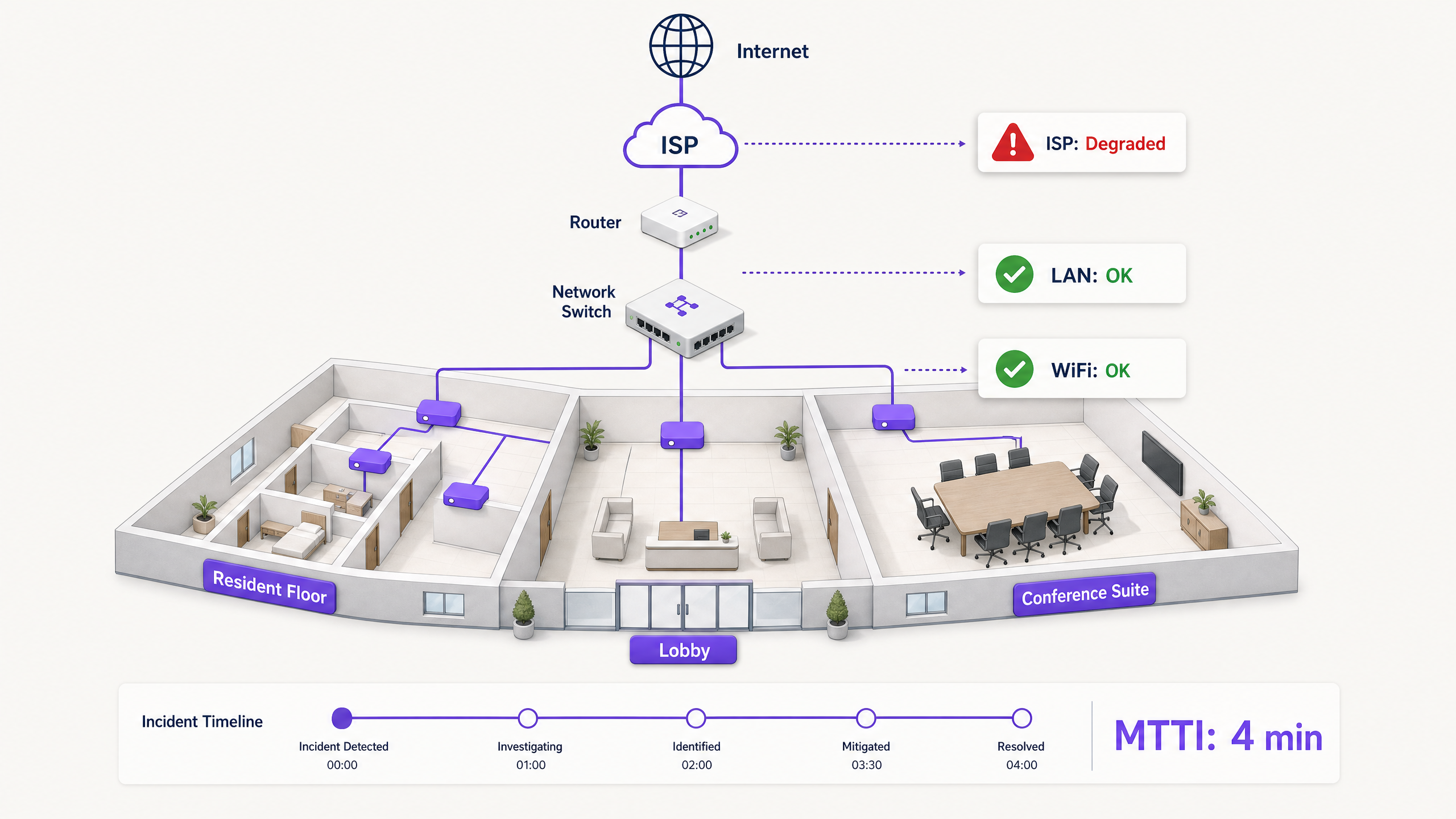
当多租户环境中的连接中断时,WiFi 总是最先被归咎的对象。它是网络中可见的边缘、设备前的最后一公里(最后一跳),也是沮丧的用户最容易抱怨的目标。对于 IT 经理、网络架构师和场所运营总监而言,这造成了持续的运营负担:即花费时间来证明清白。

平均证明清白时间 (MTTI) 衡量的是从报告事件到团队能够证明其管辖领域并非根本原因之间的平均流逝时间。在诸如长租公寓 (BTR) 街区、酒店或会议中心等复杂环境中,网络管理权分散在物业经理、托管 WiFi 服务提供商和互联网服务提供商 (ISP) 之间。在缺乏确凿遥测数据的情况下,各团队往往会争论责任归属而非着手解决故障,这导致 MTTI 延长,进而推高了平均解决时间 (MTTR)。

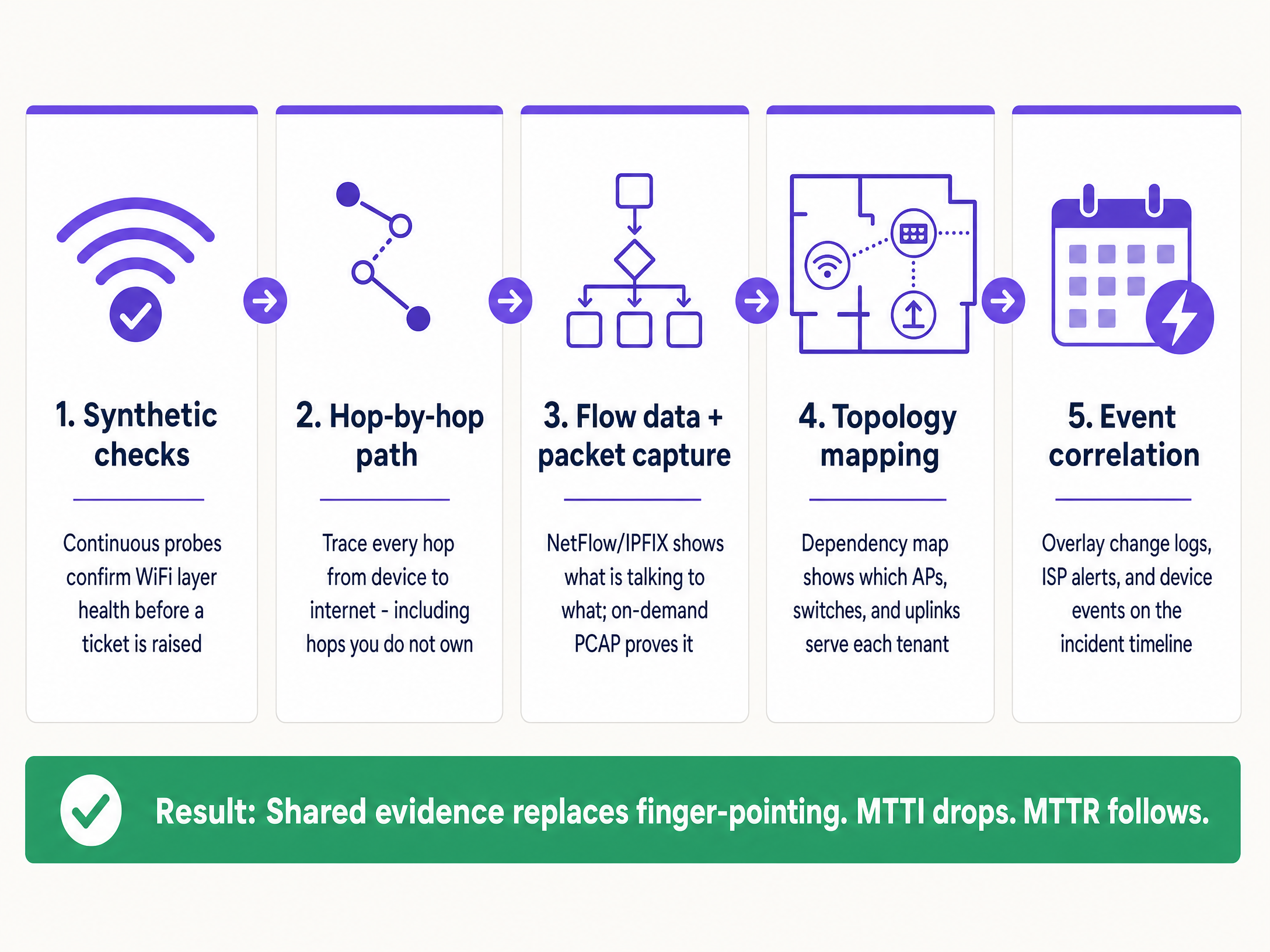
本指南详细介绍了系统性降低 MTTI 的五步可观测性方法论。通过部署持续的主动拨测(合成检测)、逐跳路径可视化、流数据分析、拓扑映射和事件关联,您可以用共享证据取代敌对式的相互指责。我们的目标不是更快地在推诿游戏中胜出,而是彻底终结这种游戏。

技术深挖:MTTI 的运作机制

MTTI 与平均识别时间的区别

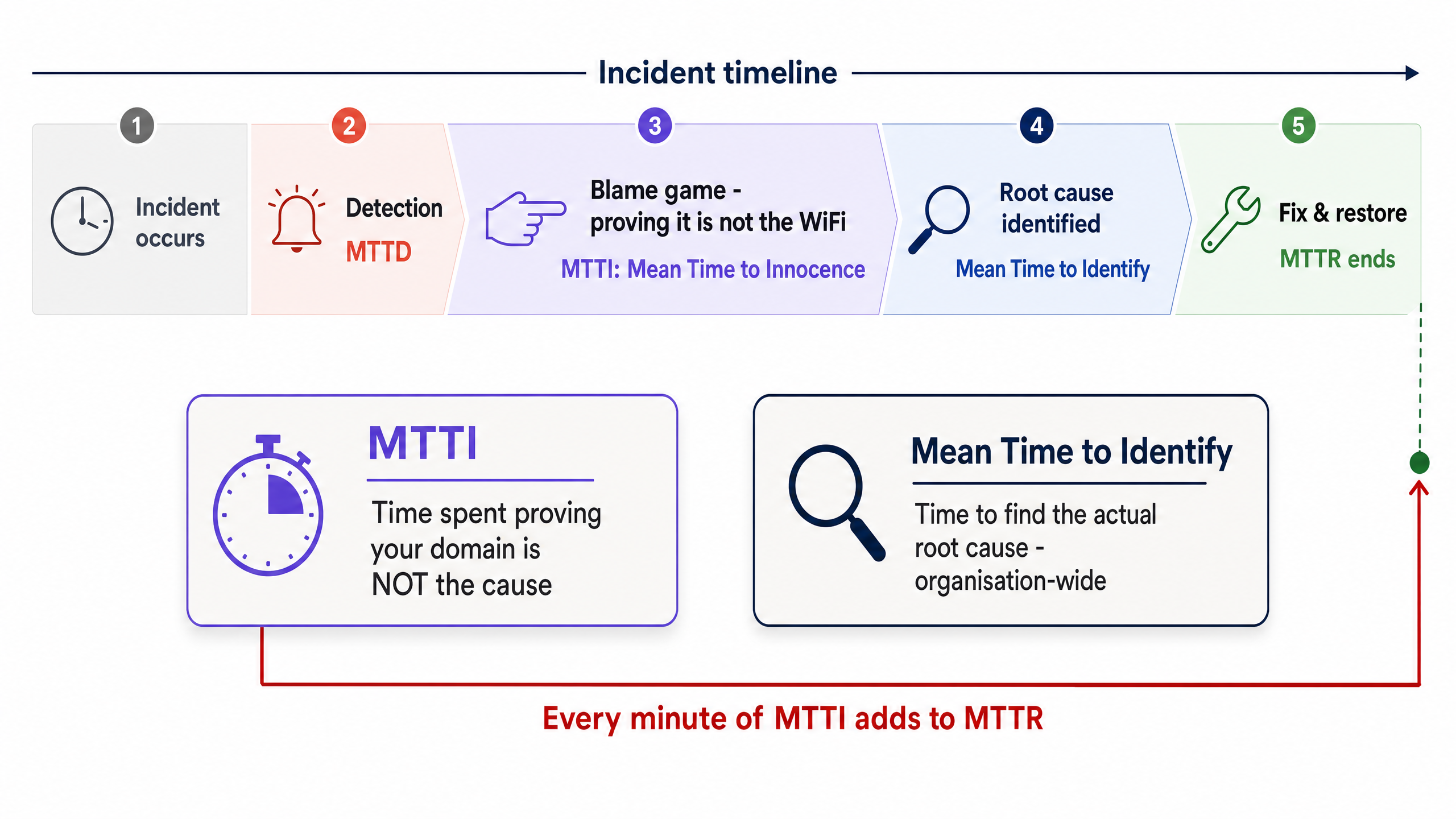
区分 MTTI 与平均识别时间至关重要。平均识别时间是一个组织层面的指标,用于追踪找出故障实际根本原因所需的时间。而 MTTI 是一个孤立的、特定领域的指标,用于追踪一个团队证明自己不是“罪魁祸首”所需的时间。

MTTI 每增加一分钟,都会直接累加到 MTTR 中。如果托管 WiFi 提供商花费 40 分钟手动检查接入点 (AP) 和交换机日志,最后才得出问题出在 ISP 端的结论,那么在实际修复工作开始之前,MTTR 就已经平白增加了 40 分钟。
mtti_vs_mttr_diagram.png

为什么 WiFi 总是替罪羊

在为 80,000 多个活跃场所的 3.5 亿独立用户提供服务的环境中,Purple 反复看到了同样的模式。由于以下三个结构性现实,WiFi 层默认会成为被归咎的对象:

  1. 可见性偏差:WiFi 信号指示图标是普通场所用户唯一可用的网络诊断工具。
  2. 边缘邻近性:作为连接到客户端设备的最后一跳,WiFi 继承了所有上游故障的症状。从用户的角度来看,ISP 端的 DNS 超时与 AP 故障看起来完全一样。
  3. 遥测空白:从历史上看,证明无线网络健康状况需要人工干预。如果您无法在两分钟内出示无线层运行良好的证明,您就会在舆论上陷入被动。

多租户环境的复杂性

在单租户企业中,网络团队拥有从 AP 到防火墙的整个技术栈。而在多租户 WiFi 环境中,所有权是割裂的。

长租公寓 (BTR) 居民向物业经理付费。物业经理与托管 WiFi 提供商签约。托管 WiFi 提供商则依赖第三方 ISP 线路,且通常还依赖业主的楼内分配网络。当居民无法播放流媒体视频时,提供商必须迅速证明 WiFi 硬件(Cisco Meraki、HPE Aruba、Ruckus 或 Juniper Mist)没有问题,并将故障定位到客户端设备、大楼交换机或 ISP。如果做不到这一点,就会损害提供商与物业经理之间的商业关系。

实施指南:五步方法论

要系统性地降低 MTTI,请部署这套五层可观测性架构。
troubleshooting_methodology.png

1. 持续主动拨测(合成检测)

不要等待用户投诉。部署自动化的主动探测器,从网络边缘持续模拟用户行为。

  • 实施:配置 AP 或专用传感器,针对 DHCP 响应、DNS 解析、HTTP 可达性以及认证流程(例如 802.1Xcaptive portal 登录)运行定期测试。
  • 成效:当工单创建时,您首先检查拨测仪表板。如果探测器显示在投诉发生的准确时间 HTTP 可达性良好,您可以立即排除 WiFi 层和 WAN 线路的问题,将注意力转移到特定的客户端设备或目标应用程序上。

2. 逐跳路径可视化

仅仅证明您的硬件健康是不够的,您还必须证明通往互联网的路径是畅通的。

  • 实施:使用路径可视化工具追踪流量,从接入层跨越局域网 (LAN),穿过分界点,并进入 ISP 网络。
  • 成效:当延迟激增时,路径追踪会准确显示是哪个节点引入了延迟。如果第一到第四跳(您的管辖领域)显示 2 毫秒的延迟,而第五跳(ISP 边缘路由器)显示 150 毫秒的延迟 and 12% 的丢包率,您就有了可以提交给 ISP 的确凿证据。

3. 流数据与按需数据包捕获

当用户报告特定应用程序故障时,您需要会话级别的可见性。

  • 实施:从核心交换机或防火墙导出 NetFlow 或 IPFIX 数据。确保您的接入层硬件支持远程、按需进行数据包捕获 (PCAP),而无需工程师亲临现场。
  • 成效:流数据可以证明前往特定服务的流量是否正常离开您的网络。如果是,则说明网络是清白的。如果 d如果需要更深入的取证证明,在特定 VLAN 上进行针对性的 PCAP 可以提供 TCP 重传或服务器端重置的无可辩驳的证据。

4. 拓扑与依赖关系映射

在多租户环境中,隔离爆炸半径是分类故障的最快方法。

  • 实施:维护一个实时、动态更新的依赖关系图,将每个 AP 连接到其交换机、上行链路和 WAN 电路,并与租户 VLAN 进行映射。
  • 结果:如果故障影响了多个楼层的 AP,但仅限于单个交换机,则问题出在交换机上。如果它影响了所有 AP,但仅影响一个租户的 VLAN,则这是一个逻辑配置问题。快速确定范围可以避免在调查健康的基础设施上浪费精力。

5. 事件关联

没有上下文的数据会延长调查时间。

  • 实施:将变更日志、ISP 维护警报、硬件固件更新和用户工单输入到单个时间线视图中。
  • 结果:将身份验证失败的激增与 10 分钟前发生的 Microsoft Entra ID 证书过期事件进行叠加,可以立即确定根本原因,从而完全绕过网络硬件。

最佳实践

  • 标准化硬件栈:将部署限制在主流企业级厂商(Cisco Meraki、HPE Aruba、Ruckus、Juniper Mist、Ubiquiti UniFi、Cambium、Extreme、Fortinet),这些厂商提供用于主动测试和远程 PCAP 的 API。
  • 自动化证据收集:配置您的监控平台,在创建 ITSM 工单的瞬间自动将主动测试结果和路径跟踪附加到工单中。
  • 共享仪表板:为物业经理提供对高级健康仪表板的只读访问权限。透明度可以预防推诿责任。
  • 正式追踪 MTTI:测量从工单创建到您的团队提供“免责”证据之间的时间。将其与 MTTR 一起作为主要 KPI。

故障排除与风险缓解

  • 风险:“未发现故障”循环:用户报告问题,但主动测试检查显示为绿色(正常)。
    • 缓解措施:问题可能与特定设备相关,或与射频干扰(同频干扰或物理障碍)有关。使用客户端分析来检查特定设备的 RSSI 和漫游历史记录。
  • 风险:ISP 否认:尽管您提供了证据,ISP 仍拒绝承认故障。
    • 缓解措施:提供逐跳路径跟踪,显示开始丢包的确切 IP 地址。分享展示从您的分界点干净流出的 PCAP。铁证如山的数据会迫使问题升级到 1 级支持以上。
  • 风险:Captive Portal 故障:当门户无法加载时,用户会归咎于 WiFi。
    • 缓解措施:隔离身份提供商。检查集成状态(Microsoft Entra ID、Okta、Google Workspace)。如果网络允许预身份验证流量,但 IdP 超时,则网络是无辜的。

投资回报率 (ROI) 与业务影响

降低 MTTI 不仅能节省工程师的时间,还能带来可衡量的业务价值。

  1. 缩短 MTTR:在事件处理中减少 40 分钟的推诿时间可以直接缩短停机时间,从而保护 零售酒店 环境中的收入。
  2. SLA 合规性:当故障在于 ISP 或建筑基础设施时,更快的免责证明可以防止对托管 WiFi 提供商进行不公正的处罚。
  3. 客户留存:在多租户 WiFi 领域,物业经理会与提供透明度和快速解答的提供商续签合同。共享证据可以建立信任,而防御性辩解则会破坏信任。
  4. 资源优化:高薪的 3 级网络工程师可以将时间花在设计解决方案上,而不是手动证明网络运行正常。

关键定义

Mean Time to Innocence (MTTI)

The average time required for a specific IT team to prove, using objective data, that their domain or infrastructure is not the root cause of a reported incident.

Critical for managed WiFi providers who must defend their service against property managers and ISPs.

Mean Time to Identify

The organisation-wide metric tracking the total time elapsed from incident detection to the discovery of the actual root cause.

MTTI is a subset of this metric. Reducing MTTI directly reduces the overall time to identify.

Synthetic Checks

Automated, continuous tests that emulate user traffic (e.g., DNS lookups, HTTP requests) to proactively monitor network health.

Used to prove the WiFi layer was functioning correctly at the exact moment a user complained.

Hop-by-Hop Path Visibility

Telemetry that traces network traffic node-by-node from the client to the destination, measuring latency and loss at each specific router or switch.

Essential for proving a fault lies in an ISP network or a landlord's distribution switch, rather than the managed WiFi hardware.

Flow Data (NetFlow/IPFIX)

Network protocol data that provides a summary of traffic conversations, showing source, destination, protocol, and volume.

Used to prove that specific application traffic is successfully leaving the local network.

On-Demand Packet Capture (PCAP)

The ability to remotely record raw network traffic from an access point or switch for forensic analysis.

The ultimate proof used to demonstrate server-side errors or client device misbehaviour.

Blast Radius

The scope of impact of a specific incident (e.g., one user, one AP, one switch, one tenant, or the entire building).

Determining the blast radius via topology mapping is the fastest way to exclude healthy infrastructure from an investigation.

Event Correlation

The practice of overlaying different data streams (logs, alerts, updates) on a single timeline to identify cause and effect.

Used to prove that a network outage was caused by a third-party change, such as an unannounced ISP maintenance window.

应用实例

A 350-room hotel reports that in-room WiFi is slow across the entire property. The front desk blames the managed WiFi provider. How do you exonerate the network and find the root cause?

  1. Check the synthetic probes: DNS and HTTP reachability tests show the APs have a clean connection to the internet. 2. Review the topology map: The issue affects all APs across all switches, ruling out edge hardware. 3. Execute a path trace: The trace shows 2ms latency within the hotel LAN, but 180ms latency at the third hop (the ISP's aggregation router). 4. Export the evidence: Send the path trace screenshot to the hotel manager and the ISP.
考官评语: This approach cuts MTTI to under five minutes. By starting with synthetic checks rather than manually polling APs, the engineer immediately ruled out the wireless layer. The path trace provided undeniable proof for the ISP, preventing the standard 'check your router' deflection.

A national retailer reports point-of-sale (POS) terminals in one region are dropping connections to the payment processor. The network team is blamed for a firewall or routing misconfiguration.

  1. Isolate the blast radius: Confirm only POS terminals (specific VLAN) are affected; guest WiFi and back-office systems are healthy. 2. Analyse flow data: NetFlow confirms traffic destined for the payment processor's IP range is successfully leaving the store routers. 3. Capture packets: An on-demand PCAP on the POS VLAN reveals the payment processor's server is sending TCP resets (RST). 4. Share the PCAP with the payment processor's support team.
考官评语: Flow data is the ultimate arbiter here. Proving the traffic left the network cleanly shifted the burden of proof to the third-party service. The PCAP provided the forensic evidence needed to force the payment processor to investigate their own load balancers.

练习题

Q1. A tenant in a coworking space complains they cannot access their corporate VPN. Other tenants are browsing the internet without issue. What is the most efficient way to prove the WiFi network is not at fault?

提示:Consider the blast radius and the specific type of traffic failing.

查看标准答案

First, use the topology map to confirm the blast radius is limited to one user or one specific service, ruling out a general AP or switch failure. Second, analyse flow data (NetFlow/IPFIX) for that client's IP address. If the flow data shows the VPN traffic (e.g., UDP 500 or TCP 443) is leaving the network cleanly, the WiFi and LAN are innocent. The issue is either the client's VPN configuration or the corporate firewall blocking the connection.

Q2. Your monitoring dashboard shows an AP has gone offline, but the property manager insists the WiFi is broken because the ISP is down. How do you prove the issue is internal power, not the ISP?

提示:Look for correlation between infrastructure state and external events.

查看标准答案

Use event correlation and topology mapping. If the topology map shows only one AP is offline while others on the same switch are functioning, the ISP circuit is clearly active. Event correlation might show a PoE (Power over Ethernet) failure log from the switch port connected to that specific AP. This proves the issue is local hardware or cabling, not the WAN circuit.

Q3. A stadium operations director claims the WiFi failed during halftime because ticket scanners stopped working. You need to exonerate the network in under two minutes. What telemetry do you use?

提示:You need historical proof of health at the exact moment of the reported failure.

查看标准答案

Pull the historical data from the continuous synthetic checks. Show the operations director the dashboard confirming that during the exact 15-minute halftime window, the APs were successfully resolving DNS and reaching the ticketing server's IP address with low latency. This immediately proves the wireless network was healthy and shifts the investigation to the ticketing application servers, which likely buckled under the sudden load.