跳至主要內容

平均證明清白時間:如何證明不是 WiFi 的問題

平均證明清白時間 (MTTI) 是一項關鍵指標,定義了 IT 團隊花費多少時間來證明網路問題並非其責任。本指南詳細介紹了一套包含五個步驟的可觀測性方法論,旨在消除多租戶環境中的推諉現象,以共享證據取代互相指責,從而降低平均修復時間 (MTTR)。

📖 6 分鐘閱讀📝 1,348 字數🔧 2 範例3 練習題📚 8 關鍵定義

收聽此指南

查看播客逐字稿
Speak in British English with a confident, authoritative, and conversational tone - like a senior network consultant briefing a client over a coffee. Measured pace, clear diction, occasional dry wit. Not a lecture. Not a sales pitch. Just straight talk from someone who has seen this problem a hundred times: Welcome to the Purple technical brief. I am going to talk to you today about something every network manager knows in their bones, even if they have never heard the formal term for it. Mean time to innocence. Or MTTI. [short pause] The time you spend proving it is not your fault. Here is the scenario. It is nine in the morning. Residents in a build-to-rent block start calling the front desk. The WiFi is broken. The property manager calls the managed WiFi provider. The managed WiFi provider calls the ISP. The ISP says check the router. The router team says check the access points. The access point vendor says check the client devices. And somewhere in the middle of all that, forty-five minutes have gone by, and nobody has actually fixed anything. That, right there, is mean time to innocence in action. [short pause] And it is costing you more than you think. Let me define it properly. Mean time to innocence is the average elapsed time between when a problem is detected and when any given team can demonstrate, with evidence, that their domain is not the root cause. It is not the same as mean time to identify, which is the organisation-wide metric for finding the actual root cause. MTTI is siloed. It is personal. It is the network team saying, here is the data, it is not us, now look elsewhere. The problem is that without the right tooling, that proof takes time. And every minute of MTTI is a minute added directly to your mean time to resolution, your MTTR. The two are inseparable. So why does the WiFi always get blamed first? [short pause] Three reasons. First, WiFi is visible. When something breaks, people look at the thing they can see, and the WiFi signal bars on their phone are the most visible indicator of connectivity. Second, WiFi is the last hop before the device, so it is the first thing that looks suspicious when a device cannot reach the internet. Third, and this is the uncomfortable one, WiFi teams often cannot prove innocence quickly because they lack the right telemetry. If you cannot show a clean bill of health for the wireless layer in under two minutes, you are going to spend the next hour defending yourself. Now, in a single-tenant enterprise environment, this is annoying. In a multi-tenant environment, it is genuinely damaging. Think about a hotel like Premier Inn, or a build-to-rent residential block, or a conference centre running back-to-back events. You have a property manager who does not own the network. You have residents or guests who do not understand the network. And you have a managed WiFi provider who is responsible for the wireless layer but not the ISP circuit, not the in-building cabling, and not the client devices. When something breaks, the property manager blames the WiFi provider because that is the contract they can point to. The resident blames the building because that is who they pay rent to. And the WiFi provider has to exonerate the network fast, or the relationship deteriorates. [short pause] MTTI is not just a technical metric in this context. It is a commercial one. So let us talk about the methodology that actually shortens it. There are five layers, and you need all five. Layer one: continuous synthetic checks. Before any ticket is raised, you should have automated probes running from the network itself, testing DNS resolution, HTTP reachability, latency to known endpoints, and authentication flows. Tools like Juniper Mist's Marvis, or the synthetic testing built into platforms like ThousandEyes, run these checks every few minutes. When an incident occurs, you can pull up a graph and show exactly when the WiFi layer last had a clean synthetic check, and whether it was clean or degraded at the time of the complaint. That alone cuts MTTI dramatically, because you either confirm the WiFi was healthy, or you confirm it was not, and you stop arguing about it. Layer two: hop-by-hop path visibility. This is where most teams fall down. You can prove the access point is healthy. You can prove the switch is healthy. But can you prove the path from the switch to the ISP handoff is healthy? In a multi-tenant building, there are often hops you do not own. The in-building distribution network, the landlord's core switch, the demarcation point to the ISP. You need path trace data that crosses those boundaries. Not just a ping to eight-eight-eight-eight. Actual traceroute-style visibility that shows you every hop, its latency, and whether it is dropping packets. When you can show that hops one through four are clean and hop five, which is the ISP's edge router, is showing forty percent packet loss, the conversation changes immediately. Layer three: flow data with on-demand packet capture. NetFlow and IPFIX give you a conversation-level view of what is talking to what on the network. When a resident says the streaming service is broken, flow data tells you whether traffic to that service's IP ranges is even leaving the network. If it is leaving the network clean and the problem is downstream, that is your evidence. If it is not leaving the network at all, you know where to look. On-demand packet capture, available on platforms like Cisco Meraki and HPE Aruba, lets you grab a targeted capture for a specific client or VLAN without touching the hardware. That is your forensic layer. You use it sparingly, but when you need it, it is definitive. Layer four: topology and dependency mapping. In a multi-tenant environment, you need a live map that shows which access points serve which tenants, which switches those APs connect to, which uplinks those switches use, and which ISP circuit serves each uplink. When an incident occurs, you can immediately identify the blast radius. Is this affecting one tenant or all tenants? One floor or the whole building? One VLAN or all VLANs? That scoping question, answered in thirty seconds from a topology map, tells you whether the problem is in the WiFi layer, the building network, or the WAN. It also tells you who else to loop in, and who you can immediately exclude. Layer five: event correlation. This is the one that ties everything together. Change logs, ISP maintenance alerts, device firmware updates, power events, and user complaints all need to sit on the same timeline. When you overlay a spike in client association failures with a firmware push that happened twelve minutes earlier, you have your root cause. When you overlay a latency spike with an ISP maintenance window that was not communicated to you, you have your evidence for the escalation. Event correlation is not glamorous, but it is the difference between a forty-five-minute blame game and a four-minute exoneration. Now, a word on the cultural dimension, because this is where a lot of teams get it wrong. The goal of reducing MTTI is not to win the blame game faster. It is to end the blame game entirely. [short pause] Shared evidence changes the dynamic. When the WiFi provider can send the property manager a link to a dashboard showing green across the wireless layer, amber on the in-building switch, and red on the ISP circuit, the conversation stops being adversarial. It becomes collaborative. The property manager calls the ISP. The ISP fixes the circuit. The residents get connectivity back. And the WiFi provider's contract is renewed because they were the ones who found the problem. That is the commercial case for investing in observability tooling. Not just faster troubleshooting, but better relationships with the people who pay you. Let me run through a couple of quick scenarios to make this concrete. Scenario one: a 350-room hotel. Guests at a Premier Inn-style property start reporting that the in-room WiFi is slow. The front desk logs a ticket with the managed WiFi provider. With synthetic checks running, the provider can see that DNS resolution times spiked from twelve milliseconds to four hundred milliseconds at seven forty-three in the morning. The WiFi layer is healthy. The path trace shows the latency is introduced at the third hop, which is the ISP's aggregation router. The provider sends the hotel manager a screenshot of the path trace with the degraded hop highlighted in red, alongside the synthetic check graph showing the WiFi layer was clean throughout. The ISP is called. The ISP confirms a routing issue on their side. Total time from complaint to exoneration of the WiFi layer: six minutes. MTTR for the full incident: twenty-two minutes, because the ISP fix took sixteen minutes. Without the observability tooling, that six-minute exoneration would have been forty minutes of back-and-forth, and the MTTR would have been over an hour. Scenario two: a retail chain. A national retailer with WiFi across two hundred stores notices that the point-of-sale terminals in one region are intermittently losing connectivity to the payment processor. The network team is immediately blamed. Flow data shows that traffic to the payment processor's IP range is leaving the store network cleanly. The problem is not the network. A packet capture on the payment processor VLAN shows TCP retransmissions spiking, which points to a server-side issue at the payment processor. The network team shares the flow data and the capture summary with the payment processor's support team. The payment processor identifies a misconfigured load balancer on their side. The network team's MTTI: eight minutes. The payment processor's fix time: thirty-five minutes. Without the flow data, the network team would have spent those thirty-five minutes reprovisioning VLANs and rebooting switches that were working perfectly. Right. Let me give you the rapid-fire version of the key questions I get asked on this topic. Is it the WiFi or the device? Run a synthetic check from the AP itself. If the AP can reach the internet cleanly and the device cannot, it is the device. If the AP cannot reach the internet, it is upstream of the device. Is it the WiFi or the ISP? Path trace to the internet. If the latency or loss is introduced at a hop outside your network boundary, it is the ISP. What is the difference between MTTI and mean time to identify? MTTI is your team's time to prove innocence. Mean time to identify is the organisation's time to find the actual culprit. MTTI is a subset of mean time to identify. How do I cut MTTI without buying new tools? Start with what you have. Most enterprise access point platforms, including Cisco Meraki, HPE Aruba, and Juniper Mist, have built-in synthetic testing and client diagnostics. Use them. Document your topology. Build a shared dashboard that the property manager or operations team can see. Transparency is the cheapest MTTI reduction tool available. To wrap up. Mean time to innocence is the hidden tax on every network incident. In multi-tenant environments, where accountability is fragmented across providers, landlords, and ISPs, it is the metric that determines whether you retain contracts or lose them. The methodology to reduce it is not complicated: synthetic checks, path visibility, flow data, topology mapping, and event correlation. The goal is not to win the blame game. It is to replace the blame game with shared evidence, so that every team can focus on fixing the problem rather than defending their patch. [short pause] Because every minute spent proving innocence is a minute added to the time your residents, guests, or shoppers spend without connectivity. And that is the number that actually matters. Thanks for listening. If you want to see how Purple's Multi-Tenant WiFi platform surfaces this kind of observability data across 80,000 live venues, head to purple dot ai.

📚 核心系列的一部分:多租戶 WiFi:完整指南

header_image.png

執行摘要

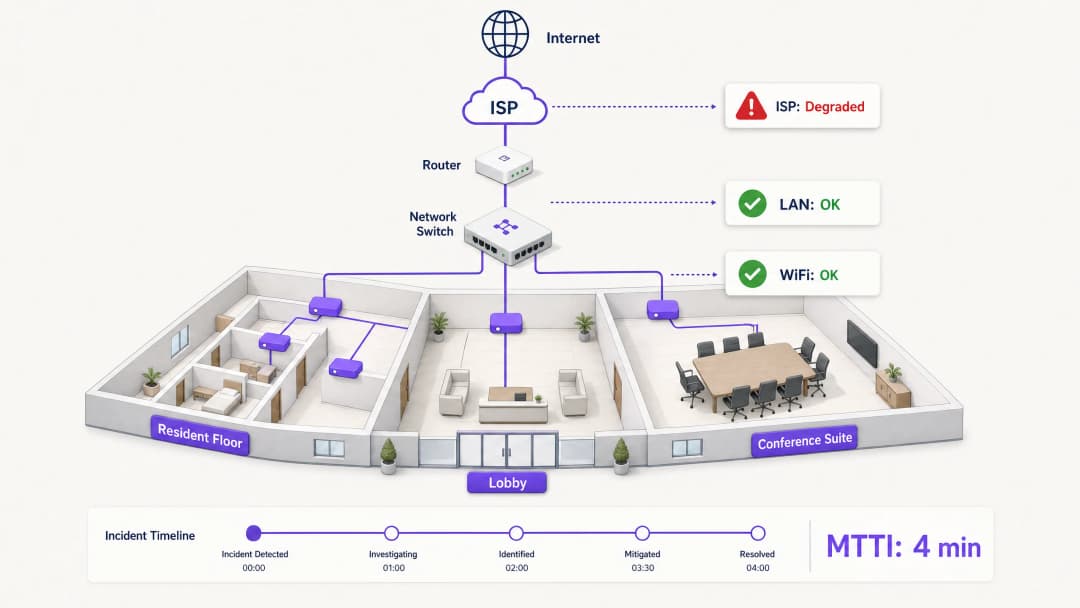
當多租戶環境中的連線中斷時,WiFi 總是首當其衝被歸咎。它是網路中顯而易見的邊緣、裝置前的最後一跳,也是受挫使用者最容易怪罪的目標。對於 IT 經理、網路架構師和場域營運總監而言,這造成了持續的營運負擔:花費時間來證明清白。

平均證明清白時間 (MTTI) 衡量的是從通報事件到團隊能夠證明其管轄範圍並非根本原因之間的平均流逝時間。在租賃專用住宅 (BTR) 大樓、飯店或會議中心等複雜環境中,網路權責分散在物業經理、託管 WiFi 供應商和網際網路服務供應商 (ISP) 之間。在缺乏明確遙測數據的情況下,由於各團隊爭論責任歸屬而非解決故障,MTTI 會拉長平均修復時間 (MTTR)。

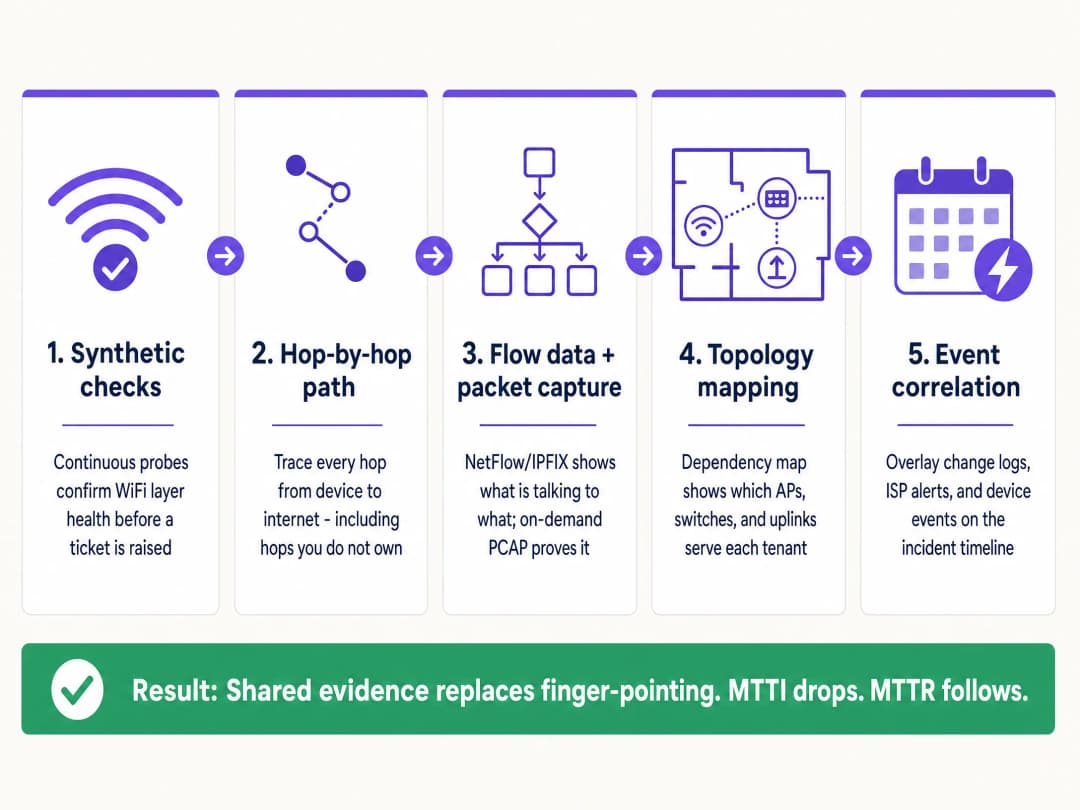
本指南詳細介紹了一套包含五個步驟的可觀測性方法論,以系統化地縮短 MTTI。透過部署持續的模擬檢測、逐跳路徑可視性、流量數據分析、拓撲繪製和事件關聯,您可以用共享證據取代敵對式的互相指責。其目標不是更快地在推諉遊戲中勝出,而是徹底終結這種現象。

技術深度探討:MTTI 的運作機制

MTTI 與平均識別時間的區別

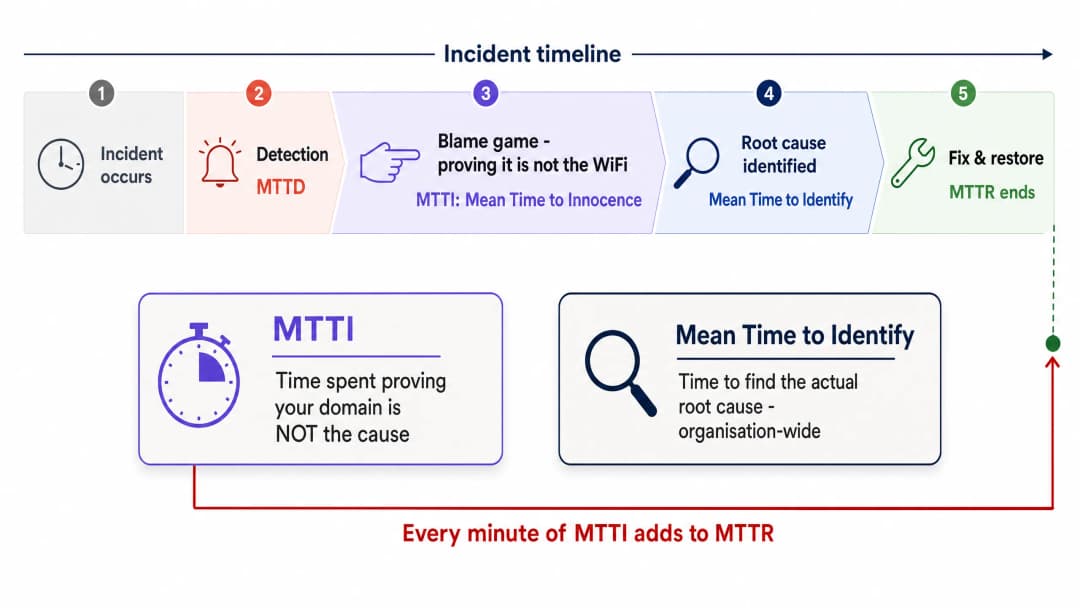
區分 MTTI 與平均識別時間至關重要。平均識別時間是一項組織層級的指標,用於追蹤找出中斷實際根本原因所需的時間。而 MTTI 則是一項孤立的、特定領域的指標,用於追蹤單一團隊證明自己並非罪魁禍首所需的時間。

MTTI 的每一分鐘都會直接增加 MTTR。如果託管 WiFi 供應商在得出問題出在 ISP 的結論之前,花費了 40 分鐘手動檢查無線基地台 (AP) 和交換器記錄,那麼在實際開始修復之前,MTTR 就已經被強加了 40 分鐘的延遲罰時。

mtti_vs_mttr_diagram.png

為什麼 WiFi 總是背黑鍋

在為 80,000 多個實體場域、3.5 億不重複使用者提供服務的環境中,Purple 反覆看到相同的模式。由於以下三個結構性現實,WiFi 層預設會被歸咎:

  1. 可見性偏差:WiFi 訊號指示器是普通場域使用者唯一可用的網路診斷工具。
  2. 邊緣鄰近性:作為連接用戶端裝置的最後一跳,WiFi 承接了所有上游故障的症狀。從使用者的角度來看,ISP 端的 DNS 逾時與 AP 故障看起來完全一樣。
  3. 遙測差距:在過去,證明無線網路健康狀況需要人工介入。如果您無法在兩分鐘內出示無線層運作正常的證明,您就會失去話語權。

多租戶環境的複雜性

在單一租戶企業中,網路團隊擁有從 AP 到防火牆的整個技術堆疊。但在多租戶 WiFi 環境中,所有權是破碎的。

BTR 居民向物業經理付費。物業經理與託管 WiFi 供應商簽約。託管 WiFi 供應商依賴第三方 ISP 線路,且通常還依賴房東的大樓內部分配網路。當居民無法串流影片時,供應商必須迅速排除 WiFi 硬體(Cisco Meraki、HPE Aruba、Ruckus 或 Juniper Mist)的嫌疑,並將故障隔離至用戶端裝置、大樓交換器或 ISP。若無法做到這一點,將會損害供應商與物業經理之間的商業關係。

實作指南:五步驟方法論

若要系統化地縮短 MTTI,請實作此五層可觀測性架構。

troubleshooting_methodology.png

1. 持續的模擬檢測

不要等待使用者抱怨。部署自動化模擬探針,從網路邊緣持續模擬使用者行為。

  • 實作:設定 AP 或專用感測器,針對 DHCP 回應、DNS 解析、HTTP 可達性以及驗證流程(例如 802.1XCaptive Portal 登入)執行排程測試。
  • 成效:當建立工單時,您首先檢查模擬儀表板。如果探針在投訴發生的確切時間顯示 HTTP 可達性正常,您便能立即排除 WiFi 層和 WAN 線路的嫌疑,將焦點轉移到特定的用戶端裝置或目標應用程式。

2. 逐跳路徑可視性

如果無法證明通往網際網路的路徑暢通,僅證明您的硬體健康是遠遠不夠的。

  • 實作:使用路徑視覺化工具追蹤流量,從存取層跨越 LAN、通過分界點並進入 ISP 網路。
  • 成效:當延遲飆升時,路徑追蹤會精確顯示是哪個節點引入了延遲。如果第一到第四跳(您的管轄範圍)顯示 2 毫秒的延遲,而第五跳(ISP 邊緣路由器)顯示 150 毫秒的延遲和 12% 的封包遺失率,您就有了確鑿的證據可以提供給 ISP。

3. 流量數據與隨選封包擷取

當使用者回報特定應用程式的故障時,您需要對話層級的可視性。

  • 實作:從核心交換器或防火牆匯出 NetFlow 或 IPFIX 數據。確保您的存取層硬體支援遠端、隨選封包擷取 (PCAP),而無需工程師親臨現場。
  • 成效:流量數據可證明前往特定服務的流量是否正常離開您的網路。如果是,則代表網路是清白的。如果若需要更深入的鑑識證明,在特定 VLAN 上進行針對性的 PCAP 可提供無可爭辯的證據,證明存在 TCP 重傳或伺服器端重設。

4. 拓撲與相依性對應

在多租戶環境中,隔離波及範圍(blast radius)是分類故障最快的方法。

  • 實作:維護一份即時、動態更新的相依性地圖,將每個 AP 連結到其交換器、上行鏈路和 WAN 線路,並對應到租戶 VLAN。
  • 成果:如果故障影響了多個樓層的 AP,但僅限於單一交換器,則問題出在交換器。如果影響了所有 AP,但僅限於單一租戶的 VLAN,則屬於邏輯設定問題。快速界定範圍可避免浪費精力去調查健康的基礎設施。

5. 事件關聯

缺乏脈絡的數據會延長調查時間。

  • 實作:將變更記錄、ISP 維護警示、硬體韌體更新和使用者工單整合到單一時間軸檢視中。
  • 成果:將驗證失敗的急遽增加與 10 分鐘前發生的 Microsoft Entra ID 憑證過期事件重疊比對,即可立即找出根本原因,完全繞過網路硬體。

最佳實踐

  • 標準化硬體堆疊:將部署限制在主流企業級廠商(Cisco Meraki、HPE Aruba、Ruckus、Juniper Mist、Ubiquiti UniFi、Cambium、Extreme、Fortinet),這些廠商提供 API 以進行模擬測試和遠端 PCAP。
  • 自動化證據收集:設定您的監控平台,在建立 ITSM 工單的瞬間,自動將模擬測試結果和路徑追蹤附加到工單中。
  • 共享儀表板:為物業經理提供高階健康狀況儀表板的唯讀存取權限。透明度可預防互相推諉。
  • 正式追蹤 MTTI:衡量從工單建立到您的團隊提供「無罪證明」之間的時間。將其與 MTTR 一併視為主要 KPI。

疑難排解與風險緩釋

  • 風險:「未發現故障」的無限循環:使用者回報問題,但模擬檢查顯示正常(綠燈)。
    • 緩釋措施:問題可能與特定裝置有關,或與射頻干擾(同頻道干擾或物理障礙物)有關。使用用戶端分析來檢查特定裝置的 RSSI 和漫遊歷史記錄。
  • 風險:ISP 否認:儘管您有證據,ISP 仍拒絕承認故障。
    • 緩釋措施:提供逐跳(hop-by-hop)路徑追蹤,顯示開始丟包的確切 IP 位址。分享 PCAP 以證明從您的分界點(demarcation point)流出的流量是乾淨的。確鑿的數據能迫使問題升級至一線客服以上。
  • 風險:Captive Portal 故障:當入口網站無法載入時,使用者會歸咎於 WiFi。
    • 緩釋措施:隔離身分識別提供者(IdP)。檢查整合狀態(Microsoft Entra ID、Okta、Google Workspace)。如果網路允許驗證前的流量,但 IdP 逾時,則網路是無辜的。

投資報酬率(ROI)與業務影響

降低 MTTI 除了能節省工程時間外,還能帶來可衡量的業務價值。

  1. 降低 MTTR:在事件處理中省去 40 分鐘的互相推諉,可直接減少停機時間,從而保護 零售旅宿 環境中的營收。
  2. SLA 合規性:當故障在於 ISP 或大樓基礎設施時,更快的釐清責任可防止託管 WiFi 供應商遭受不公平的處罰。
  3. 客戶留存:在多租戶 WiFi 領域,物業經理會與提供透明度和快速解答的供應商續約。共享證據能建立信任,而防衛性的爭辯則會破壞信任。
  4. 資源最佳化:高薪的 Level 3 網路工程師能將時間花在設計解決方案上,而不是手動證明網路運作正常。

關鍵定義

Mean Time to Innocence (MTTI)

The average time required for a specific IT team to prove, using objective data, that their domain or infrastructure is not the root cause of a reported incident.

Critical for managed WiFi providers who must defend their service against property managers and ISPs.

Mean Time to Identify

The organisation-wide metric tracking the total time elapsed from incident detection to the discovery of the actual root cause.

MTTI is a subset of this metric. Reducing MTTI directly reduces the overall time to identify.

Synthetic Checks

Automated, continuous tests that emulate user traffic (e.g., DNS lookups, HTTP requests) to proactively monitor network health.

Used to prove the WiFi layer was functioning correctly at the exact moment a user complained.

Hop-by-Hop Path Visibility

Telemetry that traces network traffic node-by-node from the client to the destination, measuring latency and loss at each specific router or switch.

Essential for proving a fault lies in an ISP network or a landlord's distribution switch, rather than the managed WiFi hardware.

Flow Data (NetFlow/IPFIX)

Network protocol data that provides a summary of traffic conversations, showing source, destination, protocol, and volume.

Used to prove that specific application traffic is successfully leaving the local network.

On-Demand Packet Capture (PCAP)

The ability to remotely record raw network traffic from an access point or switch for forensic analysis.

The ultimate proof used to demonstrate server-side errors or client device misbehaviour.

Blast Radius

The scope of impact of a specific incident (e.g., one user, one AP, one switch, one tenant, or the entire building).

Determining the blast radius via topology mapping is the fastest way to exclude healthy infrastructure from an investigation.

Event Correlation

The practice of overlaying different data streams (logs, alerts, updates) on a single timeline to identify cause and effect.

Used to prove that a network outage was caused by a third-party change, such as an unannounced ISP maintenance window.

範例

A 350-room hotel reports that in-room WiFi is slow across the entire property. The front desk blames the managed WiFi provider. How do you exonerate the network and find the root cause?

  1. Check the synthetic probes: DNS and HTTP reachability tests show the APs have a clean connection to the internet. 2. Review the topology map: The issue affects all APs across all switches, ruling out edge hardware. 3. Execute a path trace: The trace shows 2ms latency within the hotel LAN, but 180ms latency at the third hop (the ISP's aggregation router). 4. Export the evidence: Send the path trace screenshot to the hotel manager and the ISP.
考官評語: This approach cuts MTTI to under five minutes. By starting with synthetic checks rather than manually polling APs, the engineer immediately ruled out the wireless layer. The path trace provided undeniable proof for the ISP, preventing the standard 'check your router' deflection.

A national retailer reports point-of-sale (POS) terminals in one region are dropping connections to the payment processor. The network team is blamed for a firewall or routing misconfiguration.

  1. Isolate the blast radius: Confirm only POS terminals (specific VLAN) are affected; guest WiFi and back-office systems are healthy. 2. Analyse flow data: NetFlow confirms traffic destined for the payment processor's IP range is successfully leaving the store routers. 3. Capture packets: An on-demand PCAP on the POS VLAN reveals the payment processor's server is sending TCP resets (RST). 4. Share the PCAP with the payment processor's support team.
考官評語: Flow data is the ultimate arbiter here. Proving the traffic left the network cleanly shifted the burden of proof to the third-party service. The PCAP provided the forensic evidence needed to force the payment processor to investigate their own load balancers.

練習題

Q1. A tenant in a coworking space complains they cannot access their corporate VPN. Other tenants are browsing the internet without issue. What is the most efficient way to prove the WiFi network is not at fault?

提示:Consider the blast radius and the specific type of traffic failing.

查看標準答案

First, use the topology map to confirm the blast radius is limited to one user or one specific service, ruling out a general AP or switch failure. Second, analyse flow data (NetFlow/IPFIX) for that client's IP address. If the flow data shows the VPN traffic (e.g., UDP 500 or TCP 443) is leaving the network cleanly, the WiFi and LAN are innocent. The issue is either the client's VPN configuration or the corporate firewall blocking the connection.

Q2. Your monitoring dashboard shows an AP has gone offline, but the property manager insists the WiFi is broken because the ISP is down. How do you prove the issue is internal power, not the ISP?

提示:Look for correlation between infrastructure state and external events.

查看標準答案

Use event correlation and topology mapping. If the topology map shows only one AP is offline while others on the same switch are functioning, the ISP circuit is clearly active. Event correlation might show a PoE (Power over Ethernet) failure log from the switch port connected to that specific AP. This proves the issue is local hardware or cabling, not the WAN circuit.

Q3. A stadium operations director claims the WiFi failed during halftime because ticket scanners stopped working. You need to exonerate the network in under two minutes. What telemetry do you use?

提示:You need historical proof of health at the exact moment of the reported failure.

查看標準答案

Pull the historical data from the continuous synthetic checks. Show the operations director the dashboard confirming that during the exact 15-minute halftime window, the APs were successfully resolving DNS and reaching the ticketing server's IP address with low latency. This immediately proves the wireless network was healthy and shifts the investigation to the ticketing application servers, which likely buckled under the sudden load.