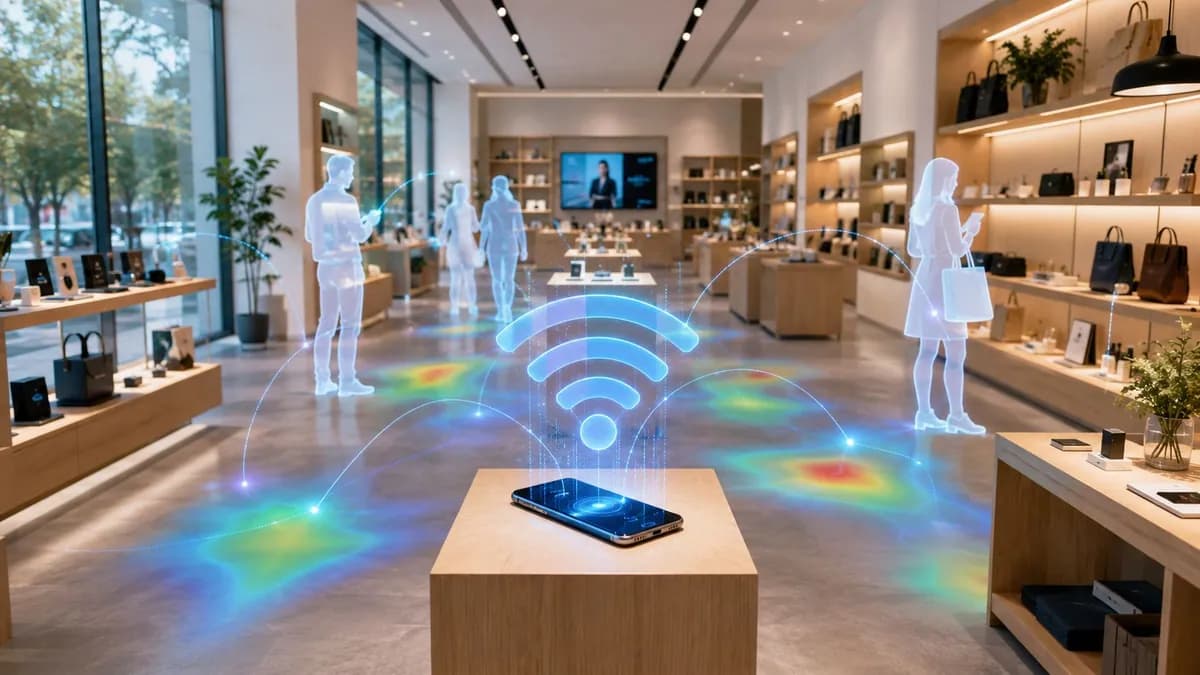
Omnichannel Retail & E-Commerce WiFi ROI Advisor
Model how in-store Guest WiFi and captive portal onboarding turn physical store footfall into opted-in digital CRM profiles, mitigating showrooming and driving measurable online revenue.
High-touch fashion, electronics, or lifestyle retail where customer profiling and loyalty rewards drive repeat visits.
Quick Guide: The Evolution of Online Shopping
Online shopping has evolved from an experimental domestic television setup in 1979 to a global $6.3+ trillion omnichannel marketplace. Here are the defining milestones in e-commerce history:
- 1979: Michael Aldrich invents online shopping using a modified domestic TV connected to a transaction processing computer via a telephone line.
- 1991 - 1995: The World Wide Web commercialisation, Netscape SSL security, and the founding of Amazon and eBay establish secure web shopping.
- 1998 - 2014: PayPal digital wallet, Shopify cloud storefronts, and Apple Pay mobile checkouts simplify online payments.
- 2020 - 2026: The rise of omnichannel "phygital" retail, where in-store Guest WiFi, captive portals, and AI analytics bridge physical store visits with online e-commerce.
Global e-commerce sales reached $6.3 trillion USD and continue growing toward $6.9 trillion, transforming how consumers interact with both digital stores and physical retail venues. The ability to go online and purchase items in a minute is something the world has become accustomed to, and it continues to integrate deeply into everyday life.
Check out these important steps taken to drive the e-commerce world we know today - the ability for instant access has been a long time in the making.
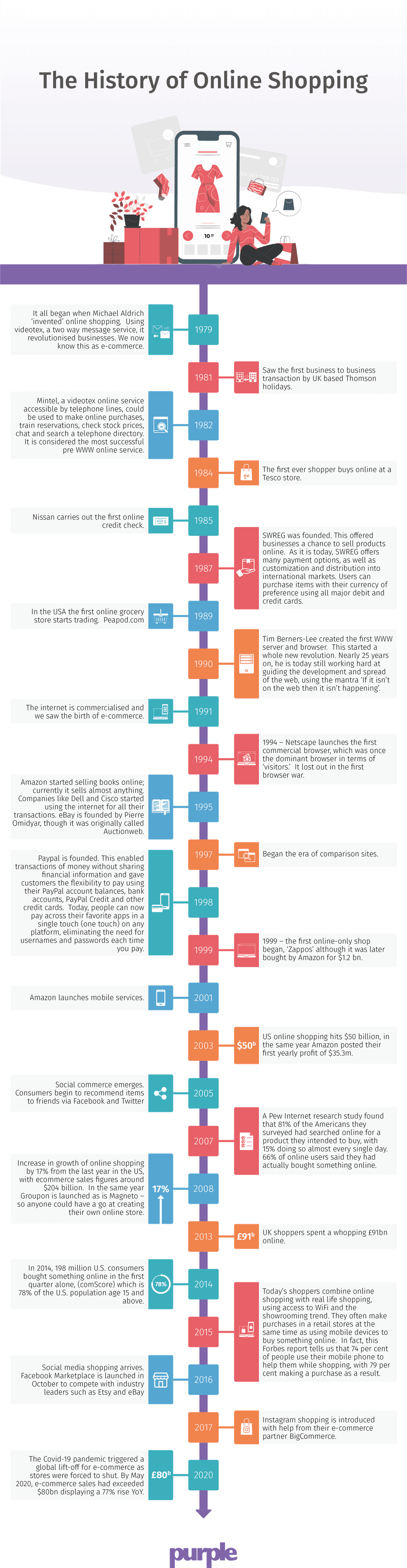
| Year | Milestone | Key Innovation | Impact on Commerce |
|---|---|---|---|
| 1979 | Michael Aldrich invents online shopping | Videotex via phone line & TV | First electronic shopping system |
| 1981 | Thomson Holidays B2B booking | Agent terminal network | First commercial business transaction |
| 1984 | First online grocery order (Tesco) | Jane Snowball ordering via Videotex | Pioneered home consumer ordering |
| 1990 | Tim Berners-Lee creates World Wide Web | HTTP protocol & browser | Universal web connectivity foundation |
| 1994 | Netscape SSL protocol launch | Encrypted web transmission | Secured online credit card payments |
| 1995 | Amazon & eBay founded | Scalable web catalog & online auctions | Mass market consumer e-commerce |
| 1998 | PayPal established | Digital wallet payment gateway | Streamlined checkout & reduced fraud |
| 2006 | Shopify launch | Turnkey SaaS e-commerce platform | Democratized online store creation |
| 2014 | Apple Pay launched | Biometric tokenized mobile checkout | Accelerated mobile device sales |
| 2026 | Omnichannel Phygital & Guest WiFi Analytics | In-store WiFi captive portal & AI CRM | Unified in-store and online shopper engagement |
A brief history of online shopping and its future prospects
Online shopping has a rich history woven into the fabric of the Internet era. It is a journey that changed how we buy and sell, reshaping modern global commerce across digital storefronts and physical venues alike.
Milestones in the history of e-commerce: the birth of online shopping
E-commerce's inception dates back to the late 1970s and early 1980s. The concept of conducting transactions electronically was poised for growth. It was a time when ideas were brewing, waiting for the right technological advancements to turn them into reality.
Tracing back to the first online retailer: Michael Aldrich in 1979
The title of the first online retailer belongs to English inventor Michael Aldrich. In 1979, he demonstrated a system using Videotex - connecting a modified domestic television to a real-time transaction processing computer via a telephone line. This landmark innovation was the precursor to modern e-commerce.
The role of the World Wide Web in e-commerce
The commercialisation of the World Wide Web in 1991 by Tim Berners-Lee was foundational for e-commerce. It provided a universal and accessible platform for businesses to showcase and sell their products, paving the way for global online marketplaces.
Notable technological advancements in e-commerce: SSL and encryption
Secure Sockets Layer (SSL) and encryption technology, introduced by Netscape in 1994, were crucial in gaining consumer trust. They safeguarded personal and financial information - a vital step in convincing users that online credit card transactions were safe.
Michael Aldrich: the pioneer of online shopping
Michael Aldrich's vision and innovation laid the groundwork for what e-commerce has become today. His early work demonstrated the feasibility and potential of selling goods electronically, setting the stage for the e-commerce platforms that followed.
The evolution of online marketplaces: from Amazon and eBay to Shopify
The landscape of online shopping underwent a dramatic transformation with the emergence of platforms like Amazon and eBay. These platforms changed how we shop and redefined the nature of the retail marketplace.
Reinvention of online shopping with Amazon and eBay
Amazon, founded in 1994 by Jeff Bezos, began as an online bookstore and quickly expanded into a diverse range of products. eBay, launched in 1995 by Pierre Omidyar (originally named AuctionWeb), introduced peer-to-peer online auctions. Both platforms brought unique elements to online shopping - convenience and variety from Amazon, and the engagement of online bidding from eBay.
Transition from physical stores to online storefronts
This era marked a significant shift from brick-and-mortar stores to digital storefronts. Traditional businesses recognized the need to establish an online presence. The transition involved rethinking marketing, customer service, and logistics in the context of the digital world.
Shopify: a new era of online shopping
Shopify launched in 2006, making it possible for independent merchants to set up online stores with ease. It democratized e-commerce, offering user-friendly tools to create, manage, and scale online shops without requiring complex technical infrastructure.
The role of online auctions in e-commerce evolution
Online auction sites introduced a dynamic where price determination became interactive, adding an element of excitement to the digital shopping experience.
Shopping malls vs online marketplaces: consumer preferences in 2026
The relation between physical shopping malls and online marketplaces centers on consumer convenience. While physical locations offer tactile, social experiences, online marketplaces provide round-the-clock selection and home delivery. Modern consumers frequently leverage both modes simultaneously.
Revolutionizing the shopping experience with smartphones and digital wallets
The advent of smartphones and mobile networks altered the landscape of online shopping, offering unparalleled convenience and personalized shopping experiences.
Influence of mobile devices on the online shopping space
Smartphones are ubiquitous, fundamentally changing how consumers interact with online stores. The portability of mobile devices means that shopping can happen anywhere, removing location constraints.
Making online purchases with smartphones
With just a few taps, consumers can browse products, read reviews, compare prices, and make purchases. This convenience led to a surge in mobile commerce, making it a critical component of the retail ecosystem.
Transition from web browsers to mobile apps for shopping
Shoppers increasingly rely on dedicated mobile apps for streamlined, personalized shopping. Apps feature user-friendly interfaces, fast loading times, and instant push notifications that keep consumers engaged.
The advent of secure online transactions: Apple Pay and digital wallets
Apple Pay, introduced in 2014, revolutionized online transactions by offering secure, single-touch payment authentication. It simplified checkouts, allowing users to pay securely using biometric authentication.
From shopping cart to shopping app: transforming customer experiences
The transformation from traditional shopping carts to mobile shopping apps represents a key shift in consumer behaviour. Mobile apps offer personalized recommendations, loyalty rewards, and responsive support.
The influence of Amazon Prime on e-commerce growth
Amazon Prime served as a major catalyst in e-commerce evolution, reshaping consumer expectations around delivery speeds and subscription value.
Amazon Prime revolutionized online shopping by combining fast shipping, streaming media, and exclusive member deals. These benefits created subscriber loyalty, encouraging more frequent purchases.
The role of subscription services in online retail
Subscription services foster customer retention and create recurring revenue streams for businesses across physical and digital retail channels.
Impact of Amazon Prime on retail sales
Amazon Prime set new industry benchmarks for shipping speed and fulfillment, prompting competing retailers to upgrade their logistics and digital offerings.
The future of online shopping: how e-commerce will evolve in 2026 and beyond
Artificial intelligence (AI) is playing a transformative role in e-commerce. AI personalizes shopping experiences by analyzing consumer behaviour and preferences, delivering tailored product recommendations, and optimizing search results.
How virtual reality and AR are reshaping retail experiences
Virtual reality (VR) and augmented reality (AR) offer immersive experiences, enabling shoppers to preview furniture in their homes or virtually try on apparel before purchasing.
Evolving payment methods in e-commerce
Payment methods continue to evolve, incorporating decentralized ledger verification, biometric authentication, and instant digital wallet checkouts.
The phygital future: bridging online shopping with in-store Guest WiFi analytics
The future of retail belongs to "phygital" integration - blending physical store environments with digital e-commerce intelligence. Over 79% of consumers use their mobile phones while shopping in physical stores to compare prices, read reviews, or redeem digital coupons.
Forward-thinking retailers use enterprise Guest WiFi platforms like Purple to connect offline visitors with digital channels. By offering fast Guest WiFi via custom-branded captive portals, retailers collect opt-in customer data, deliver contextual in-store promotions directly to smartphones, and sync footfall analytics into e-commerce marketing automation platforms.
Frequently asked questions about the history of online shopping
When was online shopping invented and by whom?
Online shopping was invented in 1979 by English inventor Michael Aldrich. He connected a modified domestic television to a real-time transaction processing computer using a standard telephone line, creating theVideotex system that laid the groundwork for modern e-commerce.
What was the first product ever sold online?
The first online retail transaction occurred in May 1984 when 72-year-old Jane Snowball in Gateshead, England used a Videotex system on her television to order margarine, eggs, and cornflakes from her local Tesco store. In August 1994, the first encrypted secure web transaction took place when NetMarket sold a Sting CD for $12.48 plus shipping using SSL security.
How has online shopping impacted physical retail stores?
Online shopping transformed physical retail into part of an integrated omnichannel experience. Rather than replacing physical stores, digital channels complement brick-and-mortar locations: over 79% of in-store shoppers use smartphones to research items, compare prices, or view loyalty offers while browsing.
How do physical retailers connect online e-commerce with in-store visitors?
Physical retailers use enterprise Guest WiFi solutions like Purple to bridge offline footfall with online platforms. By offering fast Guest WiFi via branded captive portals, retailers collect compliant customer opt-ins, trigger real-time personalized offers, and sync in-store behavioral analytics directly into e-commerce CRMs.