Smart retail technology feasibility and ROI advisor
Compare the capital costs, installation complexity, and visitor data capture of cashierless computer vision against enterprise WiFi physical space analytics.
Ceiling camera & sensor grid
Uses hundreds of overhead RGB/depth cameras, shelf weight sensors, and high-performance on-premise GPU servers to track product removals.
Enterprise wireless footfall intelligence
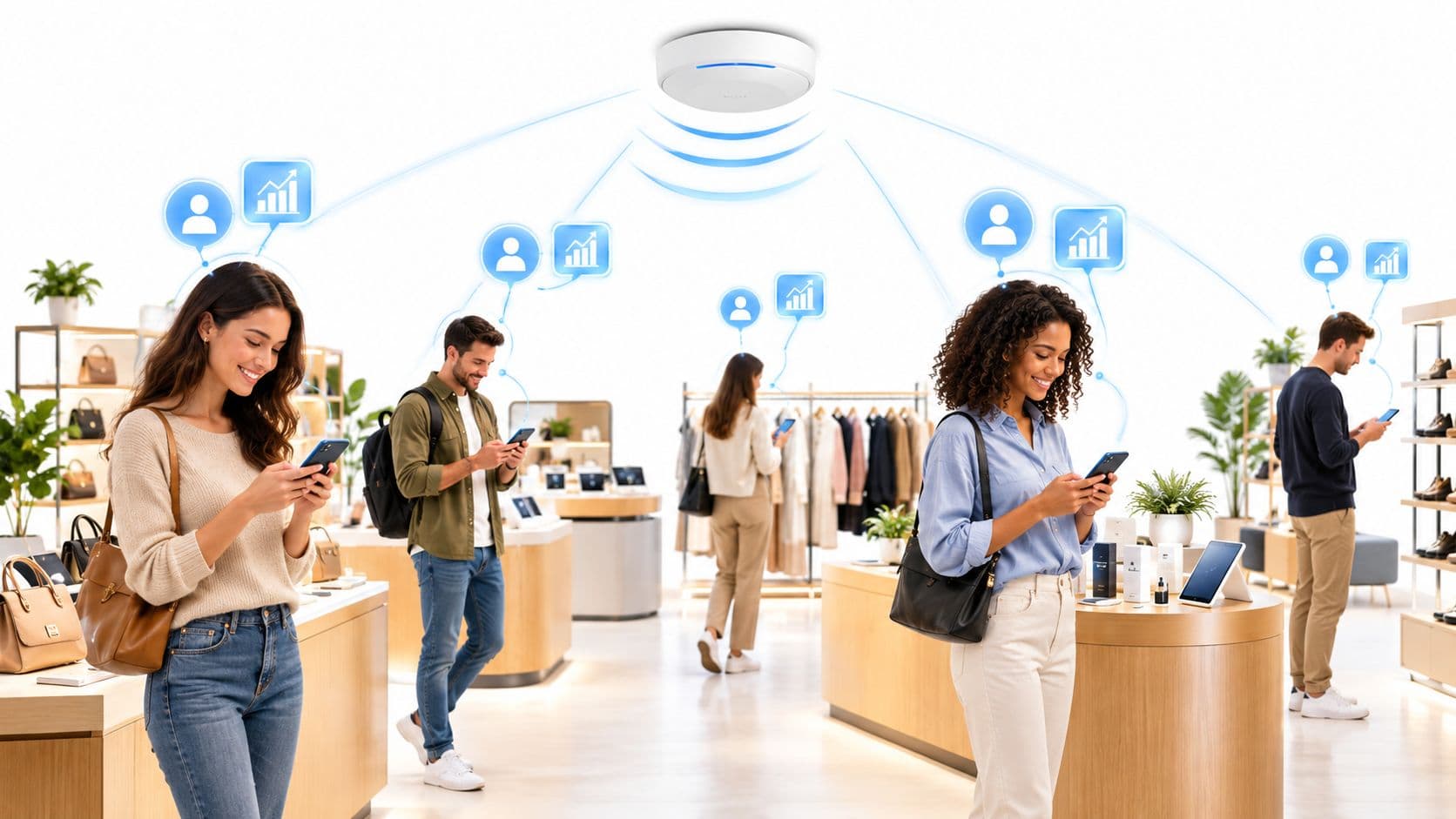
Captures footfall volume, dwell times, department heatmaps, and return frequency using your existing enterprise WiFi network telemetry.
| Evaluation criteria | Computer vision & shelf sensors | Smart WiFi physical analytics |
|---|---|---|
| Primary purpose | Itemised grab-and-go checkout automation | Footfall, dwell time, journey mapping & CRM capture |
| Hardware footprint | Massive ceiling camera arrays & load-cell shelving | Existing wireless access points (Cisco Meraki, HPE Aruba, Ruckus, Juniper Mist, Ubiquiti UniFi and others) |
| Shopper requirement | Must download app or scan credit card at turnstile | Passive detection (estimates, as phones randomise MAC addresses); optional guest portal |
| Privacy & regulatory risk | Complex biometric, facial and movement surveillance rules | Pseudonymised telemetry; still personal data under GDPR, so signage and a lawful basis are needed |
| Time to positive ROI | 36 to 60+ months (due to heavy amortisation) | 1 to 3 months (immediate operational insights) |
Ready to add retail visitor analytics without new hardware?
Generate footfall heatmaps, cross-store journey flows, and automated marketing campaigns across your estate.
Autonomous store vs spatial WiFi analytics: Cost and ROI calculator
Compare deployment CapEx, annual OpEx, spatial tracking precision, and CRM data capture between Amazon Go style computer vision, smart carts, and enterprise WiFi venue analytics.
Computer vision + shelf sensors
Overhead RGB/depth cameras + load-cell shelving + on-premise GPU inferencing servers.
Connected smart carts & kiosks
RFID-tagged merchandise, digital screen shopping carts, and optical self-checkout kiosks.
WiFi analytics + BLE spatial beacons
Uses existing enterprise APs (Cisco Meraki, HPE Aruba, Ruckus, Juniper Mist, Ubiquiti UniFi, Cambium, Extreme, Fortinet) + captive portal CRM capture.
Ready to evaluate spatial intelligence for your retail stores?
Discover how Purple turns existing enterprise WiFi into rich footfall analytics, dwell tracking, and high-converting marketing campaigns.
When Amazon launched its cashierless Amazon Go convenience stores, it captured global headlines and set off a wave of speculation across the physical retail sector. Powered by a proprietary combination of ceiling-mounted computer vision cameras, deep learning algorithms, shelf weight sensors, and sensor fusion, Amazon Go promised a checkout-free shopping environment known as "Just Walk Out" technology. Shoppers simply scan a QR code upon entry, pick items off the shelf, and walk out, with their payment card automatically billed moments later.
For store operations directors, retail CIOs, and venue managers, the initial awe was quickly met with pragmatic questions. What specific hardware and network architecture powers this autonomous experience? What are the capital expenditure (CapEx) and operational overheads of deploying hundreds of overhead cameras and load cells? And most importantly: how can traditional brick-and-mortar retailers capture equivalent spatial footfall insights, customer dwell times, and basket uplift without investing $150 to $250 per square foot in specialist camera hardware?
This technical analysis examines the multi-sensor architecture powering Amazon Go, evaluates its operational and privacy trade-offs, and details how modern enterprise WiFi analytics and location intelligence provide a high-ROI, hardware-agnostic alternative for physical retailers.
How Amazon Go works: computer vision, sensor fusion, and edge AI
The engineering foundation of Amazon Go relies on three core computational disciplines: multi-camera computer vision, multi-modal sensor fusion, and edge machine learning inference. Together, these systems build a continuous, real-time spatial digital twin of the retail environment.
1. High-density ceiling camera arrays and 3D pose estimation
Unlike standard security cameras that capture wide-angle 2D video for retrospective review, an Amazon Go store mounts hundreds of specialised RGB and depth-sensing cameras across the ceiling grid - typically one camera for every 25 to 35 square feet of retail floor space. These cameras execute continuous spatial tracking and 3D human pose estimation:
- Continuous person re-identification: As shoppers move between aisles and cross paths, multi-camera tracking maintains persistent digital tokens for each shopper without relying on facial recognition.
- Interaction and gesture analysis: Visual algorithms detect when a shopper reaches their arm towards a shelf, tracking hand trajectory and item interaction down to the millisecond.
- Occlusion handling: When multiple shoppers cluster around a promotional display, overlapping camera angles resolve visual occlusions to determine who touched each product.
2. Shelf weight load cells and time-of-flight sensors
Computer vision alone struggles with visual ambiguity - for example, differentiating between two identical soda cans with different flavour variants or detecting when a customer picks up two chocolate bars stacked together. To solve this, Amazon embeds precision weight load cells directly into store shelving:
- Milligram-level weight delta: The shelf detects the exact microsecond an item is lifted and confirms the exact weight removed.
- Return detection: If a shopper changes their mind and places an item back onto the wrong shelf, weight sensors identify the discrepancy and prevent false billing.
3. Sensor fusion and edge GPU inferencing
The core computational breakthrough is sensor fusion - the real-time mathematical combination of visual tracking data, shelf weight changes, and barcode inventory maps. High-throughput edge servers located in the store backroom process these sensory streams simultaneously. When camera tracking confirms Customer A reached towards Shelf B at the exact timestamp Shelf B registered a 350g reduction, the digital cart updates instantly.
The operational and financial realities of autonomous retail
While the technical accomplishment of Just Walk Out technology is undeniable, scaling full autonomous computer vision across commercial retail portfolios has encountered significant economic and operational friction.
1. High capital expenditure and retrofitting friction
Installing hundreds of specialised cameras, structured category-6A cabling, load-bearing ceiling trusses, and edge compute racks costs upwards of $150 to $250 per square foot. For a standard 20,000 sq ft supermarket, retrofitting costs easily exceed $3,000,000 per venue. This makes payback timelines prohibitive for grocery and general retail operating on 2% to 4% net profit margins.
2. Ongoing maintenance, calibration, and manual validation
Camera lenses require regular cleaning in dusty store environments, shelf sensors require frequent recalibration when product planograms change, and complex edge models require continuous tuning. Independent retail audits revealed that high-friction transactions often required human review teams to manually verify edge-case video recordings.
3. Data capture limitations: spatial tracking vs CRM profiles
Computer vision tracks physical movements within the store, but it does not inherently capture compliant first-party customer marketing data unless the customer is forced to log into a bespoke native application. In contrast, omni-channel retail success requires building verified CRM profiles, driving post-visit retention, and measuring repeat visits across physical and online channels.
How retailers achieve spatial intelligence with enterprise WiFi analytics
For the vast majority of physical retailers, the primary business objective is not removing the cashier - it is understanding shopper behaviour, optimising store layout, measuring dwell time, and capturing verified customer data. Enterprise WiFi presence analytics delivers over 90% of these spatial intelligence capabilities at a fraction of the cost, using existing wireless infrastructure.
1. Comprehensive passerby, capture rate, and conversion tracking
Over 88% of shoppers carry an active smartphone with wireless scanning enabled. As visitors walk past your storefront, enterprise access points detect probing probe-request signals. This allows retail operators to measure:
- Street-level passerby traffic: Total footfall volume walking past the venue exterior.
- Storefront capture rate: The exact percentage of passerby footfall that turns into the store entrance.
- Cross-location loyalty: How frequently shoppers visit multiple regional store locations over 30, 60, and 90-day intervals.
2. Zone dwell times and floor heatmaps
By analysing received signal strength indicators (RSSI) across multiple access points and BLE beacons, spatial location engines calculate visitor coordinates with 1 to 3 metre precision. Retail merchandisers can pinpoint:
- High-dwell zones: Which product displays and promotional aisles hold customer attention longest.
- Floor dead zones: Low-traffic aisles that suffer from poor merchandising or navigational bottlenecks.
- Queue wait times: Real-time checkout congestion monitoring to trigger additional till openings.
3. First-party CRM data capture and automated marketing
When shoppers connect to guest WiFi through a branded captive portal, they exchange verified contact details (name, email, mobile number) for high-speed internet access. Purple delivers an average 28% captive portal connect rate with verified GDPR and CCPA marketing consent. Retailers can immediately trigger:
- Automated win-back campaigns: Send targeted discount vouchers to shoppers who have not returned within 21 days (+18% repeat visit lift).
- In-venue digital feedback: Trigger real-time microsurveys during peak dwell periods to measure customer satisfaction.
- Omnichannel CRM synchronisation: Sync in-store visit history directly into Salesforce, HubSpot, Klaviyo, or Bloomreach.
Unlock spatial retail analytics without expensive camera hardware
Turn your existing Cisco Meraki, Aruba, Ruckus, or Fortinet wireless networks into powerful venue analytics and marketing engines. Capture verified guest profiles, analyse footfall heatmaps, and optimise store revenue with Purple.
Frequently asked questions
What technology does Amazon Go use for Just Walk Out shopping?
Amazon Go uses a combination of ceiling-mounted RGB and depth computer vision cameras, shelf-mounted weight load cells (sensor fusion), and deep learning object recognition models running on edge GPU servers to track item interactions.
How much does Amazon Go autonomous store technology cost?
Deploying full computer vision and weight sensor infrastructure costs between $150 and $250 per square foot ($500,000 to over $1,500,000 per store location), with significant recurring cloud inferencing and camera calibration costs.
How does WiFi spatial analytics compare to Amazon Go camera tracking?
While computer vision delivers sub-centimeter item tracking, Enterprise WiFi spatial analytics captures 100% of storefront passerby traffic, zone dwell times, repeat visitor loyalty, and verified opt-in CRM profiles at less than 3% of the hardware CapEx.
How does guest WiFi capture first-party retail customer data?
When shoppers connect through a branded captive portal, they provide verified contact details (email, phone, demographic preferences) with explicit GDPR and CCPA consent, enabling automated marketing campaigns and personalized promotional messaging.