Guest WiFi solution advisor
Pick your venue, peak device count, priority and hardware to get a sized deployment blueprint and the controller settings to apply.
Network and VLAN
Guest experience and PMS- Subnet
- /22 for 780 addresses
- One subnet is fine at this size.
- VLAN
- Dedicated guest VLAN, isolated from PMS, POS and back-office networks
- Isolation
- Layer 2 client isolation; allow AirPlay and Chromecast only within a guest’s own room group
- RF
- Plan for in-room coverage, not corridor-only APs; 20 or 40 MHz on 5 GHz
Onboarding
Frictionless access- Primary method
- Passpoint (Hotspot 2.0) or OpenRoaming profile, so returning guests connect automatically over WPA3-Enterprise
- Fallback
- Short captive portal for first-time guests, which offers the Passpoint profile after sign-up
- Venue pattern
- Room number and surname check against the PMS (for example Oracle OPERA) at first login
- Bandwidth policy
- Free tier around 10-15 Mbps per device; optional paid premium tier
Data and compliance
UK GDPR · PECR- CRM and automation
- Sync profiles to the PMS and CRM so loyalty members are recognised on arrival
- Compliance
- UK GDPR and PECR for marketing consent; keep any paid-tier card handling out of PCI DSS scope
- Portal discovery
- Where supported, advertise the portal with DHCP option 114 (RFC 8910) so devices find it without HTTP interception.
- Wireless > Access control: association Open (or Enhanced Open), splash page = click-through or sign-on with RADIUS
- Custom splash URL: <your Purple portal URL>
- RADIUS: Purple servers on UDP 1812 (authentication) and 1813 (accounting)
- Walled garden: Purple portal domains plus any social login providers you offer
- Firewall and traffic shaping: deny Local LAN, set a per-client bandwidth limit
Menu names differ between controller versions; use these as a checklist against your vendor's documentation.
Assumptions and method
- ·Addresses = peak devices × 1.3 to cover devices that leave before their lease expires and MAC address randomisation. Subnet = smallest prefix with enough usable hosts (600 × 1.3 = 780, so /22).
- ·Uplink = peak devices × 1.5 Mbps average demand for this venue type × 1.2 headroom, rounded up to a standard circuit size. Averages assume most connected devices are idle at any instant; measure your own peak before buying circuits.
Rolling out guest WiFi across several venues?
Optional: Purple wireless architects can review hardware compatibility, RADIUS failover and consent workflows with you.
Key Takeaways: Modern Guest WiFi Solutions
- Seamless Passwordless Access: Technologies like Passpoint (802.11u) and OpenRoaming eliminate login friction, allowing visitors to connect automatically with WPA3-Enterprise encryption after a one-time profile setup.
- Granular Device Management: Identity-Based Pre-Shared Keys (iPSK) isolate headless IoT devices (smart TVs, game consoles) with unique per-user or per-room credentials on shared venue infrastructure.
- Zero Trust Staff Security: Integrating WiFi authentication with Entra ID or Okta pushes device certificates to staff devices, revoking network access automatically when an employee leaves.
- GDPR-Compliant First-Party Data: Modern guest WiFi turns network access into a strategic asset by capturing opt-in marketing leads, footfall analytics, and dwell time metrics responsibly.
Let's be honest, traditional guest WiFi is broken. The days of hunting for passwords scribbled on napkins or getting stuck on clunky, insecure login pages are well and truly over. Modern guest WiFi solutions have grown up, evolving far beyond a simple shared password into a powerful asset for any physical venue.
Rethinking guest WiFi: moving beyond passwords and portals
For years, providing internet access felt like a basic utility, often with a user experience to match. Think of it like a hotel giving every single guest the same physical key to the front door. Sure, it works, but it’s clumsy, insecure, and offers no real value beyond entry. This old model is riddled with problems.
- High Friction: Annoying captive portals and shared passwords create a poor first impression, adding a layer of frustration before a visitor has even settled in.
- Major Security Risks: Open networks are a playground for bad actors, and a single shared key offers zero accountability, making it impossible to trace malicious activity.
- No Business Value: It’s a pure cost centre. You're paying for the connection and the hardware with no tangible return on that investment.
This approach just isn’t sustainable. Visitor expectations have been completely reshaped by the seamless, always-on connectivity of cellular networks. People now expect to connect instantly and securely, without having to jump through hoops. This fundamental shift has fuelled massive growth in the market for intelligent guest WiFi solutions.
The demand for better connectivity isn’t just anecdotal. In the UK, the guest WiFi provider services market is booming, projected to reach $150.536 million by 2026. This rapid expansion reflects the urgent need for secure, frictionless access in hospitality, retail, and public venues. You can explore more about these market trends and their drivers in the full report.
The new era of intelligent access
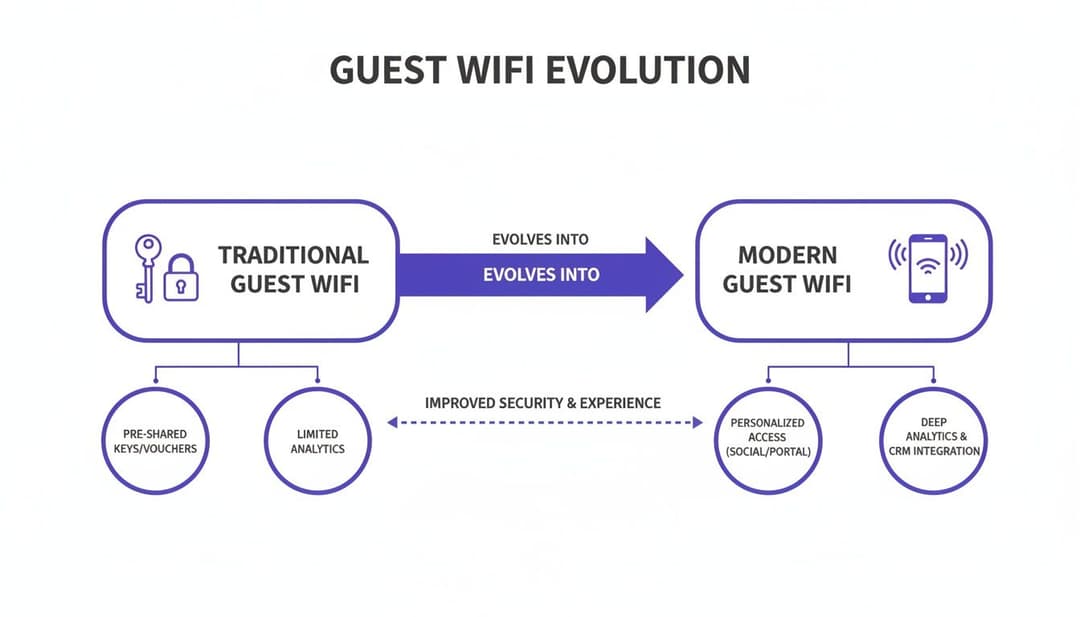
The evolution of guest WiFi mirrors the move from that clunky physical key to a modern, keyless entry app on your phone. It’s smarter, more secure, and offers a tailored experience. Today’s advanced guest WiFi solutions ditch the password entirely, shifting towards an identity-driven model.
This new way of thinking centres on passwordless access and the principles of Zero Trust networking. Instead of just handing out an internet connection, these platforms are designed to:
- Improve the visitor experience with frictionless onboarding.
- Gather compliant, first-party data with explicit user consent.
- Strengthen your overall network security by verifying every single user.
By shifting the focus from simple connectivity to intelligent access, businesses can finally turn a long-standing operational cost into a strategic asset. This modern approach sets the stage for creating tangible business value, from boosting customer loyalty to gaining deep insights into visitor behaviour - all starting with a simple, secure WiFi connection.
Understanding the technologies that power seamless WiFi
To understand why modern guest WiFi solutions are such a huge step up, we need to start with the technology most people are familiar with: the captive portal. It’s that login page that pops up, interrupting whatever you were doing to make you accept terms, hand over an email address, or watch an ad. While common, it is a tool stuck in a past era of connectivity.
Captive portals are a source of friction. They halt the user’s journey, are often difficult on mobile devices, and can present security vulnerabilities. The connection is usually unencrypted before you log in, making them a target for eavesdropping. You can read full technical details in our guide on what a captive portal is.
A comparison of guest WiFi authentication methods
To see how far network access has evolved, it helps to compare traditional access methods with modern authentication options.
| Method | User Experience | Security Level | Best For |
|---|---|---|---|
| Open Network (No Password) | Very easy, but unencrypted. | None | Not recommended for business settings. |
| Shared Password (PSK) | Simple, but a major security risk when shared. | Low | Small private settings like a home office. |
| Captive Portal | Higher friction on mobile devices. | Low (pre-auth) | Public venues needing terms acceptance or data capture. |
| Passpoint / OpenRoaming | Seamless and automatic after one-time setup. | High (WPA2/3-Enterprise) | Large public venues, transport hubs, and multi-site businesses. |
| iPSK | Simple password entry, per device or user. | Medium-High | Connecting headless devices like smart TVs and game consoles. |
| Certificate-Based Access | Automated and identity-driven. | Very High (Zero Trust) | Securing staff and corporate devices without shared passwords. |
As shown above, modern solutions like Passpoint and certificate-based access provide a fundamental upgrade in network security and visitor convenience.
Your digital passport for WiFi
Think about how your phone connects to a mobile network as you travel - it just works, automatically and securely, without you having to do a thing. That’s exactly the experience that modern technologies like Passpoint (IEEE 802.11u) and OpenRoaming bring to WiFi. You can think of Passpoint as a digital passport for your device.
Once a user authenticates on a Passpoint-enabled network for the first time, their device receives this credential. From then on, their device automatically and securely connects to any other participating network globally, without presenting another login screen.
This automatic connection is a significant security upgrade. The entire connection is encrypted from the very first data packet, protecting users from man-in-the-middle attacks common on traditional public WiFi networks.
Seamless roaming is essential for high-density environments. With mobile connections in the UK expected to reach 143% of the population by late 2025, and 99.5% of those being broadband, the demand for reliable public networks in hotels and transport hubs is clear. A Passpoint-certified platform like Purple enables secure, automatic access visitors expect.
Connecting more than just phones and laptops
Passpoint is ideal for smartphones and laptops, but headless devices - such as smart TVs in hotels, gaming consoles in student accommodation, or digital signage in retail centres - cannot always support enterprise 802.1X authentication.
That's where Identity-Based Pre-Shared Keys (iPSK) come into play. An iPSK system allows network administrators to generate a unique key for every individual device or user group.
- For hospitality: Each guest room's smart TV and media hub receives its own unique key, completely isolated from neighbouring rooms.
- For student housing: A resident receives a single iPSK for their laptop, phone, and gaming console, creating a personal private network bubble.
A Zero Trust approach for your staff
Modern guest WiFi solutions also transform staff connectivity. Shared staff passwords create severe security vulnerabilities. Modern enterprise networks shift staff to certificate-based access, directly aligned with a Zero Trust security model where no user or device is trusted implicitly.
By integrating with your identity provider (such as Entra ID or Okta), the WiFi system automatically issues a unique digital certificate to each employee device. Access is granted based on verified identity and role. When an employee leaves, their network access is revoked instantly when removed from the corporate directory.
Turn your guest WiFi into a secure business asset
Discover how Purple delivers passwordless Passpoint roaming, Zero Trust network segmentation, and GDPR-compliant analytics on your existing access point infrastructure.
Speak to a WiFi ExpertHow to navigate security and compliance on guest networks
Offering guest WiFi opens access to your physical space while creating digital touchpoints. Modern guest WiFi solutions balance convenient visitor access with strong network defenses.
Adopting a Zero Trust security model
The most effective way to secure any network is to adopt a Zero Trust security architecture: never trust, always verify. No user or device receives access until identity is confirmed.
Building walls with network segmentation
Securing guest WiFi requires ensuring guest traffic can never cross over into internal corporate networks. Network segmentation creates isolated VLANs for distinct traffic types:
- Guest Traffic: Isolated direct path to the internet. Guests cannot see or interact with internal servers, databases, or corporate endpoints.
- Corporate Traffic: Employees operate in a separate encrypted lane with access to internal resources.
- Operational & Payment Traffic: Point-of-sale terminals and IoT sensors operate on dedicated VLANs meeting PCI DSS isolation requirements.
Respecting privacy and ensuring compliance
Data protection regulations like GDPR require explicit consent for collecting personal data. Purple gathers first-party data responsibly by enforcing explicit opt-in checkboxes for marketing and providing self-serve user tools to inspect or delete personal records.
Putting guest WiFi solutions to work in your industry
A five-star digital experience in hospitality
In hospitality, guest WiFi directly impacts reviews and repeat bookings. Passpoint enables instant connectivity without splash pages, allowing hotels to send welcome messaging and post-stay feedback requests seamlessly. Learn more in our hotel WiFi solutions guide.
Unlocking shopper insights in retail and shopping centres
In retail venues, guest WiFi analytics provides actionable venue intelligence:
- Footfall Patterns: Track peak entry hours and flow between store zones.
- Dwell Times: Measure how long visitors spend near key displays or tenants.
- Visit Frequency: Measure repeat visitor percentages across daily and weekly windows.
Ensuring ironclad security in healthcare
Healthcare facilities require strict separation between guest browsing and critical clinical networks. Network segmentation ensures patient internet access remains completely isolated from medical devices and electronic health records.
Delivering home-like simplicity in residential buildings
In multi-tenant residential properties (BTR and student housing), iPSK gives each apartment a private network bubble for personal IoT devices while maintaining central cloud management.
Choosing and implementing your guest WiFi solution
Selecting the right guest WiFi platform requires evaluating vendor flexibility. Avoid proprietary hardware lock-in by choosing a hardware-agnostic cloud platform compatible with your existing network gear.
Key criteria for selecting a vendor
- Hardware Compatibility: Support for major enterprise vendors including Cisco Meraki, Aruba, Ruckus, and Ubiquiti UniFi.
- Scalability: Cloud-native architecture that scales seamlessly across single venues or global multi-site estates.
- Security & Compliance: Passpoint certification, WPA3 support, and built-in GDPR compliance tools.
- Integration Capabilities: Pre-built API connectors for CRM platforms, identity providers, and marketing automation tools.
Measuring the ROI of your modern guest WiFi platform
A modern guest WiFi solution converts an operational cost into a quantifiable revenue driver through key metrics:
- Visitor Loyalty: Track repeat visit frequencies and footfall return rates.
- Customer Lifetime Value (CLV): Measure conversion rates from opt-in marketing campaigns triggered via WiFi onboarding.
- IT Support Efficiency: Reduce support tickets related to forgotten passwords and portal login failures.
Frequently asked questions about guest WiFi solutions
How difficult is it to switch from a captive portal to a seamless solution?
Switching is straightforward with a cloud-native platform like Purple. You do not need to replace access points; your existing hardware is simply configured to point to the cloud controller. Deployment is typically completed in weeks.
Is collecting guest data through WiFi compliant with GDPR?
Yes. Data collection is compliant when built on explicit consent and transparency. Visitors must actively opt-in for marketing communications, and users retain full rights to manage or delete their stored data.
Can modern guest WiFi solutions actually improve security?
Yes. Modern guest WiFi replaces unencrypted open networks and shared passwords with WPA3 enterprise encryption, Passpoint authentication, VLAN segmentation, and Zero Trust certificate access for staff devices.
Ready to transform your guest WiFi into a strategic asset? Purple provides secure, passwordless access for guests and staff, integrating with your existing network hardware to deliver actionable insights. Discover the Purple platform today.