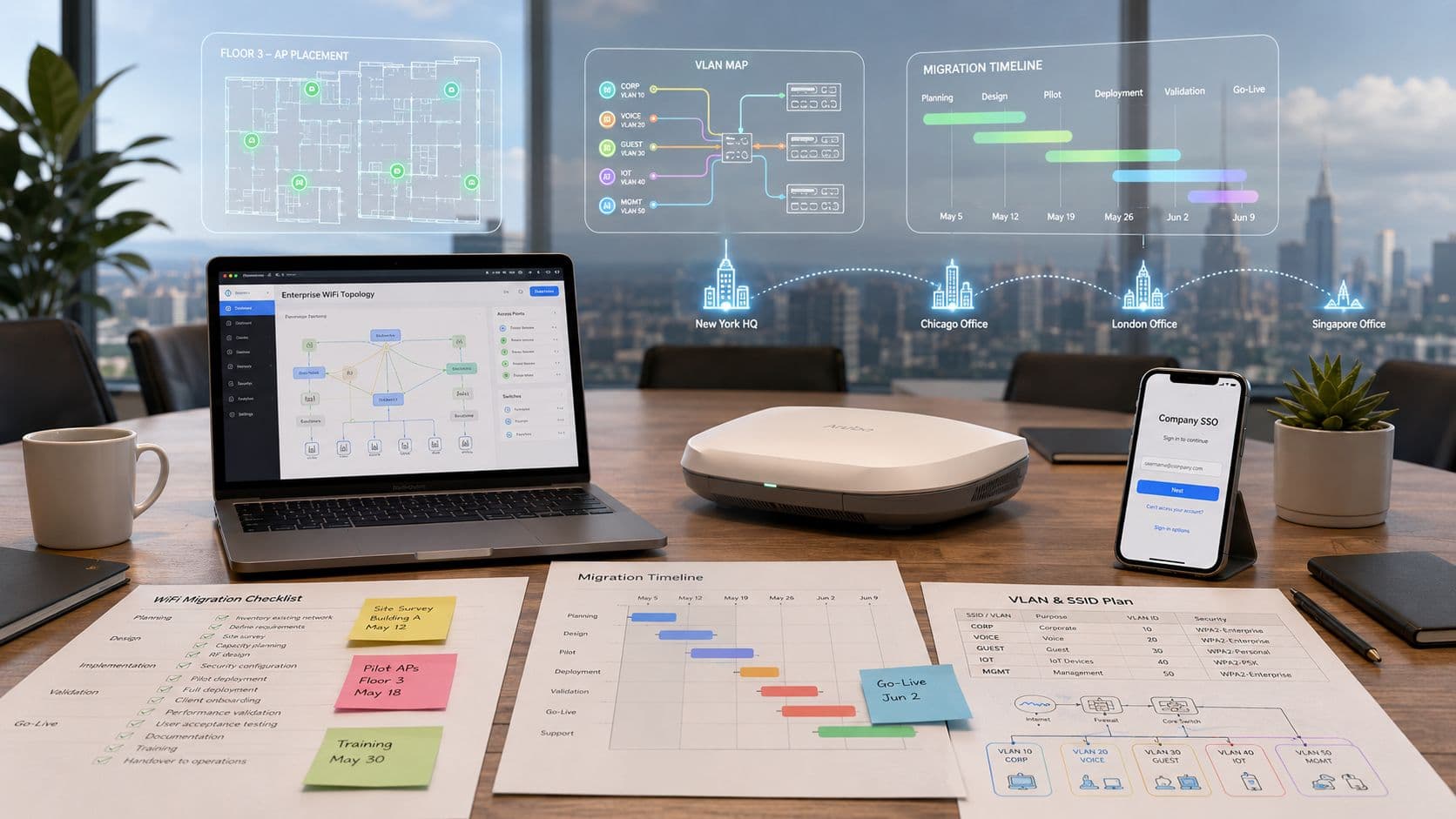
Traditional captive portals remain popular because they're familiar, easy to explain and available on many wireless controllers. They're also a weak default for modern guest WiFi. Splash pages depend on browser redirects, user interaction and often open or shared-access designs, while US guidance has warned that web redirects and captive portals have serious security weaknesses.Jisc guidance
The strongest captive portal alternatives aren't one category. OpenRoaming and Passpoint target automatic, encrypted guest roaming. Certificate-based access serves staff and managed devices. SSO connects WiFi policy to identity providers, while iPSK, PPSK and MPSK handle legacy, IoT and multi-family devices. This list compares them by first-packet security, onboarding effort, device compatibility, identity and hardware dependencies, roaming behavior, administration and venue fit. For context, a venue such as Madeira Remote Coliving may need resident simplicity, staff separation and support for devices that can't run enterprise authentication.
1. Purple
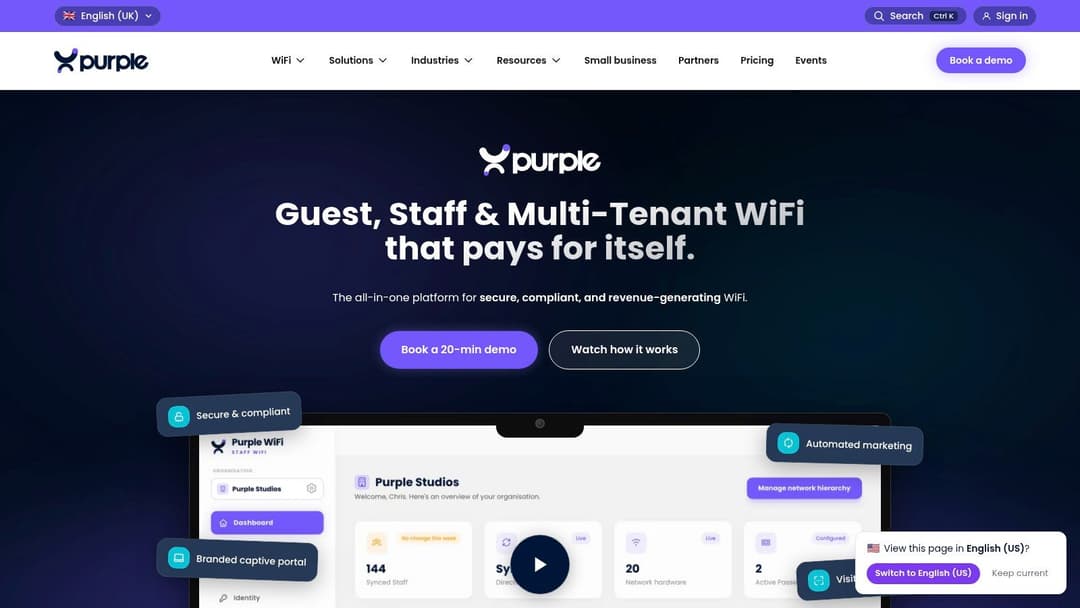
Purple suits venues that need guest roaming, staff identity and device-level access controls on one WiFi platform. It combines OpenRoaming and Passpoint for guests, certificate-based EAP-TLS for staff, and iPSK-style controls for devices that cannot support 802.1X. The result is an authentication layer for different user and device classes, rather than another splash page.
Guests can authenticate once, commonly through email, then reconnect with less effort on later visits. Passpoint provisions the device for automatic authentication, so returning users do not need to complete a browser flow each time. The same approach is already used at named US sites, including Eastern Michigan University, as documented in related deployment guidance.US OpenRoaming deployments
Why it works across user types
For staff, Purple uses EAP-TLS certificates instead of shared passwords. Integrations with Microsoft Entra ID, Google Workspace and Okta can provision access and revoke it when directory roles change. That model fits hospitals, offices, universities and multi-site operators where each connection should map to an individual identity.
Purple runs as a cloud overlay on existing network hardware, with compatibility across Cisco Meraki, Aruba, Ruckus, Juniper Mist and UniFi. A cloud RADIUS design removes the need to operate an on-premises RADIUS server, although the network still needs suitable RADIUS, Change of Authorization and walled-garden capabilities.
Practical rule: Assess Purple as a multi-class access platform, not only as a portal product. Its value is clearest when one deployment must separate guests, staff, residents, IoT and legacy devices without giving every group the same login process.
Built-in analytics, CRM connectors and marketing automation can turn consented first-party WiFi data into operational and marketing insight. The trade-off is commercial complexity. The free Connect guest tier may not include the analytics, surveys, security features or automation expected by an enterprise operator, so total cost depends on selected tiers and add-ons. Review this captive portal guide from Purple, then confirm licensing and controller requirements before committing.
Explore Purple's WiFi platform
2. SecureW2 JoinNow and Cloud RADIUS
SecureW2 takes a certificate-first approach. JoinNow guides users through device enrollment, obtains a certificate and configures the operating system for WPA-Enterprise, usually through EAP-TLS. After that initial setup, the device can authenticate directly to WiFi without repeatedly entering a password or completing a captive portal.
The platform combines cloud PKI with Cloud RADIUS and policy lookups against identity providers such as Microsoft Entra ID, Okta and Google Workspace. That allows administrators to apply access rules by user, device or directory status. Staff and contractors can receive different privileges, while a compromised or departed user's certificate can be revoked without rotating a shared key.
Where the model fits
JoinNow is particularly suitable for offices, universities and distributed organizations with managed devices or a serious BYOD program. It can also support guest workflows, but administrators need to design the guest experience carefully. A certificate workflow is secure, yet it asks more from a visitor than a simple click-through page.
The benefit is consistency. The same identity-led architecture can support WiFi, VPN and wired access, rather than leaving wireless as the least controlled part of the estate. It also removes the recurring support problem created by shared passwords, especially when users copy credentials onto personal devices.
The costs are mostly operational rather than conceptual:
- PKI capability: Network teams new to certificates need to understand enrollment, renewal, trust chains and revocation.
- Device coverage: Confirm support for the operating systems and ownership models used by staff, contractors and BYOD users.
- Budget visibility: SecureW2 uses quote-based pricing, so a discovery process is needed before you can build a reliable business case.
SecureW2 is a strong security-led choice, but it isn't automatically the best guest marketing platform. If the venue needs roaming, analytics and consented first-party engagement alongside staff certificates, compare the required functions rather than assuming Cloud RADIUS alone will cover them.
3. RUCKUS Cloudpath Enrollment System
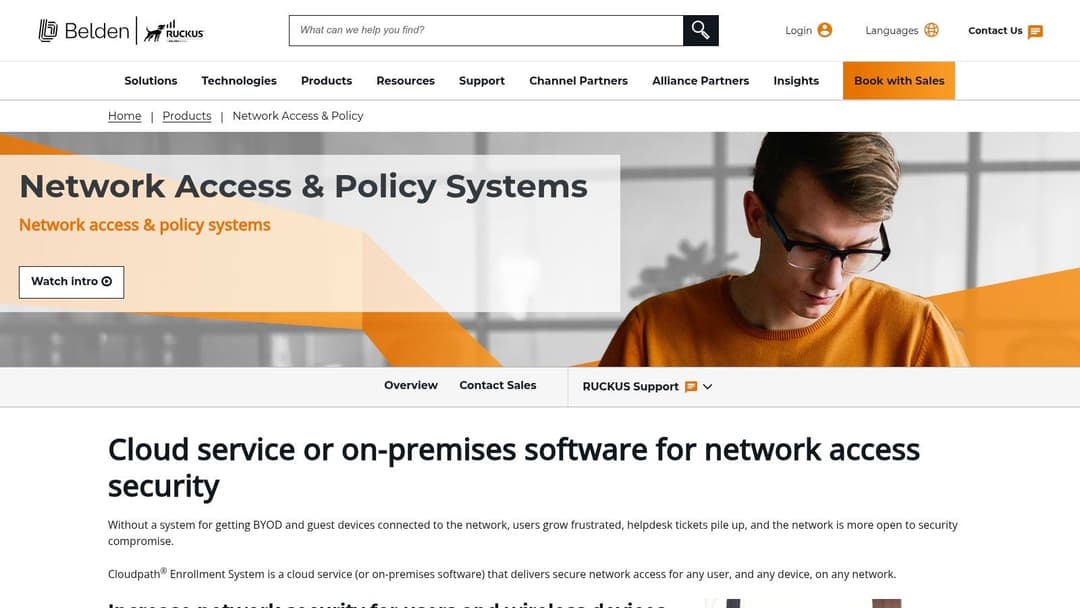
Cloudpath is built around guided enrollment and policy enforcement. A user joins an enrollment SSID, follows a self-service process, and receives a per-device certificate. The system then moves the device onto a protected 802.1X SSID, reducing daily reliance on splash pages.
That migration is the important operational feature. A captive portal can authenticate a browser session, but it doesn't necessarily create a durable, managed relationship between the device and the network. Cloudpath does, which makes repeat access simpler and gives administrators a stronger basis for policy decisions.
The practical advantage of mixed device support
Cloudpath also supports Dynamic PSK and Private PSK models for devices that can't use 802.1X. That matters in hospitality, education, residential buildings and IoT-heavy environments. A printer, sensor or older consumer device may not handle certificate enrollment, but it can often use a uniquely assigned key mapped to a policy or VLAN.
The result is a useful bridge between one shared password and full enterprise authentication. Each key can be associated with a device, resident or role, allowing administrators to revoke or isolate access without changing the entire SSID credential.
Cloudpath is most compelling on RUCKUS infrastructure, where the workflows and documentation align closely with the wireless platform. Heterogeneous estates need more design work, particularly around controller integration, policy exchange and the exact behavior of PPSK across vendors. Some network teams may also find the DPSK operating model demanding during rollout.
Cloudpath works best when the organization treats onboarding as a controlled migration to secure SSIDs, not as a prettier login page.
Education, hotels and multi-family properties are natural fits. If the estate uses several WLAN vendors, assess interoperability before selecting it. This Cloudpath comparison can help frame the decision against a broader cloud overlay.
4. HPE Aruba ClearPass and Central NAC Air Pass
Aruba's approach combines a mature network access control system with Passpoint and OpenRoaming capabilities. ClearPass provides AAA, device profiling, onboarding, and policy enforcement, while Central NAC Air Pass supports a more roaming experience for participating users and venues.
This is a deep enterprise architecture rather than a lightweight portal substitute. Administrators can create separate policies for employees, contractors, guests, BYOD and devices, then apply those policies according to identity, certificate state, device profile or network location. ClearPass also supports guest sponsorship workflows when a conventional guest process is still required.
Why Aruba estates should consider it
Passpoint changes the guest model. Instead of presenting a browser splash page whenever a visitor arrives, the device receives a profile and authenticates automatically when it sees a compatible network. That's especially useful for campuses, public sector estates, transit adjacent locations and organizations with repeat visitors.
US public-sector WiFi provides a useful comparison. Federal and municipal networks allow staff and visitors to sign up once and automatically connect across participating buildings, using WPA2-Enterprise with AES and EAP-PEAP/MS-CHAPv2 in their central authentication flows. The model demonstrates why per-user credentials and network segmentation can be preferable to a shared password or repeated portal redirect.
Aruba's weakness is complexity. ClearPass design, licensing, certificates, Passpoint profiles, RADIUS and policy dependencies all require careful planning. MAC randomization can also make classic portal recognition unreliable, which strengthens the case for certificates or Passpoint rather than trying to repair an old redirect-based workflow.
HPE Aruba Central NAC Air Pass
5. Cisco Identity Services Engine and Cisco Spaces OpenRoaming
Cisco ISE is the policy engine in this combination. It handles enterprise AAA, certificate-based 802.1X, BYOD onboarding, device profiling and guest access workflows. Cisco Spaces OpenRoaming adds a federated route to automatic visitor connectivity, reducing the number of times a returning user needs to interact with a portal.
ISE suits organizations that already run Cisco wireless, switching and identity controls. It can check certificate status, apply policy through identity and device context, and support sponsored or self-service guest access where a portal remains necessary. That breadth makes it suitable for large estates, but it also means administrators need to map the complete authentication path before deployment.
OpenRoaming is the guest-facing differentiator. The WiFi Alliance has described Passpoint connectivity in public US spaces and cited a central city deployment.WiFi Alliance Passpoint deployments The operational idea is straightforward. A device is provisioned once, then uses federation and automatic authentication instead of repeating local web login steps.
The main trade-off
Cisco's ecosystem depth can be an advantage or a constraint. A Cisco WLAN estate can use the native integrations effectively, while a multi-vendor environment must validate RADIUS attributes, roaming federation, policy enforcement and support boundaries. Spaces capabilities also depend on licensing, so the product name alone doesn't define the available feature set.
Cisco ISE is therefore strongest where centralized policy and enterprise integration matter more than deployment simplicity. It may be excessive for a small venue that only needs isolated guest internet, but it can be appropriate for healthcare, higher education, airports and large corporate estates.
Compare Cisco Spaces with Purple
Cisco Identity Services Engine
6. Juniper Mist Access Assurance with Passpoint and MPSK
Juniper Mist offers several alternatives because different devices need different authentication methods. Passpoint and OpenRoaming serve compatible guest devices, Access Assurance provides cloud NAC and AAA policy, and Multiple PSK or Private PSK supports older, IoT and specialized endpoints.
That combination is useful in mixed environments. A returning visitor can use a provisioned Passpoint profile, an employee can authenticate through an identity policy, and an IoT device can receive an individual PSK with role or VLAN mapping. The administrator doesn't have to force every endpoint into one method because the SSID is shared.
Mist's cloud model also produces detailed WLAN and endpoint telemetry. That can help teams troubleshoot authentication failures, identify device classes and understand how policy decisions affect access. RadSec support is relevant where the organization participates in secure roaming federation and needs protected communication between roaming components.
Device class should drive the choice
Passpoint is the cleanest answer for compatible guest devices because it removes the repeated browser interaction. MPSK or PPSK is more practical for devices without 802.1X capability, but it still creates an administrative process for issuing, storing and revoking keys. Access Assurance adds central policy, though administrators should confirm which functions are included in the selected license.
Mist isn't a universal replacement for every portal function. If the venue still needs branded pages, surveys, or detailed guest data capture, it may require a third-party portal alongside the network controls. That can create two systems to administer and two places to troubleshoot.
Juniper Mist wireless documentation
7. ExtremeCloud IQ with PPSK and ExtremeGuest
ExtremeCloud IQ uses PPSK to give users or devices distinct keys while retaining a practical shared-SSID model. Administrators can associate each key with a role, policy or VLAN, creating more accountability than a single password and avoiding the full onboarding burden of certificate-based 802.1X.
This is a useful middle ground for multi-family buildings, guest networks and IoT estates. A resident, contractor or device can receive an individual credential, while the network can revoke that credential without disrupting every other user. It's simpler than a full PKI deployment, although it doesn't offer the same certificate lifecycle controls.
When ExtremeGuest still makes sense
ExtremeCloud IQ also supports 802.1X, SAML SSO and other wireless security options. ExtremeGuest remains available when a venue needs a conventional portal for terms acceptance, guest registration or a branded access journey. That gives operators a migration path, but retaining the portal means they haven't eliminated browser friction for that user group.
PPSK availability depends on the relevant license tier, so confirm the entitlement before designing the deployment. The same applies if the organization expects to add OpenRoaming later. Roaming federation can require additional components and integration work beyond the initial PPSK rollout.
Extreme is a sensible choice when the current WLAN estate already uses its cloud management platform and the immediate problem is shared-password risk. It's less compelling if the business needs a single system for federated guest roaming, employee certificates, CRM data and multi-vendor hardware.
7-Way Comparison of Captive Portal Alternatives
| Solution | 🔄 Implementation complexity | 💡 Resource requirements | 📊 Expected outcomes | Ideal use cases | ⭐ Key advantages / ⚡ Efficiency |
|---|---|---|---|---|---|
| Purple | Moderate, cloud RADIUS overlay; fast rollout but some network config | Low - Moderate, cloud service + compatible controllers; paid add‑ons for full value | High, seamless guest/staff certificate access; built‑in analytics for ROI | Retail, hospitality, stadiums, hospitals, multi‑family venues | ⭐ Enterprise security, OpenRoaming/Passpoint, CRM/marketing integration ⚡ Fast time‑to‑live |
| SecureW2 JoinNow + Cloud RADIUS | Moderate - High, PKI concepts and device onboarding workflows | Moderate, Cloud PKI, IdP integrations; quote/discovery recommended | High, passwordless 802.1X across WiFi/VPN/wired; reduces captive portals | Enterprises seeking organization‑wide certificate‑based access | ⭐ Strong PKI automation and IdP support ⚡ Automated enrollment speeds rollout |
| RUCKUS Cloudpath Enrollment System | Moderate, guided self‑service; best experience on RUCKUS gear | Moderate, AD/MDM integrations; DPSK for legacy/IoT | High, per‑device certificates, reduced daily portal dependence | Education, hospitality, MDUs, RUCKUS‑centric deployments | ⭐ Mature enrollment flows and DPSK support ⚡ Smooth device migration to secure SSIDs |
| HPE Aruba ClearPass + Central NAC Air Pass | High, complex design and licensing; detailed planning needed | High, ClearPass + Central NAC and Aruba APs; licensing entitlements | High, granular policy, Passpoint/OpenRoaming for seamless guest access | Large, segmented networks; public sector and education | ⭐ Comprehensive NAC, profiling and Passpoint support ⚡ Scalable for large estates |
| Cisco ISE + Cisco Spaces OpenRoaming | High, enterprise‑grade setup and licensing complexity | High, ISE deployment, Spaces licensing; optimal with Cisco WLAN | High, robust AAA, certificate checks, roaming federation for return visitors | Large Cisco‑based campuses and service‑provider sites | ⭐ Battle‑tested at scale with broad integrations ⚡ OpenRoaming speeds re‑association |
| Juniper Mist Access Assurance + Passpoint/MPSK | Moderate - High, cloud NAC + Passpoint setup; licensing checks | Moderate, Mist cloud, Access Assurance entitlements; MPSK/PPSK for IoT | High, AI telemetry, seamless onboarding, multiple portal alternatives | Modern cloud WLAN estates, IoT‑mixed environments | ⭐ Integrated AI telemetry and flexible portal alternatives ⚡ Tight WLAN+NAC integration |
| ExtremeCloud IQ (PPSK/MPSK) + ExtremeGuest | Moderate, PPSK simpler than full 802.1X; optional portal workflows | Moderate, Cloud IQ licensing; PPSK availability varies by tier | Medium - High, per‑device keys reduce portal use; practical bridge to 802.1X | BYOD environments, Multi-Family/MDUs, organizations seeking PPSK | ⭐ Practical PPSK tooling and runbooks; optional guest app ⚡ Lower overhead than full 802.1X |
Choose the Authentication Model That Fits the Venue
There isn't one universal winner among captive portal alternatives. The correct choice follows the device population, the identity model, and the venue's tolerance for operational complexity.
Choose OpenRoaming or Passpoint when visitors return regularly, move between participating locations or need encrypted connectivity without repeated browser interaction. Public spaces, campuses, transit hubs, hotels and multi-site venues benefit most when profile provisioning is realistic for their audience. City deployments and named US OpenRoaming sites show that this model is operating beyond laboratory demonstrations.US OpenRoaming deployment examples
Choose EAP-TLS with cloud RADIUS when staff identity, certificate lifecycle and immediate revocation matter most. Offices, hospitals, universities and managed BYOD programs should prioritize individual credentials over shared PSKs. Choose PPSK, MPSK or iPSK for legacy devices, IoT, residents and multi-family environments where 802.1X isn't practical.
Before piloting, inventory the endpoints and record which ones support Passpoint, WPA2- or WPA3-Enterprise, 802.1X and certificate enrollment. Confirm your WLAN vendor, RADIUS support, Change of Authorization, VLAN isolation, identity provider integrations, roaming requirements and licensing. Also decide what personal data the venue needs. US business guidance distinguishes basic portals from enterprise systems with audit and CCPA/CPRA tooling, while the broader compliance question is data minimization, not collecting more identity information.US guest WiFi and compliance guidance
Purple is relevant when one operator wants a cloud overlay across supported hardware, combining guest Passpoint and OpenRoaming, staff identity integration, analytics and controls for legacy or multi-tenant devices. It can reduce the number of separate systems, but the network still needs compatible controller features and a properly segmented design.
Start with the authentication model, not the splash-page design. A polished portal can still leave the organization dependent on redirects, shared credentials and manual support. A well-designed combination of roaming profiles, certificates and per-device keys gives each user group an access method that matches its device and risk profile.
Purple combines Passpoint and OpenRoaming for lower-friction guest access, certificate-based staff authentication and controls for legacy or multi-family devices on supported WLAN hardware. Visit Purple to evaluate how its cloud identity and WiFi platform could replace repeated captive portal logins without forcing one authentication model on every device.