
Retail unified commerce & in-store data ROI calculator
Model your retail chain's first-party customer profile capture, cross-channel revenue uplift, and data maturity powered by Purple retail WiFi analytics.
High brand engagement with high omnichannel crossover. Focus on in-store digital styling, loyalty sync, and clienteling.
Evaluate your retail architecture maturity
Four core capabilities of unified commerce
Single customer view (SCV)
Bridge anonymous in-store footfall with online eCommerce profiles. Capture verified names, verified emails, phone numbers, and visit frequency through branded captive portal login with GDPR/CCPA consent.
Deploy in-store WiFi analytics for retail chains
Join enterprise retailers like Under Armour, PizzaExpress, and Home Depot. Turn anonymous store visitors into loyal omnichannel customers.
Executive summary
Modern retail operates in an environment where customer buying behaviors span multiple physical and digital touchpoints. Shoppers research products on mobile apps while browsing physical store aisles, order online for in-store collection (buy online, pick up in store), and expect consistent pricing, loyalty rewards, and customer service across every channel. According to IHL Group research, unified commerce represents a $2.6 trillion global opportunity, with unified retailers achieving 8.9% higher profit margins and 14.2% faster revenue growth than competitors operating fragmented systems.
While omnichannel strategies connected multiple customer-facing channels, they frequently left the underlying technology stack fragmented. Point-of-sale (POS) systems, eCommerce platforms, inventory databases, and loyalty schemes remained in independent silos. Unified commerce resolves this limitation by connecting all customer touchpoints and back-office systems into a single, centralized real-time platform. By integrating in-store guest WiFi analytics with cloud CRM platforms, enterprise retailers capture verified first-party customer profiles and attribute physical footfall directly to digital revenue.
This comprehensive guide examines the technical and operational differences between omnichannel retail and unified commerce, details the data architecture needed for single customer views, provides an architectural comparison matrix, and presents a 4-step deployment framework for retail chains.
What is the difference between omnichannel retail and unified commerce?
Although omnichannel retail and unified commerce both aim to deliver seamless customer experiences across physical stores and digital channels, their architectural foundations and data flow models differ fundamentally.
What is omnichannel retail?
Omnichannel retail is a customer-facing strategy that provides multiple ways for consumers to interact and purchase - including physical brick-and-mortar stores, desktop eCommerce websites, mobile applications, social commerce, and telephone support. In an omnichannel architecture, retailers build individual point-to-point software integrations between separate applications (for example, syncing eCommerce orders to a store POS or connecting web analytics to email marketing software).
However, because omnichannel architectures rely on disparate databases, data synchronization is often delayed or incomplete. Inventory levels may take hours to reconcile, customer purchase histories remain split between online and offline systems, and physical store staff lack real-time visibility into an in-store shopper's online shopping cart.
What is unified commerce?
Unified commerce is a centralized platform architecture that manages all customer-facing touchpoints, transactional engines, inventory databases, and marketing channels through a single core software system. Instead of maintaining separate software systems with complex point-to-point APIs, unified commerce uses a centralized data layer and decoupled front-end microservices.
In a unified commerce environment, when a customer browses a product online, visits a physical store, connects to in-store guest WiFi, purchases an item at the register, or requests a return via mobile app, every event updates a single unified profile in real time. This delivers 100% accurate inventory visibility, frictionless cross-channel fulfillment, and personalized customer engagement.
The physical store data disconnect in legacy retail
Physical brick-and-mortar venues account for over 80% of total retail sales globally. However, for most traditional retailers, physical stores remain a primary data blind spot:
- Anonymous store footfall: While web analytics tracks every click, dwell time, and bounce on an eCommerce site, traditional retailers have zero insight into the 90% of in-store visitors who leave without making an immediate purchase.
- Disconnected loyalty records: Shoppers who make cash or unlinked card payments in-store cannot be matched to their digital eCommerce profiles.
- Inaccurate physical-to-digital attribution: Retail marketing teams cannot measure whether an in-store display, window promotion, or local event drove eCommerce transactions in the following 30 days.
How in-store guest WiFi connects physical foot traffic with digital CRM
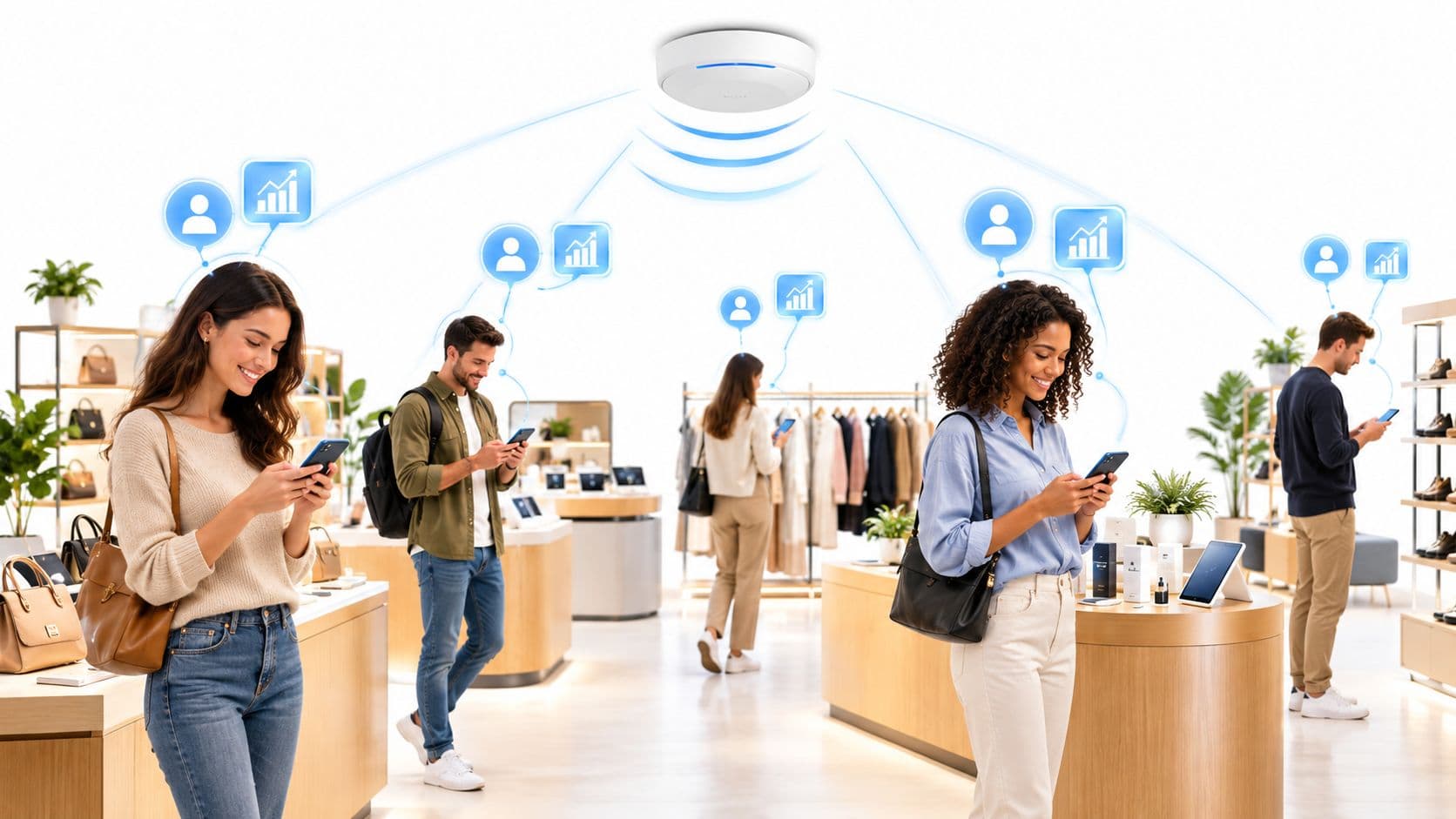
Enterprise guest WiFi platforms like Purple bridge the gap between physical store visitors and digital commerce platforms. When shoppers connect to the store guest WiFi network, the access point redirects their browser to a branded captive portal splash screen:
- First-party data capture with verified consent: Shoppers authenticate via email, mobile number, or social credentials, providing explicit CCPA/CPRA marketing opt-in consent. Across Purple deployments in over 100,000 venues, verified opt-in rates consistently exceed 80%.
- Real-time CRM and CDP synchronization: The connecting profile (verified name, email, demographic details, and visit timestamp) is instantly synced via webhook or API into the retailer's CRM or Customer Data Platform (such as Salesforce, Klaviyo, HubSpot, Microsoft Dynamics, or Segment).
- Single customer view (SCV) creation: The platform matches the visitor's physical device identifier and email against existing eCommerce records, establishing a unified profile that tracks both online browsing history and physical store visit frequency.
- WiFi presence analytics: The wireless network anonymously tracks passerby footfall, capture rates, dwell times across store zones, and return visit intervals - providing retail operations teams with spatial insights comparable to web analytics.
4 core pillars of retail unified commerce
A complete unified commerce strategy combines four interconnected operational pillars:
1. Single customer view (SCV) across physical and digital channels
Consolidating in-store WiFi logins, POS receipts, eCommerce orders, and customer service interactions into a single database profile. Store associates equipped with mobile POS devices can instantly view a customer's lifetime spend, preferred product categories, and open support tickets as soon as the customer identifies themselves in-store.
2. Real-time physical-to-digital revenue attribution
Tracking the complete multi-channel customer lifecycle. Retailers can determine whether physical store visits accelerate digital repeat purchases, calculate the customer lifetime value (LTV) of omnichannel shoppers versus single-channel buyers, and attribute marketing campaign spend accurately.
3. Hyper-personalized in-store marketing and clienteling
Triggering automated, context-aware communications based on physical presence. For example, welcoming a VIP customer with a personalized SMS offering loyalty points when they enter the store, or sending an automated post-visit email survey 30 minutes after departure to capture Net Promoter Score (NPS) feedback.
4. Unified inventory management and flexible fulfillment
Providing real-time stock visibility across all distribution centers and physical retail locations. Enables Buy Online, Pick Up In-Store (BOPIS), Buy Online, Return In-Store (BORIS), and Ship-from-Store workflows without inventory discrepancies or overselling.
Architectural comparison: Siloed vs Omnichannel vs Unified Commerce
The table below summarizes the key architectural and operational differences between siloed retail, omnichannel retail, and modern unified commerce:
| Capability | Siloed Multi-Channel | Omnichannel Retail | Unified Commerce |
|---|---|---|---|
| Data Architecture | Disconnected databases per channel | Separate databases connected via point-to-point APIs | Single centralized cloud data platform |
| In-Store Footfall Tracking | None (Anonymous footfall) | Basic infrared door beam counters | Real-time WiFi presence analytics & heatmaps |
| Customer Profile Sync | Zero cross-channel matching | Batch overnight synchronization | Instant real-time sync across POS, web & WiFi |
| Cross-Channel Attribution | Unmeasurable | Probabilistic estimates | Deterministic multi-touch attribution |
| Inventory Visibility | Siloed by warehouse/store | Periodic batch updates (inventory lag) | Real-time perpetual stock across all nodes |
| Average Profit Margin Uplift | Baseline | +3.2% | +8.9% (IHL Group Benchmark) |
Proven retail unified commerce case studies
Enterprise retailers deploy Purple in-store guest WiFi and analytics to power their unified commerce initiatives:
- Under Armour: Connected in-store captive portal WiFi across retail flagship stores, capturing millions of verified customer profiles that feed directly into their CRM to power cross-channel digital marketing campaigns.
- Domino's Pizza: Deployed Purple guest WiFi across store locations, capturing customer contact data at point-of-collection to drive mobile app downloads and automate personalized retention offers.
- PizzaExpress: Integrated in-store WiFi onboarding with their digital loyalty app, achieving over 120,000 new verified loyalty registrations monthly and increasing repeat dine-in frequency.
4-step framework to transition to unified commerce
- Audit existing data infrastructure: Map data flows between your eCommerce platform (Shopify Plus, Salesforce Commerce Cloud, Adobe Commerce), POS hardware, CRM systems, and enterprise wireless access points.
- Deploy enterprise guest WiFi with captive portal integration: Standardize guest WiFi across physical stores using cloud RADIUS and certified captive portals that capture compliant first-party customer profiles with 80%+ opt-in rates.
- Unify customer data via API connectors: Configure automated webhooks to sync in-store guest WiFi authentication events, dwell metrics, and visit counts directly into your CRM or CDP.
- Automate personalized omnichannel engagement: Build automated lifecycle workflows - such as automated post-visit feedback microsurveys, tailored email recommendations based on store visit frequency, and in-store loyalty rewards.
To explore how in-store WiFi analytics powers unified commerce for retail chains, consult our WiFi Marketing & First-Party Data Guide or schedule a technical consultation with our retail networking team.
Frequently asked questions
What is the difference between omnichannel retail and unified commerce?
Omnichannel retail connects multiple shopping channels (online store, mobile app, physical brick-and-mortar) but frequently relies on separate back-end databases. Unified commerce consolidates all customer data, inventory management, point-of-sale (POS), and in-store WiFi touchpoints into a single, centralized real-time platform.
How does in-store guest WiFi connect physical store visits with online eCommerce data?
When shoppers log into in-store guest WiFi via a branded captive portal, their verified email and profile are synchronized with the retailer's customer relationship management (CRM) or customer data platform (CDP), establishing a single customer view across physical and digital transactions.
What are the primary business benefits of unified commerce for retailers?
Unified commerce eliminates inventory discrepancies, enables frictionless click-and-collect fulfillment, provides physical-to-digital revenue attribution, and increases customer lifetime value (LTV) by up to 30% through personalized in-store and online marketing.
How does WiFi presence analytics help retailers optimize physical store operations?
WiFi presence analytics measures foot traffic, passerby capture rates, department dwell times, and repeat visit frequency. Retailers use these spatial insights to optimize staff scheduling, improve store layouts, and evaluate visual merchandising effectiveness.
How do retailers ensure data privacy compliance when collecting in-store customer data?
Enterprise guest WiFi platforms like Purple ensure full compliance with the TCPA and CAN-SPAM, CCPA/CPRA, and global privacy standards by capturing explicit, unbundled marketing consent during captive portal onboarding and providing automated privacy management tools.