How WiFi evolved and changed global business: tech and ROI evaluator
Explore the technical milestones of IEEE 802.11 standards from 1999 to 2026, compare physical spectrum capabilities, and calculate venue performance metrics for your network.
WiFi 6 / 6E (802.11ax) standards profile - 2021
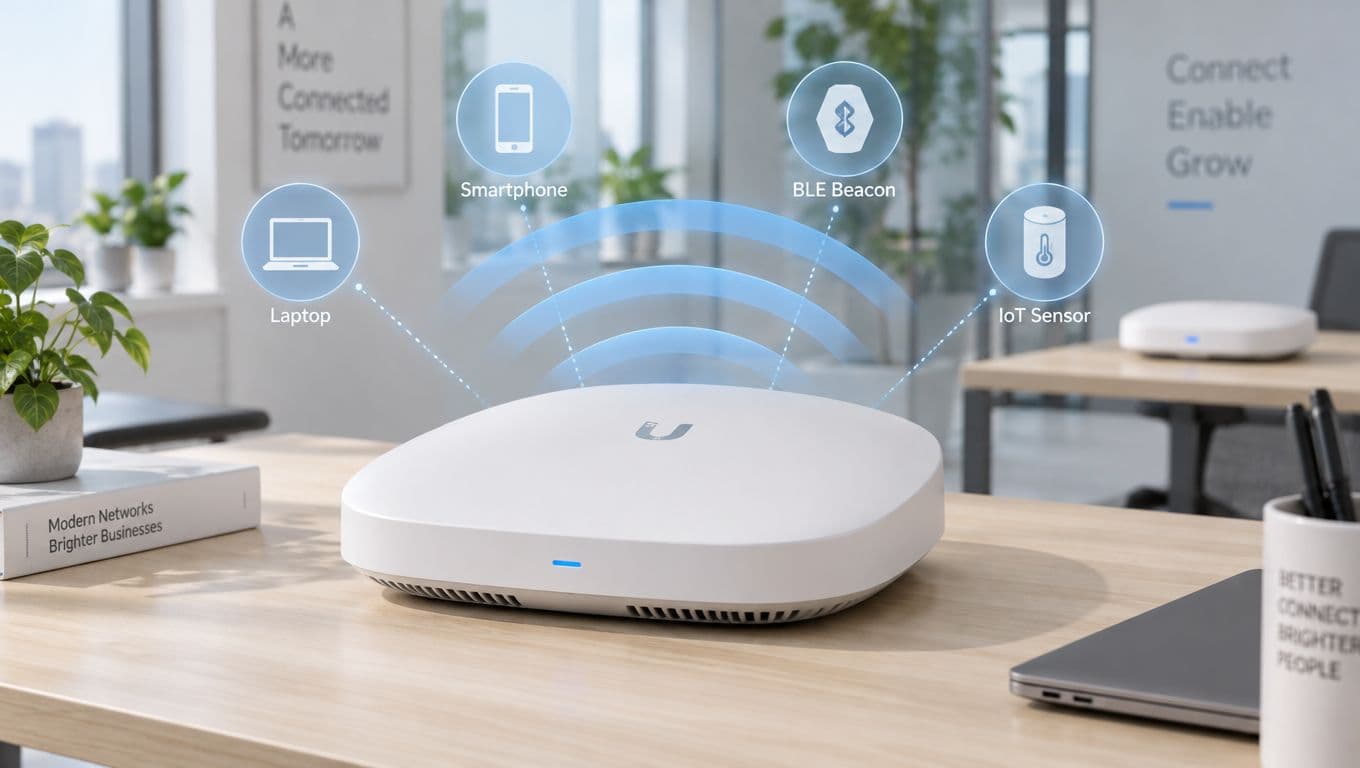
Max PHY rate: 9.6 GbpsOFDMA and 6 GHz clean spectrum, solving high-density venue congestion. Powers IoT smart venues, contactless ordering, hospital RTLS asset tracking, and Industry 4.0.
Shifted physical stores from transactional spaces to immersive digital-physical experience hubs.
Ready to upgrade your WiFi infrastructure into a high-ROI data engine?
Purple layers on top of your existing hardware (Cisco Meraki, HPE Aruba, Ruckus, Juniper Mist, Ubiquiti UniFi, Cambium, Extreme, Fortinet) to deliver secure guest onboarding, verified CRM lead capture, and location footfall analytics across 80,000+ venues.
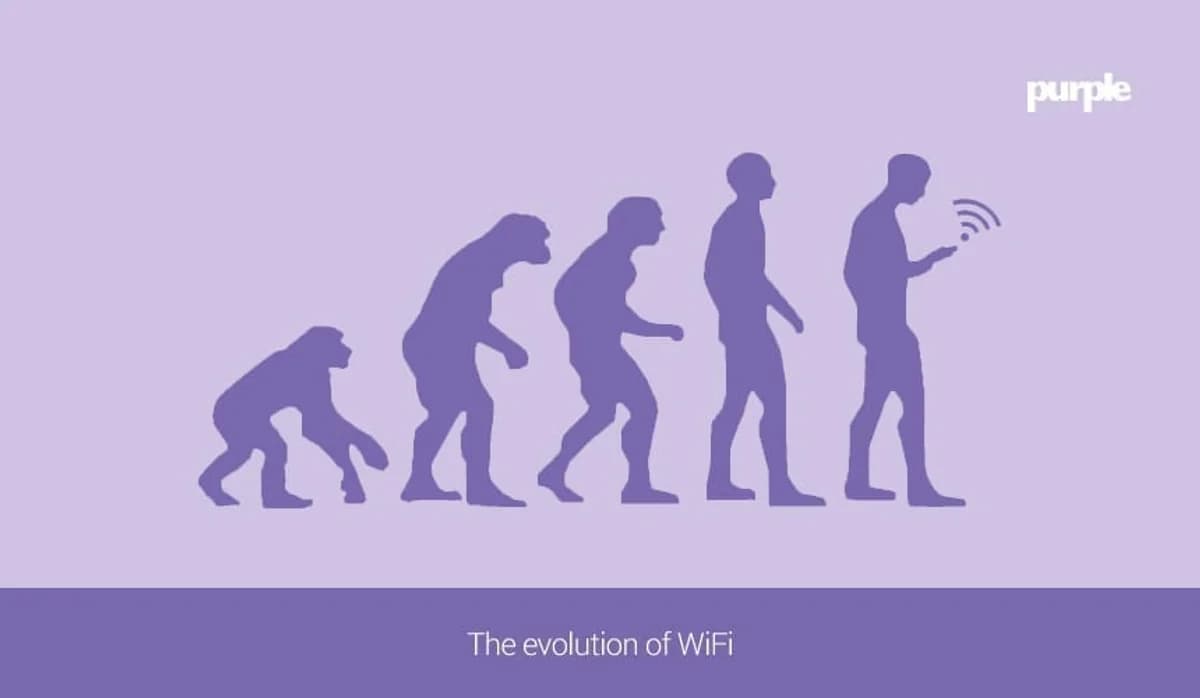
The history of WiFi spans more than three decades of rapid innovation, transforming wireless networking from an experimental 2Mbps technology into an indispensable utility powering global commerce, healthcare, hospitality, and smart infrastructure. Understanding how WiFi evolved from early frequency-hopping radio experiments to modern multi-gigabit WiFi 7 (802.11be) standards provides essential context for network engineers and venue operators designing enterprise wireless environments.
Key takeaways: history of WiFi evolution
- 1997 Creation: The initial IEEE 802.11 specification delivered maximum wireless data rates of just 2Mbps over 2.4GHz spectrum.
- Frequency Spectrum Expansion: WiFi expanded from congested 2.4GHz spectrum (802.11b/g) into 5GHz (802.11a/n/ac) and 6GHz (WiFi 6E/7) to overcome radio frequency interference and co-channel contention.
- MIMO & Density Breakthroughs: 802.11n introduced Multiple-Input Multiple-Output (MIMO) technology, while WiFi 6 (802.11ax) introduced OFDMA to manage thousands of simultaneous client connections in crowded venues.
- Modern Enterprise Integration: Today, WiFi platforms like Purple pair high-speed wireless standards with automated captive portals, Passpoint roaming, and venue location analytics across major enterprise hardware vendor ecosystems.
Understanding the origins of WiFi
Wireless communication relies on radio frequency (RF) signals to transmit data frames through the air without physical copper cabling. The foundation of modern WiFi stems from frequency-hopping spread spectrum technology pioneered in the 1940s, which laid the groundwork for secure radio transmissions.
In the late 1980s, the US Federal Communications Commission (FCC) released unlicensed spectrum in the 2.4GHz band (ISM band), enabling researchers and technology companies to build non-line-of-sight wireless network equipment.
1997: the birth of IEEE 802.11
The formal history of WiFi began in 1997 when the Institute of Electrical and Electronics Engineers (IEEE) released the original 802.11 standard. Operating on the 2.4GHz frequency, this baseline protocol allowed maximum bandwidth speeds of 2 Megabits per second (Mbps).
While 2Mbps was revolutionary for wireless mobility, early 802.11 equipment suffered from high signal attenuation, expensive hardware costs, and limited interoperability between manufacturers.
1999: 802.11b and 802.11a bring WiFi home
In 1999, the Wireless Ethernet Compatibility Alliance (WECA) - later rebranded as the Wireless Fidelity (WiFi) Alliance - was formed to certify device interoperability. That same year, IEEE introduced two complementary standards:
- 802.11b: Operating in the 2.4GHz band, 802.11b boosted throughput to 11Mbps using Direct-Sequence Spread Spectrum (DSSS). It became the first commercially viable home and office WiFi standard.
- 802.11a: Operating in the cleaner 5GHz spectrum, 802.11a delivered speeds up to 54Mbps using Orthogonal Frequency-Division Multiplexing (OFDM). However, shorter signal ranges and higher component costs delayed widespread adoption compared to 802.11b.
2003: 802.11g increases wireless speeds
The release of 802.11g in 2003 combined the best attributes of previous standards: 54Mbps maximum throughput using OFDM modulation, while remaining in the accessible 2.4GHz frequency band with full backward compatibility for 802.11b devices.
The 802.11g standard triggered explosive growth in laptop connectivity, coffee shop hotspots, and early enterprise guest networks. However, because 2.4GHz only contains three non-overlapping channels (1, 6, and 11), growing device density quickly led to co-channel interference in urban environments.
2009: 802.11n introduces MIMO technology
Ratified in 2009, IEEE 802.11n represented a quantum leap in RF spectrum efficiency. By introducing Multiple-Input Multiple-Output (MIMO) technology, access points could utilize multiple spatial streams (antennas) to send and receive data simultaneously.
Key innovations of 802.11n included:
- Dual-Band Operation: Access points supported both 2.4GHz and 5GHz frequencies simultaneously.
- Channel Bonding: Combining two 20MHz channels into 40MHz channels to double data rates up to 600Mbps.
- Beamforming: Directional signal focusing to concentrate RF energy toward active client devices.
2014: WiFi 5 (802.11ac) expands 5GHz spectrum
Introduced in 2014, 802.11ac (retrospectively named WiFi 5) shifted focus exclusively to the 5GHz frequency band to deliver gigabit wireless speeds. By implementing 256-QAM modulation, 80MHz channel widths, and explicit Multi-User MIMO (MU-MIMO), WiFi 5 allowed access points to communicate with multiple client devices simultaneously on downlink transmissions.
For detailed analysis of channel planning in 5GHz networks, see our guide to the best 5GHz WiFi channels.
2019: WiFi 6 (802.11ax) handles high device density
By 2019, the explosive proliferation of smartphones, tablets, IoT sensors, and wearable devices created intense airtime contention in commercial venues like stadiums, shopping centers, and corporate offices. WiFi 6 (802.11ax) was engineered specifically to solve high-density network congestion rather than focusing solely on peak single-client speed.
WiFi 6 introduced Orthogonal Frequency-Division Multiple Access (OFDMA), borrowed from cellular LTE networks. OFDMA divides a single WiFi channel into smaller Resource Units (RUs), allowing an access point to serve up to 30 clients concurrently in a single transmission window.
2021: WiFi 6E unlocks the 6GHz spectrum
WiFi 6E extended 802.11ax capabilities into the 6GHz spectrum, adding up to 1,200 MHz of clear, contiguous frequency spectrum. Because legacy 2.4GHz and 5GHz devices cannot access the 6GHz band, WiFi 6E eliminated backward-compatibility overhead and co-channel interference from older hardware.
2024 and beyond: WiFi 7 (802.11be) and extremely high throughput
WiFi 7 (IEEE 802.11be) marks the latest milestone in WiFi history, bringing Extremely High Throughput (EHT) across 2.4GHz, 5GHz, and 6GHz bands simultaneously. Featuring 320MHz channel widths, 4096-QAM (4K-QAM), and Multi-Link Operation (MLO), WiFi 7 enables client devices to transmit data over multiple bands at the same time, reducing latency to under 5 milliseconds.
How modern enterprise guest WiFi builds on WiFi history
As WiFi standards evolved from basic connectivity to multi-gigabit wireless fabrics, venue requirements expanded beyond raw bandwidth. Today, businesses view guest WiFi as a strategic customer engagement and operational intelligence asset.
Modern cloud WiFi platforms integrate directly with enterprise hardware vendors like Cisco Meraki, HPE Aruba, Ruckus, and Ubiquiti UniFi to deliver seamless guest onboarding and compliance:
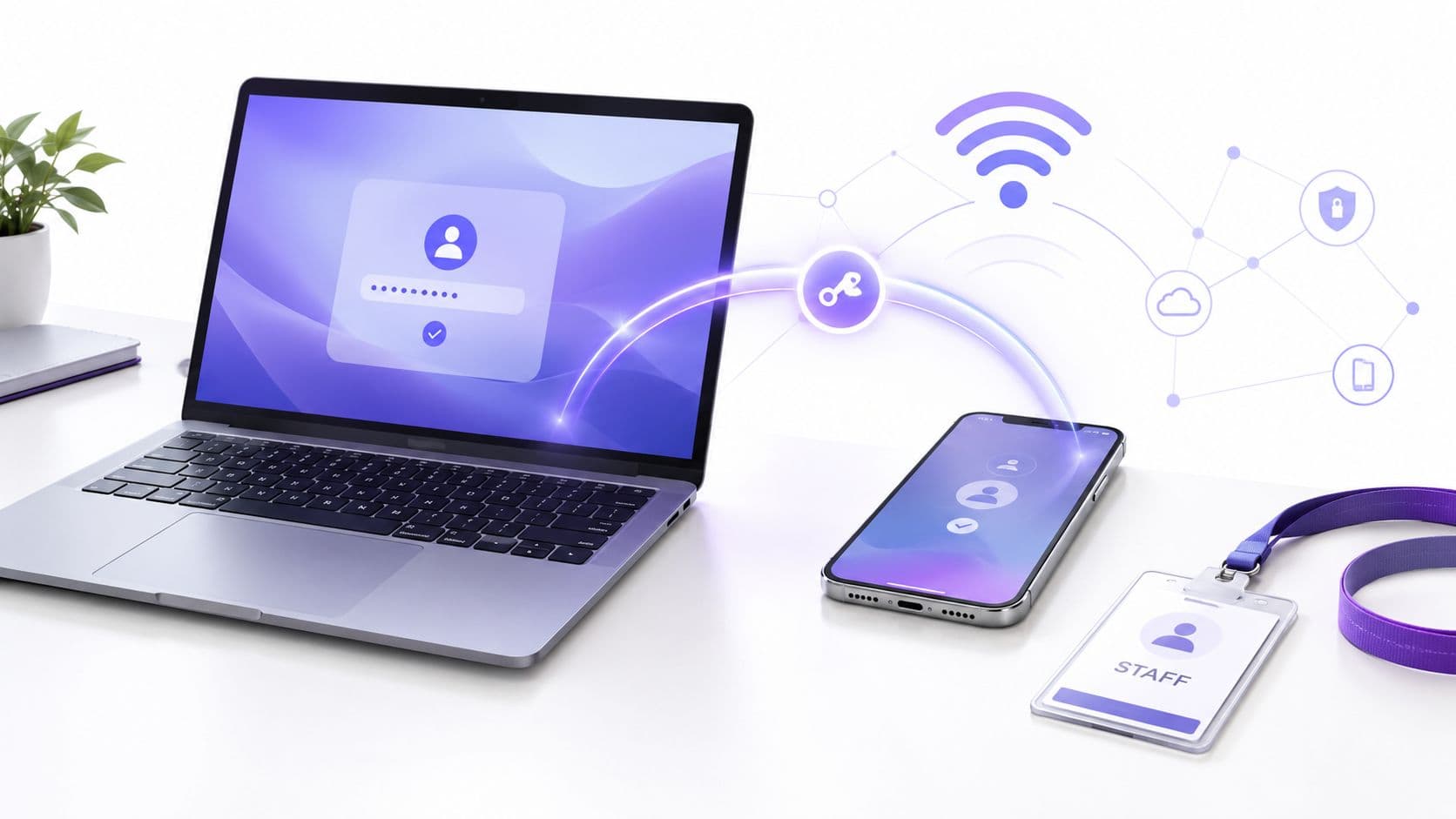
- Cloud Captive Portals: Secure guest authentication via social login, email registration, or custom forms. Explore our Guest WiFi Guide for details.
- Enterprise WiFi Security: Implementing WPA3 Enterprise and 802.1X Cloud RADIUS for zero-trust network access. Learn more in our Enterprise WiFi Security Guide.
- Location Analytics: Converting guest traffic and dwell time into actionable operational insights. Discover more in our WiFi Analytics Guide.
Upgrade your venue WiFi from standard connectivity to business intelligence
Modern WiFi 6 and WiFi 7 networks provide the speed foundation, but Purple provides the software layer. Transform your existing enterprise wireless access points into automated captive portals, guest engagement hubs, and location analytics engines without replacing hardware.
Frequently asked questions about WiFi history
When was WiFi invented and who created it?
WiFi was officially released for consumers in 1997 with the ratification of the IEEE 802.11 standard. The technology builds on radio frequency research by CSIRO in Australia, frequency-hopping spread spectrum patents by Hedy Lamarr and George Antheil in 1942, and unlicensed spectrum allocation by the US FCC in 1985.
What is the difference between WiFi 5, WiFi 6, and WiFi 7?
WiFi 5 (802.11ac) operates on 5GHz to deliver up to 6.9Gbps using MU-MIMO. WiFi 6 (802.11ax) adds 2.4GHz/5GHz OFDMA to serve high device density efficiently. WiFi 7 (802.11be) operates across 2.4GHz, 5GHz, and 6GHz bands simultaneously using 320MHz channels and MLO to reach speeds up to 46Gbps with sub - 5ms latency.
Why did WiFi expand from 2.4GHz into 5GHz and 6GHz spectrums?
The 2.4GHz band contains only three non-overlapping channels (1, 6, and 11), making it heavily congested by Bluetooth devices, microwave ovens, and neighboring WiFi networks. Expanding into 5GHz (25 non-overlapping channels) and 6GHz (up to 1,200 MHz spectrum) eliminated radio interference and expanded channel widths for high-density venues.
What does IEEE 802.11 stand for?
IEEE 802.11 refers to the Institute of Electrical and Electronics Engineers working group 11 within the Local Metropolitan Area Networks standards committee (802), which maintains standards for wireless local area networks (WLANs).
How does Purple enhance modern WiFi 6 and WiFi 7 venue deployments?
Purple operates above the physical RF layer, integrating with enterprise access points from Cisco Meraki, HPE Aruba, Ruckus, and Ubiquiti UniFi to deliver cloud captive portals, Passpoint Wi-Fi CERTIFIED roaming, location analytics, and automated guest marketing workflows.