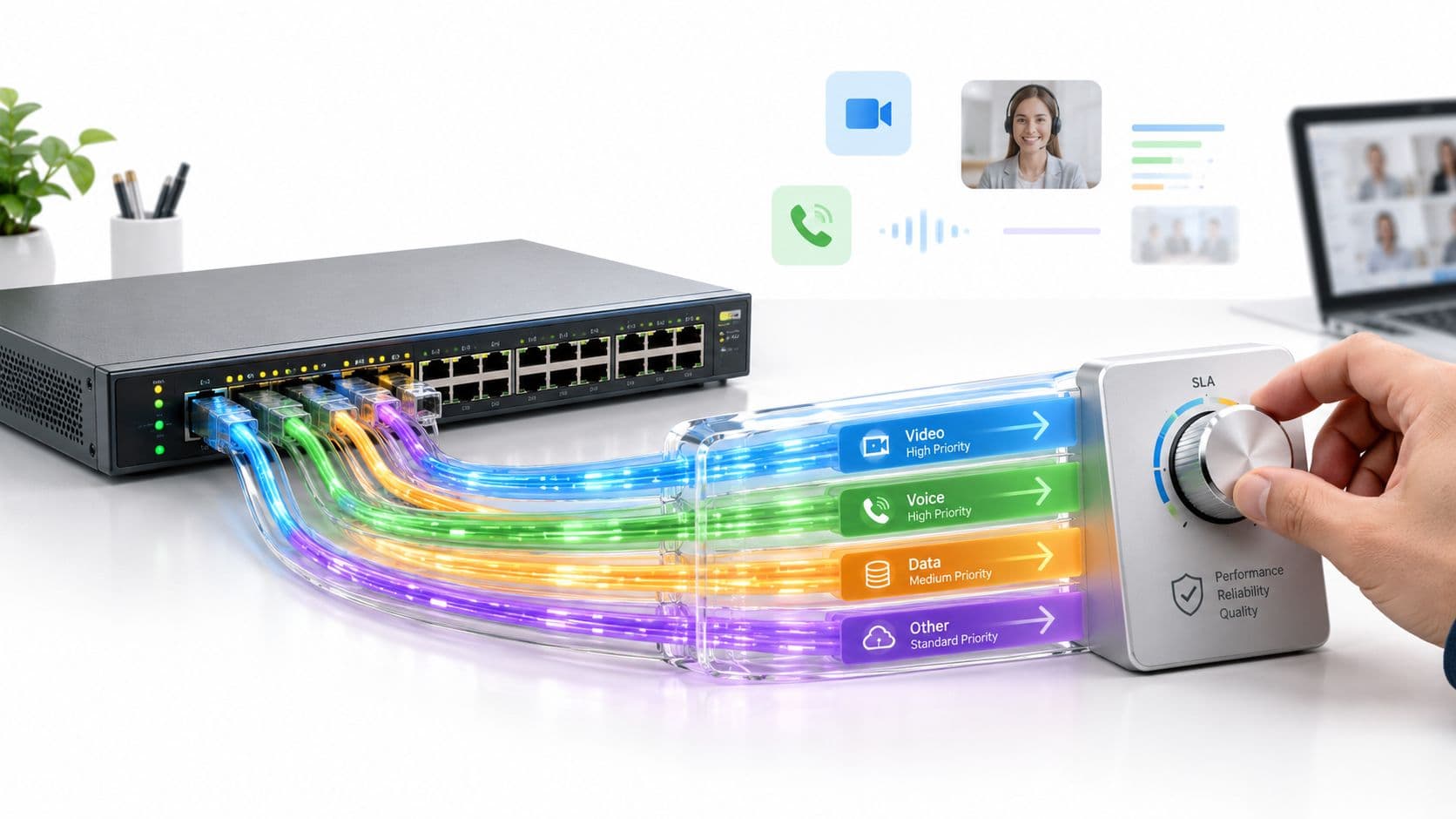
A busy hotel, shopping center or hospital can have plenty of bandwidth and still deliver a poor experience. A guest starts a large download, staff devices synchronize in the background, and suddenly a voice call becomes choppy while a payment terminal waits for a response. The link isn't necessarily undersized. The network is treating traffic with very different business consequences as if it were equal.
That's why how to prioritize network traffic starts with policy, not a router checkbox. You need to decide which applications, people, and devices must remain usable during contention, then make those decisions visible in configuration, identity systems, and operational documentation. US guidance treats traffic management as a documented practice with transparency expectations, particularly where latency-sensitive services need protection during congestion.
Why Prioritizing Network Traffic Matters Right Now
At an event venue, the failure pattern is familiar. Guest WiFi usage rises, video uploads compete with staff systems, and background updates consume the same access path as point-of-sale traffic. A payment terminal may only exchange small amounts of data, but delay at the wrong moment affects a transaction. A voice or video call has the opposite profile - it needs packets to arrive consistently rather than waiting behind a large transfer.
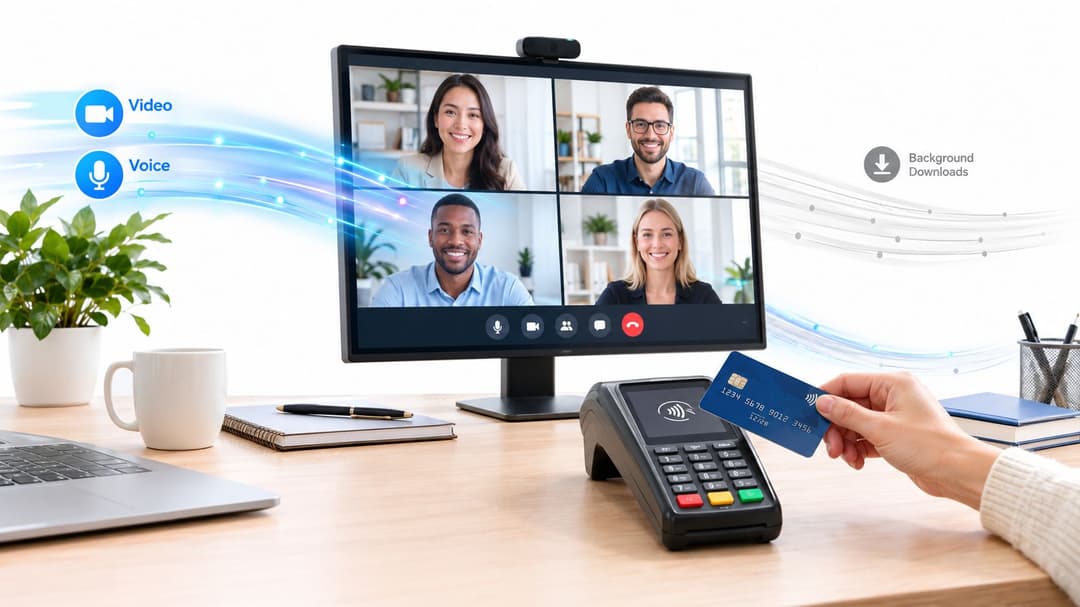
QoS doesn't create capacity. It decides how the available capacity is used when demand exceeds it. That distinction matters because prioritization can protect a call, transaction or clinical workflow, but it can't repair a failing circuit, eliminate an upstream ISP bottleneck or compensate for poor wireless coverage.
The business consequence of equal treatment
Without a deliberate policy, guest traffic often receives the same scheduling opportunity as staff applications, IoT telemetry and operational systems. In hospitality, retail and healthcare, that creates a mismatch between network behavior and business risk. A short delay in a background synchronization job is usually tolerable. The same delay in a voice queue, payment flow or urgent collaboration session may not be.
The FCC net neutrality guidelines recognize that traffic management may prioritize some categories over others when categories are treated consistently and the approach is proportionate to technical needs and congestion risk. Under US regulatory frameworks, major fixed and mobile ISPs disclose traffic-management practices to make prioritization more transparent to customers. FCC and industry traffic-management guidance makes the operational point clear: prioritization needs a defensible reason and an understandable description.
Practical rule: Protect the application outcome, not the device that happens to be using it.
A device-based rule can work in a home network, but enterprise environments are dynamic. Staff move between access points, contractors use managed or unmanaged hardware, and one laptop may run voice, browsing and bulk transfer simultaneously. Classification based on identity, application and device role is more durable than a static list of MAC addresses.
What good prioritization can and can't do
A sound design gives critical traffic a better chance during contention, reserves capacity for important classes and prevents background flows from filling queues. It can also make incidents easier to diagnose because the policy explains why a packet was marked, queued or limited.
It won't improve every application equally, and it may deliberately slow lower-priority traffic. That trade-off is acceptable only when the policy states what is being protected, who owns the decision and when the rule applies. The Purple WiFi solution for IT and network teams is relevant to this governance problem because identity and device context can help network teams keep guest, staff and operational traffic in the intended policy domain.
Planning Requirements and Defining Traffic Classes
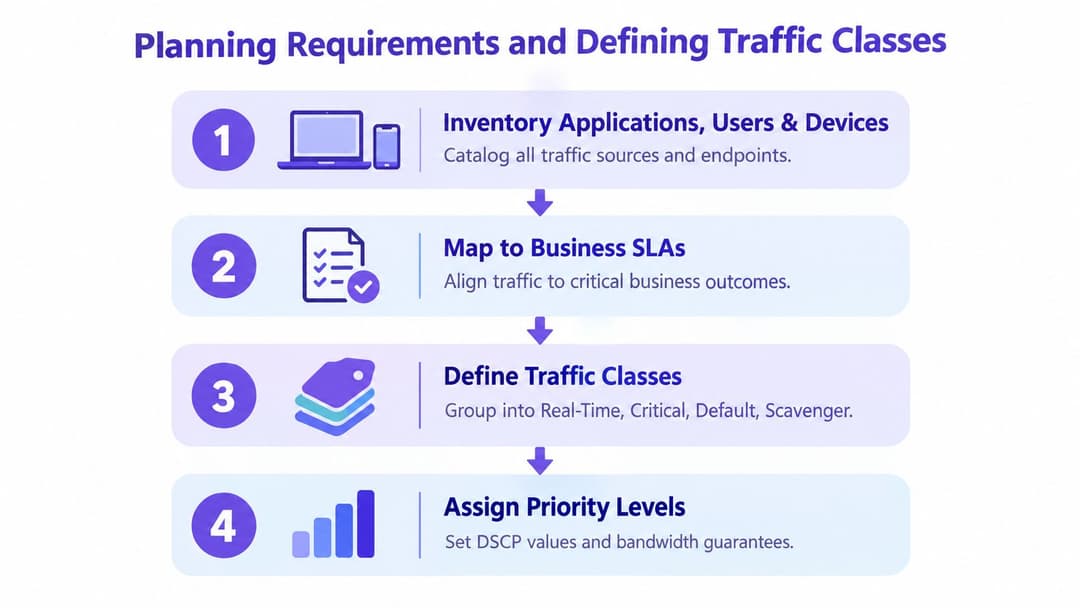
Start with an inventory, not a marking scheme. List applications, users, devices, sites and links, then record what breaks first when the network is busy. Don't begin by assigning the highest priority to everything that sounds important. A class is useful only when it remains scarce enough to protect the traffic that needs it.
Build the policy from business outcomes
Map each traffic source to a service expectation. Voice and interactive video usually need low delay, low jitter and controlled loss. Payment, clinical and operational applications may need predictable delivery and assured bandwidth. Software updates, backups, guest browsing and large media transfers can normally use best-effort or scavenger treatment.
Use a short classification set that operators can understand under pressure:
- Real-time: Voice, interactive video, and other flows where delay variation damages usability.
- Critical business: Payment, clinical, operational, or transaction traffic that needs a reliable minimum during contention.
- Default: Ordinary staff, guest, and application traffic with no exceptional treatment.
- Scavenger: Bulk transfers, updates, backups, and non-urgent synchronization.
The labels aren't universal standards. The useful part is the decision behind each label, including the owner, the measurable service expectation, and the circumstances that activate it.
Choose strict priority carefully
A strict-priority queue is appropriate for traffic that is sensitive to delay, but it must be bounded. If too many applications enter that queue, the scheduler has little room to serve other traffic and can create starvation elsewhere. Assured forwarding or class-based weighted scheduling is often safer for critical business traffic because it protects a minimum share without making every packet jump to the front.
Identity should be part of the inventory. A staff voice client, guest video stream and building-management sensor may share an access point but have different policy requirements. Platforms such as Purple identity-based networking can provide user and device context for classification, reducing dependence on extra SSIDs or fragile device lists.
Document criteria before enforcement
US transparency expectations make documentation part of the technical design. FCC materials describe the need for ISPs to explain whether applications receive the same QoS, disclose traffic management criteria, identify affected applications and peak periods, and describe consequences where fair use rules are breached. The FCC's net neutrality guidelines provide the relevant compliance context.
Record, at minimum:
- Traffic definition: Application, protocol, destination, user group, or device role.
- Treatment: Marking, queue, minimum reservation, shaping, and policing action.
- Scope: Sites, SSIDs, links, tenants, and business hours.
- Reason: The service outcome the policy protects.
- Owner and review trigger: Who approves changes and what evidence prompts a revision.
HIPAA compliant networks often rely on quality-of-service models showing what explicit policy looks like in practice. A standard model reserves AF1 5%, AF2 7.5%, AF3 30%, AF4 7.5%, DE 39%, EF 10%, and Management 1% of contracted bandwidth, adding up to 100%. Healthcare QoS overviews are a useful US benchmark because they define minimum commitments by class instead of relying on informal “high priority” labels.
Marking Queuing Shaping and Policing Explained
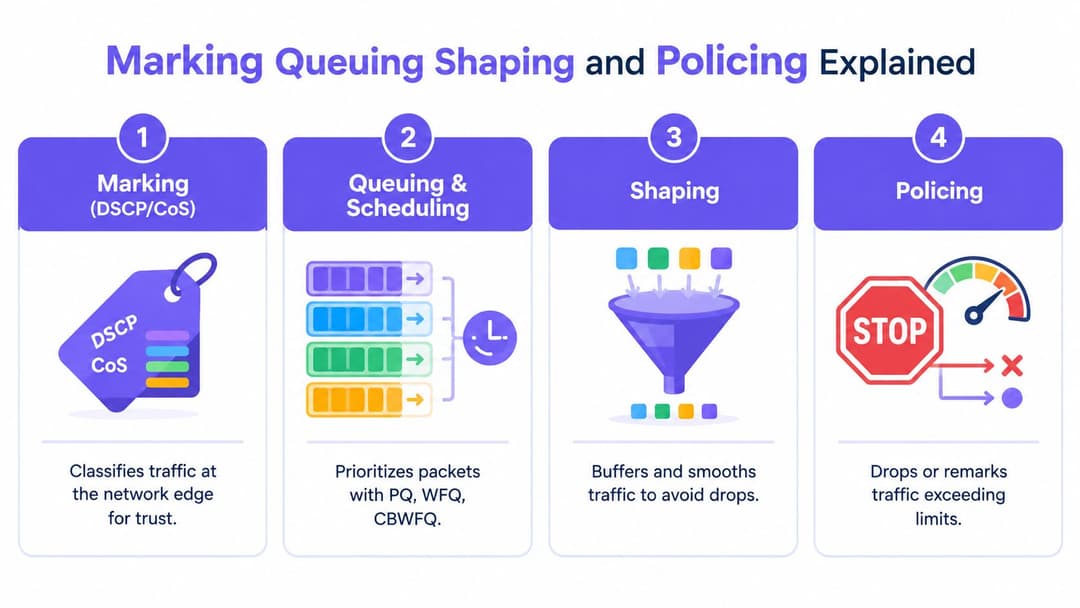
These mechanisms solve different problems. Marking identifies a class, queuing controls transmission order, shaping delays packets to smooth a flow, and policing enforces a limit by dropping or remarking traffic. Deploying one without the others often produces a policy that looks correct in a dashboard but fails at the congestion point.
Mark at the edge, trust selectively
DSCP on IP traffic and CoS on Ethernet frames carry class information. Mark traffic where you can identify it reliably, usually at a controlled access edge, and define trust boundaries explicitly. A managed voice device may be trusted after validation. A guest endpoint should not be allowed to declare itself critical by setting a favorable value.
Switches and routers may strip or rewrite markings as traffic crosses administrative boundaries. Your design therefore needs a remarking policy, not an assumption that a value survives end to end.
Queue for contention
Scheduling decides which packet moves when an interface is full. Low-latency or strict-priority treatment suits bounded real-time traffic. Class-based weighted scheduling suits business classes that need proportional access and minimum guarantees. Best-effort and scavenger queues absorb traffic that can tolerate delay.
The HSCN model demonstrates why minimum reservations matter. Priority marking alone doesn't guarantee service during contention. The practical QoS methodology described by CloudSwitched stresses classification first, followed by percentage-based policing or shaping so critical flows retain routing opportunities when classes compete.
Shape before a bottleneck, police at a boundary
Shaping buffers packets and releases them at a controlled rate. It works well on an organization's WAN edge when the actual provider rate is known and the local device must prevent an upstream queue from becoming the uncontrolled bottleneck.
Policing is more abrupt. It measures traffic against a limit and can drop or remark packets that exceed it. Use it where a hard contract, class boundary or tenant limit matters. Don't use aggressive policing for bursty interactive traffic without testing, because drops can damage the very application the policy is meant to protect.
| Traffic Class | Recommended Mechanism | When to Use It |
|---|---|---|
| Real-time | Strict priority with a ceiling, plus edge marking | Voice and interactive video need low delay, but the queue must remain bounded |
| Critical business | Weighted queue with a minimum reservation | Transactions and operational applications need predictable access during contention |
| Default | Fair or weighted best-effort queue | General staff, guest and ordinary application traffic |
| Scavenger | Low-weight queue, shaping or lower marking | Backups, updates and bulk transfers should yield without being blocked unnecessarily |
The main production failure is over-prioritization. Industry data describes higher-priority packets as more likely to be delivered while lower-priority packets may be delayed or dropped during congestion, and reports mobile download speeds slowing by 44% in the peak hour. The industry submission on net neutrality supports a practical response: measure congestion windows, protect real-time traffic and keep background flows best effort.
Enforcing Policies Across Routers Switches and Wireless
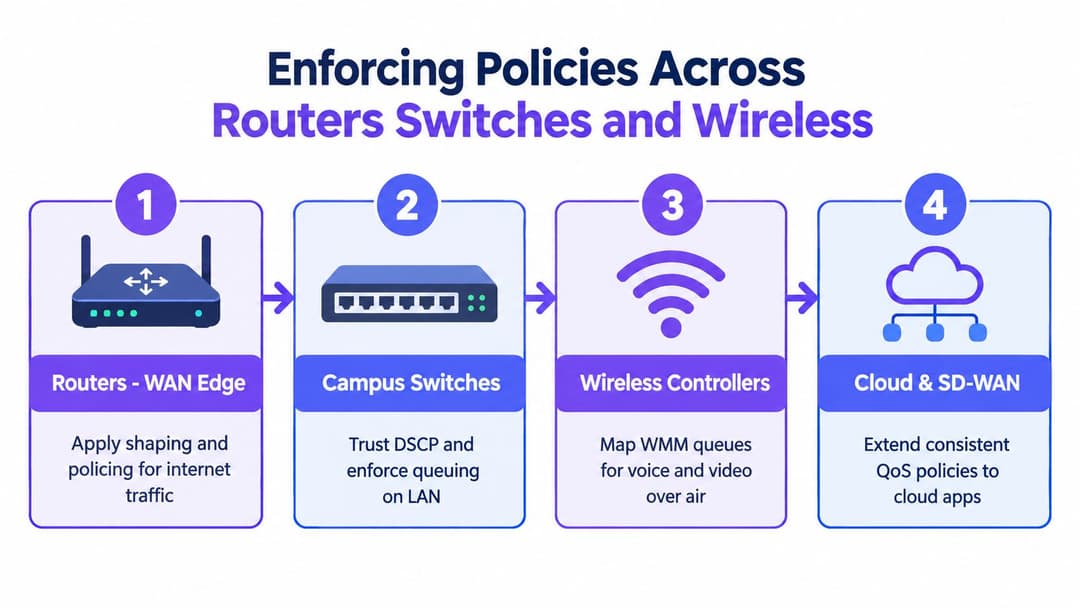
Implementation should follow the traffic path. Put rate control where the bottleneck exists, preserve class information across trusted segments and map wired classes to the wireless queues that transmit packets over the air.
Start at the WAN edge
On an internet router or SD-WAN appliance, classify traffic before the constrained egress interface. Apply shaping slightly below the usable provider rate when the provider's queue is causing latency. Police guest or tenant classes where a hard limit is required, and preserve a management class so administrators can still reach the site during saturation.
For site-to-site traffic, apply the same class model to the overlay and underlay. A policy that protects voice on the LAN but sends all encrypted tunnels through one unmanaged queue hasn't solved the end-to-end problem. Check whether the SD-WAN platform can classify before encryption, carry class information in the tunnel and schedule traffic per path.
Define the switch trust boundary
Access switches should accept markings only from devices and ports you trust. A voice handset or controlled access point may be allowed to retain an approved marking. Guest-facing ports, unmanaged endpoints and general user ports should be remarked into the appropriate class at ingress.
On campus uplinks, configure queues that match the agreed class model. Avoid creating a separate interpretation on every switch. Mixed vendor estates often fail because one platform calls a queue “voice”, another maps it to a different DSCP value, and the wireless controller applies another treatment entirely.
Map wireless policy to WMM
Wireless controllers translate traffic classes into WiFi Multimedia queues. Voice and video need the corresponding wireless treatment, but airtime remains a shared medium. A high-priority wireless queue can still suffer when coverage, channel use or client behavior is poor.
Use identity and device role to classify traffic before it reaches the controller. Staff, guests and IoT systems can share an access layer while receiving different policy treatment, provided the identity source is reliable. Directory integration with Entra ID, Google Workspace or Okta can support staff context, while iPSK remains useful for legacy devices that can't complete modern identity flows.
Keep cloud platforms consistent
Meraki, Aruba, Ruckus, Mist and UniFi expose different names and levels of control, so translate your policy into vendor-neutral requirements first:
- Classify: Match identity, application, device role, or subnet.
- Mark: Set or remark DSCP at the defined trust boundary.
- Queue: Map the class to a wired or wireless scheduler.
- Control: Shape or police at the actual constrained interface.
- Record: Store the policy owner, scope, reason, and change history.
Cloud-managed platforms simplify rollout, but they don't remove the need to understand precedence. A global application rule may override an SSID policy, while a switch may rewrite markings before the WAN appliance sees them. Test one path, capture the observed class at each hop and only then replicate the configuration.
Monitoring Verification and Ongoing Optimization
A QoS policy isn't working because the configuration committed successfully. It works when the intended traffic is classified correctly, retains the expected treatment across the path and meets its service requirement while competing traffic is present.
Verify the packet journey
Test in four layers:
- Classification: Confirm the application, identity and device match the intended rule.
- Marking: Inspect DSCP or CoS at ingress and egress across routers, switches, access points and tunnels.
- Scheduling: Review queue utilization, drops, tail drops, shaping delay and policing actions.
- Experience: Compare latency, jitter, loss, call quality and transaction responsiveness during normal and congested periods.
Interface counters tell you whether a queue is active. They don't tell you whether the user experience is acceptable, so pair them with application telemetry and controlled tests. For wireless environments, a latency and jitter test from Purple can contribute a practical experience check alongside controller and switch data.
Baseline before changing policy
Capture ordinary behavior before deployment. Note where congestion occurs, which queues fill, which applications experience delay and when the problem appears. After implementation, repeat the same observations under comparable conditions.
Set alerts around congestion windows rather than alerting on every packet drop. A small number of drops in a scavenger queue may be expected. Persistent drops in a real-time queue, rising shaping delay or frequent remarking at an unexpected boundary needs investigation.
A priority policy without counters is an opinion about performance, not evidence of performance.
Review reservations when application mix changes, sites add new services or business owners alter their SLAs. The FCC and state-level public safety profiles are useful reminders that explicit class allocations make trade-offs visible. The operator can discuss whether a class has enough protection instead of arguing from anecdotes.
Decide between classic QoS and slicing
Classic QoS queues are the practical choice when you control the access interface and need to arbitrate contention among staff, guests and operational traffic. They classify packets and schedule them within the available path.
Slicing-based prioritization is a different service model. T-Mobile and other carriers launched consumer 5G+ Fast Lanes in 2026, describing dedicated 5G Standalone network resources for busy locations such as stadiums, shopping malls and transit stations, while their Network Boost features use traditional QoS queuing on congested cell towers. The industry reports on 5G network slicing plans illustrate the distinction.
For a venue, classic QoS may be enough for staff systems and local WLAN traffic. A slicing-based product may become relevant where the mobile access service itself needs differentiated treatment during an event. Treat those as separate control planes, and document who provides the guarantee.
Troubleshooting Common Prioritization Problems
Most failed QoS deployments break at a boundary or at a classification decision. Start by identifying the first hop where observed behavior diverges from the policy, then fix that layer instead of adding more rules.
If the priority queue isn't protecting traffic
Check whether the application matches the rule, whether the packet is marked as expected and whether the queue is congested. A priority queue that never fills isn't proving much. Generate controlled contention, then inspect queue counters while the protected application runs.
If real-time traffic is delayed, look for excessive priority membership, an unbounded queue or a downstream interface with no equivalent treatment. Remove broad application matches before increasing priority. More priority classes usually produce less meaningful priority.
If markings disappear
Trace the packet across the trust boundary. Access switches may remark untrusted endpoints, wireless controllers may translate values into WMM treatment, and encrypted overlays may hide inner markings from the underlay scheduler. Decide where marking is authoritative, then configure every subsequent hop to preserve or deliberately translate it.
Upstream ISP handling is another possibility. Your local router can schedule egress traffic, but it can't control an external provider's internal queues. If the provider manages congestion differently, collect timestamps, queue evidence and application symptoms before escalating.
If wireless performance remains poor
Separate QoS from radio problems. High retransmission, weak coverage, channel contention and oversubscribed access points can undermine a correct WMM mapping. Test at the client location, compare wired and wireless paths and check whether voice and video are entering the intended wireless queue.
Keep guest, staff and IoT identity accurate. If devices move roles or authentication falls back to a shared network, the scheduler may be enforcing the wrong policy perfectly.
Keep the policy defensible
Document every change with its reason, owner, scope and rollback method. Record affected applications and peak periods where traffic management applies, following the transparency principles described in the FTC and state attorneys general published guidance. Review the policy after incidents, major application changes and new access models such as SD-WAN or 5G slicing.
Prioritization is continuous policy management backed by packet mechanics. When the rules, identity context, queues and measurements agree, the network protects the services that matter without pretending that bandwidth is unlimited.
Purple can connect user and device identity with enforceable network policies, helping teams separate staff, guest and operational traffic across mixed vendor estates. Visit Purple to assess how identity-based WiFi, analytics and network integration can support a documented traffic-prioritization strategy.