WLAN access point capacity planner
Size access points, internet bandwidth, PoE and switch ports for a wireless LAN from floor area, users and WiFi generation, with the working shown.
How the numbers are reached
RF design for this venue
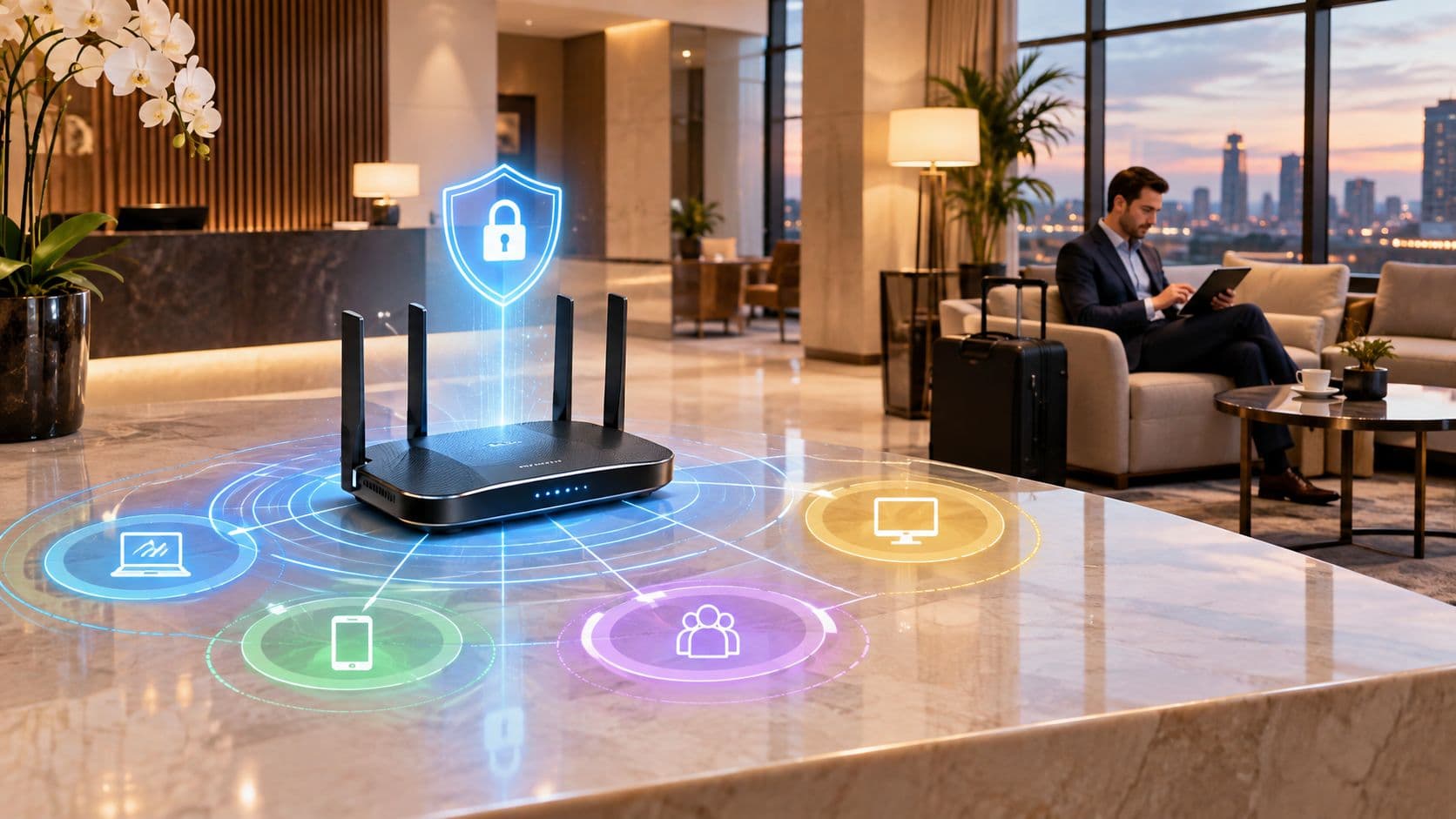
Recommended SSID and VLAN segmentation
| VLAN | Authentication | Who and what |
|---|---|---|
| VLAN 10: Management | Static IP / certificate | Access points, switches and PoE infrastructure |
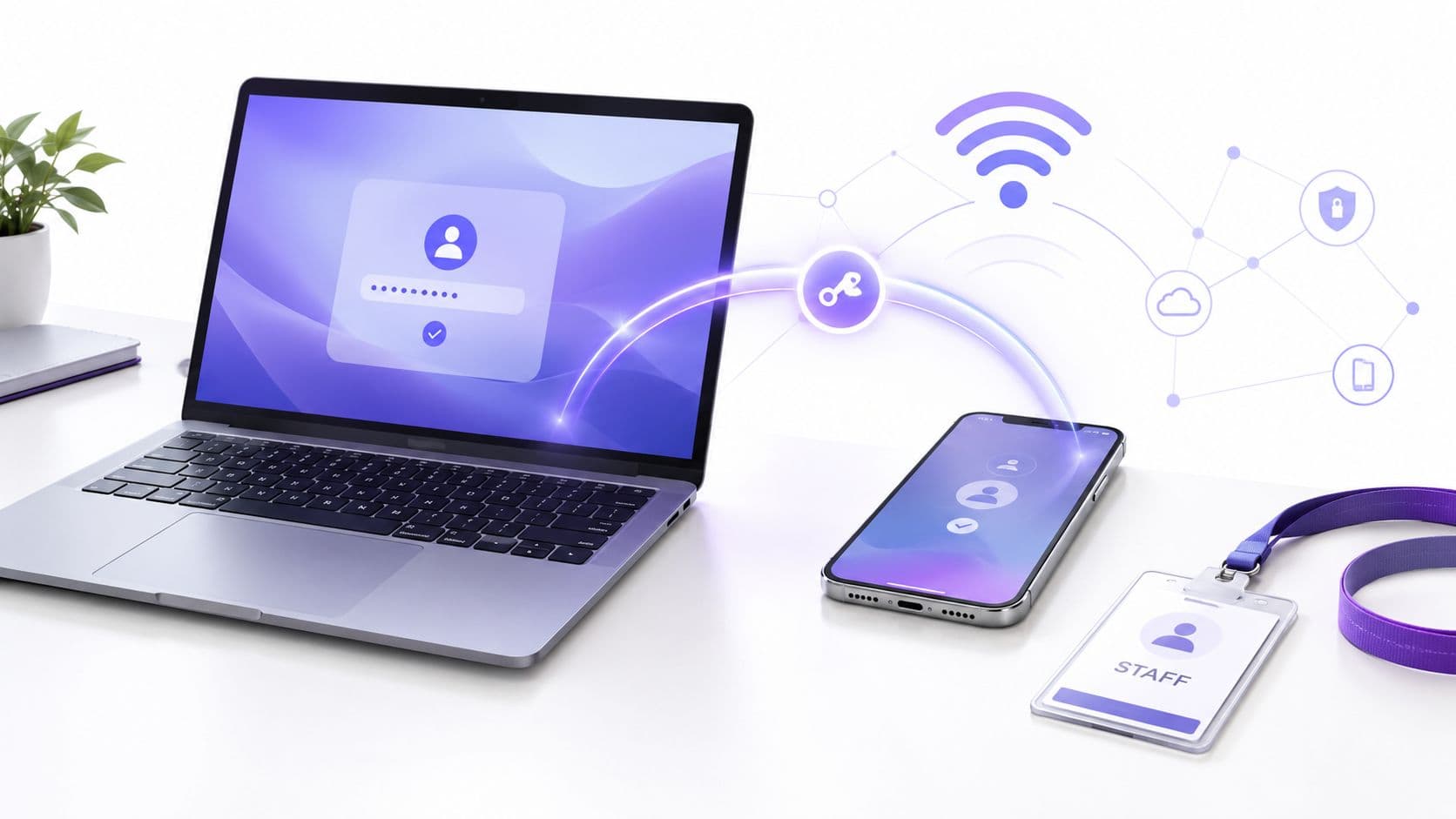
| VLAN 20: Corporate staff | 802.1X EAP-TLS (Entra ID / Okta) | Employee laptops, tablets and managed mobiles |
| VLAN 30: Guest visitors | Captive portal + Passpoint | Visitors, clients and contractors, internet only |
| VLAN 40: Headless IoT | Identity PSK (iPSK) | Meeting room displays, lighting and printers |
Channel planning and RF tips
- Turn off the 2.4 GHz radio on a share of APs in dense floors: only three non-overlapping 20 MHz channels (1, 6, 11) exist.
- Use 802.1X certificate authentication pushed by Intune or Jamf so no shared password is ever issued.
- Enable 802.11k/v/r so Teams and Zoom calls survive roaming between APs.
- Raise the minimum basic data rate to 12 Mbps to cut beacon and management-frame airtime.
Method and assumptions: AP count is the larger of a coverage figure (typical usable cell per AP for this venue type) and a capacity figure (50 active clients per dual-radio AP, raised 15% for WiFi 6E and 25% for WiFi 7 for the extra 6 GHz radio), plus 15% for redundancy and awkward rooms. Bandwidth assumes 6 Mbps per active device with 45% of devices active at peak. PoE uses a typical maximum draw per AP; check the datasheet of the model you buy. This is a budget estimate, not a substitute for a predictive design and on-site survey.
Purple handles visitor onboarding with SSO sign-in (Entra ID, Okta, Google Workspace), so reception and IT stop issuing guest passwords.
A Wireless Local Area Network (WLAN) is an enterprise networking architecture that uses high-frequency radio waves - defined by the IEEE 802.11 standards family - to connect client devices to a local network and the internet without physical cables. In commercial buildings, sports venues, healthcare facilities, and university campuses, a WLAN bridges mobile laptops, smartphones, point-of-sale terminals, and IoT sensors to core wired infrastructure. This technical guide is part of our series on enterprise WiFi security and network access management.
What is a Wireless LAN (WLAN)?
A Wireless LAN (WLAN) is a radio-based local area network operating under IEEE 802.11 standards (including WiFi 6, 6E, and WiFi 7). Unlike home consumer routers, an enterprise WLAN uses coordinated access points, central network controllers, RADIUS authentication servers, and VLAN segmentation to deliver secure, high-density connectivity across physical sites.
Key takeaways: wireless LAN architecture
- IEEE 802.11 foundation: Enterprise WLANs operate on 2.4 GHz, 5 GHz, and 6 GHz spectrum bands using standards from 802.11n to 802.11be (WiFi 7).
- WLAN vs WiFi: WLAN is the overarching technical network architecture, while WiFi is the brand standard for 802.11 interoperable devices.
- Enterprise hardware: Core components include Wireless Access Points (APs), Wireless LAN Controllers (WLCs), PoE switching, and RADIUS authentication engines.
- Security and access control: Robust business WLANs enforce WPA3-Enterprise, 802.1X EAP-TLS certificate authentication, dynamic VLAN assignment, and isolated guest portals.
- Scalability and roaming: Fast roaming protocols (802.11r, 802.11k, 802.11v) prevent session drops as users move between access points in large facilities.
How a wireless LAN functions
At its core, a WLAN replaces physical copper Ethernet patch cables with modulated radio signals. An access point connects directly to an enterprise Ethernet switch via Power over Ethernet (PoE). It receives data packets from the wired backbone, encodes them into radio frequency (RF) frames, and broadcasts them through internal or external antennas.
Client devices equipped with wireless network interface cards (NICs) listen on specific channel frequencies. When a laptop or cell phone sends data, its wireless NIC converts digital packets into RF signals. The nearest access point captures these radio waves, translates them back into Ethernet frames, and forwards them across the local network router to their destination.
Enterprise WLANs must manage signal interference, wall attenuation, and high device density. Advanced access points use multi-user MIMO (MU-MIMO) and beamforming technology to direct targeted RF signals toward active clients, maximizing throughput and reducing co-channel interference.
WLAN vs WiFi vs wired Ethernet: key differences
IT teams often need to evaluate network architectures when upgrading site infrastructure. The table below outlines how enterprise WLANs compare to traditional wired Ethernet and cellular private networks.
| Feature / Metric | Wireless LAN (WLAN / WiFi) | Wired Ethernet (LAN) | Cellular Private Network (5G/LTE) |
|---|---|---|---|
| Medium | Radio Frequency (2.4/5/6 GHz) | Copper (Cat6a) / Fiber | Licensed / CBRS Radio Spectrum |
| Mobility | Full site mobility with fast roaming | Fixed desk / wall outlet tethering | High-speed wide-area roaming |
| Max Throughput | Up to 46 Gbps (WiFi 7 peak theoretical) | 10 Gbps to 100 Gbps per port | Up to 10 Gbps |
| Deployment Cost | Low to moderate cabling costs | High cabling and outlet installation cost | High infrastructure and spectrum cost |
| Security Layer | WPA3-Enterprise / 802.1X / Passpoint | 802.1X / Physical port security | SIM / eSIM cryptographic authentication |
| Primary Venue Use | Offices, retail, healthcare, hospitality, education | Data centers, fixed servers, high-bitrate AV | Industrial automation, massive outdoor sites |
Evolution of IEEE 802.11 standards in enterprise WLANs
Enterprise WLAN performance depends heavily on the underlying 802.11 WiFi Alliance standard deployed across site access points:
| Standard Name | Release Year | Frequency Bands | Max Physical Speed | Key Technological Advancement |
|---|---|---|---|---|
| 802.11n (WiFi 4) | 2009 | 2.4 GHz, 5 GHz | 600 Mbps | Introduced MIMO multi-antenna spatial streams |
| 802.11ac (WiFi 5) | 2013 / 2016 | 5 GHz | 6.9 Gbps | 256-QAM modulation, 160 MHz channels, Wave 2 MU-MIMO |
| 802.11ax (WiFi 6 / 6E) | 2019 / 2021 | 2.4 GHz, 5 GHz, 6 GHz | 9.6 Gbps | OFDMA subcarriers, 1024-QAM, 6 GHz clean spectrum |
| 802.11be (WiFi 7) | 2024 | 2.4 GHz, 5 GHz, 6 GHz | 46 Gbps | 320 MHz channels, 4096-QAM, Multi-Link Operation (MLO) |
For detailed guidance on optimizing 5 GHz spectrum channels, explore our technical breakdown of the best 5 GHz WiFi channels.
Core hardware components of an enterprise WLAN
A reliable business WLAN relies on four essential architectural layers:
- Wireless Access Points (APs): Transceivers mounted on ceilings or walls that convert wired network traffic into radio signals. Modern enterprise APs contain dedicated scanning radios to detect rogue access points and RF interference.
- Wireless LAN Controllers (WLC): Appliances (physical, virtual, or cloud-managed) that centrally manage AP configurations, radio channel assignment, transmit power levels, and client load balancing.
- PoE Switches and Routers: Network switches providing Power over Ethernet (802.3at/802.3bt) to drive access points while routing traffic between internal VLANs.
- Identity & Authentication Servers: Central RADIUS servers (such as cloud RADIUS) that validate device identity, enforce 802.1X authentication, and assign dynamic network access policies. For guest access, explore our captive portal guide.
Managing multi-vendor enterprise WLAN infrastructure?
Purple integrates seamlessly across Cisco Meraki, HPE Aruba, Ruckus, Ubiquiti UniFi, and Huawei hardware. Provide secure 802.1X onboarding, branded captive portals, and compliance reporting without upgrading existing access points.
Securing an enterprise WLAN
Because radio waves penetrate walls, open wireless signals present a major attack surface if left unsecured. Enterprise WLAN security requires a multi-layered approach:
- WPA3-Enterprise: Standardizes 192-bit cryptographic security suites for corporate devices, protecting sensitive network traffic from decryption even if password credentials are compromised.
- 802.1X EAP-TLS Authentication: Replaces shared WPA passwords with digital client certificates. Devices are authenticated against a RADIUS server before network port access is granted.
- Network Segmentation & Dynamic VLANs: Separates corporate laptops, IoT facility sensors, and guest visitors into isolated broadcast domains, preventing lateral threat movement across the network.
- Passpoint (Hotspot 2.0): Enables secure, seamless WiFi onboarding using cellular credentials or encrypted profile installation. Read more in our guide to Hotspot 2.0 technology.
WLAN roaming protocols: 802.11r, 802.11k, and 802.11v
In large facilities like hospitals, warehouses, or corporate campuses, users move continuously while connected to VoIP calls or cloud applications. Without fast roaming protocols, moving between access points causes 1 to 3-second handoff delays and dropped calls.
Enterprise WLANs solve handoff latency through three coordinated IEEE standards:
- 802.11k (Assisted Roaming): Provides client devices with a curated list of neighbor access points, eliminating the need for the device to scan all radio channels before roaming.
- 802.11r (Fast Transition): Caches 802.1X encryption keys across neighbor APs, reducing handoff re-authentication time from 1000 ms to under 50 ms.
- 802.11v (Wireless Network Management): Allows the network controller to direct client devices toward less congested access points or superior frequency bands (band steering).
Transform your venue WLAN with Purple
Purple turns existing venue access points into secure, intelligent wireless networks. Over 80,000 live venues trust Purple for RADIUS authentication, visitor analytics, and compliance across Cisco Meraki, HPE Aruba, Ruckus, and UniFi infrastructure.
Frequently asked questions
What is the difference between WLAN and WiFi?
A Wireless LAN (WLAN) is the overall technical network type - a local area network linked by radio waves. WiFi is the consumer brand name and certification standard defined by the WiFi Alliance for devices that implement IEEE 802.11 specs. In practice, all modern WLANs use WiFi technology.
What are the main advantages of a Wireless LAN?
Key benefits of a WLAN include full mobile connectivity for staff and guests, reduced cabling installation costs, rapid network expansion, central network management, and support for high device density across physical facilities.
How does 802.1X security work on an enterprise WLAN?
Under 802.1X, when a device connects to a WLAN access point, the AP blocks network traffic until the device authenticates with a central RADIUS server using digital certificates (EAP-TLS) or secure credentials (PEAP). Upon successful verification, the RADIUS server assigns the device to an authorized VLAN.
How many access points does an enterprise WLAN require?
The number of access points depends on floor square footage, wall construction materials, expected client device density, and bandwidth requirements. A professional RF site survey determines AP placement to prevent coverage dead zones and co-channel interference.