Microsegmentation policy advisor & blast radius calculator
Model your estate profile, network isolation level, and high-risk workloads to calculate lateral attack surface reduction and receive an actionable Zero Trust policy blueprint.
Moderate risk: coarse departmental VLAN boundaries
Subnet-wide blast radiusSubnets isolate broad departments, but any device within a subnet can freely attack adjacent peers and unmanaged devices sharing that segment.
- Enforce Layer 4 microsegmentation policies between workloads on the same VLAN
- Implement dynamic 802.1X role-based access control with Cloud RADIUS
- Deploy automated iPSK for headless IoT to assign unique dynamic microsegments
- Block east-west traffic between peer wireless clients at the access point layer
Ready to secure your enterprise estate with microsegmentation?
Purple integrates seamlessly with Cisco Meraki, Aruba, Ruckus, and Juniper Mist to isolate clients, enforce private WiFi bubbles, and deliver Cloud RADIUS authentication.
Micro-segmentation is a security architecture that divides networks into granular, isolated trust zones, down to individual workloads, users, or devices, to prevent attackers moving laterally after an initial breach. In the US, 43% of businesses, about 612,000 organizations, experienced a cyber security breach or attack in the previous 12 months in 2025/2026, making containment an operational requirement rather than a theoretical design preference (US cyber security data).
The important distinction is that micro-segmentation isn't “more VLANs”. It applies narrowly scoped access policies between systems that may already share the same network, data center, wireless infrastructure, or cloud environment. A compromised laptop might still reach the services it needs, but it shouldn't automatically reach a finance server, building-management controller, domain controller, or another user's device.
That difference matters in legacy and mixed-trust US estates. Organizations often operate modern cloud workloads beside old applications, unmanaged devices, operational technology, contractor access, and guest WiFi. A perimeter firewall can control what enters the estate, but it can't by itself govern every east-west connection once an attacker has obtained valid credentials or compromised an internal endpoint.
Why Micro-Segmentation Has Become Essential for US Networks
The UK government's latest breach survey estimated that 43% of businesses, approximately 612,000 organizations, experienced a breach or attack in the last 12 months, while around 19%, roughly 267,000 businesses, were victims of at least one cyber crime (UK breach and attack figures). The same source records cyber crime across every business size band, from 17% of micro businesses to 48% of large businesses. Containment is now an operational requirement for organizations of every size, not a concern limited to financial institutions or government departments.
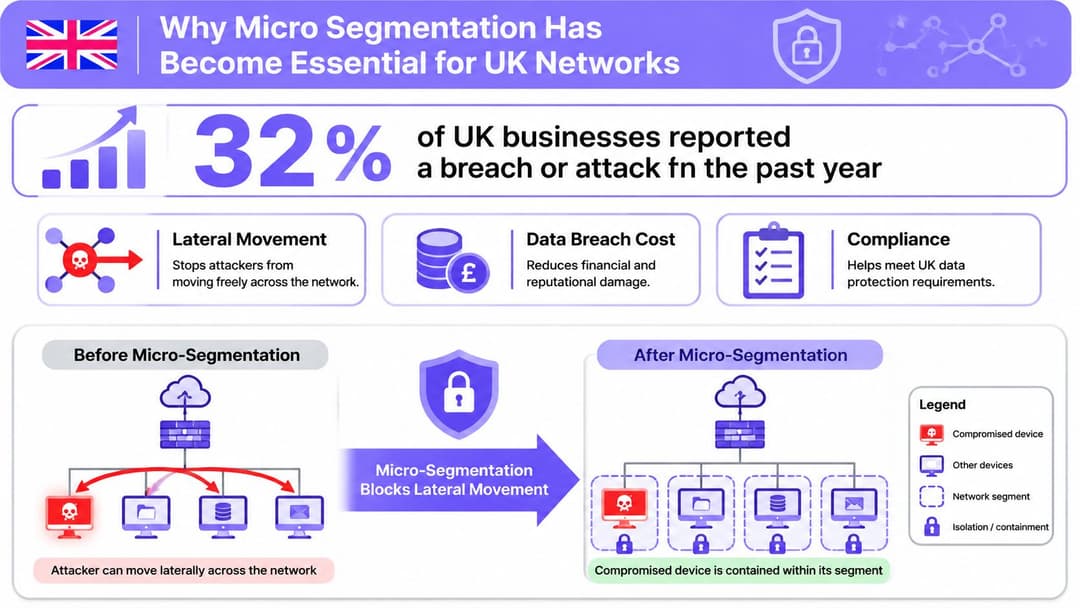
A perimeter model concentrates security decisions at the edge. Firewalls, edge intrusion detection, remote-access gateways, and broad VLAN boundaries still have important roles, but they cannot inspect or govern every workload-to-workload connection inside an estate. After phishing, stolen credentials, an exposed service, or a vulnerable endpoint provides access, a flat internal network gives an attacker room to probe and pivot.
The blast-radius problem
Legacy US estates are often organized around departments, buildings, or technical functions. Those broad zones remain useful for administration, yet their boundaries can be too coarse for modern access control. A device on a staff subnet may reach file services, print systems, management interfaces, application servers, and other endpoints without each route receiving a specific business justification.
Micro-segmentation creates smaller trust zones and applies policy to the relationships within them. A rule might allow a point-of-sale terminal to contact its payment service, a clinical device to reach a named management platform, or an application tier to query its database. Unrelated paths can be denied even when systems share switching infrastructure.
The US survey also estimated about 8.58 million cyber crimes affecting US businesses in the most recent survey year, while reported breach prevalence remained at 43% in both 2024/2025 and 2025/2026, after standing at 50% in 2023/2024 (US cyber security statistics). Persistent exposure makes perimeter-only controls a poor fit for mixed-trust estates.
Practical rule: Assume an attacker will eventually obtain an internal foothold. Define how much of the property that foothold can reach, then reduce that reach through tested policy.
Zero trust provides the strategic principle that access must be verified and limited instead of inherited from network location. Micro-segmentation is the enforcement layer that converts that principle into traffic decisions. US public-sector network guidance calls for granular, isolated zones based on function, data sensitivity, user groups, and service criticality, including separation between production, development, testing, and training environments (US zero-trust network guidance).
Deployment succeeds when teams map dependencies before enforcement. In legacy environments, an undocumented service call or management connection can support a critical process, so policies should begin in observation mode, proceed through a limited pilot, and expand as exceptions are verified. For architectural context, network segmentation for US businesses explains broader boundaries before workload-level controls are introduced.
Wireless access belongs in the same design. Staff, contractors, and guests may use the same building infrastructure, but identity-based WiFi platforms such as an enterprise WiFi security guide can feed user and device context into segmentation decisions, helping apply different access policies without treating WiFi as a separate security domain.
How Micro-Segmentation Actually Works
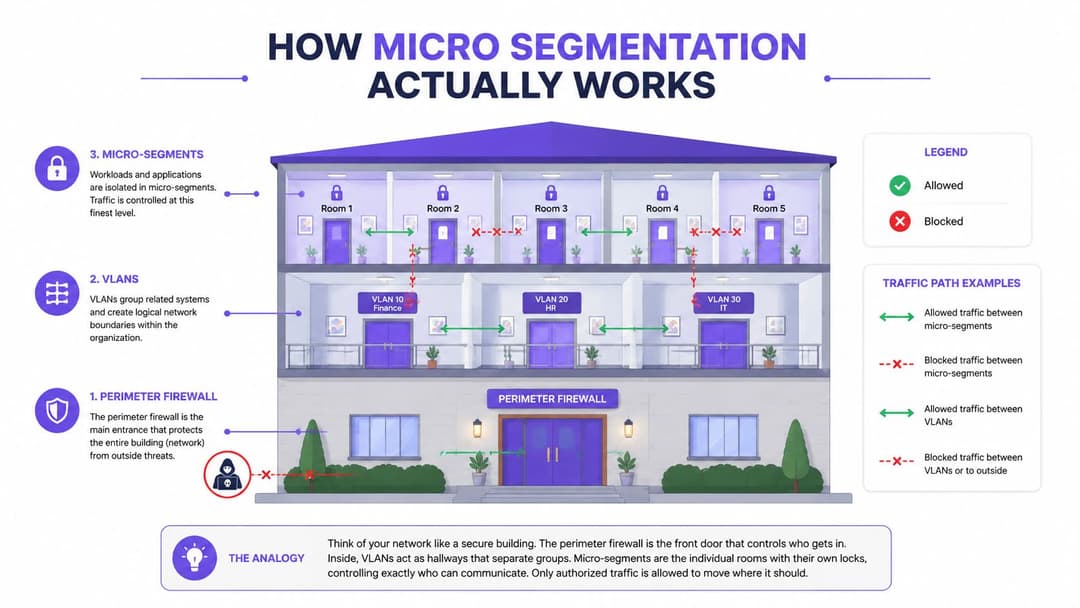
A useful analogy is a secure office building. The perimeter firewall is the front door. It controls who enters the building from outside. VLANs are the floors, separating broad groups such as staff, guests, servers, or facilities equipment. Micro-segments are the individual rooms, each with its own lock and a policy describing who or what may enter.
That policy usually starts from a deny-by-default position. The platform observes a connection between two workloads, users, or devices, then permits it only when a defined business requirement exists. The important detail is that the control operates between internal entities, not merely between the corporate network and the internet.
Where policy is enforced
The enforcement point determines what the system can see and how precisely it can act.
- A hypervisor or virtual switch can inspect traffic between virtual machines without sending every flow to a physical firewall. This suits virtualized application estates.
- A host operating system firewall applies controls close to the workload and can protect systems that sit across different network locations.
- A network fabric or software-defined network enforces policy at switches, routers, or gateways. This avoids endpoint changes but generally works with broader network attributes.
- An identity-aware access platform can bind a decision to a person, device, role, or authentication result rather than relying only on an address.
That last point matters because IP addresses change. Virtual machines migrate, DHCP leases expire, devices roam between access points, and cloud resources are recreated. A rule tied only to an address can become inaccurate. A rule tied to workload identity, application role, device posture, or authenticated user context has a better chance of following the thing it is meant to protect.
East-west traffic is the differentiator
North-south traffic crosses the perimeter, such as a user browsing out to the internet or an external client reaching a published application. East-west traffic moves inside the estate, such as an application calling a database or an endpoint contacting a file server. Attackers depend on east-west paths after gaining access.
Micro-segmentation governs those internal conversations directly. It can permit the application-to-database flow while blocking endpoint-to-database access, even when both systems sit within a broad server or campus zone. In wireless estates, identity-driven design also helps translate authentication into network placement. Tools such as an iPSK subnet designer can support deliberate separation for devices that can't use modern user authentication.
The operational challenge is choosing the right policy granularity. A rule that's too broad recreates implicit trust. A rule that's too narrow can break legitimate dependencies. Effective deployments begin with observed communication and then refine the permitted paths.
Comparing Agent-Based Network-Based and Host-Based Approaches
Implementation models vary by property. The correct choice depends on operating systems, ownership boundaries, visibility requirements, and tolerance for endpoint change. In a mixed-trust US environment, those constraints often matter more than the preferred architecture on paper.
Agent-based controls install a lightweight component on each protected workload. The agent can identify process-level communication and apply policy close to the operating system. This suits cloud and virtualized workloads, where workload identity can change more often than physical network placement. It also gives security teams clearer evidence about which process initiated a connection.
The trade-off is deployment effort. Legacy operating systems, unsupported appliances, tightly controlled production servers, and unmanaged devices may not accept an agent. Teams need processes for version management, health monitoring, exception handling, and formal approval where software installation affects production.
Network-based controls apply policy at switches, routers, gateways, or a software-defined fabric. They avoid changes to every endpoint, making them practical for campus networks, IoT, guest infrastructure, and equipment that cannot run an agent. Their limitation is context. They may classify traffic by address, port, segment, or device category without identifying the process behind an encrypted east-west flow.
Host-based controls use native operating-system firewalls and central configuration management. For a mixed-trust estate, this can provide a practical starting point without adding another enforcement platform. The control still depends on disciplined deployment, auditing, and removal when systems change. Inconsistent configuration creates policy drift and makes later troubleshooting harder.
| Criteria | Agent-Based | Network-Based | Host-Based |
|---|---|---|---|
| Enforcement location | Workload or endpoint | Switch, router, gateway, or fabric | Native operating-system firewall |
| Visibility | Often process and workload aware | Usually network and flow aware | Strong on the protected host |
| Legacy compatibility | Can be limited by operating system or appliance | Suitable for devices that can't run agents | Dependent on operating-system capability |
| Operational burden | Agent rollout, upgrades, and health checks | Fabric design, integration, and rule management | Configuration control and policy consistency |
| Best fit | Data-center and cloud workloads | Campus, IoT, guest, and unmanaged estates | Mixed estates and incremental programs |
| Main weakness | Coverage gaps where agents can't be installed | Coarser identity and process context | Management complexity at scale |
Hybrid deployments reflect how real-world facilities are built. An enterprise might enforce policies through agents for application workloads, network controls for cameras and building systems, and host firewalls for servers sitting between both groups. The design should follow dependency mapping and phased enforcement, rather than forcing every device into one model.
Identity services add a separate control input. A cloud RADIUS provider can connect authentication events with role-based network access, helping assign policy to users or device identities at the access layer. That supports segmentation for WiFi and other shared infrastructure, but it does not replace workload-level controls or host firewalls.
The strongest design usually accepts network constraints instead of treating every device as a modern cloud workload.
Real-World Use Cases from WiFi to Multi-Tenant Environments
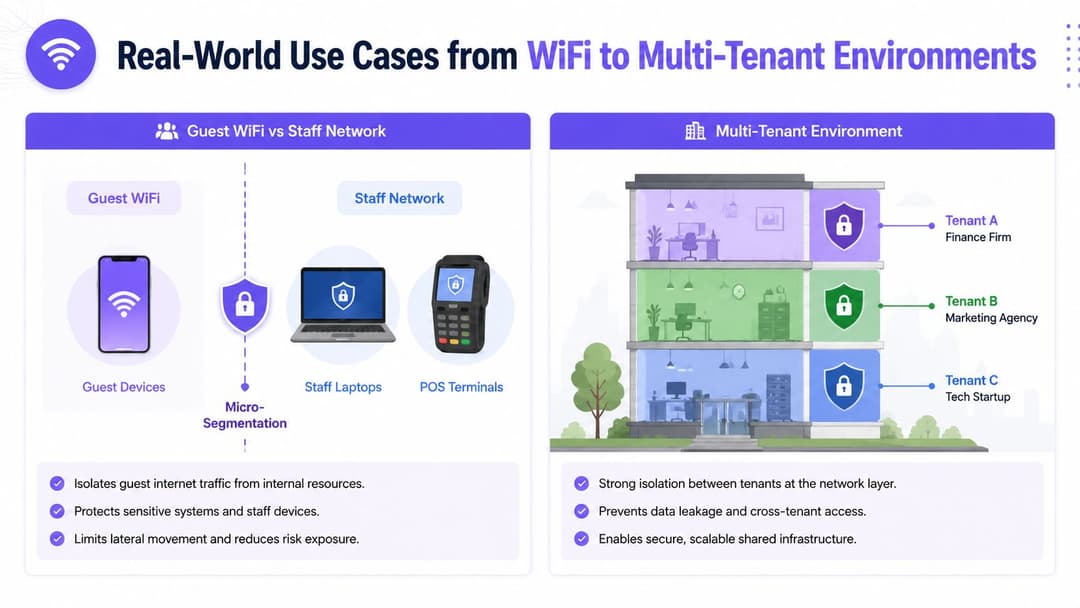
Micro-segmentation becomes easier to justify when it solves a visible access problem. Guest WiFi is the straightforward example. A visitor needs internet access, but shouldn't inherit a route to staff applications because both networks use the same access points and switching infrastructure.
An identity-based platform can assign users to different VLANs or trust zones after authentication. Staff credentials can produce one access profile, contractors another, and guests a restricted profile. That is safer than relying on a shared guest password, because a leaked password doesn't automatically become a key to the internal network.
IoT and healthcare environments
IoT devices deserve a separate policy model because they often have limited security capability and long replacement cycles. A CCTV camera may need to reach a recording platform and management service, but it shouldn't initiate connections to user laptops. An HVAC controller may need a facilities-management path, while a payment terminal should communicate only with its approved payment and management services.
Healthcare facilities add operational sensitivity. Clinical equipment, administrative endpoints, patient-facing services, and facilities systems can have different ownership and availability requirements. The sensible approach is to define the required flows, isolate the device groups, and monitor exceptions rather than place every device into one permissive "trusted" network.
Multi-tenant commercial property
Multi-Family buildings introduce a different boundary problem. A landlord may provide shared physical connectivity while each tenant expects logical isolation from every other tenant. Each tenant needs its own access policy, administrative boundary, and route to approved shared services, such as internet access or building amenities.
Policy-as-code can make onboarding repeatable. Instead of manually altering switch configurations for every new tenant, the operator defines a tenant profile and applies it through the network and identity systems. The result is separation that can extend across wired access, wireless access, and SD-WAN edges.
Teams evaluating this model should understand the difference between isolated tenants and merely separate accounts. A practical explanation of understanding SaaS tenants is useful because the same principle applies to network services, namely shared infrastructure does not have to mean shared trust.
Purple can integrate with identity providers and RADIUS to assign network access according to user or device identity, including dynamic role-based placement and isolation for multi-tenant WiFi. In practice, that makes it one component of a wider segmentation architecture. The access platform decides where a connection belongs, while firewalls, switches, hosts, and workload controls determine what that connection can reach.
Where Micro-Segmentation Reduces Risk Most
Micro-segmentation isn't primarily a data-center compliance exercise. It delivers the greatest value where a compromise in one trust group could expose systems with a very different operational role.
The NCSC's operational technology guidance describes micro-segmentation as dividing zones into smaller units based on workloads, applications, or device functions, potentially down to individual devices, services, or protocols (NCSC OT micro-segmentation guidance). That framing is more useful than treating every environment as a generic IP network. An industrial controller, a building management system, and a corporate laptop need different protections and different communication rules.
Prioritize the expensive failure paths
A flat campus network creates unnecessary paths between endpoints, file services, print systems, voice platforms, and administrative interfaces. The answer isn't always a complete redesign. A targeted policy around privileged administration, sensitive servers, third-party access, and device classes can remove the most dangerous paths first.
| Risk hotspot | Segmentation strategy | Blast-radius reduction |
|---|---|---|
| Guest access | Separate guest identity and traffic from corporate services, with internet-only policy where appropriate | A guest compromise remains within the guest trust zone |
| IoT devices | Permit only required management and service flows | A vulnerable device can't freely probe user or server networks |
| Contractor access | Assign a time-bound or role-specific zone with restricted routes | Third-party credentials don't provide general internal reach |
| Legacy application servers | Use host or network controls where agents aren't viable, then allow documented dependencies | A compromised legacy workload has fewer paths to adjacent systems |
| OT and facilities systems | Separate operational zones from corporate IT and examine inter-zone communications | Ransomware in IT has a harder route into safety or availability-sensitive systems |
The FTC and state attorneys general advise basing segmentation decisions on the protection assets require, their need to interact with other assets, and the extent to which their integrity is trusted. That makes risk-led prioritization more defensible than segmenting by organizational fashion.
Performance concerns still deserve testing. Policy placement, encryption, inspection method, and device capacity all affect the result, so a supplier's generic performance claim isn't a substitute for a pilot in the target estate. The operational overhead is real, but so is the cost of leaving high-value paths implicit.
Implementing Micro-Segmentation Without Breaking Legacy Systems
The safest program starts with observation, not blocking. In monitor-only mode, collect flow records and endpoint information without changing production traffic. Network TAPs, NetFlow collectors, switch telemetry, and agent-based discovery can reveal which systems communicate, which connections are persistent, and which "temporary" exceptions have become business dependencies.
Discover the network before writing rules
Inventory alone isn't enough. Map each application to its supporting services, owners, data sensitivity, and operational criticality. Record undocumented service calls, administrative paths, backup traffic, monitoring connections, and vendor access. A policy based on an architecture diagram from years ago will fail as soon as it meets the estate.
The FTC and state attorneys general recommend documenting how segmentation will be planned, designed, enforced, and monitored so that a compromise remains contained to the breached segment (FTC segmentation planning guidance). That documentation should be an operational record, not a one-off design document.
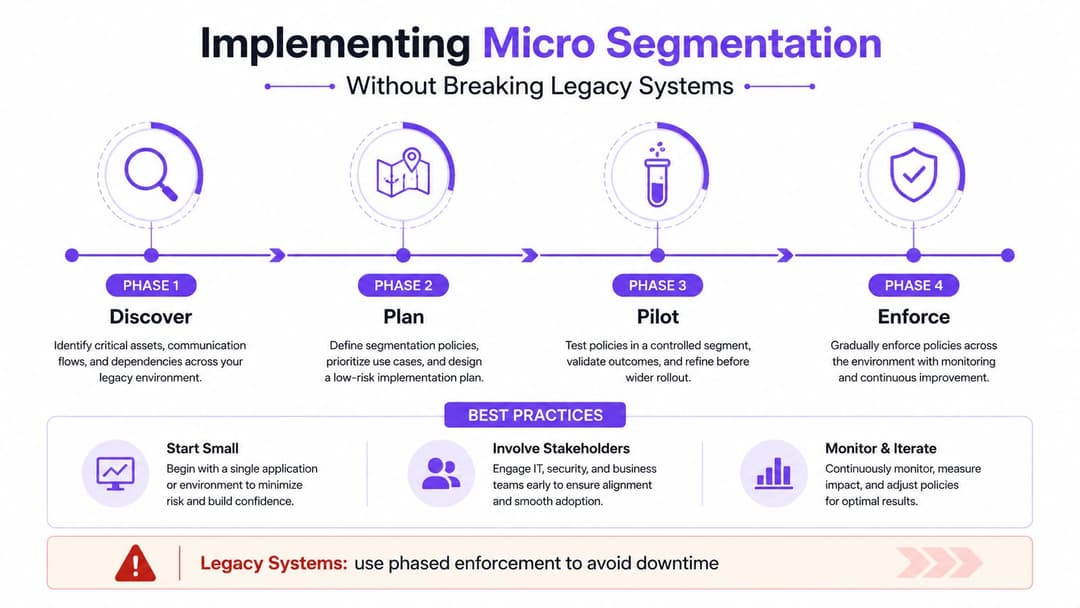
Move through controlled enforcement
Use a staged path:
- Discover: Capture east-west flows and identify asset owners, applications, protocols, and unknown devices.
- Plan: Group assets by business function, sensitivity, trust, and dependency. Draft allow policies from observed requirements.
- Pilot: Test policies against a representative workload group, preferably in shadow or staging mode. Confirm that monitoring, backup, administration, and support paths continue to work.
- Enforce: Start with high-confidence restrictions, such as guest-to-corporate access or IoT-to-domain-controller paths. Expand only after service owners validate the result.
Keep rollback procedures practical. Define who can disable a policy, which change window applies, what evidence triggers rollback, and how the decision is recorded. Maintain an exception register for legacy systems that can't support agents or modern controls, including an owner, compensating control, review date, and removal condition.
Deployment discipline: If nobody owns an exception, it isn't an exception. It's permanent undocumented access.
The US zero-trust research cited by the sector reports that 92% of organizations currently segment their networks, but distinguishes that broad segmentation from workload-level micro-segmentation (US zero-trust adoption data). That distinction should shape program reporting. A segmented network isn't necessarily a least-privilege network.
Connecting Micro-Segmentation to Your Zero Trust Strategy
Zero trust becomes enforceable when micro-segmentation applies identity, device context, application ownership, and least-privilege decisions to internal traffic. Without that enforcement point, verification often ends at login.
Connect directory services, RADIUS, endpoint signals, workload identity, and policy engines so access decisions affect wireless, wired, cloud, and SD-WAN environments. In US public-sector estates, this supports separation between production, development, testing, and training while accommodating mixed-trust networks.
Treat the controls as an operating discipline. Review dependencies, remove stale exceptions, test policy changes, and reassess zones as applications or ownership change. Begin with a high-value path that has clear business ownership, then expand after its dependencies are understood.
Audit guest access, privileged administration, IoT and facilities devices, and legacy application dependencies first. Select an enforcement method each area can support, document required flows, and phase controls around operational risk. This makes what is micro segmentation useful as a design and governance question.
Purple connects identity-based WiFi access with role and tenant isolation through RADIUS-driven network placement and policies for users or devices. Visit Purple to assess how its networking platform could fit a broader micro-segmentation and zero-trust program across guest, staff, and multi-family environments.