

Brazil LGPD and Guest WiFi: A Compliance Guide
This technical reference guide details how Brazil's LGPD applies to enterprise guest WiFi deployments, focusing on captive portal compliance, lawful bases for processing, and the intersection with the Marco Civil da Internet. It provides actionable implementation guidance for IT leaders and network architects to mitigate regulatory risk while maintaining network utility.
🎧 Listen to this Guide
View Transcript
Executive Summary
For enterprise IT leaders and network architects deploying Guest WiFi across Brazilian operations, the Lei Geral de Proteção de Dados (LGPD) presents a distinct compliance challenge. While heavily influenced by the European GDPR, Brazil's data protection framework contains critical nuances—such as a mandatory Data Protection Officer (DPO) requirement, tighter response windows for data subject requests, and the compounding obligations of the Marco Civil da Internet. The Autoridade Nacional de Proteção de Dados (ANPD) has steadily escalated its enforcement posture throughout 2024 and 2025, moving from initial warnings to targeted sanctions. This guide provides a definitive technical reference for structuring captive portal authentication, managing data retention lifecycles, and ensuring robust compliance without sacrificing the operational intelligence derived from your WiFi Analytics .
Technical Deep-Dive: The LGPD Framework for Network Operators
When a user connects to a public or enterprise guest network, the infrastructure inherently processes personal data. Under the LGPD (Law No. 13,709/2018), MAC addresses, IP allocations, session timestamps, and any information collected via the captive portal constitute personal data requiring a lawful basis for processing.
Lawful Bases for Captive Portal Authentication
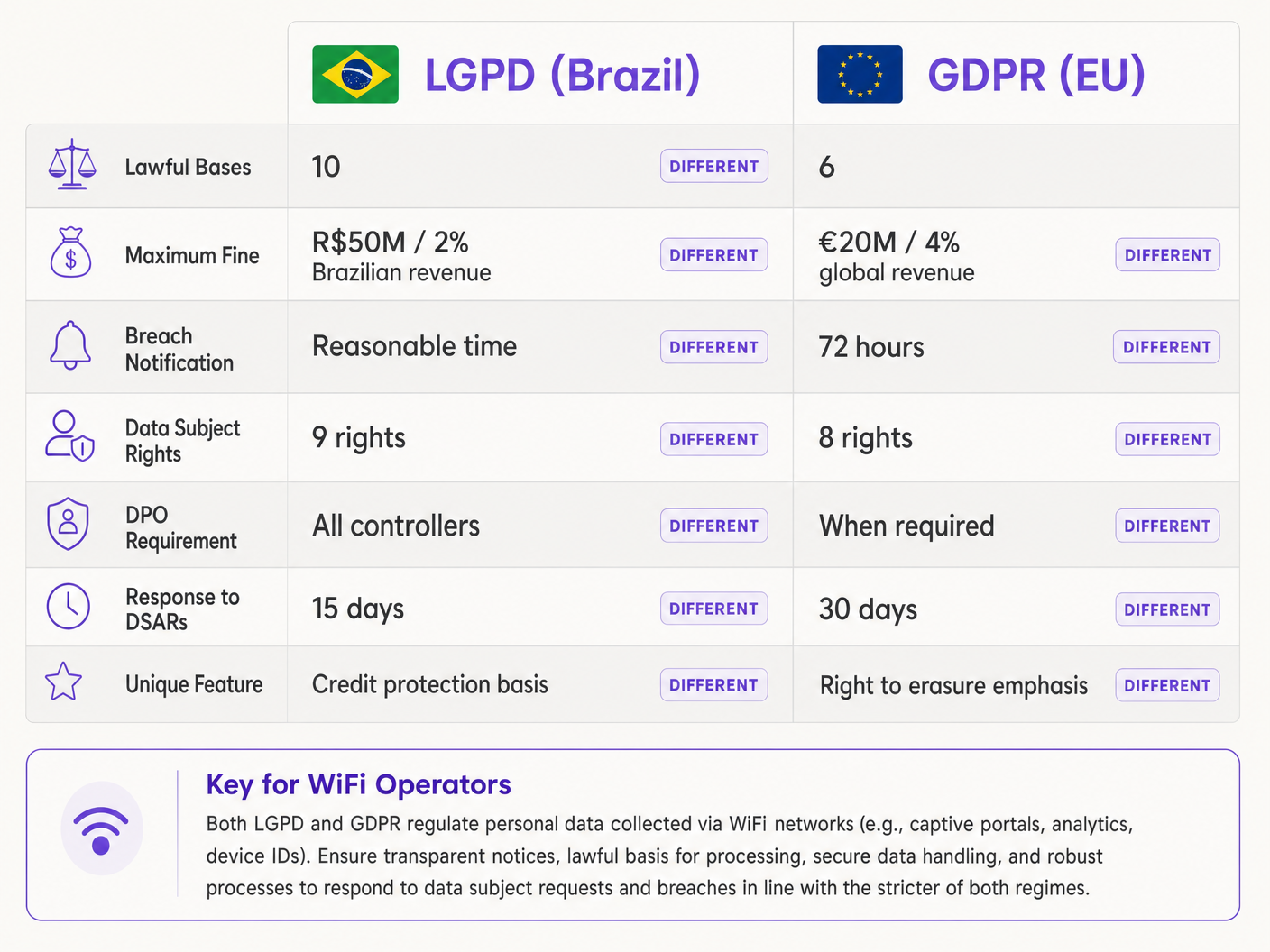
The LGPD establishes ten lawful bases for processing personal data (Article 7). For guest WiFi deployments, architects must carefully map data flows to the appropriate basis:
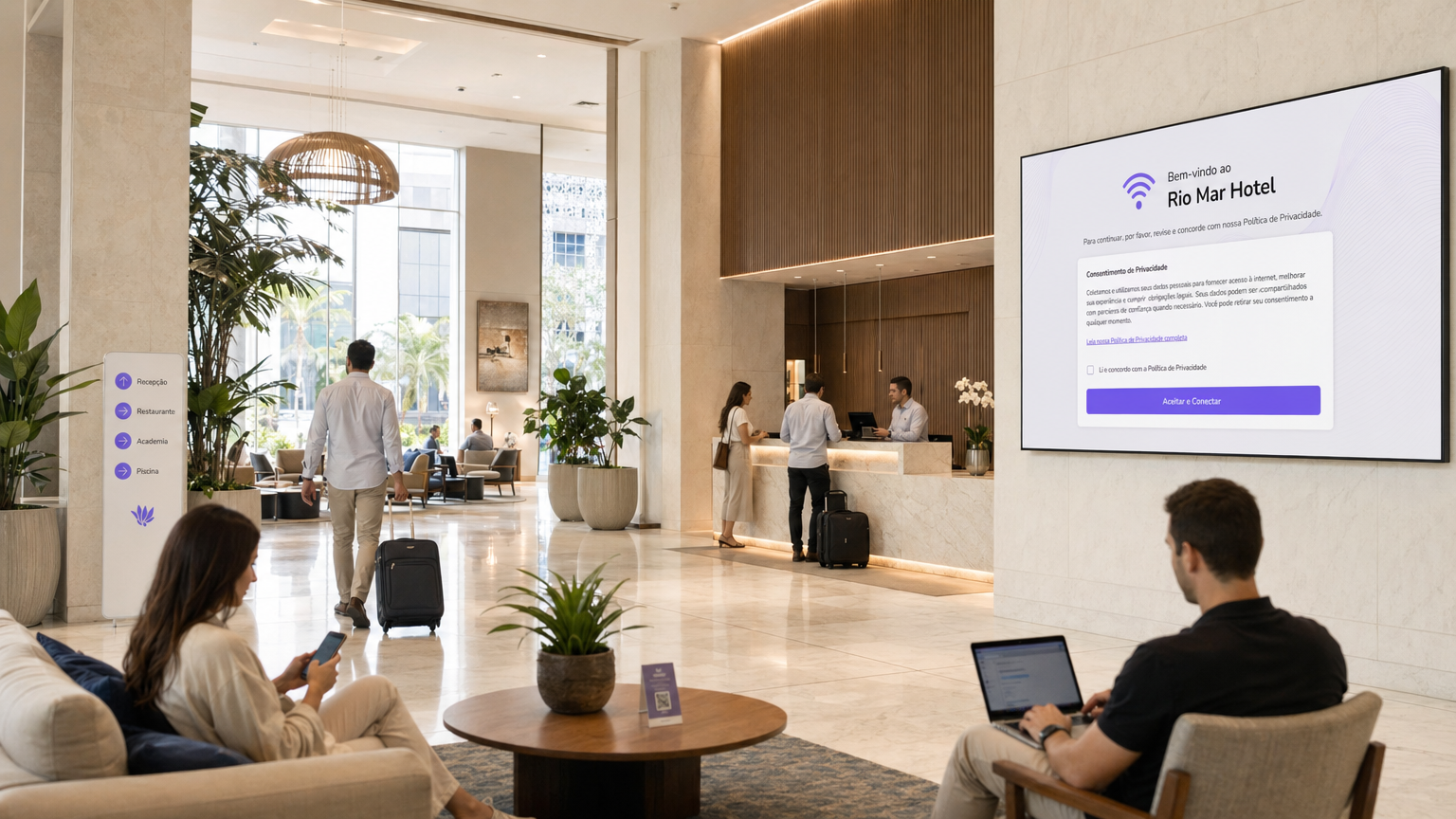
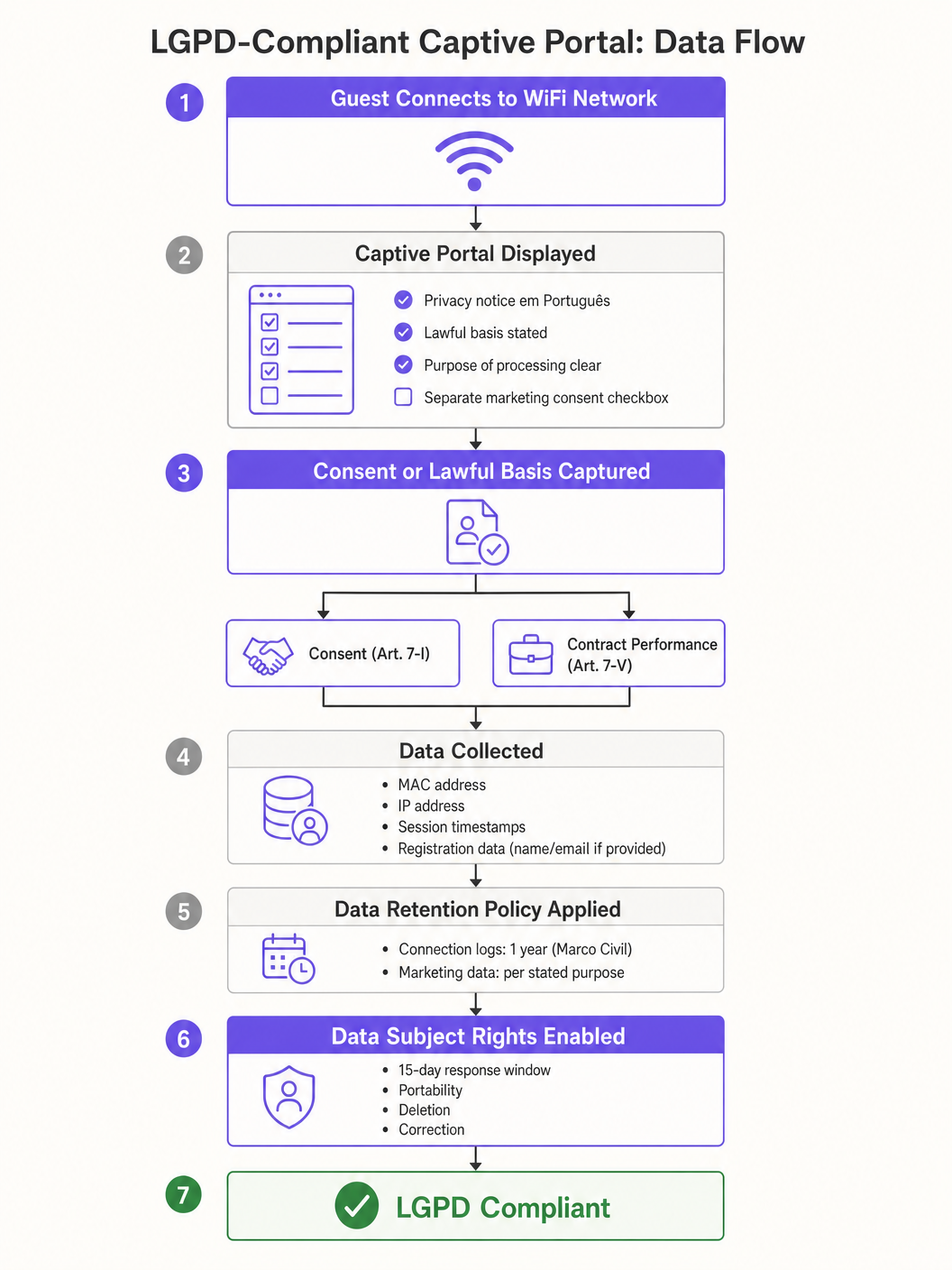
1. Consent (Article 7, I) The most common basis for public venues (such as Retail environments). Consent must be free, informed, unambiguous, and specific. The captive portal must present an unchecked checkbox linking to a Portuguese-language privacy notice. Crucially, operators cannot bundle network access consent with marketing consent; these must remain distinct actions.
2. Contract Performance (Article 7, V) Highly relevant for Hospitality deployments. When a guest books a hotel room that explicitly includes WiFi access, the processing of their connection data is necessary for the execution of that contract. This provides a robust basis for basic network provisioning without requiring active checkbox consent at the portal.
3. Legitimate Interests (Article 7, IX) This basis requires a documented balancing test demonstrating that the controller's interests do not override the data subject's fundamental rights. While defensible for basic network security logging and threat mitigation, relying on legitimate interests for behavioural analytics or marketing profiling carries significant regulatory risk.
The Marco Civil da Internet Intersection
A critical failure point for multinational deployments is treating the LGPD in isolation. Brazil's internet civil rights framework, the Marco Civil da Internet (Law 12,965/2014), operates concurrently. Under Article 13 of the Marco Civil, entities qualifying as internet connection providers are statutorily required to retain connection logs for a minimum of one year. This supersedes standard LGPD data minimisation principles; a policy stating "all connection data is deleted after 30 days" is actively non-compliant with the Marco Civil.
Implementation Guide: Architecting Compliance
Deploying a compliant architecture requires aligning network controllers, identity providers, and analytics platforms. Purple acts as a seamless identity provider, enabling secure, compliant authentication—including support for OpenRoaming under the Connect license—while managing the underlying consent lifecycle.
1. Captive Portal Configuration
- Language Localization: The privacy notice and consent mechanisms must be presented in Brazilian Portuguese.
- Granular Consent Architecture: Implement distinct, unchecked checkboxes for (a) Terms of Service/Privacy Policy acceptance required for access, and (b) Optional marketing communications.
- Controller Identification: The portal must clearly identify the data controller and provide direct contact details for the mandatory Data Protection Officer (DPO).
2. Data Retention Lifecycle Management
Configure automated data lifecycle policies within your analytics platform:
- Connection Logs: Set retention to exactly one year to satisfy the Marco Civil obligation, followed by automated deletion.
- Marketing/Profile Data: Tie retention directly to the stated purpose and ensure immediate deletion upon consent withdrawal.
3. Data Subject Access Request (DSAR) Workflow
The LGPD mandates a 15-day response window for DSARs—half the time permitted under GDPR. Network operators must implement automated tooling to retrieve, export, correct, or anonymise a specific user's data across the entire WiFi architecture within this constrained timeframe.
Best Practices & Industry Standards
When designing your network architecture, consider these established best practices:
- Adopt Profile-Based Authentication: Transitioning toward profile-based authentication (such as Passpoint/OpenRoaming) reduces the reliance on repetitive captive portal data collection, enhancing security while streamlining the compliance footprint. This aligns with modern Internet of Things Architecture: A Complete Guide principles.
- Mandatory DPO Appointment: Unlike the GDPR, the LGPD requires all data controllers to appoint a DPO. Ensure this role is filled and publicly documented per ANPD Resolution 18.
- Data Protection Impact Assessments (DPIA): Conduct a formal DPIA before deploying advanced analytics, such as an Indoor Positioning System: UWB, BLE, & WiFi Guide , as location tracking involves heightened privacy implications.
Troubleshooting & Risk Mitigation
Common Failure Modes
- The Translation Trap: Utilizing European Portuguese instead of Brazilian Portuguese for privacy notices, which can invalidate informed consent.
- The Deletion Overreach: Configuring aggressive 30-day data deletion policies that violate the Marco Civil's one-year retention mandate for connection logs.
- The Consent Bundle: Forcing users to accept marketing communications to gain network access. This violates the LGPD requirement that consent be freely given.
ANPD Enforcement Reality
While the ANPD's initial fines have been relatively low compared to the ICO or CNIL, their enforcement trajectory is accelerating. Recent actions have targeted improper data sharing and inadequate security measures. The maximum penalty is 2% of Brazilian annual revenue (capped at R$50 million per violation), making compliance a board-level priority for enterprise operators.
ROI & Business Impact
Investing in a robust, LGPD-compliant WiFi architecture delivers measurable business value beyond risk mitigation. A transparent, secure authentication process builds user trust, increasing portal conversion rates. Furthermore, by utilizing a compliant platform like Purple, venues can safely leverage retail media monetization and operational analytics without exposing the enterprise to regulatory sanctions. The ROI is calculated not just in avoided fines, but in the sustained ability to generate first-party data intelligence in the Brazilian market.
Podcast Briefing
Listen to our comprehensive 10-minute briefing on architecting LGPD compliance for enterprise WiFi networks:
Key Terms & Definitions
Autoridade Nacional de Proteção de Dados (ANPD)
Brazil's national data protection authority, responsible for issuing guidance, auditing compliance, and enforcing administrative sanctions under the LGPD.
IT teams must monitor ANPD resolutions (such as Resolution 18 regarding DPOs) to ensure their technical configurations remain aligned with regulatory expectations.
Marco Civil da Internet
Brazil's internet civil rights framework (Law 12,965/2014) which mandates specific data retention periods for internet connection providers.
Network architects must configure storage systems to retain connection logs for one year to satisfy this law, running parallel to LGPD requirements.
Lawful Basis
The specific legal justification required under Article 7 of the LGPD to process personal data, such as Consent or Contract Performance.
Before deploying a captive portal, the IT team must document exactly which lawful basis applies to the data being collected to survive an ANPD audit.
Data Subject Access Request (DSAR)
A formal request from an individual to access, correct, anonymise, or delete their personal data held by a controller.
WiFi operators must have automated tooling to process these requests across all databases within the strict 15-day window mandated by the LGPD.
Data Protection Officer (DPO)
The individual designated by the controller to act as a communication channel between the controller, data subjects, and the ANPD.
Unlike GDPR, the LGPD requires all entities processing personal data to appoint a DPO and publicly display their contact information on the captive portal.
Profile-Based Authentication
A secure method of network access (e.g., OpenRoaming) where devices authenticate automatically using a cryptographic profile rather than a web-based captive portal.
Reduces compliance overhead by minimizing repetitive data collection and relying on established identity providers.
Connection Logs
Technical metadata generated during network access, including IP addresses, MAC addresses, and session timestamps.
Must be securely stored for exactly one year under the Marco Civil, requiring specific configuration in the network controller or analytics platform.
Anonymisation
The process of irreversibly altering personal data so that it can no longer be attributed to a specific individual.
Under the LGPD, users have an explicit right to request anonymisation of their data, which analytics platforms must support as an alternative to outright deletion.
Case Studies
A multinational retail chain is expanding into São Paulo and needs to deploy guest WiFi across 50 stores. They currently use a standard GDPR captive portal that deletes all data after 90 days. How must they adapt this architecture for the Brazilian market?
The architecture requires three critical modifications. First, the data retention policy must be bifurcated: connection logs (IP, MAC, timestamps) must be retained for exactly one year to comply with Article 13 of the Marco Civil da Internet, while marketing data can follow the 90-day policy. Second, the privacy notice must be translated into Brazilian Portuguese and explicitly name the mandatory Data Protection Officer (DPO). Third, the automated DSAR response workflow must be reconfigured to ensure data retrieval or deletion is executed within 15 days, rather than the 30 days permitted under GDPR.
A luxury hotel in Rio de Janeiro wants to provide seamless WiFi to guests without requiring them to fill out a captive portal form every time they connect. How can they achieve this compliantly under the LGPD?
The hotel should leverage 'Contract Performance' (Article 7, V) as the lawful basis for processing connection data for registered guests, as internet access is a contracted amenity of the room booking. They can implement profile-based authentication (like Passpoint) tied to the guest's reservation profile. For non-guests (e.g., conference attendees or restaurant patrons), the network should segment them to a standard captive portal relying on explicit 'Consent' (Article 7, I).
Scenario Analysis
Q1. Your marketing team wants to implement a new captive portal in your São Paulo locations that requires users to provide their email address and agree to receive promotional offers before they can access the free WiFi. As the network architect, how should you respond?
💡 Hint:Consider the LGPD requirements for consent to be 'freely given' and the concept of consent bundling.
Show Recommended Approach
You must reject this architecture. Under the LGPD, consent must be freely given. Conditioning the provision of a service (WiFi access) on consent for an unrelated purpose (marketing communications) invalidates the consent. The portal must be redesigned with two separate checkboxes: one mandatory checkbox for accepting the network terms of service, and one optional, unchecked checkbox for marketing communications.
Q2. A user who connected to your stadium WiFi six months ago submits a formal request to have all their data deleted under the LGPD. Your automated system is configured to purge their CRM profile, but the network engineering team points out that deleting their connection logs violates the Marco Civil. How do you resolve this conflict?
💡 Hint:Evaluate the hierarchy and interaction between the LGPD data subject rights and statutory retention obligations.
Show Recommended Approach
You must execute a partial deletion. Under the LGPD, the right to deletion is not absolute; it does not override statutory obligations. You must delete the user's marketing and profile data from the CRM and analytics platforms. However, you must retain the core connection logs (IP, MAC, timestamps) for the remainder of the 1-year period mandated by Article 13 of the Marco Civil. You must respond to the user within 15 days explaining exactly what was deleted and why the connection logs were retained.
Q3. You are migrating your European WiFi architecture to Brazil. Your current GDPR process allows 30 days to respond to Data Subject Access Requests (DSARs) and relies on manual database queries by the IT team. Why is this problematic for the Brazilian deployment?
💡 Hint:Compare the statutory response windows between the two regulatory frameworks.
Show Recommended Approach
This is problematic because the LGPD mandates a 15-day response window for DSARs, exactly half the time allowed under GDPR. A manual query process that takes up to 30 days will result in compliance failures in Brazil. The IT team must implement automated tooling within the analytics platform to rapidly retrieve, compile, and export user data to meet the stricter 15-day SLA.




