

LGPD do Brasil e WiFi de Convidados: Um Guia de Conformidade
Este guia de referência técnica detalha como a LGPD do Brasil se aplica a implementações de WiFi de convidados empresariais, focando na conformidade do captive portal, bases legais para processamento e a intersecção com o Marco Civil da Internet. Fornece orientação de implementação acionável para líderes de TI e arquitetos de rede para mitigar o risco regulatório, mantendo a utilidade da rede.
🎧 Ouça este Guia
Ver Transcrição
Resumo Executivo
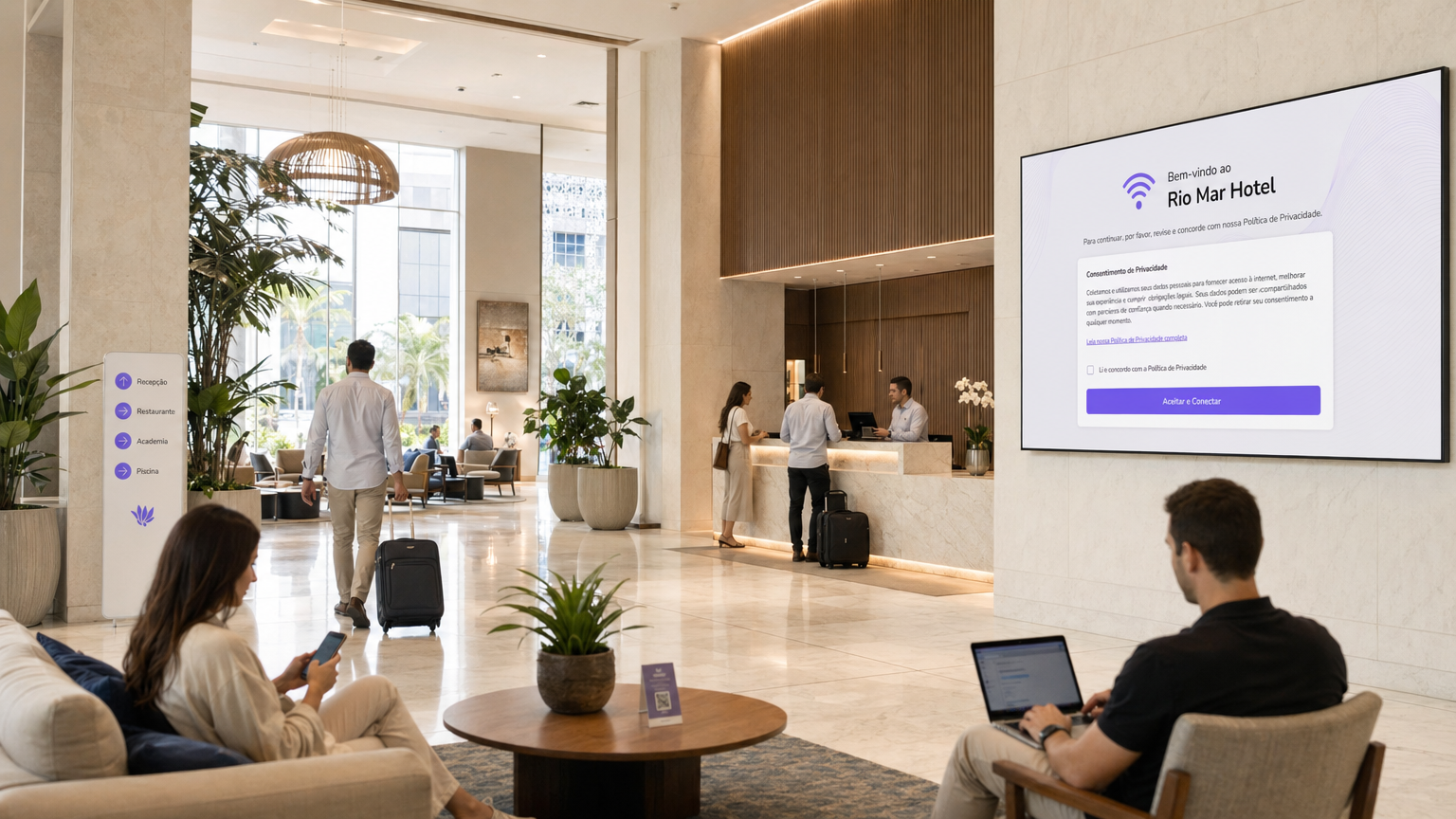
Para líderes de TI empresariais e arquitetos de rede que implementam WiFi de Convidados em operações brasileiras, a Lei Geral de Proteção de Dados (LGPD) apresenta um desafio de conformidade distinto. Embora fortemente influenciada pelo GDPR europeu, a estrutura de proteção de dados do Brasil contém nuances críticas — como um requisito obrigatório de Encarregado de Proteção de Dados (DPO), prazos de resposta mais apertados para pedidos de titulares de dados e as obrigações adicionais do Marco Civil da Internet. A Autoridade Nacional de Proteção de Dados (ANPD) tem vindo a intensificar a sua postura de fiscalização ao longo de 2024 e 2025, passando de avisos iniciais para sanções direcionadas. Este guia fornece uma referência técnica definitiva para estruturar a autenticação do captive portal, gerir os ciclos de vida de retenção de dados e garantir uma conformidade robusta sem sacrificar a inteligência operacional derivada da sua Análise de WiFi .
Análise Técnica Detalhada: O Enquadramento da LGPD para Operadores de Rede
Quando um utilizador se conecta a uma rede pública ou de convidados empresarial, a infraestrutura processa inerentemente dados pessoais. Ao abrigo da LGPD (Lei n.º 13.709/2018), endereços MAC, atribuições de IP, carimbos de data/hora de sessão e qualquer informação recolhida através do captive portal constituem dados pessoais que exigem uma base legal para o processamento.
Bases Legais para Autenticação de Captive Portal
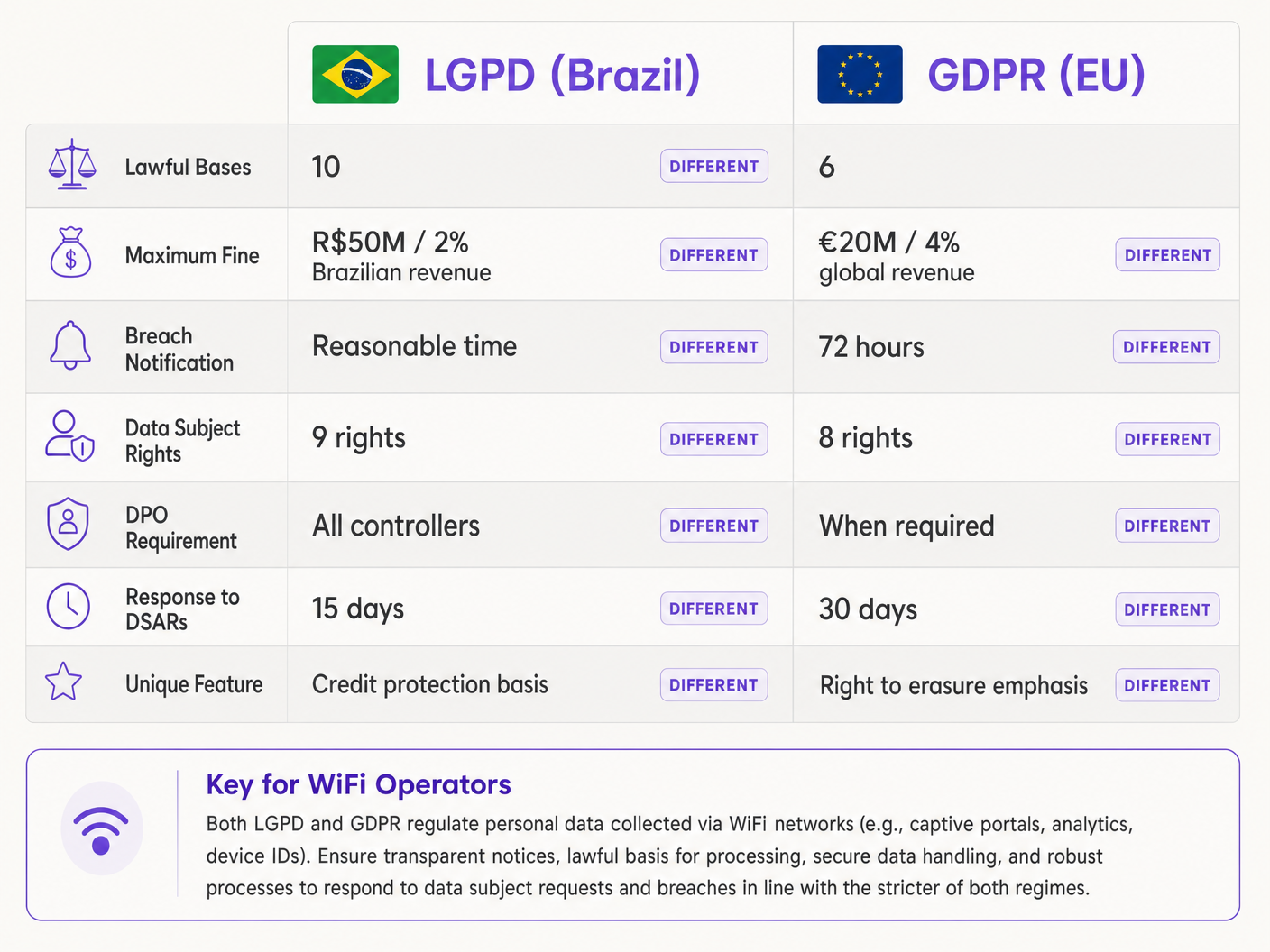
A LGPD estabelece dez bases legais para o processamento de dados pessoais (Artigo 7.º). Para implementações de WiFi de convidados, os arquitetos devem mapear cuidadosamente os fluxos de dados para a base apropriada:
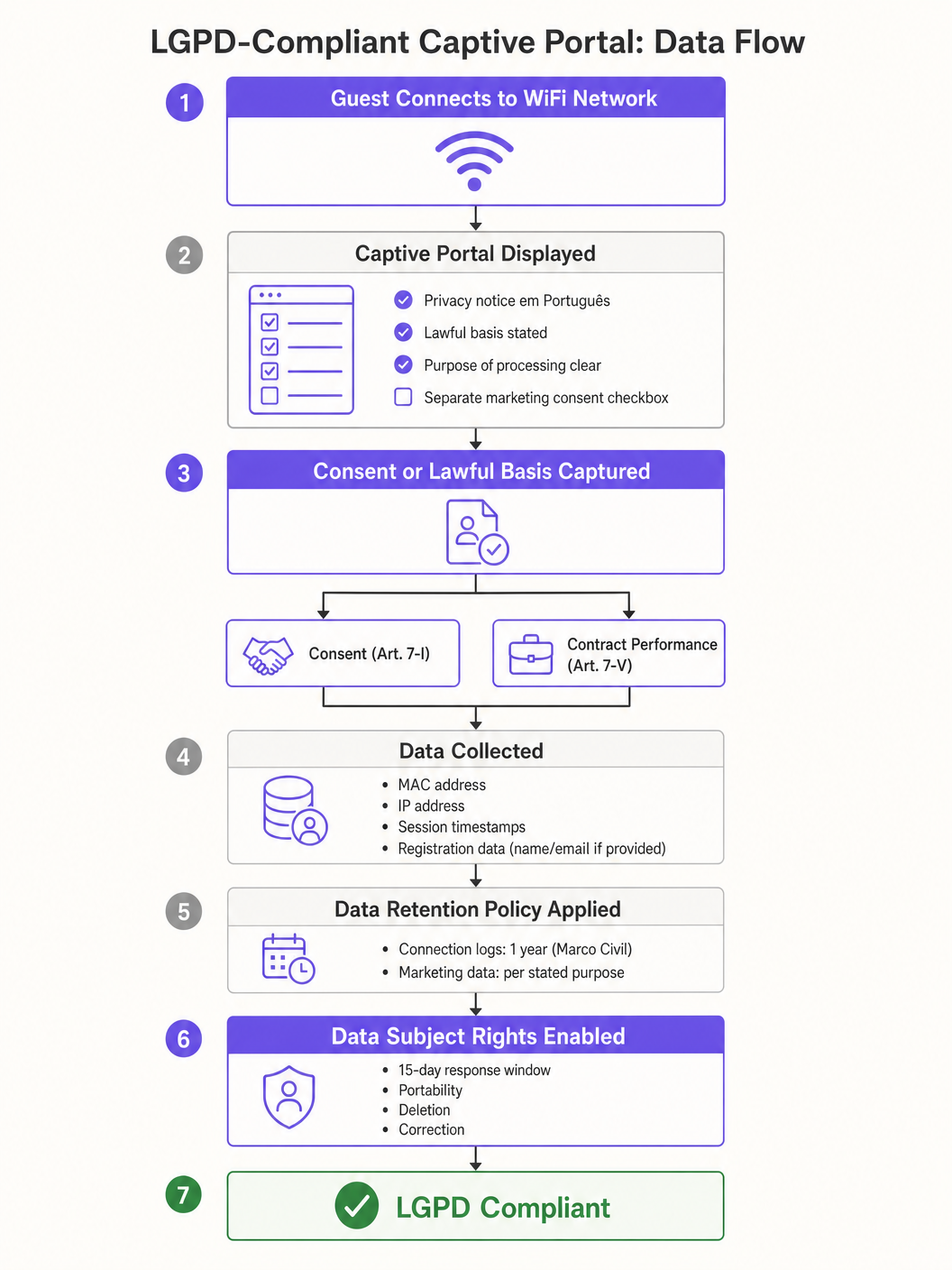
1. Consentimento (Artigo 7.º, I) A base mais comum para locais públicos (como ambientes de Retalho ). O consentimento deve ser livre, informado, inequívoco e específico. O captive portal deve apresentar uma caixa de seleção desmarcada que remeta para um aviso de privacidade em português. Crucialmente, os operadores não podem agrupar o consentimento de acesso à rede com o consentimento de marketing; estas devem permanecer ações distintas.
2. Execução de Contrato (Artigo 7.º, V) Altamente relevante para implementações de Hotelaria . Quando um hóspede reserva um quarto de hotel que inclui explicitamente acesso WiFi, o processamento dos seus dados de conexão é necessário para a execução desse contrato. Isto fornece uma base robusta para o provisionamento básico da rede sem exigir consentimento ativo por caixa de seleção no portal.
3. Interesses Legítimos (Artigo 7.º, IX) Esta base exige um teste de ponderação documentado que demonstre que os interesses do responsável pelo tratamento não se sobrepõem aos direitos fundamentais do titular dos dados. Embora defensável para registos básicos de segurança de rede e mitigação de ameaças, depender de interesses legítimos para análises comportamentais ou criação de perfis de marketing acarreta um risco regulatório significativo.
A Interseção com o Marco Civil da Internet
Um ponto crítico de falha para implementações multinacionais é tratar a LGPD isoladamente. O enquadramento dos direitos civis da internet no Brasil, o Marco Civil da Internet (Lei 12.965/2014), opera em simultâneo. Ao abrigo do Artigo 13.º do Marco Civil, as entidades que se qualificam como fornecedores de conexão à internet são legalmente obrigadas a reter registos de conexão por um mínimo de um ano. Isto anula os princípios padrão de minimização de dados da LGPD; uma política que afirma "todos os dados de conexão são eliminados após 30 dias" está ativamente em não conformidade com o Marco Civil.
Guia de Implementação: Arquitetando a Conformidade
A implementação de uma arquitetura em conformidade exige o alinhamento de controladores de rede, fornecedores de identidade e plataformas de análise. Purple atua como um fornecedor de identidade contínuo, permitindo autenticação segura e em conformidade — incluindo suporte para OpenRoaming sob a licença Connect — enquanto gere o ciclo de vida de consentimento subjacente.
1. Configuração do Captive Portal
- Localização de Idioma: O aviso de privacidade e os mecanismos de consentimento devem ser apresentados em português do Brasil.
- Arquitetura de Consentimento Granular: Implementar caixas de seleção distintas e desmarcadas para (a) aceitação dos Termos de Serviço/Política de Privacidade exigida para acesso e (b) comunicações de marketing opcionais.
- Identificação do Responsável pelo Tratamento: O portal deve identificar claramente o responsável pelo tratamento de dados e fornecer detalhes de contacto diretos para o Encarregado de Proteção de Dados (DPO) obrigatório.
2. Gestão do Ciclo de Vida de Retenção de Dados
Configure políticas automatizadas de ciclo de vida de dados na sua plataforma de análise:
- Registos de Conexão: Defina a retenção para exatamente um ano para satisfazer a obrigação do Marco Civil, seguida de eliminação automatizada.
- Dados de Marketing/Perfil: Vincule a retenção diretamente ao propósito declarado e garanta a eliminação imediata após a retirada do consentimento.
3. Fluxo de Trabalho de Pedidos de Acesso de Titulares de Dados (DSAR)
A LGPD exige um prazo de resposta de 15 dias para DSARs — metade do tempo permitido sob o GDPR. Os operadores de rede devem implementar ferramentas automatizadas para recuperar, exportar, corrigir ou anonimizar os dados de um utilizador específico em toda a arquitetura WiFi dentro deste prazo limitado.
Melhores Práticas e Padrões da Indústria
Ao projetar a sua arquitetura de rede, considere estas melhores práticas estabelecidas:
- Adote Autenticação Baseada em Perfil: A transição para autenticação baseada em perfil (como Passpoint/OpenRoaming) reduz a dependência da recolha repetitiva de dados do captive portal, melhorando a segurança e simplificando a pegada de conformidade. Isto alinha-se com os princípios modernos de Arquitetura da Internet das Coisas: Um Guia Completo .
- Nomeação Obrigatória de DPO: Ao contrário do GDPR, a LGPD exige que todos os responsáveis pelo tratamento de dados nomeiem um DPO. Garanta que esta função seja preenchida e documentada publicamente de acordo com a Resolução ANPD 18.
- Avaliações de Impacto na Proteção de Dados (DPIA): Realize uma DPIA formal antes de implementar análises avançadas, como um Guia de Sistema de Posicionamento Interno: UWB, BLE e WiFi , uma vez que o rastreamento de localização envolve implicações de privacidade acrescidas.
Resolução de Problemas e Mitigação de Riscos
Modos de Falha Comuns
- A Armadilha da Tradução: Utilizar Português Europeu em vez de Português do Brasil para avisos de privacidade, o que pode invalidar o consentimento informado.
- O Excesso de Eliminação: Configurar políticas agressivas de eliminação de dados em 30 dias que violam o mandato de retenção de um ano do Marco Civil para registos de conexão.
- O Pacote de Consentimento: Forçar os utilizadores a aceitar comunicações de marketing para obter acesso à rede. Isto viola o requisito da LGPD de que o consentimento seja dado livremente.
Realidade da Fiscalização da ANPD
Embora as multas iniciais da ANPD tenham sido relativamente baixas em comparação com a ICO ou a CNIL, a sua trajetória de fiscalização está a acelerar. Ações recentes visaram a partilha inadequada de dados e medidas de segurança insuficientes. A penalidade máxima é de 2% da receita anual brasileira (limitada a R$50 milhões por violação), tornando a conformidade uma prioridade a nível de conselho para operadores empresariais.
ROI e Impacto nos Negócios
Investir numa arquitetura WiFi robusta e em conformidade com a LGPD oferece valor comercial mensurável para além da mitigação de riscos. Um processo de autenticação transparente e seguro constrói a confiança do utilizador, aumentando as taxas de conversão do portal. Além disso, ao utilizar uma plataforma em conformidade como a Purple, os locais podem alavancar com segurança a monetização de media de retalho e a análise operacional sem expor a empresa a sanções regulatórias. O ROI é calculado não apenas em multas evitadas, mas na capacidade sustentada de gerar inteligência de dados primários no mercado brasileiro.
Resumo do Podcast
Ouça o nosso resumo abrangente de 10 minutos sobre como arquitetar a conformidade com a LGPD para redes WiFi empresariais:
Termos-Chave e Definições
Autoridade Nacional de Proteção de Dados (ANPD)
Brazil's national data protection authority, responsible for issuing guidance, auditing compliance, and enforcing administrative sanctions under the LGPD.
IT teams must monitor ANPD resolutions (such as Resolution 18 regarding DPOs) to ensure their technical configurations remain aligned with regulatory expectations.
Marco Civil da Internet
Brazil's internet civil rights framework (Law 12,965/2014) which mandates specific data retention periods for internet connection providers.
Network architects must configure storage systems to retain connection logs for one year to satisfy this law, running parallel to LGPD requirements.
Lawful Basis
The specific legal justification required under Article 7 of the LGPD to process personal data, such as Consent or Contract Performance.
Before deploying a captive portal, the IT team must document exactly which lawful basis applies to the data being collected to survive an ANPD audit.
Data Subject Access Request (DSAR)
A formal request from an individual to access, correct, anonymise, or delete their personal data held by a controller.
WiFi operators must have automated tooling to process these requests across all databases within the strict 15-day window mandated by the LGPD.
Data Protection Officer (DPO)
The individual designated by the controller to act as a communication channel between the controller, data subjects, and the ANPD.
Unlike GDPR, the LGPD requires all entities processing personal data to appoint a DPO and publicly display their contact information on the captive portal.
Profile-Based Authentication
A secure method of network access (e.g., OpenRoaming) where devices authenticate automatically using a cryptographic profile rather than a web-based captive portal.
Reduces compliance overhead by minimizing repetitive data collection and relying on established identity providers.
Connection Logs
Technical metadata generated during network access, including IP addresses, MAC addresses, and session timestamps.
Must be securely stored for exactly one year under the Marco Civil, requiring specific configuration in the network controller or analytics platform.
Anonymisation
The process of irreversibly altering personal data so that it can no longer be attributed to a specific individual.
Under the LGPD, users have an explicit right to request anonymisation of their data, which analytics platforms must support as an alternative to outright deletion.
Estudos de Caso
A multinational retail chain is expanding into São Paulo and needs to deploy guest WiFi across 50 stores. They currently use a standard GDPR captive portal that deletes all data after 90 days. How must they adapt this architecture for the Brazilian market?
The architecture requires three critical modifications. First, the data retention policy must be bifurcated: connection logs (IP, MAC, timestamps) must be retained for exactly one year to comply with Article 13 of the Marco Civil da Internet, while marketing data can follow the 90-day policy. Second, the privacy notice must be translated into Brazilian Portuguese and explicitly name the mandatory Data Protection Officer (DPO). Third, the automated DSAR response workflow must be reconfigured to ensure data retrieval or deletion is executed within 15 days, rather than the 30 days permitted under GDPR.
A luxury hotel in Rio de Janeiro wants to provide seamless WiFi to guests without requiring them to fill out a captive portal form every time they connect. How can they achieve this compliantly under the LGPD?
The hotel should leverage 'Contract Performance' (Article 7, V) as the lawful basis for processing connection data for registered guests, as internet access is a contracted amenity of the room booking. They can implement profile-based authentication (like Passpoint) tied to the guest's reservation profile. For non-guests (e.g., conference attendees or restaurant patrons), the network should segment them to a standard captive portal relying on explicit 'Consent' (Article 7, I).
Análise de Cenários
Q1. Your marketing team wants to implement a new captive portal in your São Paulo locations that requires users to provide their email address and agree to receive promotional offers before they can access the free WiFi. As the network architect, how should you respond?
💡 Dica:Consider the LGPD requirements for consent to be 'freely given' and the concept of consent bundling.
Mostrar Abordagem Recomendada
You must reject this architecture. Under the LGPD, consent must be freely given. Conditioning the provision of a service (WiFi access) on consent for an unrelated purpose (marketing communications) invalidates the consent. The portal must be redesigned with two separate checkboxes: one mandatory checkbox for accepting the network terms of service, and one optional, unchecked checkbox for marketing communications.
Q2. A user who connected to your stadium WiFi six months ago submits a formal request to have all their data deleted under the LGPD. Your automated system is configured to purge their CRM profile, but the network engineering team points out that deleting their connection logs violates the Marco Civil. How do you resolve this conflict?
💡 Dica:Evaluate the hierarchy and interaction between the LGPD data subject rights and statutory retention obligations.
Mostrar Abordagem Recomendada
You must execute a partial deletion. Under the LGPD, the right to deletion is not absolute; it does not override statutory obligations. You must delete the user's marketing and profile data from the CRM and analytics platforms. However, you must retain the core connection logs (IP, MAC, timestamps) for the remainder of the 1-year period mandated by Article 13 of the Marco Civil. You must respond to the user within 15 days explaining exactly what was deleted and why the connection logs were retained.
Q3. You are migrating your European WiFi architecture to Brazil. Your current GDPR process allows 30 days to respond to Data Subject Access Requests (DSARs) and relies on manual database queries by the IT team. Why is this problematic for the Brazilian deployment?
💡 Dica:Compare the statutory response windows between the two regulatory frameworks.
Mostrar Abordagem Recomendada
This is problematic because the LGPD mandates a 15-day response window for DSARs, exactly half the time allowed under GDPR. A manual query process that takes up to 30 days will result in compliance failures in Brazil. The IT team must implement automated tooling within the analytics platform to rapidly retrieve, compile, and export user data to meet the stricter 15-day SLA.




