

Brasilien LGPD und Guest WiFi: Ein Compliance-Leitfaden
Dieser technische Referenzleitfaden beschreibt, wie Brasiliens LGPD auf Enterprise Guest WiFi-Implementierungen angewendet wird, mit Fokus auf Captive Portal-Compliance, rechtmäßige Verarbeitungsgründe und die Schnittstelle zum Marco Civil da Internet. Er bietet umsetzbare Implementierungsanleitungen für IT-Führungskräfte und Netzwerkarchitekten, um regulatorische Risiken zu mindern und gleichzeitig die Netzwerknutzung aufrechtzuerhalten.
🎧 Diesen Leitfaden anhören
Transkript anzeigen
Zusammenfassung für Führungskräfte
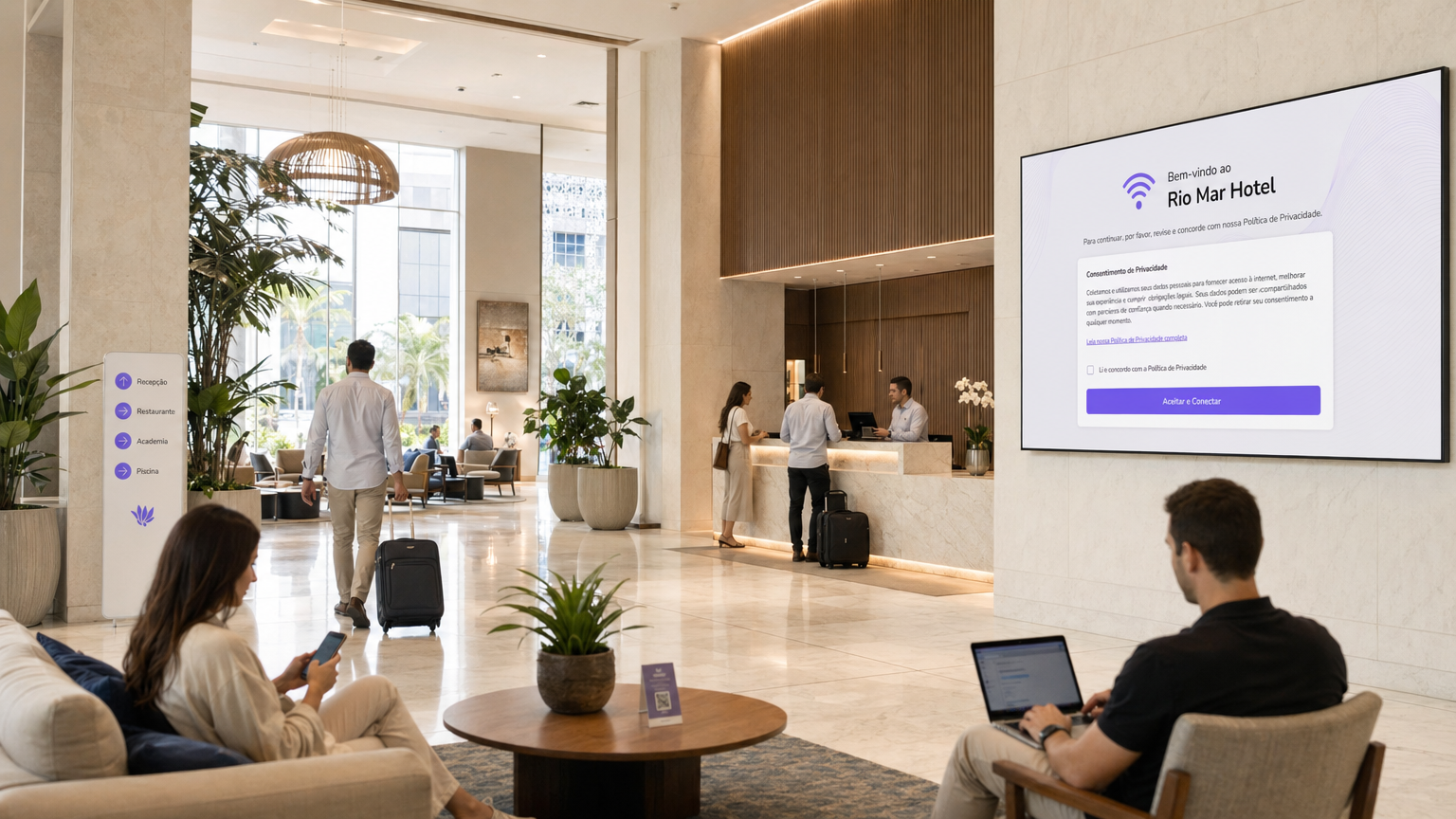
Für IT-Führungskräfte und Netzwerkarchitekten, die Guest WiFi in brasilianischen Betrieben implementieren, stellt die Lei Geral de Proteção de Dados (LGPD) eine besondere Compliance-Herausforderung dar. Obwohl stark von der europäischen GDPR beeinflusst, enthält Brasiliens Datenschutzrahmen kritische Nuancen – wie eine obligatorische Anforderung an einen Datenschutzbeauftragten (DPO), engere Antwortfristen für Anfragen von betroffenen Personen und die sich verstärkenden Verpflichtungen des Marco Civil da Internet. Die Autoridade Nacional de Proteção de Dados (ANPD) hat ihre Durchsetzungsposition in den Jahren 2024 und 2025 stetig verschärft und ist von anfänglichen Warnungen zu gezielten Sanktionen übergegangen. Dieser Leitfaden bietet eine definitive technische Referenz für die Strukturierung der Captive Portal-Authentifizierung, die Verwaltung von Datenaufbewahrungszyklen und die Sicherstellung einer robusten Compliance, ohne die aus Ihren WiFi Analytics gewonnenen Betriebsdaten zu opfern.
Technischer Deep-Dive: Das LGPD-Framework für Netzwerkbetreiber
Wenn ein Benutzer sich mit einem öffentlichen oder unternehmenseigenen Gastnetzwerk verbindet, verarbeitet die Infrastruktur von Natur aus personenbezogene Daten. Gemäß der LGPD (Gesetz Nr. 13.709/2018) stellen MAC-Adressen, IP-Zuweisungen, Sitzungszeitstempel und alle über das Captive Portal gesammelten Informationen personenbezogene Daten dar, die eine rechtmäßige Grundlage für die Verarbeitung erfordern.
Rechtmäßige Grundlagen für die Captive Portal-Authentifizierung
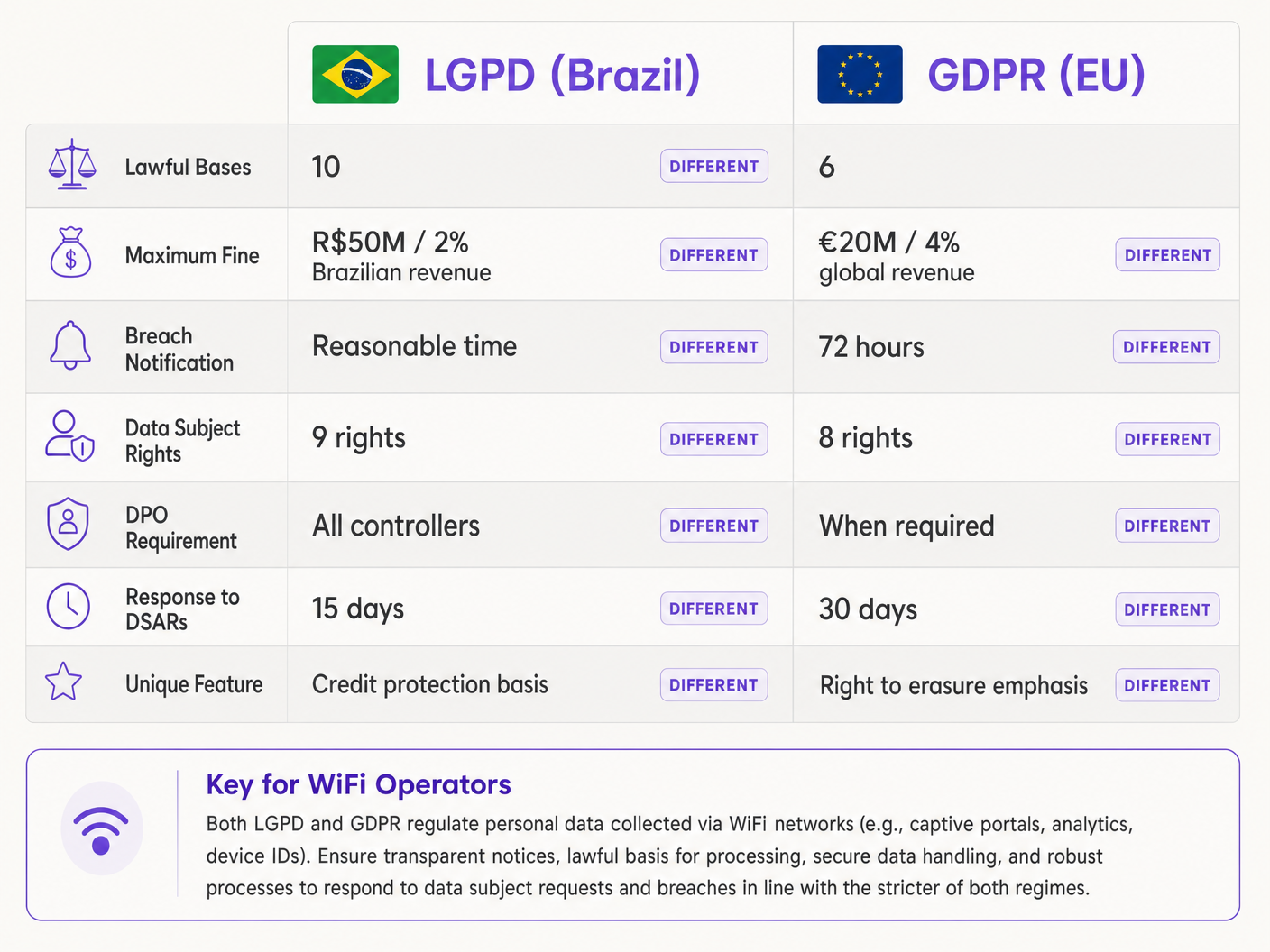
Die LGPD legt zehn rechtmäßige Grundlagen für die Verarbeitung personenbezogener Daten fest (Artikel 7). Für Guest WiFi-Implementierungen müssen Architekten Datenflüsse sorgfältig der entsprechenden Grundlage zuordnen:
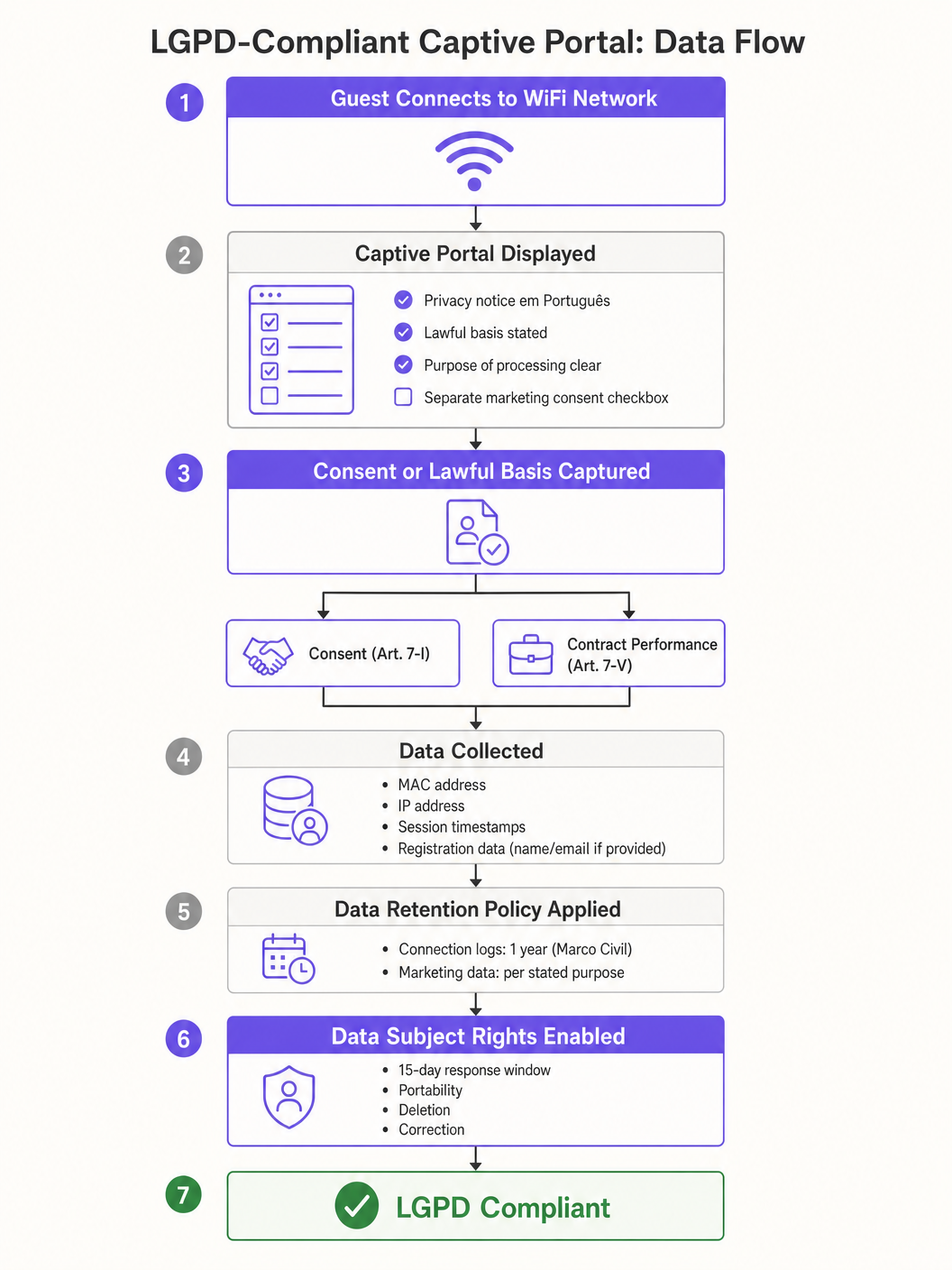
1. Einwilligung (Artikel 7, I) Die häufigste Grundlage für öffentliche Einrichtungen (wie Einzelhandelsumgebungen ). Die Einwilligung muss freiwillig, informiert, eindeutig und spezifisch sein. Das Captive Portal muss ein nicht angekreuztes Kontrollkästchen anzeigen, das auf eine Datenschutzerklärung in portugiesischer Sprache verweist. Entscheidend ist, dass Betreiber die Einwilligung zum Netzwerkzugang nicht mit der Marketing-Einwilligung bündeln dürfen; diese müssen getrennte Aktionen bleiben.
2. Vertragserfüllung (Artikel 7, V) Hochrelevant für Gastgewerbe -Implementierungen. Wenn ein Gast ein Hotelzimmer bucht, das explizit WiFi-Zugang beinhaltet, ist die Verarbeitung seiner Verbindungsdaten für die Erfüllung dieses Vertrags notwendig. Dies bietet eine robuste Grundlage für die grundlegende Netzwerkbereitstellung, ohne dass eine aktive Kontrollkästchen-Einwilligung am Portal erforderlich ist.
3. Berechtigte Interessen (Artikel 7, IX) Diese Grundlage erfordert eine dokumentierte Interessenabwägung, die zeigt, dass die Interessen des Verantwortlichen die Grundrechte der betroffenen Person nicht überwiegen. Obwohl für grundlegende Netzwerksicherheitsprotokollierung und Bedrohungsabwehr vertretbar, birgt die Berufung auf berechtigte Interessen für Verhaltensanalysen oder Marketing-Profiling ein erhebliches regulatorisches Risiko.
Die Schnittstelle zum Marco Civil da Internet
Ein kritischer Fehlerpunkt bei multinationalen Implementierungen ist die isolierte Betrachtung der LGPD. Brasiliens Rahmenwerk für Internet-Bürgerrechte, das Marco Civil da Internet (Gesetz 12.965/2014), operiert gleichzeitig. Gemäß Artikel 13 des Marco Civil sind Unternehmen, die als Internetverbindungsanbieter qualifiziert sind, gesetzlich verpflichtet, Verbindungsprotokolle für mindestens ein Jahr aufzubewahren. Dies ersetzt die Standardprinzipien der LGPD zur Datenminimierung; eine Richtlinie, die besagt, dass „alle Verbindungsdaten nach 30 Tagen gelöscht werden“, ist aktiv nicht konform mit dem Marco Civil.
Implementierungsleitfaden: Compliance-Architektur
Die Implementierung einer konformen Architektur erfordert die Abstimmung von Netzwerk-Controllern, Identitätsanbietern und Analyseplattformen. Purple fungiert als nahtloser Identitätsanbieter, der eine sichere, konforme Authentifizierung ermöglicht – einschließlich Unterstützung für OpenRoaming unter der Connect-Lizenz – und gleichzeitig den zugrunde liegenden Einwilligungslebenszyklus verwaltet.
1. Captive Portal-Konfiguration
- Sprachlokalisierung: Die Datenschutzerklärung und die Einwilligungsmechanismen müssen in brasilianischem Portugiesisch präsentiert werden.
- Granulare Einwilligungsarchitektur: Implementieren Sie separate, nicht angekreuzte Kontrollkästchen für (a) die Annahme der Nutzungsbedingungen/Datenschutzerklärung, die für den Zugang erforderlich ist, und (b) optionale Marketingkommunikation.
- Identifikation des Verantwortlichen: Das Portal muss den Datenverantwortlichen klar identifizieren und direkte Kontaktdaten für den obligatorischen Datenschutzbeauftragten (DPO) bereitstellen.
2. Verwaltung des Datenaufbewahrungslebenszyklus
Konfigurieren Sie automatisierte Datenlebenszyklusrichtlinien innerhalb Ihrer Analyseplattform:
- Verbindungsprotokolle: Legen Sie die Aufbewahrungsfrist auf genau ein Jahr fest, um der Marco Civil-Verpflichtung nachzukommen, gefolgt von einer automatischen Löschung.
- Marketing-/Profildaten: Verknüpfen Sie die Aufbewahrung direkt mit dem angegebenen Zweck und stellen Sie die sofortige Löschung bei Widerruf der Einwilligung sicher.
3. Workflow für Anfragen betroffener Personen (DSAR)
Die LGPD schreibt ein Antwortfenster von 15 Tagen für DSARs vor – die Hälfte der unter GDPR zulässigen Zeit. Netzwerkbetreiber müssen automatisierte Tools implementieren, um die Daten eines bestimmten Benutzers in der gesamten WiFi-Architektur innerhalb dieses engen Zeitrahmens abzurufen, zu exportieren, zu korrigieren oder zu anonymisieren.
Best Practices & Industriestandards
Berücksichtigen Sie bei der Gestaltung Ihrer Netzwerkarchitektur diese etablierten Best Practices:
- Profilbasierte Authentifizierung einführen: Der Übergang zu einer profilbasierten Authentifizierung (wie Passpoint/OpenRoaming) reduziert die Abhängigkeit von wiederholter Captive Portal-Datenerfassung, erhöht die Sicherheit und optimiert gleichzeitig den Compliance-Fußabdruck. Dies steht im Einklang mit modernen Prinzipien der Internet of Things Architecture: A Complete Guide .
- Verpflichtende DPO-Ernennung: Im Gegensatz zur GDPR verlangt die LGPD von allen Datenverantwortlichen die Ernennung eines DPO. Stellen Sie sicher, dass diese Rolle gemäß ANPD-Resolution 18 besetzt und öffentlich dokumentiert ist.
- Datenschutz-Folgenabschätzungen (DPIA): Führen Sie eine formelle DPIA durch, bevor Sie fortschrittliche Analysen wie ein Indoor Positioning System: UWB, BLE, & WiFi Guide einsetzen, da die Standortverfolgung erhöhte Auswirkungen auf die Privatsphäre hat.
Fehlerbehebung & Risikominderung
Häufige Fehlerquellen
- Die Übersetzungsfalle: Die Verwendung von europäischem Portugiesisch anstelle von brasilianischem Portugiesisch für Datenschutzerklärungen, was die informierte Einwilligung ungültig machen kann.
- Die überzogene Löschung: Konfiguration aggressiver 30-Tage-Datenlöschrichtlinien, die gegen das einjährige Aufbewahrungsmandat des Marco Civil für Verbindungslogs verstoßen.
- Das Einwilligungs-Bündel: Benutzer zwingen, Marketingkommunikation zu akzeptieren, um Netzwerkzugang zu erhalten. Dies verstößt gegen die LGPD-Anforderung, dass die Einwilligung freiwillig erteilt werden muss.
ANPD-Durchsetzung in der Praxis
Obwohl die anfänglichen Bußgelder der ANPD im Vergleich zur ICO oder CNIL relativ niedrig waren, beschleunigt sich ihre Durchsetzung. Jüngste Maßnahmen zielten auf unsachgemäße Datenweitergabe und unzureichende Sicherheitsmaßnahmen ab. Die Höchststrafe beträgt 2 % des jährlichen brasilianischen Umsatzes (begrenzt auf 50 Millionen R$ pro Verstoß), was die Compliance zu einer Priorität auf Vorstandsebene für Unternehmensbetreiber macht.
ROI & Geschäftsauswirkungen
Die Investition in eine robuste, LGPD-konforme WiFi-Architektur liefert messbaren Geschäftswert über die Risikominderung hinaus. Ein transparenter, sicherer Authentifizierungsprozess schafft Benutzervertrauen und erhöht die Konversionsraten des Portals. Darüber hinaus können Veranstaltungsorte durch die Nutzung einer konformen Plattform wie Purple die Monetarisierung von Retail Media und operative Analysen sicher nutzen, ohne das Unternehmen regulatorischen Sanktionen auszusetzen. Der ROI wird nicht nur in vermiedenen Bußgeldern berechnet, sondern in der nachhaltigen Fähigkeit, First-Party-Datenintelligenz auf dem brasilianischen Markt zu generieren.
Podcast-Briefing
Hören Sie unser umfassendes 10-minütiges Briefing zur Gestaltung der LGPD-Compliance für Unternehmens-WiFi-Netzwerke:
Schlüsselbegriffe & Definitionen
Autoridade Nacional de Proteção de Dados (ANPD)
Brazil's national data protection authority, responsible for issuing guidance, auditing compliance, and enforcing administrative sanctions under the LGPD.
IT teams must monitor ANPD resolutions (such as Resolution 18 regarding DPOs) to ensure their technical configurations remain aligned with regulatory expectations.
Marco Civil da Internet
Brazil's internet civil rights framework (Law 12,965/2014) which mandates specific data retention periods for internet connection providers.
Network architects must configure storage systems to retain connection logs for one year to satisfy this law, running parallel to LGPD requirements.
Lawful Basis
The specific legal justification required under Article 7 of the LGPD to process personal data, such as Consent or Contract Performance.
Before deploying a captive portal, the IT team must document exactly which lawful basis applies to the data being collected to survive an ANPD audit.
Data Subject Access Request (DSAR)
A formal request from an individual to access, correct, anonymise, or delete their personal data held by a controller.
WiFi operators must have automated tooling to process these requests across all databases within the strict 15-day window mandated by the LGPD.
Data Protection Officer (DPO)
The individual designated by the controller to act as a communication channel between the controller, data subjects, and the ANPD.
Unlike GDPR, the LGPD requires all entities processing personal data to appoint a DPO and publicly display their contact information on the captive portal.
Profile-Based Authentication
A secure method of network access (e.g., OpenRoaming) where devices authenticate automatically using a cryptographic profile rather than a web-based captive portal.
Reduces compliance overhead by minimizing repetitive data collection and relying on established identity providers.
Connection Logs
Technical metadata generated during network access, including IP addresses, MAC addresses, and session timestamps.
Must be securely stored for exactly one year under the Marco Civil, requiring specific configuration in the network controller or analytics platform.
Anonymisation
The process of irreversibly altering personal data so that it can no longer be attributed to a specific individual.
Under the LGPD, users have an explicit right to request anonymisation of their data, which analytics platforms must support as an alternative to outright deletion.
Fallstudien
A multinational retail chain is expanding into São Paulo and needs to deploy guest WiFi across 50 stores. They currently use a standard GDPR captive portal that deletes all data after 90 days. How must they adapt this architecture for the Brazilian market?
The architecture requires three critical modifications. First, the data retention policy must be bifurcated: connection logs (IP, MAC, timestamps) must be retained for exactly one year to comply with Article 13 of the Marco Civil da Internet, while marketing data can follow the 90-day policy. Second, the privacy notice must be translated into Brazilian Portuguese and explicitly name the mandatory Data Protection Officer (DPO). Third, the automated DSAR response workflow must be reconfigured to ensure data retrieval or deletion is executed within 15 days, rather than the 30 days permitted under GDPR.
A luxury hotel in Rio de Janeiro wants to provide seamless WiFi to guests without requiring them to fill out a captive portal form every time they connect. How can they achieve this compliantly under the LGPD?
The hotel should leverage 'Contract Performance' (Article 7, V) as the lawful basis for processing connection data for registered guests, as internet access is a contracted amenity of the room booking. They can implement profile-based authentication (like Passpoint) tied to the guest's reservation profile. For non-guests (e.g., conference attendees or restaurant patrons), the network should segment them to a standard captive portal relying on explicit 'Consent' (Article 7, I).
Szenarioanalyse
Q1. Your marketing team wants to implement a new captive portal in your São Paulo locations that requires users to provide their email address and agree to receive promotional offers before they can access the free WiFi. As the network architect, how should you respond?
💡 Hinweis:Consider the LGPD requirements for consent to be 'freely given' and the concept of consent bundling.
Empfohlenen Ansatz anzeigen
You must reject this architecture. Under the LGPD, consent must be freely given. Conditioning the provision of a service (WiFi access) on consent for an unrelated purpose (marketing communications) invalidates the consent. The portal must be redesigned with two separate checkboxes: one mandatory checkbox for accepting the network terms of service, and one optional, unchecked checkbox for marketing communications.
Q2. A user who connected to your stadium WiFi six months ago submits a formal request to have all their data deleted under the LGPD. Your automated system is configured to purge their CRM profile, but the network engineering team points out that deleting their connection logs violates the Marco Civil. How do you resolve this conflict?
💡 Hinweis:Evaluate the hierarchy and interaction between the LGPD data subject rights and statutory retention obligations.
Empfohlenen Ansatz anzeigen
You must execute a partial deletion. Under the LGPD, the right to deletion is not absolute; it does not override statutory obligations. You must delete the user's marketing and profile data from the CRM and analytics platforms. However, you must retain the core connection logs (IP, MAC, timestamps) for the remainder of the 1-year period mandated by Article 13 of the Marco Civil. You must respond to the user within 15 days explaining exactly what was deleted and why the connection logs were retained.
Q3. You are migrating your European WiFi architecture to Brazil. Your current GDPR process allows 30 days to respond to Data Subject Access Requests (DSARs) and relies on manual database queries by the IT team. Why is this problematic for the Brazilian deployment?
💡 Hinweis:Compare the statutory response windows between the two regulatory frameworks.
Empfohlenen Ansatz anzeigen
This is problematic because the LGPD mandates a 15-day response window for DSARs, exactly half the time allowed under GDPR. A manual query process that takes up to 30 days will result in compliance failures in Brazil. The IT team must implement automated tooling within the analytics platform to rapidly retrieve, compile, and export user data to meet the stricter 15-day SLA.




