
Free vs. Paid Hotel WiFi: What's the Right Model for Your Property?
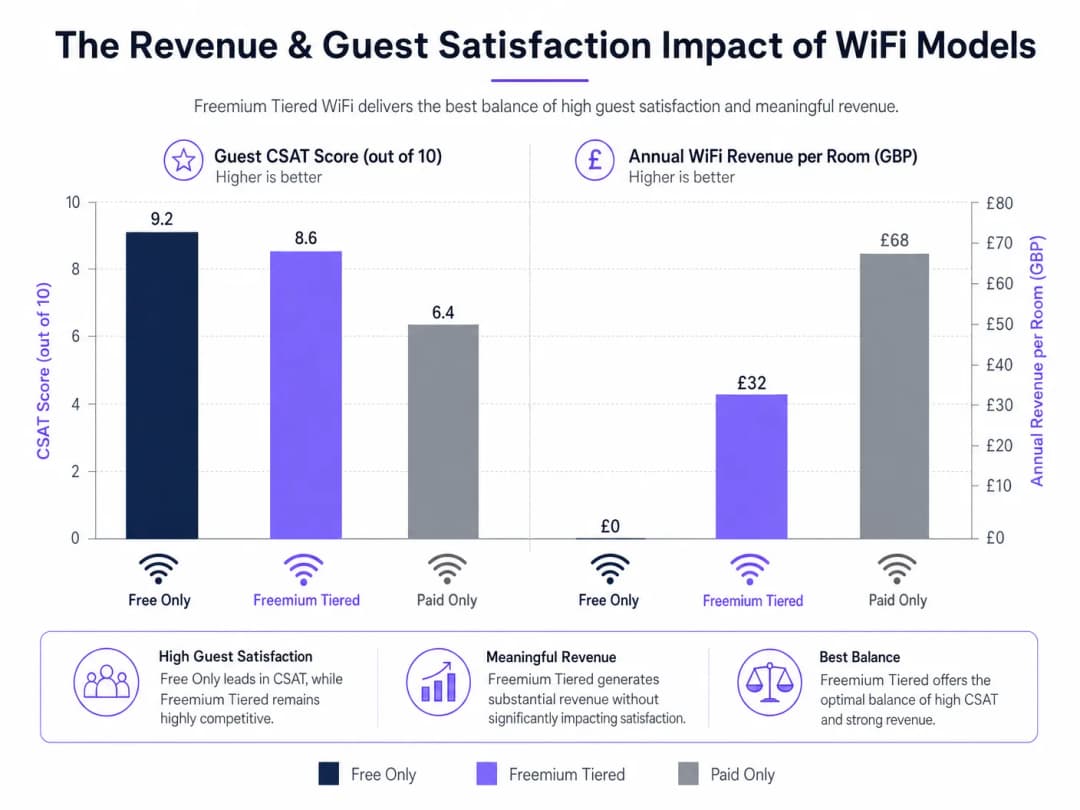
This guide provides IT leaders and venue operators with a definitive framework for choosing between free, paid, and tiered WiFi models in hospitality environments. It analyzes the technical architecture, business impact, and guest satisfaction metrics required to successfully monetize connectivity while maintaining enterprise-grade security and CCPA/CPRA compliance. Operators who implement the Freemium Tiered model can generate meaningful ancillary revenue while preserving the high CSAT scores that drive repeat bookings.
Video overview
Listen to this guide
View podcast transcript
Part of our core series: Guest WiFi Guide →

Executive Summary
The debate between free and paid WiFi in hospitality and large-scale venues is no longer a simple choice. With bandwidth demand steadily increasing due to 4K streaming, cloud-based conferencing, and a massive volume of headless IoT devices, the traditional "free for all" model is buckling under pressure. Conversely, strict "pay-to-play" models are damaging Guest Satisfaction (CSAT) scores and driving negative online reviews.
For IT managers, network architects, and CTOs, the sweet spot lies in the Freemium Tiered Model. This approach provides free, basic connectivity for all guests while offering high-speed, premium tiers for power users. This guide explores the technical architecture required to implement tiered bandwidth, the business case for driving ancillary revenue, and how platforms like Guest WiFi and WiFi Analytics transform a cost center into a strategic asset. The analysis below is relevant to any venue operator, whether managing a 50-room boutique hotel, a massive conference center, or a stadium - anywhere a decision on paid wifi service needs to be made with confidence.
The Business Case: Free vs. Paid vs. Tiered
When evaluating paid wifi service, venue operators must balance infrastructure costs with modern guest expectations. The industry has largely converged around three primary models, each with distinct financial and operational trade-offs.
1. The "Free Only" Model
Offering entirely free WiFi is often considered a baseline expectation, especially in budget and mid-scale hospitality and retail environments. Over 84% of hotel guests cite free WiFi as a key factor in booking decisions, making it almost an essential amenity.
Pros: High initial guest satisfaction; frictionless onboarding; positive impact on OTA review scores.
Cons: No direct ROI to offset rising bandwidth costs; network congestion caused by heavy users degrades the experience for everyone; missed opportunity to capture first-party data if not implemented with a Captive Portal and proper authentication.
2. The "Paid Only" Model
Charging every guest for access is now highly uncommon and generally restricted to ultra-budget carriers, specific transport hubs, or legacy systems that have not been modernized.
Pros: Direct revenue generation; naturally caps bandwidth consumption; easy to implement on older hardware.
Drawbacks: Severe negative impact on CSAT; extreme friction during onboarding; actively discourages bookings in a market where connectivity is seen as a right, not a privilege.
3. The "Freemium Tier" Model
This is the enterprise standard. A baseline speed (e.g., 5 Mbps per device) is provided for free in exchange for guest data via a splash page, while higher speeds (e.g., 25 Mbps or 100 Mbps) are monetized through a daily or per-stay fee.
Benefits: Balances guest expectations with revenue generation; enables targeted marketing through first-party data capture; ensures fair bandwidth allocation through QoS; integrates with loyalty programs.
Drawbacks: Requires sophisticated network management, a capable WiFi gateway, and seamless integration with the Property Management System (PMS).

Technical Analysis: Architecting Tiered Access
Implementing a tiered model requires robust network architecture. It is not simply a matter of throttling a router; it demands enterprise-grade access points, intelligent controllers, and secure authentication frameworks that comply with IEEE 802.1X and WPA3 standards.
Bandwidth Allocation and Quality of Service (QoS)
To successfully deploy a paid WiFi service, the network must dynamically allocate bandwidth. This is achieved through Quality of Service (QoS) policies managed at the controller level - either on-premises or, increasingly, via cloud-managed platforms.
| Tier | Throughput Cap | Common Use Case | QoS Priority |
|---|---|---|---|
| Free Basic | 5 Mbps per device | Email, browsing, social media | Low |
| Standard | 25 Mbps per device | HD streaming, standard VPN | Medium |
| Premium | 100 Mbps per device | 4K video, conferencing, large uploads | High |
As discussed in our Hotel WiFi Speed: What Guests Expect and How to Deliver It guide, setting these thresholds correctly is critical to avoiding guest frustration. A poorly calibrated free tier that cannot support even a basic YouTube stream will generate more negative reviews than a paid-only model.
Secure Authentication and Integration
A seamless onboarding experience is paramount. The legacy method of shared passwords (PSK) is a security risk and introduces friction. Modern deployments use a layered authentication approach. Captive Portals: For the free tier, guests authenticate via a branded splash page, accepting terms and providing data (e.g., email, marketing consent). This is the foundation of the WiFi Analytics data pipeline and feeds directly into CRM systems.
PMS Integration: For premium tiers, the WiFi gateway integrates directly with the hotel's PMS (e.g., Oracle Opera, Mews, or Apaleo). Guests authenticate using their room number and last name, and premium charges are automatically posted to their folio - no credit card is required on the portal.
Passpoint / OpenRoaming (IEEE 802.11u): For returning guests or loyalty members, Passpoint enables seamless, password-less, and individually encrypted (WPA3-Enterprise) connections, completely eliminating the need for a Captive Portal and providing a cellular-like roaming experience.
Network Segmentation and Security
Network segmentation via VLANs is a non-negotiable security requirement, particularly for PCI-DSS compliance in retail and hospitality environments. Guest traffic, staff traffic, and IoT/operational traffic must be on completely separate logical networks, even if they share the same physical access points.
A compromised guest device on an unsegmented network could access POS systems, smart locks, and internal management interfaces. VLANs prevent this lateral movement entirely.
-
Got questions about your specific setup?
Our team works with venue operators, IT managers, and network engineers across 80,000 venues. Book a 20-minute call and we will show you how others like you solved it.
Implementation Guide
Deploying a tiered WiFi model requires careful planning to ensure compliance, security, and a seamless guest experience. The following steps apply to both greenfield deployments and upgrades of existing infrastructure.
Step 1: Baseline Assessment. Conduct a comprehensive site survey. Assess current bandwidth usage, identify coverage gaps, and evaluate existing hardware. Ensure the backhaul - typically a dedicated fiber leased line - can support the projected peak load. For more on backhaul requirements, see What is a Leased Line? Dedicated Business Internet.
Step 2: Define Tiers. Establish clear, communicable tiers with pricing that reflects the value provided. A common structure is: Basic (Free, 5 Mbps), Business ($5 - $10/day, 25 Mbps), and Pro ($15+/day, 100 Mbps uncapped).
Step 3: Design the Captive Portal. The portal must be branded, mobile-responsive, and legally compliant. Ensure clear, unchecked opt-in checkboxes for marketing to adhere to CCPA/CPRA. The portal must clearly articulate the value proposition of the premium tier and minimize upgrade friction.
Step 4: Implement network segmentation. Configure VLANs on the controller to separate guest, staff, and operational traffic. Apply QoS policies per VLAN to enforce tier boundaries.
Step 5: Integrate with PMS and CRM. Connect the WiFi gateway to the PMS for automated folio billing. Feed captured guest data into the CRM for post-stay marketing campaigns.
Step 6: Testing and monitoring. Perform load testing before go-live. Set up continuous monitoring dashboards to track bandwidth utilization, tier adoption rates, and revenue per available room (WiFi contribution to RevPAR).
-
Best Practices
The following recommendations reflect vendor-neutral industry standards and operational experience across hospitality, retail, and events environments.
Implement WPA3 on all tiers. WPA3 provides individual data encryption per device, meaning that even on a shared free tier, one guest cannot intercept another's traffic. This is a significant improvement over WPA2 and is now supported by all modern client devices.
Use client isolation on guest VLANs. Even within the same VLAN, guest devices should be blocked from communicating directly with one another. This mitigates peer-to-peer attack vectors.
Enforce rate limiting at the AP level, not just the gateway. Controller-level QoS is more granular and responsive than gateway-level throttling, and prevents any single device from monopolizing the radio resources of a shared access point.
Audit CCPA/CPRA compliance on a quarterly basis. Ensure that the Captive Portal's consent mechanisms, data retention policies, and third-party data-sharing agreements are regularly reviewed. The average fine for data breaches is significant, and hospitality is a high-risk sector.
ROI and Business Impact
Transitioning to a tiered model converts WiFi from a sunk cost into a measurable revenue stream with multiple contributing factors.
Direct revenue: Premium tier purchases provide direct, high-margin ancillary revenue. At a 200-room property with 70% occupancy, if 10% of guests purchase a $10 premium upgrade, the property generates approximately $5,110 per month in direct WiFi revenue - enough to offset the annual infrastructure cost in many mid-scale properties.
Indirect revenue (data capture): The free tier acts as a lead generation engine. By capturing verified email and CRM data, venues can drive direct bookings, promote on-site F&B, and boost loyalty program sign-ups - each bypassing OTA commission fees that typically consume 15-25% of room revenue.
Operational Intelligence: WiFi Analytics platforms like Purple provide foot traffic heatmaps, dwell time analysis, and repeat visitor tracking. This data informs staffing decisions, promotional timing, and space utilization - leading to operational savings that compound over time.
Risk Mitigation: A poorly managed, open network poses significant legal and reputational risks. A properly architected, tiered system with WPA3, client isolation, and VLAN segmentation minimizes man-in-the-middle attack threats and demonstrates due diligence under CCPA/CPRA and PCI DSS.
The same principles apply to operators in adjacent sectors. WiFi in Auto: The Complete 2026 Enterprise Guide shows how tiered connectivity models are being deployed in automotive retail and service environments, and the healthcare sector is rapidly adopting similar frameworks for patient and visitor WiFi.
Troubleshooting and Risk Mitigation
Issue: Premium guests are reporting slow speeds despite paying for the top tier. Root Cause: QoS policies are not applied at the AP level, only at the gateway. A single AP serving 40+ devices can become a radio bottleneck regardless of gateway-level policies. Resolution: Enforce per-AP airtime fairness and ensure AP density is sufficient for the expected concurrent device count. A general rule of thumb is one AP per 20-25 concurrent devices in high-density environments.
Issue: Guests are unable to connect smart TVs or gaming consoles. Root Cause: Headless devices cannot navigate Captive Portals. Resolution: Deploy iPSK (Individual Pre-Shared Keys) to allow browserless, room-specific device onboarding. Guests generate keys via the hotel app or an in-room QR code.
Issue: CCPA/CPRA compliance concerns over data capture. Root Cause: Poorly designed consent flows on the Captive Portal. Resolution: Ensure the portal uses explicit, unchecked opt-in checkboxes for marketing. Implement a clear data retention policy and ensure the privacy notice is linked and accessible. Enterprise platforms handle this.
Key Definitions
Captive Portal
A web page that users must view and interact with before access is granted to a public WiFi network, typically used for authentication, marketing consent capture, or payment.
Essential for enforcing the free tier, capturing CCPA/CPRA-compliant marketing data, and presenting the upsell options for premium tiers. The design of the portal directly impacts both conversion rates and compliance posture.
Quality of Service (QoS)
Network management technologies that prioritize certain types of traffic or limit the bandwidth available to specific users, devices, or traffic classes.
The core mechanism used to enforce bandwidth caps on the free tier and guarantee throughput for paying premium guests. Must be configured at both the controller and AP level for maximum effectiveness.
Property Management System (PMS)
The central software system used by hotels to manage reservations, billing, room assignments, and guest profiles.
The WiFi gateway must integrate with the PMS to authenticate guests by room number and automatically post premium WiFi charges to their folio, enabling frictionless billing without a separate payment step.
Passpoint (Hotspot 2.0 / IEEE 802.11u)
A WiFi Alliance protocol that enables seamless, secure, passwordless roaming between different WiFi networks using WPA3-Enterprise certificates.
Allows returning guests or loyalty members to connect automatically and securely without interacting with a captive portal, delivering a cellular-like roaming experience and eliminating the primary source of onboarding friction.
VLAN (Virtual Local Area Network)
A logical subnetwork that groups a collection of devices from different physical network segments, enforcing traffic isolation at the software level.
Used to securely segment guest traffic from operational traffic (POS systems, smart locks, staff devices) on the same physical access points. A mandatory control for PCI DSS compliance and general risk mitigation.
Ancillary Revenue
Income generated from goods or services other than a company's primary product offering - in hospitality, anything beyond the base room rate.
Premium WiFi tiers represent a high-margin form of ancillary revenue. Unlike F&B or spa services, WiFi upgrades have near-zero marginal cost once the infrastructure is deployed, making them exceptionally profitable.
iPSK (Individual Pre-Shared Key)
A security method that provides a unique WiFi password for each user, room, or device on the same SSID, without requiring a full 802.1X infrastructure.
Crucial for securely connecting headless IoT devices - smart TVs, gaming consoles, streaming sticks - that cannot navigate a captive portal. Each room receives a unique key, maintaining isolation between guests.
Freemium Tiered Model
A service delivery model in which a baseline level of service is provided for free, with enhanced features or performance available at a premium price.
The dominant WiFi business model in modern hospitality. The free tier drives CSAT and data capture; the premium tier drives direct revenue. The model is only viable with robust QoS enforcement to ensure the paid tier delivers a meaningfully better experience.
RevPAR (Revenue Per Available Room)
A hotel performance metric calculated by multiplying the average daily room rate by the occupancy rate.
WiFi revenue and the indirect bookings driven by WiFi data capture both contribute to RevPAR. London hotel forecasts for 2026 project approximately 1.8% RevPAR growth, with tech-enabled guest experiences cited as a key driver.
Worked Examples
A 300-room luxury hotel is experiencing guest complaints about slow WiFi during peak evening hours. They currently offer a single, free, unthrottled network with a shared password. They need to improve performance for business travelers without alienating leisure guests. How should the IT team restructure the deployment?
Step 1: Replace the shared PSK with a Captive Portal integrated with the PMS (Oracle Opera). Step 2: Implement a Freemium Tiered model with three tiers: Free (10 Mbps, email authentication for CRM data capture), Business (50 Mbps, $10/day, PMS-authenticated and billed to folio), and Premium (100 Mbps, $20/day, same billing mechanism). Step 3: Configure QoS policies at the controller level to enforce per-device bandwidth caps on the free tier and guarantee throughput for paid tiers. Step 4: Deploy Passpoint profiles via the hotel loyalty app so that elite loyalty members automatically receive the Business tier for free upon arrival, with no portal interaction. Step 5: Implement VLAN segmentation to isolate guest traffic from POS and operational systems.
A large conference center is hosting a 2,000-person technology summit. The event organizer requires a dedicated, secure network for exhibitors running POS and demo hardware, and a separate general-access network for attendees. The venue's IT team must deliver both on the existing physical AP infrastructure. How is this architected?
Step 1: Utilize VLAN segmentation on the existing cloud-managed AP infrastructure to create two logical networks on the same physical hardware. Step 2: Create a dedicated SSID for Exhibitors (e.g., 'TechSummit_Exhibitor') using WPA3-Enterprise or iPSK for secure, isolated connectivity. Each exhibitor receives a unique iPSK for their booth, preventing cross-exhibitor traffic. Guarantee 20 Mbps per exhibitor booth via QoS. Step 3: Create a public SSID for attendees (e.g., 'TechSummit_Guest') with a branded captive portal capturing attendee data for the event organizer. Apply a 5 Mbps per-device cap to manage the high concurrent device count. Step 4: Charge the event organizer a premium for the dedicated, high-SLA exhibitor network as a venue service.
Practice Questions
Q1. A mid-scale hotel chain's Operations Director wants to charge all guests $5 per day for WiFi to recoup hardware costs quickly. As the Network Architect, how do you advise them, and what alternative do you propose?
Hint: Consider the impact on OTA rankings, CSAT scores, and the indirect revenue potential of the free tier.
View model answer
A Paid Only model should be strongly discouraged. Over 80% of guests consider free WiFi a prerequisite, and charging a baseline fee actively damages CSAT scores, OTA review ratings, and booking conversion. Instead, recommend a Freemium Tiered approach: provide a free 5 Mbps tier in exchange for email capture via a captive portal, and offer a premium $10/day tier at 50 Mbps for power users. The free tier generates CRM data that drives direct bookings, reducing OTA commission costs. The premium tier generates direct ancillary revenue. At 70% occupancy with 10% premium adoption, a 200-room property generates over $6,500/month - sufficient to offset infrastructure costs without damaging the brand.
Q2. You are deploying a tiered WiFi system. How do you ensure that free-tier guests do not consume all available bandwidth and degrade the experience for paying premium guests?
Hint: Think about controller-level traffic shaping and where QoS policies are applied.
View model answer
This is managed through strict Quality of Service (QoS) policies at the network controller level. When a guest authenticates via the captive portal and selects the Free tier, the controller assigns their MAC address to a specific user group or VLAN with a bandwidth cap (e.g., 5 Mbps up/down). For Premium guests authenticated via PMS integration, they are assigned to a separate group with uncapped bandwidth and higher traffic priority. Additionally, per-AP airtime fairness settings prevent any single device from monopolizing the shared radio medium. This ensures the backhaul is never saturated by non-paying users, and the premium tier consistently delivers the experience guests paid for.
Q3. A luxury resort wants to offer seamless, passwordless WiFi to its top-tier loyalty members the moment they walk onto the property, without them ever seeing a captive portal. How is this technically achieved, and what security protocol underpins it?
Hint: Consider how cellular networks handle roaming authentication, and the WiFi equivalent.
View model answer
This is achieved using Passpoint (Hotspot 2.0), based on IEEE 802.11u. The hotel's loyalty app distributes a Passpoint profile containing a secure digital certificate to the member's device. When the member arrives, their device automatically discovers the Passpoint-enabled SSID, exchanges the certificate in the background using WPA3-Enterprise and 802.1X authentication, and connects without any user interaction or captive portal. The network controller validates the certificate, confirms elite status, and assigns the device to the Premium QoS VLAN. Each connection is individually encrypted, providing far stronger security than a shared PSK. The experience is identical to how a cell phone automatically connects to a roaming cellular network in a foreign country.
Q4. A hotel is planning to deploy smart TVs and Apple TV devices in all 150 guest rooms. These devices cannot navigate a captive portal. How should the IT team handle their network onboarding?
Hint: Consider authentication methods that do not require a browser.
View model answer
The correct approach is to deploy Individual Pre-Shared Keys (iPSK). Each guest room is assigned a unique, secure WiFi password that is different from every other room. Guests can retrieve their room-specific key via a QR code on the in-room welcome card or through the hotel app. They enter this key directly into the smart TV or Apple TV settings. The network controller recognizes the unique key, authenticates the device, and assigns it to the correct room's VLAN - ensuring the device is isolated from other guests' devices. This approach maintains enterprise-grade security without requiring a browser-based captive portal interaction.
Continue reading in this series
How to Set Up Guest WiFi: A Secure Enterprise Configuration Guide
This authoritative guide provides IT leaders and network architects with a definitive blueprint for deploying secure enterprise guest WiFi. It covers essential architecture, WPA3 migration, VLAN segmentation, and captive portal integration to protect internal systems while capturing compliant first-party data.
How to Fix Slow WiFi Without Upgrading Your Internet Plan
A comprehensive technical reference guide for IT managers and network architects on optimizing enterprise WiFi performance without increasing ISP bandwidth. Covers RF tuning, client density management, QoS implementation, and how to leverage WiFi analytics to diagnose and resolve bottlenecks.
How to Build a Campus WiFi Network: A University IT Guide
This technical guide provides a comprehensive blueprint for designing and deploying high-density campus WiFi networks, covering everything from active site surveys and access point placement to controller architecture, seamless roaming, and secure guest onboarding. It is written for IT managers, network architects, and CTOs at universities and large venues who need actionable guidance to plan and execute a wireless deployment this quarter. The guide also maps Purple's Guest WiFi and analytics platform to real integration points within the deployment lifecycle.
Got questions about your specific setup?
Our team works with venue operators, IT managers, and network engineers across 80,000 venues. Book a 20-minute call and we will show you how others like you solved it.