
Zero Trust Network Access: Estrategias de implementación y mejores prácticas
Esta guía de referencia técnica proporciona a los líderes de TI y arquitectos de red un plan práctico para la implementación de Zero Trust Network Access (ZTNA) en entornos empresariales. Cubre la arquitectura central, las estrategias de microsegmentación y las metodologías de despliegue paso a paso para proteger entornos complejos sin interrumpir las operaciones.
Video overview
Escuchar esta guía
Ver transcripción del podcast
Parte de nuestra serie principal: Guía de seguridad para WiFi empresarial →

Resumen Ejecutivo
El modelo tradicional de seguridad basado en el perímetro ha quedado obsoleto. Para los recintos empresariales, que abarcan desde hoteles de 500 habitaciones hasta grandes complejos comerciales y estadios de alta densidad, asumir que el tráfico de la red interna es intrínsecamente seguro constituye una vulnerabilidad crítica. El acceso a la red de confianza cero (ZTNA) sustituye esta hipótesis errónea por un marco estricto basado en la identidad: verificar todo, no confiar en nadie por defecto y aplicar el acceso con el menor privilegio posible en todos los niveles.
Esta guía de referencia proporciona a los responsables de TI, arquitectos de red y directores de operaciones de recintos un plan práctico para la implementación del acceso a la red de confianza cero. Evita la teoría académica para centrarse en el despliegue práctico: la integración de proveedores de identidad, la implementación de la microsegmentación en entornos heredados complejos y la gestión de la verificación del estado de los dispositivos, tanto para los endpoints corporativos gestionados como para los dispositivos de invitados no gestionados. Al implementar estas estrategias, los recintos pueden proteger su infraestructura de Guest WiFi, aislar los sistemas de pago para mantener el cumplimiento de PCI-DSS y proteger la tecnología operativa crítica sin afectar a la experiencia del usuario.
Análisis técnico en profundidad
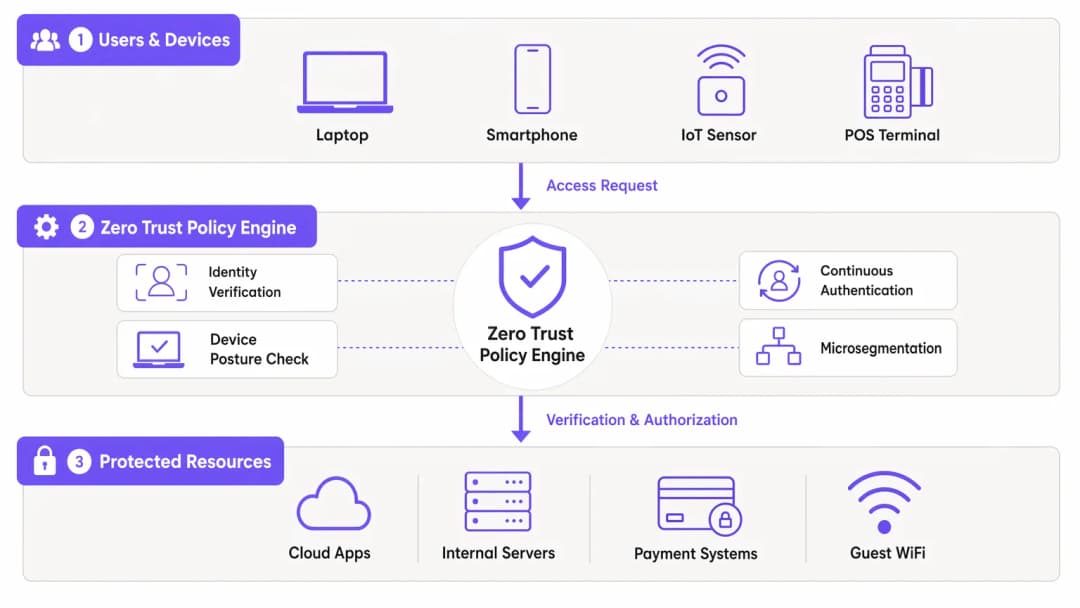
Una arquitectura robusta de acceso a la red Zero Trust se basa en la coordinación de varios componentes principales, trasladando el perímetro de seguridad desde el límite de la red hacia la identidad individual y el dispositivo.
Control de acceso basado en la identidad
En el modelo ZTNA, las decisiones de acceso se basan exclusivamente en la identidad verificada en lugar de la ubicación de la red. Un usuario que se conecta a un puerto de switch en la oficina administrativa no recibe más confianza inherente que un invitado que se conecta desde un punto de acceso público. En entornos de grandes recintos, las políticas de identidad deben adaptarse a categorías de usuarios muy diversas.
Para empleados y contratistas, la autenticación suele basarse en 802.1X vinculada a un directorio central (como Active Directory o Azure AD). Para los usuarios invitados, la verificación de la identidad se realiza a través de un Captive Portal o mecanismos de inicio de sesión social. La plataforma de Purple actúa como un proveedor de identidad clave en este contexto, capturando la identidad verificada en el momento de la conexión y transmitiendo este contexto a los puntos de aplicación de políticas posteriores.
Verificación del estado del dispositivo
La identidad por sí sola no es suficiente; el endpoint de conexión también debe ser verificado. La verificación del estado del dispositivo evalúa el estado de seguridad del terminal antes de conceder el acceso. Para los dispositivos corporativos gestionados, esto incluye comprobar la seguridad activa del endpoint, los niveles de parches del sistema operativo y el registro en el MDM.
Para los dispositivos no gestionados - como los de la red de Guest WiFi - la comprobación del estado es limitada, lo que requiere una política de denegación por defecto para el enrutamiento interno. Estos dispositivos se colocan en un segmento aislado con acceso exclusivo a internet. El motor de políticas evalúa dinámicamente estos parámetros en el momento de la conexión y de forma continua a lo largo de la sesión.
Autenticación continua y detección de amenazas
Las redes tradicionales se autentican una vez y mantienen la sesión indefinidamente. ZTNA exige una autenticación continua. El motor de políticas supervisa el comportamiento de la sesión, el volumen de datos y el uso de protocolos. Los patrones anómalos activan la reautenticación o la terminación inmediata de la sesión. Esta telemetría se envía a las plataformas SIEM, lo que permite la detección de amenazas en tiempo real y una respuesta rápida ante intentos de movimiento lateral.
¿Tiene preguntas sobre su configuración específica?
Nuestro equipo trabaja con operadores de recintos, responsables de TI e ingenieros de redes en 80 000 espacios. Reserve una llamada de 20 minutos y le mostraremos cómo lo han solucionado otros profesionales como usted.
Guía de implementación
El despliegue de ZTNA en el entorno de un recinto en producción requiere un enfoque por fases y sistemático para evitar interrupciones operativas.
Paso 1: Descubrimiento y categorización
Antes de modificar las políticas, debe establecer un inventario exhaustivo de todos los dispositivos, usuarios y cargas de trabajo. En sectores como la Hospitality o el Retail, es habitual encontrar dispositivos IoT no documentados y sistemas heredados. Utilice herramientas de descubrimiento de red para mapear los flujos de tráfico existentes e identificar todos los endpoints conectados.
Paso 2: Diseño de la segmentación
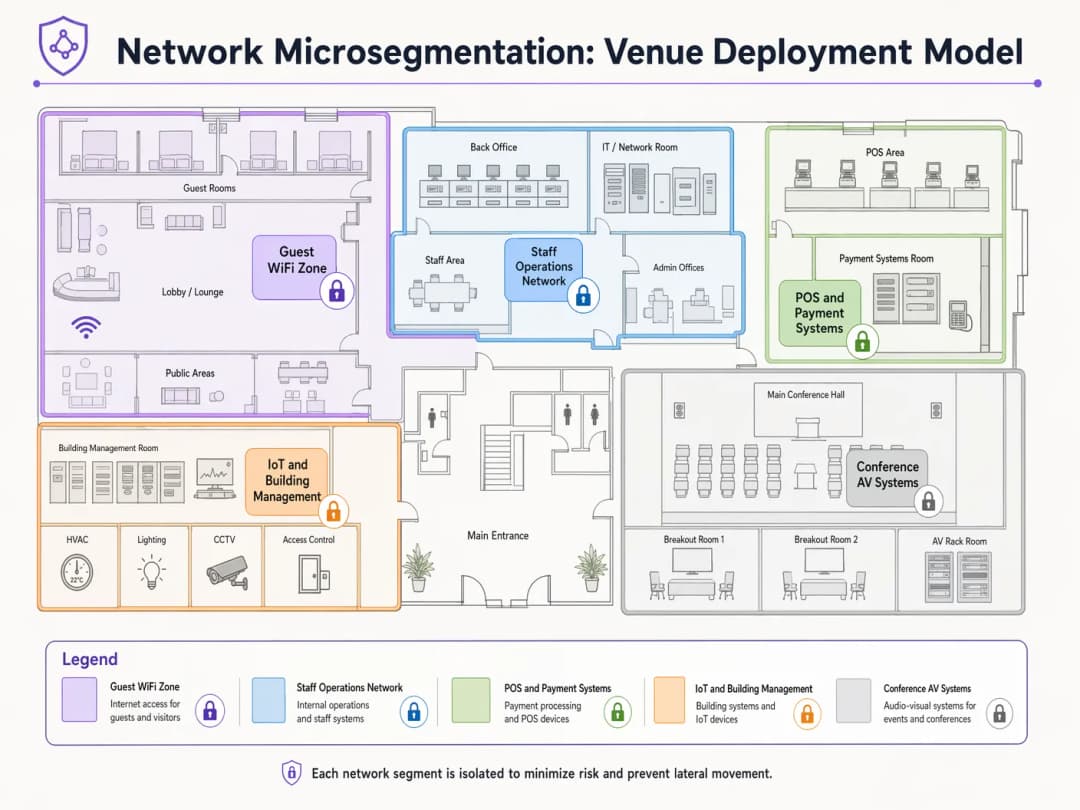
Asigne los segmentos de red de acuerdo con las funciones empresariales y los requisitos de cumplimiento. Un recinto típico requiere segmentos separados para:
- Guest WiFi: acceso exclusivo a internet.
- Operaciones del personal: acceso a aplicaciones internas.
- Sistemas de pago (POS): completamente aislados para el cumplimiento de PCI-DSS.
- Gestión de edificios/IoT: restringido a servidores de control esenciales.
Defina los flujos de tráfico permitidos entre estos segmentos utilizando una postura de denegación por defecto.
Paso 3: Integración de identidad
Integre su motor de políticas ZTNA con sus proveedores de identidad. Conecte los directorios corporativos para el personal y configure las plataformas de acceso de invitados para verificar las identidades de los mismos. Asegúrese de que los mecanismos de autenticación basados en perfiles sean robustos y escalables para gestionar la capacidad máxima del recinto.
Paso 4: Despliegue de políticas (modo de monitorización)
Inicialmente, despliegue las políticas en modo de solo observación. Esto proporciona visibilidad sobre el tráfico que se bloquearía, lo que le permitirá refinar las reglas sin interrumpir los procesos empresariales legítimos. Tras un periodo de monitorización de 2 - 4 semanas, realice la transición al modo de ejecución.
Buenas prácticas
- Asuma la brecha de seguridad: diseñe su red bajo la premisa de que un atacante ya ha comprometido un endpoint. La microsegmentación contra el movimiento lateral es su defensa principal.
- Aproveche 802.1X y WPA3: aplique una autenticación y un cifrado sólidos en la capa de acceso. Consulte la guía Solución de problemas de autenticación 802.1X en Windows 11 para obtener ayuda con el despliegue.
- Automatice la identidad de los invitados: utilice plataformas que capturen y verifiquen sin problemas la identidad de los invitados sin crear una fricción excesiva. Consulte Protección de redes Guest WiFi: buenas prácticas e implementación.
- Aisle los dispositivos IoT: los sensores IoT y los sistemas de gestión de edificios rara vez requieren acceso a internet o enrutamiento entre segmentos. Aíslelos por completo.
Solución de problemas y mitigación de riesgos
El modo de fallo más común en las implementaciones de Zero Trust Network Access es la aplicación agresiva de políticas sin un descubrimiento adecuado. Esto bloquea el tráfico crítico para el negocio y obliga a revertir los proyectos.
Riesgo: los dispositivos heredados (por ejemplo, terminales POS más antiguos o controladores de HVAC) pueden no ser compatibles con los protocolos de autenticación modernos. Mitigación: utilice el bypass de autenticación MAC (MAB) combinado con una microsegmentación y un perfilado estrictos para incorporar estos dispositivos de forma segura sin comprometer la arquitectura ZTNA global.
Riesgo: la elevada sobrecarga de la aplicación de políticas degrada el rendimiento de la red de invitados. Mitigación: Desvíe el enrutamiento del tráfico de invitados directamente a Internet en el extremo, omitiendo los motores de inspección interna profunda a menos que la inteligencia de amenazas específica indique lo contrario.
ROI e Impacto Comercial
La implementación de ZTNA ofrece un valor comercial medible que va más allá de la reducción de riesgos:
- Reducción de los Costes de Cumplimiento: Al aislar por completo el Entorno de Datos de Tarjetas de Pago (CDE) mediante la microsegmentación, los recintos reducen significativamente el alcance y el coste de las auditorías de PCI-DSS.
- Resiliencia Operativa: Limitar las brechas de seguridad a un único segmento evita interrupciones en todo el recinto, protegiendo las vías de ingresos durante las horas punta de funcionamiento.
- Analíticas Mejoradas: Los datos detallados de identidad y tráfico generados por las políticas de ZTNA enriquecen las WiFi Analytics, proporcionando información más profunda sobre el comportamiento de los usuarios y el uso de la red.
Definiciones clave
Microsegmentación
La práctica de dividir una red en segmentos aislados para reducir la superficie de ataque y evitar el movimiento lateral.
Crucial para los equipos de TI de los establecimientos para aislar los sistemas POS de la red de WiFi para invitados y de las redes del personal, garantizando el cumplimiento normativo y conteniendo posibles brechas de seguridad.
Verificación del estado del dispositivo
El proceso de evaluar el estado de seguridad de un endpoint (por ejemplo, la versión del sistema operativo o el estado del antivirus) antes de conceder acceso a la red.
Se utiliza para garantizar que los dispositivos del personal que no estén actualizados o que estén comprometidos no puedan acceder a aplicaciones internas sensibles.
Autenticación continua
La supervisión continua de la sesión de un usuario para garantizar que su identidad y comportamiento sigan siendo válidos y no presenten anomalías.
Vital en entornos de alta rotación como estadios para detectar el secuestro de sesiones o intentos inusuales de exfiltración de datos.
IEEE 802.1X
Un estándar para el control de acceso a la red basado en puertos que proporciona un mecanismo de autenticación a los dispositivos que desean conectarse a una LAN o WLAN.
El protocolo fundamental utilizado por los arquitectos de red para autenticar de forma segura los dispositivos corporativos.
Movimiento lateral
Técnicas que los ciberatacantes utilizan para avanzar progresivamente a través de una red mientras buscan datos y activos clave.
La principal amenaza que ZTNA y la microsegmentación están diseñadas para neutralizar en las redes heredadas planas.
Perímetro definido por software (SDP)
Un enfoque de seguridad que oculta la infraestructura conectada a internet para que los terceros externos y atacantes no puedan verla, ya sea que esté alojada de forma local o en la nube.
A menudo se utiliza como el mecanismo de implementación técnica para desplegar políticas de acceso ZTNA.
Acceso de mínimo privilegio
El principio de seguridad de otorgar a los usuarios y sistemas únicamente el nivel mínimo de acceso necesario para realizar sus funciones requeridas.
El marco de políticas rectoras que los administradores de TI deben utilizar al definir las reglas dentro del motor de políticas de ZTNA.
MAC Authentication Bypass (MAB)
Un método de autenticación de respaldo que utiliza la dirección MAC de un dispositivo para otorgar acceso a la red cuando no se admite 802.1X.
Utilizado pragmáticamente por los equipos de red para incorporar dispositivos IoT heredados (como impresoras antiguas o sistemas de climatización) en segmentos de red aislados.
Ejemplos prácticos
Un hotel de 400 habitaciones necesita desplegar nuevas televisiones inteligentes en todas las habitaciones de los huéspedes. Estos dispositivos requieren acceso a internet para servicios de streaming y acceso a la red local al sistema de gestión de la propiedad (PMS) para saludos personalizados y revisión de facturación. ¿Cómo se debería implementar esto bajo un modelo ZTNA?
- Coloque todas las televisiones inteligentes en un microsegmento dedicado de "Entretenimiento en habitaciones de huéspedes". 2. Configure políticas para permitir el acceso a internet saliente para streaming. 3. Implemente una política estricta y unidireccional de pasarela de API que permita a las televisiones consultar el PMS en puertos específicos (por ejemplo, HTTPS/443) solo para los endpoints requeridos. 4. Deniegue todo el tráfico lateral entre televisiones individuales y deniegue todo el tráfico entrante desde internet.
Una gran cadena minorista está implementando tabletas de punto de venta móviles (mPOS) para el personal en la tienda. Estas tabletas se conectan a través de WiFi. ¿Cómo se protege este despliegue?
- Autentique las tabletas mediante IEEE 802.1X basado en certificados (EAP-TLS). 2. Implemente verificaciones de estado del dispositivo a través de la integración con MDM para garantizar que la tableta cumple con los requisitos (actualizada, sin rootear) antes de otorgar el acceso. 3. Asigne dinámicamente las tabletas a un VLAN o segmento "mPOS" altamente restringido. 4. Permita el tráfico únicamente a las direcciones IP específicas de la pasarela de pago y a las API de inventario interno.
Preguntas de práctica
Q1. El director de TI de un estadio quiere permitir que los proveedores externos (por ejemplo, el personal de catering) accedan a sus propios sistemas de inventario en la nube a través del WiFi del estadio. ¿Cómo se debe configurar esto?
Sugerencia: Considere la diferencia entre el acceso a datos corporativos y el acceso exclusivo a internet para terceros.
Ver respuesta modelo
Cree un SSID y un microsegmento dedicados para 'Proveedores' (Vendor WiFi). Autentique a los proveedores mediante un Captive Portal o claves precompartidas únicas (WPA3-SAE). Configure la política de segmento para permitir únicamente el acceso a internet de salida, denegando estrictamente cualquier enrutamiento a las redes operativas internas o a los sistemas TPV del estadio.
Q2. Durante un despliegue de ZTNA, el equipo de operaciones informa que varios escáneres de códigos de barras heredados en el almacén han dejado de funcionar. ¿Cuál es la causa probable y la solución inmediata?
Sugerencia: Piense en lo que sucede cuando los dispositivos no admiten protocolos de autenticación modernos.
Ver respuesta modelo
Es probable que los escáneres no admitan la autenticación 802.1X y hayan sido bloqueados por la nueva política de denegación predeterminada. La solución inmediata es implementar MAC Authentication Bypass (MAB) para las direcciones MAC específicas de los escáneres y ubicarlos en un microsegmento altamente restringido que solo permita el tráfico hacia el servidor de la base de datos de inventario.
Q3. Un CTO le pide que justifique el coste de implementar la microsegmentación en una red minorista de 50 tiendas. ¿Cuál es la principal justificación comercial?
Sugerencia: Enfóquese en la contención de riesgos y el impacto en el cumplimiento.
Ver respuesta modelo
La justificación principal es la contención de riesgos y la reducción del alcance del cumplimiento normativo. Al microsegmentar la red, una brecha en un segmento menos seguro (como un dispositivo IoT o el WiFi de invitados) no puede propagarse al Entorno de Datos de Tarjetas de Pago (CDE). Esto reduce drásticamente el alcance, la complejidad y el coste de las auditorías anuales de PCI-DSS, al tiempo que evita que un incidente localizado se convierta en una filtración de datos que afecte a toda la empresa.
Continúe leyendo esta serie
Cyber Essentials y WiFi para el personal: Cómo superar los cinco controles en su red inalámbrica
Podrá mapear cada uno de los cinco controles de Cyber Essentials en el WiFi de su personal y cerrar las brechas que encuentren los evaluadores. Después, podrá elegir entre 802.1X, iPSK y una red WPA2-PSK segregada para cada clase de dispositivo. Por último, sabrá cómo preparar los puntos de acceso, las controladoras y los dispositivos BYOD para una auditoría de Cyber Essentials Plus.
Analíticas de presencia de HPE Aruba Central: configuración, exportaciones y límites
Podrá habilitar las analíticas de presencia de Aruba Central por sitio, calibrar el umbral de RSSI y los límites de permanencia frente a un recuento real sobre el terreno, y exportar agregados a nivel de sitio a través de la API REST de Central. También conocerá dónde terminan las analíticas de presencia nativas y cuándo una capa de plataforma independiente del hardware como Purple se gana su lugar en sus puntos de acceso Aruba existentes.
Cumplimiento con CIPA: lista de verificación para operadores de establecimientos
Podrá decidir si CIPA vincula su WiFi, segmentar redes, enrutar DNS a través de Purple Shield y cerrar rutas de derivación. También sabrá qué pruebas conservar para la certificación del Formulario 486 o del Formulario 479. La lista de verificación asigna un responsable a cada requisito, para que no falte nada en la certificación de su próximo año de financiación.
¿Tiene preguntas sobre su configuración específica?
Nuestro equipo trabaja con operadores de recintos, responsables de TI e ingenieros de redes en 80 000 espacios. Reserve una llamada de 20 minutos y le mostraremos cómo lo han solucionado otros profesionales como usted.