
Zero Trust Network Access: Implementation Strategies and Best Practices
This technical reference guide provides IT leaders and network architects with a pragmatic blueprint for Zero Trust Network Access (ZTNA) implementation in enterprise venues. It covers core architecture, microsegmentation strategies, and step-by-step deployment methodologies to secure complex environments without disrupting operations.
Video overview
Listen to this guide
View podcast transcript
Part of our core series: Enterprise WiFi Security Guide →

Executive Summary
The traditional perimeter-based security model is now obsolete. For enterprise venues ranging from 500-room hotels to large retail complexes and high-density stadiums, assuming that internal network traffic is inherently secure is a critical vulnerability. Zero Trust Network Access (ZTNA) replaces this flawed assumption with a strict, identity-driven framework: verify everything, trust no one by default, and enforce least-privilege access at every level.
This reference guide provides IT managers, network architects, and venue operations directors with a practical blueprint for Zero Trust Network Access implementation. It bypasses academic theory to focus on practical deployment: integrating identity providers, implementing microsegmentation in complex legacy environments, and managing device posture verification for both managed corporate endpoints and unmanaged guest devices. By implementing these strategies, venues can secure their Guest WiFi infrastructure, isolate payment systems to maintain PCI-DSS compliance, and protect critical operational technology without impacting the user experience.
Technical Deep Dive
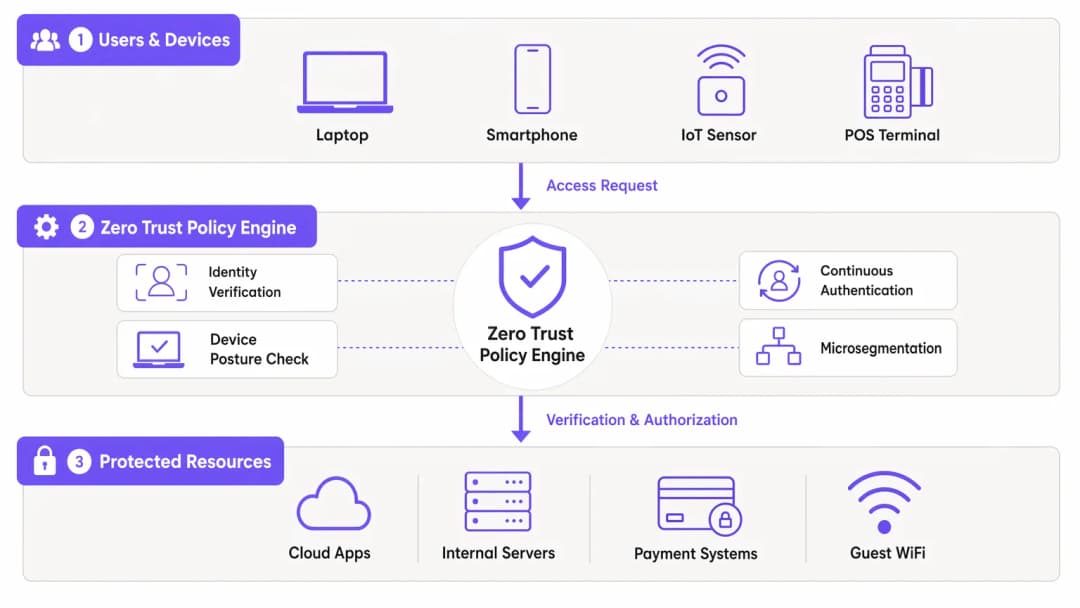
A robust Zero Trust Network Access architecture relies on the coordination of several core components, shifting the security perimeter from the network edge to individual identity and device.
Identity-Based Access Control
In the ZTNA model, access decisions are based entirely on verified identity rather than network location. A user connecting to a switch port in the back office receives no more inherent trust than a guest connecting from a public access point. In venue environments, identity policies must adapt to highly diverse user categories.
For employees and contractors, authentication typically relies on IEEE 802.1X tied to a central directory (such as Active Directory or Azure AD). For guest users, identity verification occurs via captive portals or social login mechanisms. Purple's platform acts as a key identity provider in this context, capturing verified identity at the time of connection and passing this context to downstream policy enforcement points.
Device Posture Verification
Identity alone is not enough; the connecting endpoint must also be verified. Device posture verification assesses the security status of the device before granting access. For managed corporate devices, this includes checking for active endpoint security, OS patch levels, and MDM enrollment.
For unmanaged devices - such as those on the Guest WiFi network - posture checking is limited, requiring a default-deny policy for internal routing. These devices are placed in an isolated segment with internet-only access. The policy engine dynamically evaluates these parameters at the time of connection and continuously throughout the session.
Continuous Authentication and Threat Detection
Traditional networks authenticate once and maintain the session indefinitely. ZTNA mandates continuous authentication. The policy engine monitors session behavior, data volume, and protocol usage. Anomalous patterns trigger re-authentication or immediate session termination. This telemetry is sent to SIEM platforms, enabling real-time threat detection and rapid response to lateral movement attempts.
Got questions about your specific setup?
Our team works with venue operators, IT managers, and network engineers across 80,000 venues. Book a 20-minute call and we will show you how others like you solved it.
Implementation Guide
Deploying ZTNA in a live venue environment requires a phased, systematic approach to avoid operational disruption.
Step 1: Discovery and Categorization
Before modifying policies, you must establish a comprehensive inventory of all devices, users, and workloads. In venues such as Hospitality or Retail, undocumented IoT devices and legacy systems are common. Use network discovery tools to map existing traffic flows and identify all connected endpoints.
Step 2: Segmentation Design
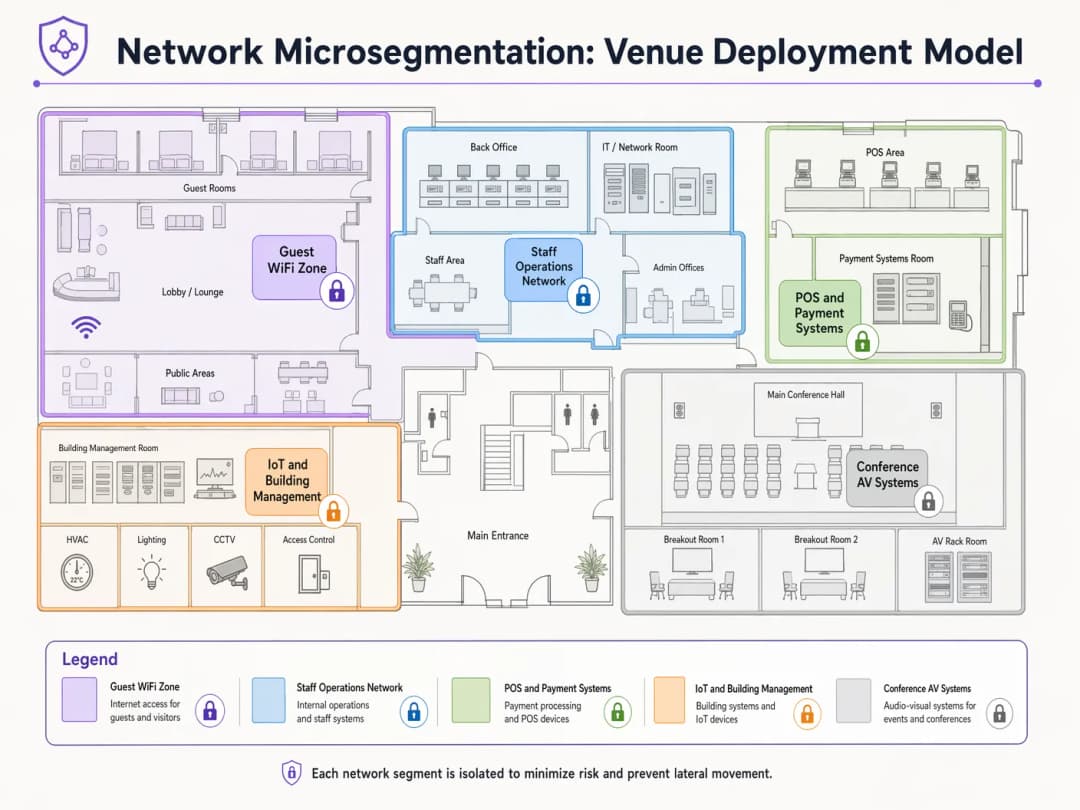
Map network segments according to business functions and compliance requirements. A typical venue requires separate segments for:
- Guest WiFi: Internet-only access.
- Staff Operations: Access to internal applications.
- Payment Systems (POS): Completely isolated for PCI-DSS compliance.
- Building Management/IoT: Restricted to essential control servers.
Define permitted traffic flows between these segments using a default-deny posture.
Step 3: Identity Integration
Integrate your ZTNA policy engine with your identity providers. Connect corporate directories for staff and configure guest access platforms to verify guest identities. Ensure that profile-based authentication mechanisms are robust and scalable to handle peak venue capacity.
Step 4: Policy Rollout (Monitoring Mode)
Initially deploy policies in observe-only mode. This provides visibility into the traffic that would be blocked, allowing you to refine rules without disrupting legitimate business processes. After a monitoring period of 2 - 4 weeks, transition to enforcement mode.
Best Practices
- Assume Breach: Design your network under the assumption that an attacker has already compromised an endpoint. Microsegmentation against lateral movement is your primary defense.
- Leverage 802.1X and WPA3: Enforce strong authentication and encryption at the access layer. Refer to the Troubleshooting Windows 11 802.1X Authentication Issues guide for deployment assistance.
- Automate Guest Identity: Use platforms that seamlessly capture and verify guest identity without creating excessive friction. See Securing Guest WiFi Networks: Best Practices and Implementation.
- Isolate IoT Devices: IoT sensors and building management systems rarely require internet access or cross-segment routing. Isolate them completely.
Troubleshooting and Risk Mitigation
The most common failure mode in Zero Trust Network Access implementations is aggressive policy enforcement without adequate discovery. This blocks business-critical traffic and forces project rollbacks.
Risk: Legacy devices (e.g., older POS terminals or HVAC controllers) may not support modern authentication protocols. Mitigation: Use MAC Authentication Bypass (MAB) combined with strict microsegmentation and profiling to securely onboard these devices without compromising the overall ZTNA architecture.
Risk: Heavy policy enforcement overhead degrades guest network performance. Mitigation: Offload guest traffic routing directly to the internet at the edge, bypassing deep internal inspection engines unless specific threat intelligence indicates otherwise.
ROI and Business Impact
Implementing ZTNA delivers measurable business value beyond risk reduction:
- Reduced Compliance Costs: By completely isolating the Cardholder Data Environment (CDE) through microsegmentation, venues significantly reduce the scope and cost of PCI-DSS audits.
- Operational Resilience: Limiting breaches to a single segment prevents venue-wide outages, safeguarding revenue streams during peak operational hours.
- Enhanced Analytics: Detailed identity and traffic data generated by ZTNA policies enriches WiFi Analytics, providing deeper insights into user behavior and network usage.
Key Definitions
Microsegmentation
The practice of dividing a network into isolated segments to reduce the attack surface and prevent lateral movement.
Critical for venue IT teams to isolate POS systems from Guest WiFi and staff networks, ensuring compliance and containing potential breaches.
Device Posture Verification
The process of assessing an endpoint's security state (e.g., OS version, antivirus status) before granting network access.
Used to ensure that unpatched or compromised staff devices cannot access sensitive internal applications.
Continuous Authentication
The ongoing monitoring of a user's session to ensure their identity and behavior remain valid and non-anomalous.
Vital in high-turnover environments like stadiums to detect session hijacking or unusual data exfiltration attempts.
IEEE 802.1X
A standard for port-based network access control that provides an authentication mechanism to devices wishing to attach to a LAN or WLAN.
The foundational protocol used by network architects to authenticate corporate devices securely.
Lateral Movement
Techniques that cyber attackers use to progressively move through a network as they search for key data and assets.
The primary threat that ZTNA and microsegmentation are designed to neutralize in flat legacy networks.
Software-Defined Perimeter (SDP)
A security approach that hides internet-connected infrastructure so that external parties and attackers cannot see it, whether it is hosted on-premises or in the cloud.
Often used as the technical implementation mechanism for deploying ZTNA access policies.
Least-Privilege Access
The security principle of granting users and systems only the minimum level of access necessary to perform their required functions.
The guiding policy framework IT managers must use when defining rules within the ZTNA policy engine.
MAC Authentication Bypass (MAB)
A fallback authentication method that uses a device's MAC address to grant network access when 802.1X is not supported.
Used pragmatically by network teams to onboard legacy IoT devices (like old printers or HVAC systems) into isolated network segments.
Worked Examples
A 400-room hotel needs to deploy new smart TVs in all guest rooms. These devices require internet access for streaming services and local network access to the property management system (PMS) for personalized greetings and billing review. How should this be implemented under a ZTNA model?
- Place all smart TVs in a dedicated 'Guest Room Entertainment' microsegment. 2. Configure policies to allow outbound internet access for streaming. 3. Implement a strict, unidirectional API gateway policy allowing the TVs to query the PMS on specific ports (e.g., HTTPS/443) only for the required endpoints. 4. Deny all lateral traffic between individual TVs and deny all inbound traffic from the internet.
A large retail chain is rolling out mobile Point of Sale (mPOS) tablets for staff on the sales floor. These tablets connect via WiFi. How do you secure this deployment?
- Authenticate the tablets using certificate-based IEEE 802.1X (EAP-TLS). 2. Implement device posture checks via MDM integration to ensure the tablet is compliant (patched, unrooted) before granting access. 3. Assign the tablets dynamically to a highly restricted 'mPOS' VLAN/segment. 4. Allow traffic only to the specific payment gateway IP addresses and internal inventory APIs.
Practice Questions
Q1. A stadium IT director wants to allow third-party vendors (e.g., catering staff) to access their own cloud-based inventory systems via the stadium's WiFi. How should this be configured?
Hint: Consider the difference between corporate data access and internet-only access for third parties.
View model answer
Create a dedicated 'Vendor WiFi' SSID and microsegment. Authenticate vendors using a captive portal or unique pre-shared keys (WPA3-SAE). Configure the segment policy to allow outbound internet access only, strictly denying any routing to the stadium's internal operational networks or POS systems.
Q2. During a ZTNA rollout, the operations team reports that several legacy barcode scanners in the warehouse have stopped working. What is the likely cause and immediate solution?
Hint: Think about what happens when devices cannot support modern authentication protocols.
View model answer
The scanners likely do not support 802.1X authentication and were blocked by the new default-deny policy. The immediate solution is to implement MAC Authentication Bypass (MAB) for the specific MAC addresses of the scanners and place them in a highly restricted microsegment that only allows traffic to the inventory database server.
Q3. A CTO asks you to justify the cost of implementing microsegmentation across a 50-site retail estate. What is the primary business justification?
Hint: Focus on risk containment and compliance impact.
View model answer
The primary justification is risk containment and compliance scope reduction. By microsegmenting the network, a breach in a less secure segment (like an IoT device or Guest WiFi) cannot spread to the Cardholder Data Environment (CDE). This dramatically reduces the scope, complexity, and cost of annual PCI DSS audits, while preventing a localized incident from becoming a company-wide data breach.
Continue reading in this series
SOC 2 Type II and Staff WiFi: Passing the Key Controls on Your Wireless Network
You will be able to map each of the key SOC 2 Type II controls to your staff WiFi and close the gaps auditors find. You can then choose between 802.1X, iPSK and a segregated WPA2-PSK network for each device class. Finally, you will know how to prepare access points, controllers and BYOD for a SOC 2 Type II audit.
HPE Aruba Central presence analytics: setup, exports and limits
You will be able to enable Aruba Central presence analytics per site, calibrate the RSSI threshold and dwell boundaries against a ground-truth count, and export site-level aggregates through the Central REST API. You will also know where native presence analytics stops and when a hardware-agnostic platform layer such as Purple earns its place on your existing Aruba access points.
CIPA compliance: compliance checklist for venue operators
You will be able to decide whether CIPA binds your WiFi, then segment networks, route DNS through Purple Shield and close bypass routes. You will also know what evidence to keep for Form 486 or Form 479 certification. The checklist assigns every requirement an owner, so your next funding year certification has nothing missing.
Got questions about your specific setup?
Our team works with venue operators, IT managers, and network engineers across 80,000 venues. Book a 20-minute call and we will show you how others like you solved it.