
Automatisation de la révocation des certificats avec OCSP et CRL dans un environnement NAC
Ce guide de référence technique offre aux responsables informatiques et aux architectes réseau une analyse complète de l'automatisation de la révocation des certificats dans un environnement de contrôle d'accès au réseau (NAC). Il explore les compromis d'architecture entre OCSP et CRL, propose des conseils de mise en œuvre neutres vis-à-vis des fournisseurs et présente l'impact commercial de l'application des politiques en temps réel.
Video overview
Écouter ce guide
Voir la transcription du podcast
Fait partie de notre série principale : Guide de sécurité WiFi d'entreprise →

Résumé opérationnel
Pour les directeurs informatiques et les architectes réseau d'entreprise gérant des environnements haute densité - tels que les établissements de l'hôtellerie, le commerce de détail et les déploiements du secteur public - la gestion du cycle de vie des certificats est une frontière de sécurité essentielle. Bien que l'IEEE 802.1X fournisse une authentification robuste pour les appareils d'entreprise et les terminaux personnels (BYOD), le mécanisme permettant de révoquer la confiance est souvent négligé jusqu'à ce qu'une faille se produise.
L'automatisation de la révocation des certificats dans un environnement de contrôle d'accès au réseau (NAC) via le protocole OCSP et les listes de révocation de certificats (CRL) comble le fossé entre le décommissionnement des terminaux et l'application des politiques réseau. Ce guide explore les mécanismes d'architecture de la révocation automatisée, en comparant les capacités en temps réel d'OCSP avec la résilience hors ligne des CRL.
En intégrant les plateformes de gestion des appareils mobiles (MDM), les autorités de certification (CA) et les moteurs de règles NAC, les organisations peuvent obtenir un accès réseau Zero-Trust où les appareils compromis ou mis hors service sont immédiatement bannis. Cette référence technique fournit des conseils de déploiement exploitables, des stratégies de l'atténuation des risques et explore comment cette posture de sécurité orientée personnel complète les infrastructures destinées au public telles que les plateformes de Guest WiFi et de WiFi Analytics de Purple.
Analyse technique approfondie
Dans tout réseau d'entreprise utilisant l'IEEE 802.1X avec EAP-TLS, les appareils s'authentifient à l'aide de certificats numériques plutôt que d'identifiants partagés. Cette approche est fondamentale pour les architectures de sécurité modernes, car elle fournit des identités liées aux appareils et s'intègre de manière transparente aux plateformes MDM via des protocoles tels que SCEP (pour aller plus loin, voir Le rôle de SCEP et du NAC dans l'infrastructure MDM moderne). Cependant, les certificats ont un cycle de vie défini. Lorsqu'un appareil est perdu, qu'un employé s'en va ou qu'une clé privée est compromise, l'infrastructure réseau doit être explicitement informée de ne plus faire confiance à ce certificat.
Cette instruction de révocation est transmise par deux mécanismes principaux : les CRL et OCSP.
Architecture des listes de révocation de certificats (CRL)
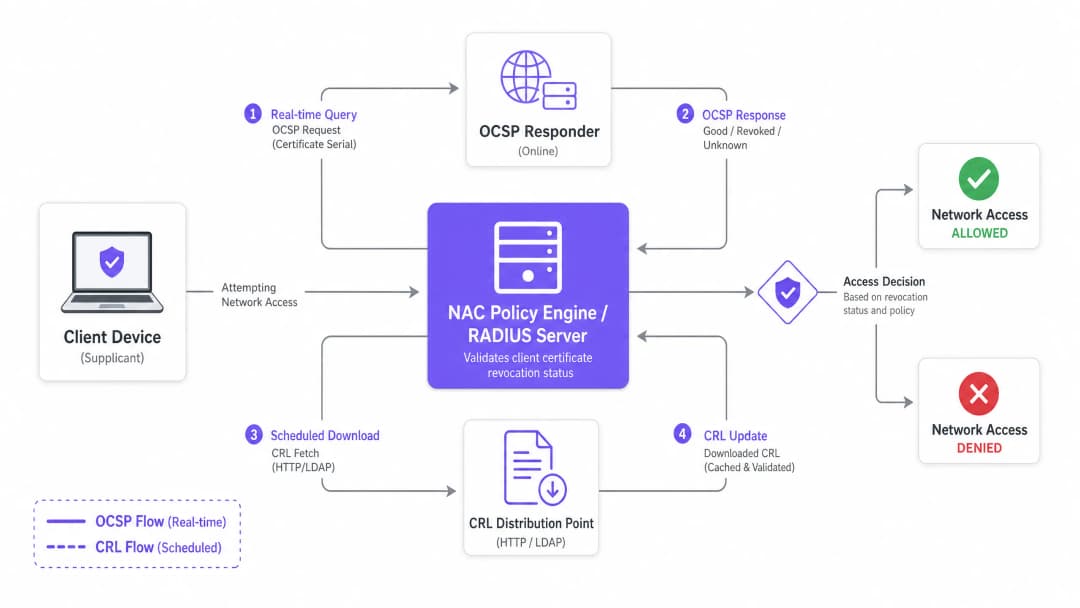
Une CRL est un fichier signé numériquement et publié par l'autorité de certification contenant les numéros de série de tous les certificats qui ont été révoqués mais qui n'ont pas encore expiré. Le moteur de règles du NAC (agissant en tant que serveur RADIUS) télécharge périodiquement cette liste à partir d'un point de distribution CRL (CDP) via HTTP ou LDAP.
Lors de la phase d'établissement de liaison EAP-TLS, le serveur RADIUS vérifie le numéro de série du certificat client entrant par rapport à sa CRL stockée localement en cache. Si le numéro de série est présent, l'authentification est rejetée.
Caractéristiques de l'architecture :
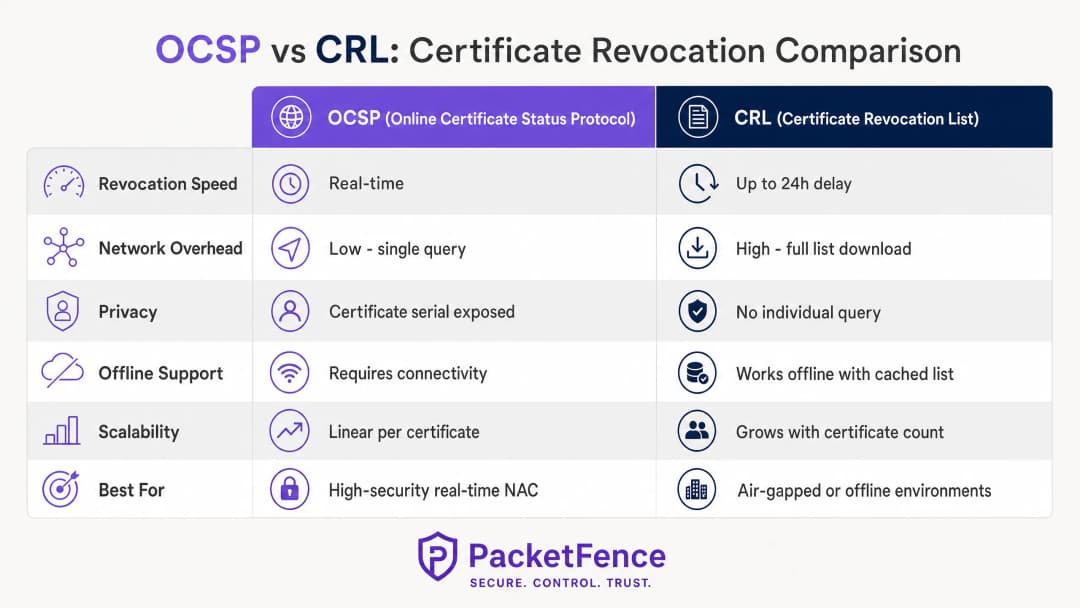
- Résilience hors ligne : Comme le serveur RADIUS met en cache la CRL, la vérification de la révocation se poursuit même si l'autorité de certification (CA) ou le CDP est inaccessible.
- Latence : Le principal inconvénient est le délai entre la révocation et l'application effective. Si un certificat est révoqué à 09h00 et que l'intervalle de mise à jour de la CRL est de 24 heures, l'appareil compromis conserve l'accès au réseau jusqu'au prochain téléchargement.
- Surcharge de bande passante : Dans les environnements comptant des milliers de certificats, les fichiers CRL peuvent atteindre plusieurs mégaoctets, ce qui sollicite la bande passante lors des cycles de mise à jour.
Architecture du protocole OCSP (Online Certificate Status Protocol)
L'OCSP résout les limites de latence de la CRL en permettant une vérification de la révocation en temps réel. Plutôt que de télécharger la liste complète, le serveur RADIUS envoie une requête ciblée contenant le numéro de série du certificat à un répondeur OCSP. Le répondeur renvoie un statut signé : Good (valide), Revoked (révoqué) ou Unknown (inconnu).
Caractéristiques architecturales :
- Application en temps réel : Les décisions de révocation prennent effet instantanément. Une fois que la CA a mis à jour le répondeur OCSP, la tentative d'authentification suivante par l'appareil compromis échouera.
- Dépendance à la disponibilité : Le moteur de politique NAC dépend de la haute disponibilité du répondeur OCSP. Si le répondeur est inaccessible, l'administrateur réseau doit définir une politique de secours : "fail open" (autoriser l'accès, ce qui compromet la sécurité) ou "fail closed" (refuser l'accès, ce qui compromet la disponibilité).
- Agrafage OCSP (OCSP Stapling) : Pour atténuer la charge et les problèmes de confidentialité, l'agrafage OCSP permet à l'appareil client de récupérer la réponse OCSP signée et de l'associer à la négociation TLS, bien que le support par le demandeur puisse varier.
Intégration avec les plateformes d'accès invité et d'analyse
Là où l'OCSP et la CRL gèrent les exigences de sécurité strictes du personnel et des appareils de l'entreprise, les réseaux ouverts au public nécessitent une architecture différente. Pour les espaces publics, l'intégration d'un NAC robuste pour le personnel avec une plateforme publique dédiée comme Purple garantit une couverture complète. La plateforme de Purple gère l'authentification par Captive Portal, l'acceptation des conditions d'utilisation et la capture de données pour le segment public, tandis que l'infrastructure réseau sous-jacente (souvent les mêmes points d'accès physiques et commutateurs) applique le 802.1X et l'OCSP pour les SSIDs d'entreprise. Comprendre l'environnement radio est crucial pour les deux segments ; consultez Fréquences WiFi : Un guide des fréquences WiFi en 2026 pour la planification du spectre.
Vous avez des questions sur votre configuration spécifique ?
Notre équipe collabore avec des exploitants de sites, des responsables informatiques et des ingénieurs réseau au sein de 80 000 sites. Réservez un appel de 20 minutes et nous vous montrerons comment d'autres professionnels comme vous ont résolu ce problème.
Guide de mise en œuvre
Le déploiement de la révocation automatisée de certificats nécessite une coordination entre les domaines PKI, MDM et NAC. Suivez ces étapes de mise en œuvre indépendantes des fournisseurs pour établir un pipeline de révocation résilient.
Étape 1 : Définir les déclencheurs de révocation
L'automatisation commence au niveau de la couche de gestion des terminaux. Configurez votre plateforme MDM (par exemple, Microsoft Intune, Jamf Pro) pour déclencher un appel API de révocation vers votre autorité de certification lorsque des conditions spécifiques sont remplies :
- Lorsqu'un appareil est désinscrit du MDM
- Lorsqu'un appareil est marqué comme non conforme
- Lorsqu'un compte utilisateur est désactivé dans le service d'annuaire
Étape 2 : Configurer l'infrastructure de révocation
Pour le déploiement de CRL :
- Configurez l'autorité de certification pour publier la CRL sur un CDP hautement disponible (par exemple, un serveur web interne avec répartition de charge).
- Définissez l'intervalle de publication de la CRL en fonction de votre tolérance au risque (par exemple, toutes les 4 heures).
- Configurez le serveur RADIUS pour récupérer la CRL à des intervalles légèrement plus courts que l'intervalle de publication afin de garantir que le cache soit toujours à jour.
Pour le déploiement de OCSP :
- Déployez au moins deux répondeurs OCSP derrière un répartiteur de charge pour garantir une haute disponibilité.
- Configurez l'autorité de certification pour transmettre immédiatement les mises à jour de révocation aux répondeurs OCSP.
- Configurez le serveur RADIUS pour interroger l'adresse IP virtuelle OCSP équilibrée lors de l'authentification EAP-TLS.
Étape 3 : Établir des politiques de secours
Ne vous fiez pas à un seul mécanisme. Configurez votre serveur RADIUS pour utiliser OCSP comme vérification de révocation principale, et basculez vers une CRL mise en cache localement si le répondeur OCSP est inaccessible. Cela offre une application en temps réel dans des conditions normales et une résilience hors ligne en cas de panne d'infrastructure.
Étape 4 : Définir le comportement en cas de défaillance
Si OCSP et la CRL mise en cache sont tous deux indisponibles, le serveur RADIUS doit décider de la manière de gérer la demande d'authentification.
- Environnements à haute sécurité (par exemple, la Santé) : Configurez sur "fail closed" (fermé par défaut). Refusez l'accès pour empêcher la connexion d'appareils potentiellement compromis.
- Environnements standards (par exemple, les hubs de transport) : Configurez sur "fail open" (ouvert par défaut) avec alerte. Autorisez l'accès pour maintenir la continuité opérationnelle, mais générez une alerte de haute priorité pour le SOC.
Bonnes pratiques
- Implémenter des CRL Delta : Si vous dépendez des CRL dans un environnement de grande taille, implémentez des CRL Delta. Ces fichiers contiennent uniquement les modifications de révocation depuis la dernière publication de la CRL de base complète, ce qui réduit considérablement la taille de téléchargement et la consommation de bande passante.
- Surveiller la latence OCSP : Les requêtes OCSP ont lieu en ligne pendant le handshake EAP-TLS. Si le répondeur OCSP met 500 ms à répondre, l'authentification est retardée de 500 ms. Surveillez la latence du répondeur et effectuez une mise à l'échelle horizontale si les temps de réponse se dégradent.
- Certificats à courte durée de vie : Envisagez de réduire les périodes de validité des certificats (par exemple, de 1 an à 7 jours) via un renouvellement automatisé SCEP/EST. Les certificats à courte durée de vie expirent naturellement rapidement, réduisant ainsi la dépendance à une infrastructure de révocation robuste.4. Alignement avec la stratégie réseau globale : Assurez-vous que votre déploiement NAC est aligné avec votre architecture de réseau étendu. Pour en savoir plus sur la conception des WAN modernes, consultez SD WAN vs MPLS: Le guide 2026 du réseau d'entreprise.
Dépannage et atténuation des risques
Le mode de défaillance le plus courant de la révocation automatisée est une rupture de liaison entre la CA et le NAC, ce qui entraîne un événement « fail closed » qui bloque l'accès des utilisateurs légitimes.
Risque : Panne du répondeur OCSP Atténuation : Déployez des répondeurs dans un cluster actif-actif sur plusieurs domaines de défaillance. Implémentez des contrôles de santé complets sur l'équilibreur de charge pour vérifier non seulement la disponibilité du port TCP 80, mais aussi la capacité du répondeur à interroger la base de données de la CA.
Risque : Cache CRL obsolète Atténuation : Les serveurs RADIUS peuvent échouer à télécharger la dernière CRL en raison de partitions réseau ou de pannes de CDP. Mettez en place une surveillance qui alerte lorsque la CRL mise en cache localement est plus ancienne que l'intervalle de publication défini.
Risque : Révocation MDM incomplète Atténuation : Si le MDM ne parvient pas à déclencher un appel de révocation vers la CA, le certificat reste valide. Implémentez un script de réconciliation qui compare périodiquement la liste des appareils actifs du MDM avec la liste des certificats valides de la CA et révoque automatiquement toutes les divergences.
ROI et impact commercial
L'automatisation de la révocation des certificats transforme la sécurité d'un processus réactif et manuel en un mécanisme de défense proactif et automatisé.
- Atténuation des risques : En éliminant la fenêtre d'exposition entre la compromission d'un appareil et l'isolation du réseau, les organisations réduisent considérablement le risque de mouvement latéral et d'exfiltration de données. C'est un élément crucial pour maintenir la conformité avec des référentiels tels que PCI-DSS et GDPR.
- Efficacité opérationnelle : L'automatisation du processus de révocation évite au personnel du support technique d'avoir à mettre à jour manuellement les configurations RADIUS ou les bases de données de la CA lors du départ de collaborateurs, ce qui permet d'économiser des centaines d'heures par an au sein des grandes entreprises.
- Stratégie d'accès unifiée : Un environnement NAC robuste pour les appareils de l'entreprise permet aux équipes informatiques de déployer en toute confiance des services parallèles, tels que le WiFi invité basé sur l'analytique de Purple ou des services de géolocalisation (voir Le BLE Low Energy expliqué pour l'entreprise), sachant que l'infrastructure centrale reste sécurisée.
Écoutez notre point technique à ce sujet ci-dessous :
Définitions clés
EAP-TLS (Extensible Authentication Protocol - Transport Layer Security)
La norme la plus sécurisée pour l'authentification réseau 802.1X, exigeant que le client et le serveur présentent tous deux des certificats numériques pour prouver leur identité.
Les équipes informatiques déploient EAP-TLS pour éliminer les risques associés à l'authentification par mot de passe, garantissant que seuls les appareils gérés et dotés de certificats peuvent se connecter au réseau de l'entreprise.
OCSP (Online Certificate Status Protocol)
Un protocole Internet utilisé pour obtenir en temps réel le statut de révocation d'un certificat numérique X.509.
Crucial pour les environnements nécessitant une application immédiate des politiques d'accès, par exemple lorsqu'un employé est licencié et que son appareil doit être instantanément déconnecté.
CRL (Liste de Révocation de Certificats)
Une liste publiée périodiquement et signée numériquement contenant les numéros de série des certificats qui ont été révoqués par l'Autorité de Certification émettrice.
Utilisé comme mécanisme de révocation principal dans les réseaux hors ligne ou isolés physiquement, ou comme mécanisme de secours hautement résilient pour OCSP.
OCSP Stapling
Un mécanisme par lequel l'appareil client récupère sa propre réponse OCSP et l'associe au protocole de handshaking TLS, en la présentant au serveur RADIUS.
Réduit la charge sur le serveur RADIUS et le répondeur OCSP, et améliore la confidentialité en empêchant l'Autorité de Certification de voir exactement quand et où un appareil s'authentifie.
Delta CRL
Une liste de révocation plus petite contenant uniquement les certificats révoqués depuis la publication de la dernière CRL de base complète.
Indispensable pour les déploiements à grande échelle afin d'éviter la congestion du réseau, car les CRL complètes peuvent devenir massives et consommer une bande passante importante lors des cycles de rafraîchissement.
CDP (Point de Distribution CRL)
L'emplacement, généralement une URL HTTP ou LDAP, où l'Autorité de Certification publie la CRL pour que les clients et les serveurs RADIUS puissent la télécharger.
Les équipes informatiques doivent s'assurer que le CDP est hautement disponible et accessible depuis tous les moteurs de politique NAC ; si le CDP est indisponible, les serveurs RADIUS ne peuvent pas mettre à jour leurs caches.
Fail Open / Fail Closed
La décision de politique dictant ce qui se passe lorsque l'infrastructure de révocation (OCSP ou CDP) est inaccessible. Fail Open autorise l'accès ; Fail Closed refuse l'accès.
Une décision commerciale critique équilibrant la posture de sécurité et le temps de fonctionnement opérationnel. Nécessite l'approbation des opérations informatiques et du CISO.
SCEP (Simple Certificate Enrollment Protocol)
Un protocole utilisé par les plateformes MDM pour automatiser l'émission de certificats numériques aux appareils gérés sans intervention de l'utilisateur.
Le point de départ du cycle de vie automatisé. SCEP émet le certificat, et le MDM demande ensuite à l'Autorité de Certification de le révoquer lorsque l'appareil est retiré du service.
Exemples concrets
Un réseau hospitalier de 500 lits migre d'un système 802.1X basé sur des identifiants vers un système EAP-TLS basé sur des certificats pour tous les appareils IoT médicaux et les ordinateurs portables du personnel. Le CISO exige que si un appareil est signalé comme volé, son accès au réseau soit interrompu dans un délai de 5 minutes. L'équipe réseau s'inquiète de la charge du serveur RADIUS s'il doit interroger en permanence des services externes. Comment concevoir l'architecture de révocation ?
L'hôpital doit déployer OCSP pour respecter l'SLA de révocation de 5 minutes, car les intervalles d'actualisation de la CRL ne permettent pas d'atteindre cet objectif de manière fiable sans engendrer une surcharge réseau importante. Pour répondre aux inquiétudes de l'équipe réseau concernant la charge, l'architecture doit implémenter des répondeurs OCSP localement dans le centre de données de l'hôpital, positionnés à proximité des serveurs RADIUS afin de minimiser la latence. Les serveurs RADIUS doivent être configurés pour interroger la VIP OCSP locale. Pour garantir la résilience, les serveurs RADIUS doivent être configurés avec un repli sur une CRL mise en cache localement et actualisée toutes les heures. La politique de défaillance doit être configurée sur "fail closed" (bloquer en cas d'échec) en raison des exigences strictes de conformité du secteur de la santé.
Une chaîne de distribution mondiale comptant 1 200 magasins utilise SCEP pour attribuer des certificats aux tablettes de point de vente (POS). Les magasins disposent d'une bande passante WAN limitée. Le directeur informatique souhaite mettre en œuvre la révocation de certificats mais craint que le téléchargement de fichiers CRL volumineux sur 1 200 serveurs RADIUS de succursale ne sature les liaisons WAN. Quelle est la stratégie de déploiement optimale ?
La chaîne de distribution doit mettre en œuvre une approche hybride utilisant des CRL Delta et l'OCSP Stapling. Tout d'abord, l'autorité de certification (CA) doit être configurée pour publier une CRL de base de manière hebdomadaire et une CRL Delta (contenant uniquement les révocations récentes) toutes les 4 heures. Les serveurs RADIUS des succursales téléchargeront uniquement les petites CRL Delta pendant la journée, ce qui minimisera l'impact sur le WAN. Alternativement, si les demandeurs d'accès EAP (supplicants) des tablettes POS le prennent en charge, l'OCSP Stapling doit être activé. Cela transfère la charge de la récupération de la réponse OCSP du serveur RADIUS de la succursale à la tablette elle-même, qui peut récupérer la réponse directement auprès de l'autorité de certification centrale via HTTPS standard, évitant ainsi totalement la surcharge de traitement du serveur RADIUS.
Questions d'entraînement
Q1. Votre organisation déploie le protocole 802.1X sur 50 filiales distantes. Les liaisons WAN vers le centre de données central sont très encombrées et perdent fréquemment des paquets. Vous devez mettre en œuvre la révocation de certificats pour les ordinateurs portables professionnels des filiales. Quelle architecture devez-vous choisir ?
Conseil : Considérez l'impact de la perte de paquets sur les protocoles en temps réel par rapport à la résilience des données mises en cache.
Voir la réponse type
Vous devriez mettre en œuvre une architecture basée sur les CRL, en utilisant spécifiquement les CRL de base et les Delta CRLs. Les liaisons WAN étant encombrées et peu fiables, les requêtes OCSP en temps réel expireront fréquemment, entraînant des retards ou des échecs d'authentification. En configurant les serveurs RADIUS locaux pour télécharger et mettre en cache les Delta CRLs pendant les heures creuses, le serveur RADIUS local peut effectuer des vérifications de révocation instantanément par rapport à son cache, même si la liaison WAN est totalement coupée pendant la tentative d'authentification.
Q2. Un audit de sécurité révèle que lorsque votre répondeur OCSP principal est hors ligne pour maintenance, tous les utilisateurs de l'entreprise sont complètement exclus du réseau WiFi. L'entreprise exige que la maintenance n'impacte pas la connectivité des utilisateurs, mais le CISO refuse de modifier la politique en "Fail Open". Comment résolvez-vous ce problème ?
Conseil : Si vous ne pouvez pas modifier la politique de défaillance, vous devez modifier la disponibilité du service.
Voir la réponse type
Vous devez mettre en œuvre une haute disponibilité pour le service OCSP. Déployez au moins un répondeur OCSP supplémentaire et placez les deux derrière un répartiteur de charge. Configurez le serveur RADIUS pour interroger l'adresse IP virtuelle (VIP) du répartiteur de charge. Pendant la maintenance, vous pouvez vider les connexions du répondeur principal, le mettre hors ligne, et le répartiteur de charge acheminera de manière transparente toutes les requêtes OCSP vers le répondeur secondaire, respectant ainsi à la fois l'exigence de disponibilité de l'entreprise et le mandat "Fail Closed" du CISO.
Q3. Vous avez configuré votre MDM pour révoquer automatiquement les certificats lorsqu'un appareil est marqué comme « perdu ». Vous testez le système en marquant un iPad de test comme perdu. Le MDM confirme la révocation, mais 10 minutes plus tard, l'iPad se connecte avec succès au WiFi de l'entreprise. Le serveur RADIUS est configuré pour utiliser une CRL publiée toutes les 24 heures. Quelle est la cause racine et comment y remédier ?
Conseil : Suivez la chronologie des données de révocation depuis l'Autorité de Certification jusqu'au moteur d'application du serveur RADIUS.
Voir la réponse type
La cause racine est la latence dans le cycle de publication et de rafraîchissement de la CRL. Bien que le MDM ait correctement demandé à l'Autorité de Certification (CA) de révoquer le certificat, la CA ne publiera pas ce statut mis à jour sur le point de distribution CRL avant le prochain cycle de 24 heures, et le serveur RADIUS ne le téléchargera pas avant l'expiration de son propre cache. Pour résoudre ce problème, vous devez soit migrer vers OCSP pour une vérification en temps réel, soit réduire considérablement les intervalles de publication et de téléchargement de la CRL (par exemple à 1 heure) afin de respecter vos impératifs de sécurité.
Continuer la lecture de cette série
Gestion de la bande passante pour le WiFi du personnel : lissage, QoS et réduction du trafic
Ce guide détaille les méthodes pratiques pour gérer la bande passante du WiFi du personnel dans les établissements d'entreprise. Il aborde le lissage du trafic, la mise en œuvre de la QoS et la manière dont le déploiement de Purple Shield réduit la charge réseau sans nécessiter de mise à niveau de l'infrastructure.
Comment réduire le nombre de SSIDs WiFi grâce au PSK par appareil (iPSK, DPSK, MPSK)
Ce guide de référence technique faisant autorité explique comment les équipes informatiques peuvent éliminer la dégradation des performances WiFi causée par la surcharge des balises SSID en regroupant plusieurs réseaux dédiés en un seul SSID à l'aide du PSK par appareil (xPSK). Il couvre le paysage des constructeurs à travers Cisco iPSK, HPE Aruba MPSK, Ruckus DPSK, Juniper Mist PPSK et Ubiquiti UniFi PPSK, avec des conseils pratiques de mise en œuvre sur l'attribution dynamique de VLAN, l'intégration de l'IoT et la conformité PCI DSS. Les exploitants de sites dans l'hôtellerie, le commerce de détail, les stades et les organisations du secteur public y trouveront des conseils d'architecture exploitables et des exemples concrets.
La checklist pour migrer d'un NAC hérité vers un NAC cloud-native
Ce guide de référence technique faisant autorité fournit une checklist structurée en trois phases pour migrer d'un contrôle d'accès réseau (NAC) hérité vers une architecture cloud-native. Il apporte aux responsables informatiques et aux architectes réseau des stratégies concrètes pour gérer l'intégration d'identité, la parité des politiques et la conformité sans perturber l'exploitation des sites.
Vous avez des questions sur votre configuration spécifique ?
Notre équipe collabore avec des exploitants de sites, des responsables informatiques et des ingénieurs réseau au sein de 80 000 sites. Réservez un appel de 20 minutes et nous vous montrerons comment d'autres professionnels comme vous ont résolu ce problème.