
O Que É Autenticação PEAP? Como o PEAP Protege Seu WiFi
Este guia completo detalha a autenticação PEAP para redes WiFi corporativas, detalhando sua arquitetura, limitações de segurança em comparação com EAP-TLS e estratégias práticas de implantação. Projetado para gerentes de TI e arquitetos de rede, ele fornece insights acionáveis sobre quando o PEAP-MSCHAPv2 permanece apropriado e como protegê-lo contra ameaças modernas.
Ouça este guia
Ver transcrição do podcast
Resumo Executivo
O Protected Extensible Authentication Protocol (PEAP) continua sendo o método de autenticação 802.1X mais amplamente implantado em ambientes corporativos atualmente. Desenvolvido em conjunto pela Cisco, Microsoft e RSA Security, o PEAP foi projetado para resolver um desafio operacional específico: como obter uma autenticação de servidor forte e baseada em certificado sem a sobrecarga administrativa esmagadora de implantar certificados de cliente em todos os dispositivos da rede.
Para diretores de TI e arquitetos de rede que gerenciam ambientes complexos — seja em Varejo , Saúde ou grandes escritórios corporativos — o PEAP-MSCHAPv2 oferece um meio-termo pragmático entre a insegurança das Chaves Pré-Compartilhadas (PSK) e a complexidade de implantação do EAP-TLS. No entanto, essa conveniência vem com compensações de segurança inerentes. À medida que os ataques de pontos de acesso não autorizados se tornam cada vez mais sofisticados, as implantações de PEAP mal configuradas apresentam uma vulnerabilidade crítica.
Este guia fornece um aprofundamento técnico abrangente na arquitetura do PEAP, sua mecânica operacional e os padrões de configuração obrigatórios necessários para protegê-lo em redes corporativas modernas.
Aprofundamento Técnico: A Arquitetura do PEAP
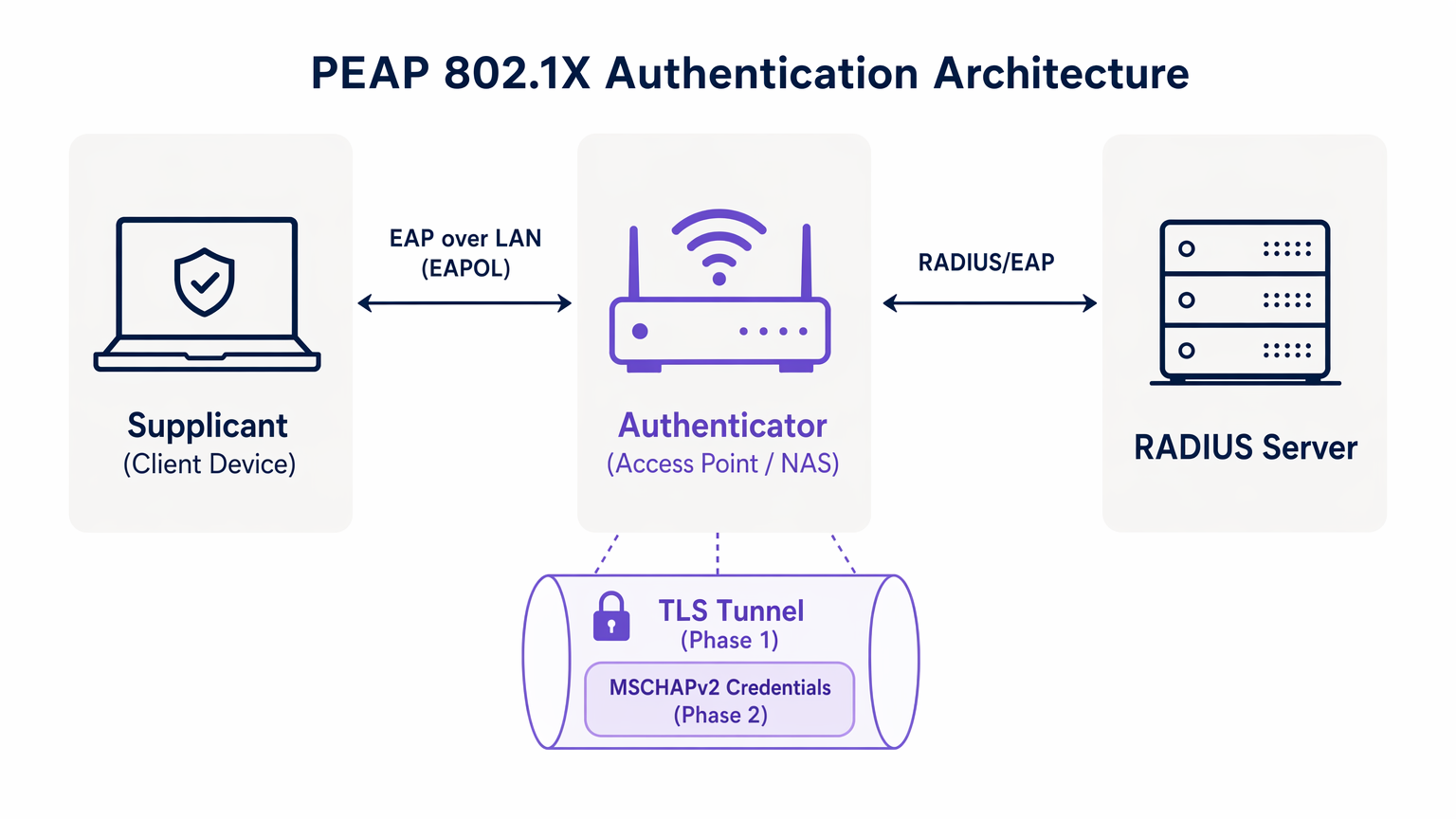
Para entender o PEAP, devemos examinar seu processo de autenticação em duas fases. O PEAP opera estabelecendo um túnel externo seguro antes de trocar quaisquer dados de credenciais sensíveis no túnel interno.
Fase 1: Estabelecimento do Túnel TLS
Quando um suplicante (dispositivo cliente) tenta se conectar à rede, o autenticador (geralmente um ponto de acesso sem fio) bloqueia todo o tráfego, exceto os quadros do Extensible Authentication Protocol over LAN (EAPOL). O autenticador encaminha esses quadros para o servidor de autenticação, geralmente um servidor RADIUS. Para uma compreensão mais ampla dessa infraestrutura, consulte nosso guia sobre O Que É RADIUS? Como os Servidores RADIUS Protegem Redes WiFi .
Durante a Fase 1, o servidor RADIUS apresenta seu certificado digital ao suplicante. O suplicante valida este certificado contra suas Autoridades Certificadoras (CAs) raiz confiáveis. Se a validação for bem-sucedida, um túnel TLS (Transport Layer Security) é estabelecido entre o suplicante e o servidor RADIUS. Este túnel criptografado protege toda a comunicação subsequente contra escutas no meio sem fio.
Fase 2: Autenticação Interna
Uma vez estabelecido o túnel TLS, a autenticação real do usuário ocorre dentro deste canal seguro. O protocolo de autenticação interna mais comum é o MSCHAPv2 (Microsoft Challenge Handshake Authentication Protocol versão 2).
Dentro do túnel, o suplicante envia as credenciais do usuário (nome de usuário e senha) para o servidor RADIUS. O servidor verifica essas credenciais em um repositório de identidade, como o Active Directory ou um diretório LDAP. Se as credenciais forem válidas, o servidor RADIUS envia uma mensagem de Access-Accept de volta ao autenticador, e o cliente recebe acesso à rede.
A premissa de segurança crítica do PEAP é que a troca vulnerável do MSCHAPv2 é totalmente encapsulada dentro do túnel TLS criptografado, protegendo-a da interceptação passiva.
Guia de Implementação: Protegendo o PEAP-MSCHAPv2
Embora o PEAP seja altamente funcional, sua configuração padrão em muitos sistemas operacionais clientes o torna vulnerável a ataques sofisticados. Implementar o PEAP com segurança requer adesão rigorosa aos seguintes padrões de implantação.
1. Validação Obrigatória do Certificado do Servidor
A vulnerabilidade mais significativa em uma implantação PEAP é a falha em impor a validação do certificado do servidor no lado do cliente. Como o PEAP não exige um certificado de cliente, o suplicante deve ter certeza absoluta de que está se comunicando com o servidor RADIUS legítimo antes de transmitir as credenciais.
Se um dispositivo cliente estiver configurado para confiar em qualquer certificado, um invasor pode implantar um ponto de acesso não autorizado, apresentar um certificado fraudulento e interceptar o handshake MSCHAPv2. Ferramentas como hostapd-wpe automatizam esse ataque.
Ação de Implementação: As equipes de TI devem configurar todos os dispositivos corporativos para validar rigorosamente o certificado do servidor. Isso envolve fixar a Autoridade Certificadora Raiz (CA Raiz) específica que emitiu o certificado do servidor RADIUS e definir explicitamente o Common Name (CN) ou Subject Alternative Name (SAN) esperado do servidor.
2. Perfis de Rede Sem Fio Impostos por MDM
Confiar nos usuários finais para configurar manualmente as configurações 802.1X é um caminho garantido para o fracasso. Os usuários frequentemente ignoram avisos de certificado, comprometendo a integridade do túnel TLS.
Ação de Implementação: Perfis de rede sem fio devem ser enviados para todos os dispositivos corporativos via plataformas de Mobile Device Management (MDM) (por exemplo, Microsoft Intune, Jamf) ou Group Policy Objects (GPO). Esses perfis devem bloquear as configurações EAP, impedindo que os usuários alterem os requisitos de validação de certificado.
3. Descontinuação de Protocolos Legados
Versões mais antigas do TLS contêm vulnerabilidades criptográficas conhecidas. As implantações PEAP devem impor padrões de criptografia modernos.
Ação de Implementação: Configure o servidor RADIUS para rejeitar conexões TLS 1.0 e TLS 1.1. Imponha o TLS 1.2 como o mínimo absoluto, com o TLS 1.3 preferencialmente onde suportado pela base de clientes.
Melhores Práticas: Segmentação Estratégica de Rede
Um erro arquitetônico comum é tentar usar o PEAP para todo o acesso sem fio, incluindo redes de convidados e BYOD. O PEAP é projetado para dispositivos corporativos gerenciados que se autenticam contra um diretório central.
Isolando o Acesso de Convidados
Para dispositivos não corporativos, o PEAP é a ferramenta errada. Tentar gerenciar credenciais de convidados em um RADIUS de diretório cria sobrecarga administrativa desnecessária e introduz riscos de segurança.
Locais nos setores de Hotelaria e Transporte devem implementar uma solução dedicada de Guest WiFi . Plataformas como Purple oferecem onboarding seguro baseado em Captive Portal que opera de forma totalmente independente da infraestrutura 802.1X corporativa. Isso garante que o tráfego de convidados seja isolado, ao mesmo tempo em que permite a captura de dados ricos por meio de WiFi Analytics .
O Papel do EAP-TLS
Ao avaliar o PEAP, os arquitetos de rede também devem considerar o EAP-TLS. O EAP-TLS fornece autenticação mútua — tanto o servidor quanto o cliente devem apresentar certificados válidos. Isso elimina completamente a dependência de senhas, tornando os ataques de roubo de credenciais obsoletos.
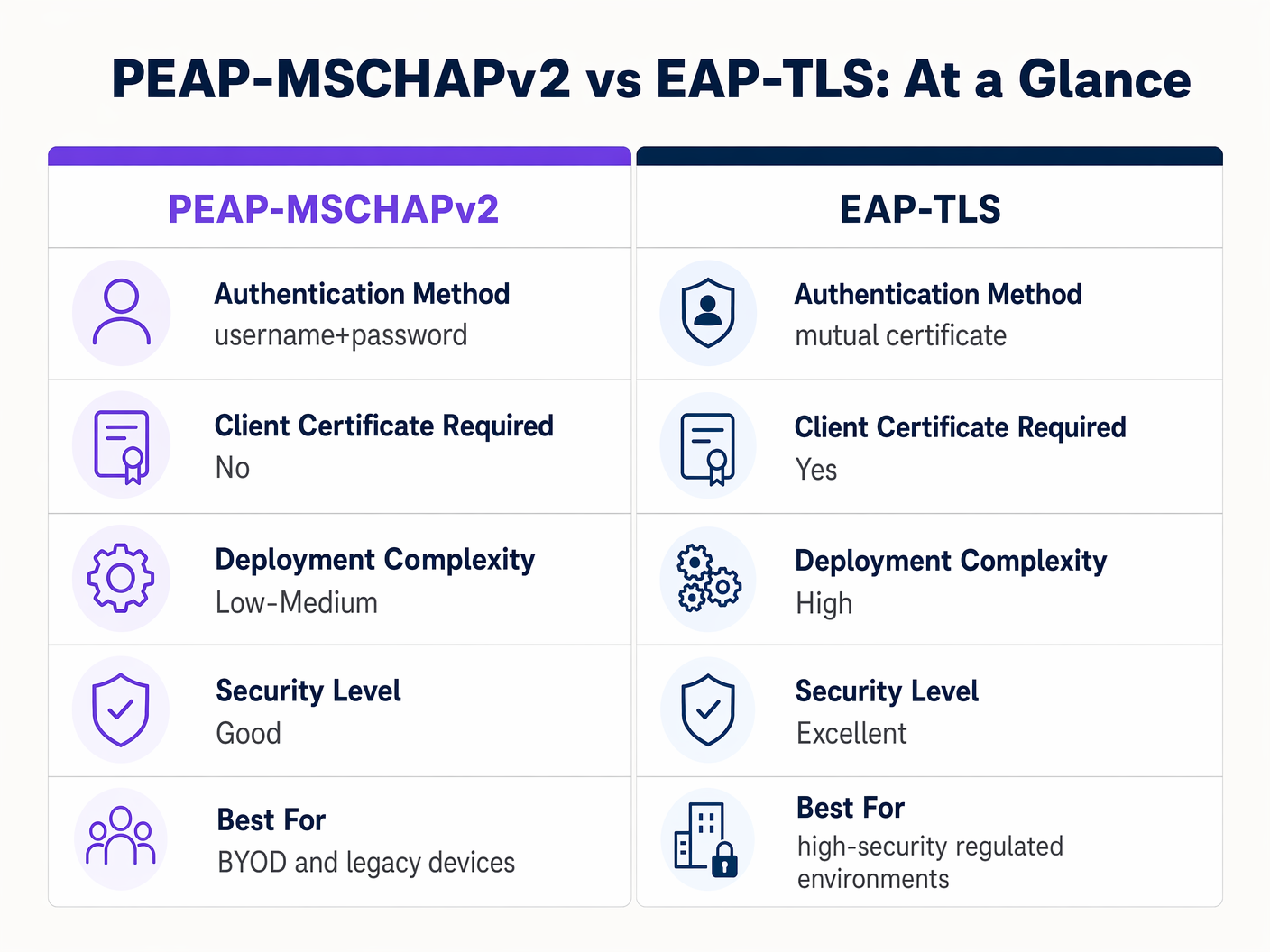
Embora o EAP-TLS ofereça segurança superior, ele requer uma robusta Infraestrutura de Chave Pública (PKI) para emitir e gerenciar certificados de cliente. Para ambientes altamente regulamentados, o EAP-TLS é a arquitetura alvo. Para organizações que carecem de maturidade em PKI, uma implantação PEAP-MSCHAPv2 estritamente configurada continua sendo uma escolha defensável.
Solução de Problemas e Mitigação de Riscos
Mesmo implantações PEAP bem arquitetadas podem apresentar falhas operacionais. Compreender os modos de falha comuns é essencial para uma resolução rápida.
A Crise de Expiração de Certificados
O evento mais disruptivo em um ambiente PEAP é a expiração não gerenciada do certificado do servidor RADIUS. Quando o certificado expira, todos os clientes que impõem a validação derrubarão imediatamente a conexão, resultando em uma interrupção em toda a rede.
Mitigação: Implemente monitoramento automatizado para o certificado do servidor RADIUS. Estabeleça um procedimento operacional padrão para renovar e implantar o novo certificado pelo menos 30 dias antes da expiração. Se estiver utilizando uma CA interna, garanta que a própria hierarquia da CA seja monitorada.
Política de Senhas e Quebra Offline
Embora o túnel TLS proteja a troca MSCHAPv2 em trânsito, se um invasor executar com sucesso um ataque de AP malicioso devido a clientes mal configurados, ele capturará os pares de desafio-resposta. Pesquisas demonstraram que os hashes MSCHAPv2 podem ser quebrados offline.
Mitigação: A complexidade da senha do usuário subjacente é a última linha de defesa. Imponha políticas de senha rigorosas — requisitos de comprimento mínimo, regras de complexidade e rotação regular — para aumentar o custo computacional da quebra offline.
ROI e Impacto nos Negócios
A transição de PSK para uma implantação PEAP 802.1X gerenciada adequadamente oferece valor de negócio mensurável em várias dimensões.
- Sobrecarga Administrativa Reduzida: A integração da autenticação WiFi diretamente com o provedor de identidade corporativa (por exemplo, Active Directory) automatiza o onboarding e o offboarding. Quando um funcionário sai, desativar sua conta de diretório revoga imediatamente o acesso à rede, eliminando a necessidade de girar uma senha compartilhada.
- Auditabilidade Aprimorada: O 802.1X fornece visibilidade granular, no nível do usuário, sobre o acesso à rede. As equipes de TI podem rastrear definitivamente a atividade da rede para indivíduos específicos, um requisito crítico para estruturas de conformidade como PCI DSS e GDPR.
- Mitigação de Riscos: Ao se afastar das chaves compartilhadas, as organizações reduzem significativamente o risco de acesso não autorizado por ex-funcionários ou agentes maliciosos, protegendo a propriedade intelectual e dados corporativos sensíveis.
Para organizações que buscam otimizar sua arquitetura de rede mais ampla juntamente com sua segurança sem fio, explorar soluções WAN modernas é altamente recomendado. Saiba mais sobre Os Principais Benefícios do SD WAN para Empresas Modernas .
Definições principais
PEAP (Protected Extensible Authentication Protocol)
An 802.1X authentication protocol that encapsulates an inner authentication method (usually MSCHAPv2) within a secure TLS tunnel.
The dominant standard for enterprise WiFi authentication due to its balance of security and deployment ease.
802.1X
The IEEE standard for port-based Network Access Control, providing an authentication mechanism to devices wishing to attach to a LAN or WLAN.
The foundational framework that protocols like PEAP and EAP-TLS operate within.
EAPOL (EAP over LAN)
The protocol used to encapsulate EAP messages over a local area network, used during the initial stages of 802.1X authentication.
The mechanism by which the client and access point communicate before the network port is fully opened.
Supplicant
The client device (laptop, smartphone) requesting access to the network.
The endpoint that must be correctly configured to validate the server certificate in a PEAP deployment.
Authenticator
The network device (access point or switch) that facilitates the authentication process between the supplicant and the RADIUS server.
The enforcement point that blocks traffic until authentication is successful.
RADIUS (Remote Authentication Dial-In User Service)
A networking protocol that provides centralized Authentication, Authorization, and Accounting (AAA) management.
The server that validates the user's credentials and issues the final accept/reject decision.
MSCHAPv2
A challenge-response authentication protocol developed by Microsoft, commonly used as the inner authentication method within PEAP.
The protocol that actually verifies the username and password, but requires the protection of the PEAP TLS tunnel due to cryptographic weaknesses.
EAP-TLS
An EAP method that requires mutual authentication using digital certificates on both the client and the server.
The highly secure alternative to PEAP, requiring a PKI deployment but eliminating password-based vulnerabilities.
Exemplos práticos
A 300-bed luxury hotel needs to secure its back-of-house staff WiFi network. Currently, they use a single WPA2-Personal password that hasn't been changed in three years due to the operational disruption it would cause to update all point-of-sale terminals and staff tablets. How should they implement PEAP to resolve this?
The hotel should deploy an 802.1X architecture using PEAP-MSCHAPv2, integrating their wireless LAN controller with their central Active Directory via a RADIUS server (e.g., Microsoft NPS). They must use their MDM platform to push a standardized wireless profile to all staff tablets and POS terminals. This profile must explicitly enforce server certificate validation, pinning the CA that issued the NPS server's certificate. Staff will authenticate using their individual AD credentials.
A large retail chain is rolling out corporate laptops to store managers across 500 locations. They want to use PEAP-MSCHAPv2 but are concerned about the administrative burden of managing RADIUS certificates across so many sites.
Instead of deploying local RADIUS servers at each store, the retailer should utilize a cloud-hosted RADIUS solution integrated with their cloud identity provider (e.g., Azure AD or Okta). The access points at all 500 locations point to the cloud RADIUS endpoints. A single, globally trusted public certificate is used on the cloud RADIUS server, and the MDM payload deployed to the laptops pins this specific public certificate.
Questões práticas
Q1. You are auditing a hospital's WiFi network. They use PEAP-MSCHAPv2 for staff devices. During your review, you notice that the MDM profile pushed to iPads does not have 'Validate Server Certificate' checked. What is the immediate risk?
Dica: Consider what happens if an attacker sets up a device broadcasting the hospital's SSID.
Ver resposta modelo
The immediate risk is a Rogue Access Point (Evil Twin) attack. Because the iPads are not validating the server certificate, they will attempt to authenticate with any AP broadcasting the correct SSID. An attacker can intercept the MSCHAPv2 handshake and attempt to crack the staff passwords offline, leading to credential compromise.
Q2. A university IT department is planning to migrate their student network from a Pre-Shared Key (PSK) to 802.1X. They want to use EAP-TLS for maximum security but are facing resistance from the helpdesk team. Why might PEAP-MSCHAPv2 be a more practical choice in this scenario?
Dica: Consider the device ownership model in a university environment.
Ver resposta modelo
In a university, the devices are unmanaged (BYOD). Deploying EAP-TLS requires issuing and installing a unique client certificate on every student's personal laptop, phone, and tablet. This presents a massive support burden for the helpdesk. PEAP-MSCHAPv2 only requires the students to enter their existing university username and password, making onboarding significantly easier while still providing a major security upgrade over PSK.
Q3. Your organization's RADIUS server certificate is expiring in 14 days. It is issued by a public CA. What steps must you take to ensure no disruption to the PEAP-MSCHAPv2 wireless network?
Dica: Think about what the supplicants are currently configured to trust.
Ver resposta modelo
You must acquire the new certificate from the public CA and install it on the RADIUS server. Crucially, you must review the MDM wireless profiles. If the profiles are pinned to the specific old certificate, they must be updated to trust the new certificate before the old one expires. If the profiles only pin the Root CA, and the new certificate is issued by the same Root CA, the transition should be seamless, but it must be tested.
Continue a ler esta série
PSK por Dispositivo por Fabricante: Comparativo entre iPSK, DPSK, MPSK e PPSK (e Suporte a WPA3)
Uma comparação abrangente das implementações de PSK por dispositivo no Cisco Meraki, HPE Aruba, Ruckus, Juniper Mist, Extreme, Fortinet e Ubiquiti UniFi. Saiba como o WPA3-SAE impacta as estratégias de chaves por dispositivo e quando implantar modos de transição em vez de migrar para o 802.1X.
O Que É Autenticação por Endereço MAC? Quando Usar e Quando Evitar
Este guia de referência técnica abrangente aborda a autenticação por endereço MAC em ambientes de WiFi corporativos — como a autenticação MAC baseada em RADIUS funciona na Camada 2, suas vulnerabilidades de segurança inerentes (incluindo spoofing de MAC e o impacto da randomização de MAC em nível de OS), e os contextos operacionais precisos onde ela permanece uma ferramenta válida para gerenciar dispositivos IoT e sem interface. Ele fornece orientação de implantação acionável para gerentes de TI e arquitetos de rede em locais de hotelaria, varejo, saúde e setor público, com exemplos práticos do mundo real, estruturas de decisão e contexto de integração para a plataforma de guest WiFi e análise da Purple.
Como Configurar WiFi Corporativo em iOS e macOS com 802.1X
Este guia autorizado fornece aos líderes de TI sêniores passos acionáveis para implantar WiFi corporativo 802.1X em dispositivos iOS e macOS. Ele aborda autenticação baseada em certificado (EAP-TLS), perfis de configuração MDM e integração de arquitetura para proteger redes corporativas, ao mesmo tempo que suporta iniciativas BYOD.