
WiFi no Comboio: O Guia Completo para Operadores Ferroviários e Passageiros
Este guia de autoridade analisa a arquitetura, os desafios de implementação e as oportunidades comerciais do WiFi para passageiros em comboios. Concebido para líderes de TI e operações seniores, abrange a agregação de backhaul, a segmentação de rede e a forma de transformar uma obrigação de conformidade em análise de dados de passageiros acionável.
Video overview
Ouça este guia
Ver transcrição do podcast
Parte da nossa série principal: Guia de Guest WiFi →
Resumo Executivo
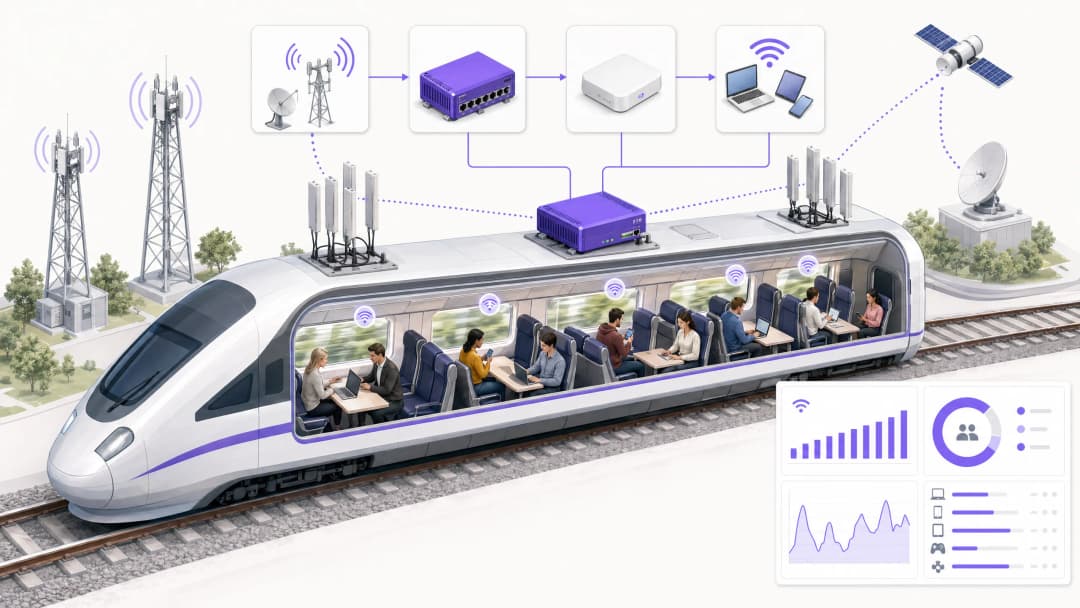
Para os operadores ferroviários, um WiFi de alta qualidade a bordo dos comboios já não é apenas uma comodidade para os passageiros, mas tornou-se uma infraestrutura operacional essencial. A diferença entre as melhores implementações e as antigas é clara: de acordo com os dados do 2º trimestre de 2025 da Ookla, a Suécia atinge uma velocidade média de download de 64,58 Mbps, enquanto o Reino Unido está estagnado em 1,09 Mbps [1]. Esta diferença de 59 vezes não é principalmente um problema tecnológico; pelo contrário, é uma falha de arquitetura e de estratégia de investimento.
Este guia fornece um modelo neutro em termos de fornecedor para diretores de TI, arquitetos de rede e líderes de operações. Analisamos a arquitetura de três camadas necessária para uma conectividade resiliente a bordo, exploramos os requisitos críticos de segurança da segmentação de rede e demonstramos como plataformas como o Guest WiFi transformam dados de ligação brutos em inteligência empresarial acionável. Quer esteja a gerir uma rota intercidades de alta velocidade ou um serviço regional de passageiros, os princípios de agregação de backhaul e de captura de dados em conformidade com o GDPR permanecem os mesmos.
Análise Técnica Detalhada: Arquitetura de Três Camadas
A implementação de WiFi moderno em comboios é fundamentalmente diferente das implementações estáticas encontradas no retalho Retail ou na hotelaria Hospitality. A rede deve manter a persistência de sessão enquanto viaja a velocidades de 300 km/h, alternando entre células de via e penetrando no material circulante fortemente isolado.
Camada 1: Backhaul WAN e Agregação
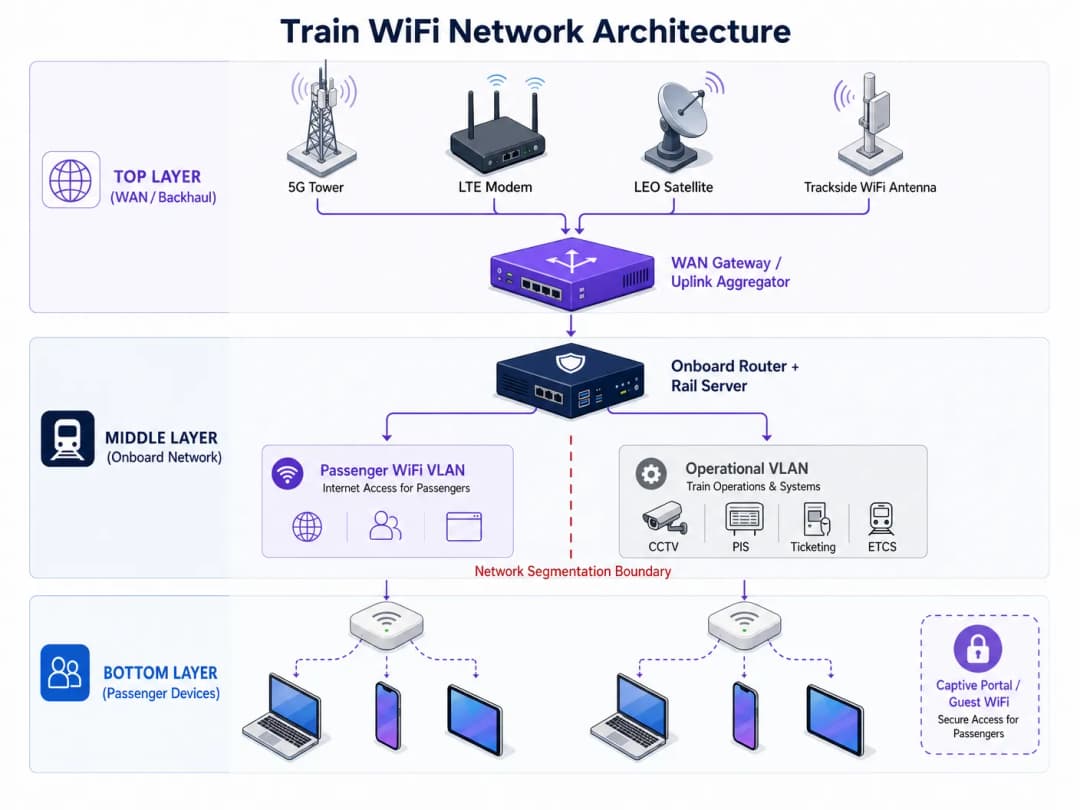
O limite da experiência do seu passageiro depende inteiramente da capacidade do seu backhaul. Um único modem LTE com uma antena montada no tejadilho já não é viável. As arquiteturas modernas utilizam um gateway WAN para agregar múltiplas ligações de subida:
- Agregação de ligações celulares (Cellular bonding): Combinação de ligações 4G/5G de múltiplos operadores de redes móveis (MNOs) para mitigar zonas sem cobertura de uma única rede.
- Infraestrutura de via: Redes sem fios dedicadas de 5 GHz ou 60 GHz implementadas ao longo do corredor ferroviário.
- Satélite LEO: Constelações de órbita terrestre baixa (por exemplo, Starlink) que fornecem um débito de 100-200 Mbps em áreas rurais ou transfronteiriças onde a rede celular terrestre falha [2].
Camada 2: Rede a Bordo e Segmentação
O gateway WAN alimenta o router e o servidor ferroviário a bordo. Esta camada lida com a função crítica de segmentação de rede.
"O WiFi para passageiros deve funcionar numa VLAN completamente isolada, sem rota de encaminhamento para redes operacionais que transportem transmissões de CCTV, Sistemas de Informação de Passageiros (PIS) ou dados de sinalização do European Train Control System (ETCS)."
O ataque cibernético de 2024 às redes WiFi de passageiros no Reino Unido destacou os graves riscos de uma segmentação inadequada, onde vulnerabilidades expostas ao público comprometeram a infraestrutura mais ampla do terminal [3]. A implementação da autenticação baseada em porta IEEE 802.1X e de regras de firewall inter-VLAN estritas é um requisito de segurança não negociável. Além disso, o servidor ferroviário fornece alojamento de aplicações contentorizadas, permitindo que o cache de conteúdo local e os serviços de Captive Portal funcionem mesmo quando a conectividade de backhaul é perdida.
Camada 3: Acesso de Passageiros e Hardware de Cabine
A camada final compreende os pontos de acesso (APs) distribuídos pelas carruagens. O hardware antigo representa um grande estrangulamento de desempenho. Na Alemanha, a atualização do WiFi 4 (802.11n) para o WiFi 5 (802.11ac) melhorou as velocidades em 241%, enquanto a transferência de tráfego da banda de 2,4 GHz para 5 GHz resultou num aumento de 328% [1]. No entanto, quase 40% das ligações ferroviárias europeias ainda dependem do WiFi 4.

Tem dúvidas sobre a sua configuração específica?
A nossa equipa trabalha com operadores de espaços, gestores de TI e engenheiros de rede em 80.000 espaços. Agende uma chamada de 20 minutos e mostraremos como outros profissionais na sua área o resolveram.
Guia de Implementação: Implantação e Conformidade
A implantação de WiFi em comboios é um projeto complexo de integração de sistemas. Os passos seguintes descrevem uma estratégia de implantação robusta:
- Realizar uma auditoria de backhaul: Antes de especificar os APs da cabine, audite a sua rota para identificar falhas na cobertura móvel. Desenhe a sua estratégia de agregação de uplink com base nestes pontos negros.
- Especificar janelas permeáveis a RF: As janelas dos comboios modernos utilizam revestimentos metálicos para eficiência térmica, o que pode atenuar os sinais móveis em 20 - 30 dB. As antenas montadas no tejadilho que alimentam os APs internos são obrigatórias para ultrapassar isto.
- Implementar um Captive Portal robusto: O Captive Portal é a interface principal entre o passageiro e o operador. Deve capturar de forma segura credenciais verificadas (e-mail ou login social) ao mesmo tempo que apresenta os termos de serviço.
- Garantir a conformidade com o GDPR: Os operadores devem estabelecer uma base legal para o processamento de dados dos passageiros. O consentimento deve ser dado livremente e registado de forma clara. Projeta a sua rede com DNS e segurança robustos é uma consideração fundamental aqui.
ROI e Impacto Comercial: Transformar Dados em Inteligência
Disponibilizar WiFi gratuito é uma despesa operacional significativa. Para gerar ROI, os operadores devem aproveitar a camada de ligação para recolher dados primários (first-party data).
Quando os passageiros se autenticam através de um Captive Portal em conformidade, os operadores podem criar perfis ricos de comportamento de viagem. É aqui que a análise de WiFi se torna transformadora. Ao analisar a frequência de ligação, os tempos de permanência em estações específicas e os padrões de ocupação das carruagens, os operadores obtêm inteligência operacional que rivaliza com as informações recolhidas em centros de Transporte e aeroportos.
Por exemplo, compreender que um grupo específico de viajantes em negócios se liga consistentemente no serviço das 07:30 permite comunicações de marketing direcionadas e de elevado valor ou a integração em programas de fidelização. Esta abordagem baseada em dados transforma a rede WiFi de um centro de custos num ativo gerador de receitas.
Ouça o Briefing
Para uma análise mais aprofundada sobre a arquitetura e a estratégia comercial, ouça o nosso briefing técnico completo:
Referências: [1] Ookla Speedtest Intelligence, "Fast Trains, Slow WiFi: The Reality of Onboard Connectivity in Europe and Asia", Q2 2025. [2] Ensaios do Setor, Integração de Satélites LEO para Mobilidade, 2024 - 2025. [3] Railway Technology, "Rede WiFi de passageiros no Reino Unido pirateada", setembro de 2024.
Definições Principais
Agregação WAN
O processo de combinar múltiplas ligações Wide Area Network (por exemplo, duas ligações 5G e uma ligação por satélite) numa única ligação lógica para aumentar o débito e a resiliência.
Crítica para comboios que se deslocam através de áreas com cobertura móvel variável para evitar a queda de ligações.
Segmentação de Rede (VLAN)
Divisão de uma rede informática em sub-redes mais pequenas e isoladas. As Virtual Local Area Networks (VLANs) mantêm o tráfego separado logicamente, mesmo que partilhe os mesmos switches físicos.
Essencial para evitar que um dispositivo de passageiro comprometido aceda a sistemas críticos de controlo do comboio.
Captive Portal
Uma página web que um utilizador de uma rede de acesso público é obrigado a visualizar e interagir antes de lhe ser concedido acesso.
Utilizado para aplicar os termos de serviço, recolher dados de utilizadores e garantir o consentimento do GDPR.
Atenuação de RF
A redução na força do sinal à medida que as ondas de rádio passam por um meio.
As janelas modernas dos comboios com revestimentos térmicos metálicos causam uma atenuação massiva de RF, exigindo antenas montadas no tejadilho.
Satélite LEO
Satélites em Órbita Terrestre Baixa que operam muito mais perto da Terra do que os satélites geoestacionários tradicionais, oferecendo menor latência e maior largura de banda.
Cada vez mais utilizado como solução de backhaul para comboios em áreas rurais ou transfronteiriças.
IEEE 802.1X
Uma norma IEEE para Controlo de Acesso à Rede baseado em portas (PNAC), que fornece um mecanismo de autenticação para dispositivos que se desejam ligar a uma LAN ou WLAN.
Utilizado para proteger as interfaces de rede operacionais no comboio contra acessos não autorizados.
Servidor de Bordo
Um computador de bordo robustecido, concebido para alojar aplicações em contentores localmente no comboio.
Utilizado para alojar serviços locais de entretenimento, caching e Captive Portal, reduzindo a dependência da ligação WAN.
Dados de Primeira Parte
Informações que uma empresa recolhe diretamente dos seus clientes e das quais é proprietária.
O principal resultado comercial de uma rede WiFi de convidados devidamente configurada.
Exemplos Práticos
Um operador ferroviário regional que opera comboios suburbanos de 4 carruagens através de uma mistura de áreas urbanas densas e vales rurais profundos está a registar queixas graves dos passageiros relativamente a quebras de WiFi. A sua configuração atual utiliza um único modem 4G LTE por comboio. Como devem redesenhar a sua arquitetura?
- Atualizar o WAN Backhaul: Substituir o modem LTE único por um WAN Gateway capaz de agregação de uplink. Instalar routers dual-SIM utilizando dois Operadores de Redes Móveis (MNOs) diferentes para fornecer failover em áreas urbanas.
- Resolver Lacunas Rurais: Para os vales profundos onde a cobertura móvel é inexistente, integrar um terminal de satélite LEO (por exemplo, Starlink Mobility) no WAN Gateway como um link agregado secundário.
- Caching Local: Implementar um servidor de bordo no comboio para colocar em cache o Captive Portal e as principais informações de viagem localmente, garantindo que a interface do passageiro permanece responsiva mesmo durante breves perdas totais de ligação em túneis.
Uma concessão ferroviária de longo curso está a atualizar a sua frota e pretende utilizar o novo WiFi de bordo para recolher dados analíticos de passageiros para marketing, semelhante ao funcionamento de espaços de [Retalho](/industries/retail). Que passos técnicos e de conformidade devem tomar?
- Implementação de Captive Portal: Implementar um Captive Portal robusto que exija que os utilizadores se autentiquem via e-mail ou login social antes de acederem à internet.
- Conformidade com o GDPR: Garantir que o portal solicita explicitamente o consentimento opt-in para comunicações de marketing. Não devem ser utilizadas caixas pré-selecionadas. O sistema deve registar a data/hora e a versão da política de privacidade consentida.
- Integração de Analytics: Encaminhar os dados de sessão autenticados para uma plataforma centralizada de WiFi Analytics para monitorizar a frequência de viagens, o tempo de permanência e cruzar dados com a bilhética quando permitido.
Perguntas de Prática
Q1. O seu CTO quer atualizar todos os pontos de acesso das carruagens para WiFi 6 para resolver as reclamações dos passageiros sobre a lentidão da internet. O seu backhaul atual é uma ligação 4G única. Qual é a resposta de arquitetura correta?
Dica: Considere onde está a ocorrer o verdadeiro estrangulamento no fluxo de dados.
Ver resposta modelo
Aconselhe o CTO a suspender a atualização dos APs e a investir o orçamento num Gateway WAN capaz de agregação de uplinks. A atualização para WiFi 6 irá melhorar as velocidades locais entre o dispositivo e o AP dentro da carruagem, mas o débito total para a internet continuará estrangulado pela ligação 4G única. Corrija primeiro o estrangulamento do backhaul.
Q2. Durante uma revisão do design de rede, um engenheiro sugere o encaminhamento dos dados de CCTV do comboio através das mesmas interfaces de router que o WiFi de passageiros para poupar nos custos de cablagem. Como responde?
Dica: Considere as implicações de segurança ao misturar tráfego público e operacional.
Ver resposta modelo
Rejeite a proposta imediatamente. O WiFi de passageiros e os sistemas operacionais, como o CCTV, devem ser estritamente segmentados em VLANs isoladas com regras de firewall de rejeição total ("deny-all") entre eles. Misturar este tráfego cria uma vulnerabilidade de segurança crítica, permitindo potencialmente que um ator malicioso no WiFi público aceda ou perturbe as operações do comboio.
Q3. A equipa de marketing quer subscrever automaticamente todos os passageiros que utilizam o WiFi gratuito numa newsletter semanal para aumentar o envolvimento. O que deve configurar no Captive Portal para garantir que isto é legal?
Dica: Reveja os requisitos para o processamento lícito de dados ao abrigo do GDPR.
Ver resposta modelo
Deve configurar o Captive Portal para incluir uma caixa de seleção de consentimento explícita e desmarcada para comunicações de marketing. A subscrição automática ou caixas pré-assinaladas violam os requisitos do GDPR para um consentimento livre e inequívoco. O sistema deve também registar a marca temporal deste consentimento para fins de auditoria.
Continue a ler esta série
Staff WiFi vs. Guest WiFi: Melhores Práticas de Segmentação de Rede Corporativa
Um guia técnico abrangente para líderes de TI sobre como segmentar redes WiFi de funcionários e convidados. Abrange arquitetura de VLAN, autenticação 802.1X, políticas de firewall e o impacto comercial de um design de rede seguro.
Gestão de WiFi de Hóspedes de Hotel: Integrar PMS, Portais e Padrões de Marca
Este guia técnico detalha como estruturar redes WiFi de hotel de classe empresarial, focando-se na segmentação de VLAN, integração de PMS para gestão automatizada de sessões e otimização de Captive Portal para recolha de dados em conformidade com o GDPR.
Como Configurar WiFi de Convidados: Um Guia de Configuração Segura para Empresas
Este guia autoritário fornece aos líderes de TI e arquitetos de rede um plano definitivo para implementar WiFi de convidados seguro em ambientes empresariais. Abrange a arquitetura essencial, a migração para WPA3, a segmentação de VLAN e a integração de captive portal para proteger os sistemas internos enquanto se recolhem dados primários em conformidade.
Tem dúvidas sobre a sua configuração específica?
A nossa equipa trabalha com operadores de espaços, gestores de TI e engenheiros de rede em 80.000 espaços. Agende uma chamada de 20 minutos e mostraremos como outros profissionais na sua área o resolveram.