Retail loyalty and WiFi ROI calculator
Estimate how many loyalty members your guest WiFi enrols each year, and the extra revenue their additional visits are worth.
Door-counter visits per month across the stores you are modelling.
Turns visits into 54,000 unique shoppers a year. Weekly grocery shoppers are about 30-50.
Average basket per visit that ends in a purchase.
Share of unique shoppers who sign in to the WiFi at least once. 20-35% is typical in retail.
Share of WiFi sign-ups who also tick the loyalty programme consent.
Extra visits a member makes versus a non-member. Start low (5-15%) and test.
Projected annual impact
New loyalty members a year
+4,212
351 a month from 16,200 WiFi sign-ups
Incremental revenue, run rate
£171,836
2,527 extra visits x £68. Year one: £85,918
Share of shoppers enrolled
7.8%
Lift vs store revenue
1.2%
Works on your existing access points: Cisco Meraki, HPE Aruba, Ruckus, Juniper Mist, Ubiquiti UniFi and more.
Method and assumptions
- Unique shoppers = 18,000 visits x 12 / 4 visits each = 54,000. Counting visits instead would enrol a weekly shopper 52 times.
- Members = unique shoppers x 30% WiFi adoption x 26% opt-in.
- Revenue counts only the extra visits members make (+15%), never their existing spend. Year one is halved because members join evenly through the year.
Four ways WiFi turns footfall into loyalty revenue
One-step loyalty enrolment on the captive portal
351 / month
4,212 new members a year
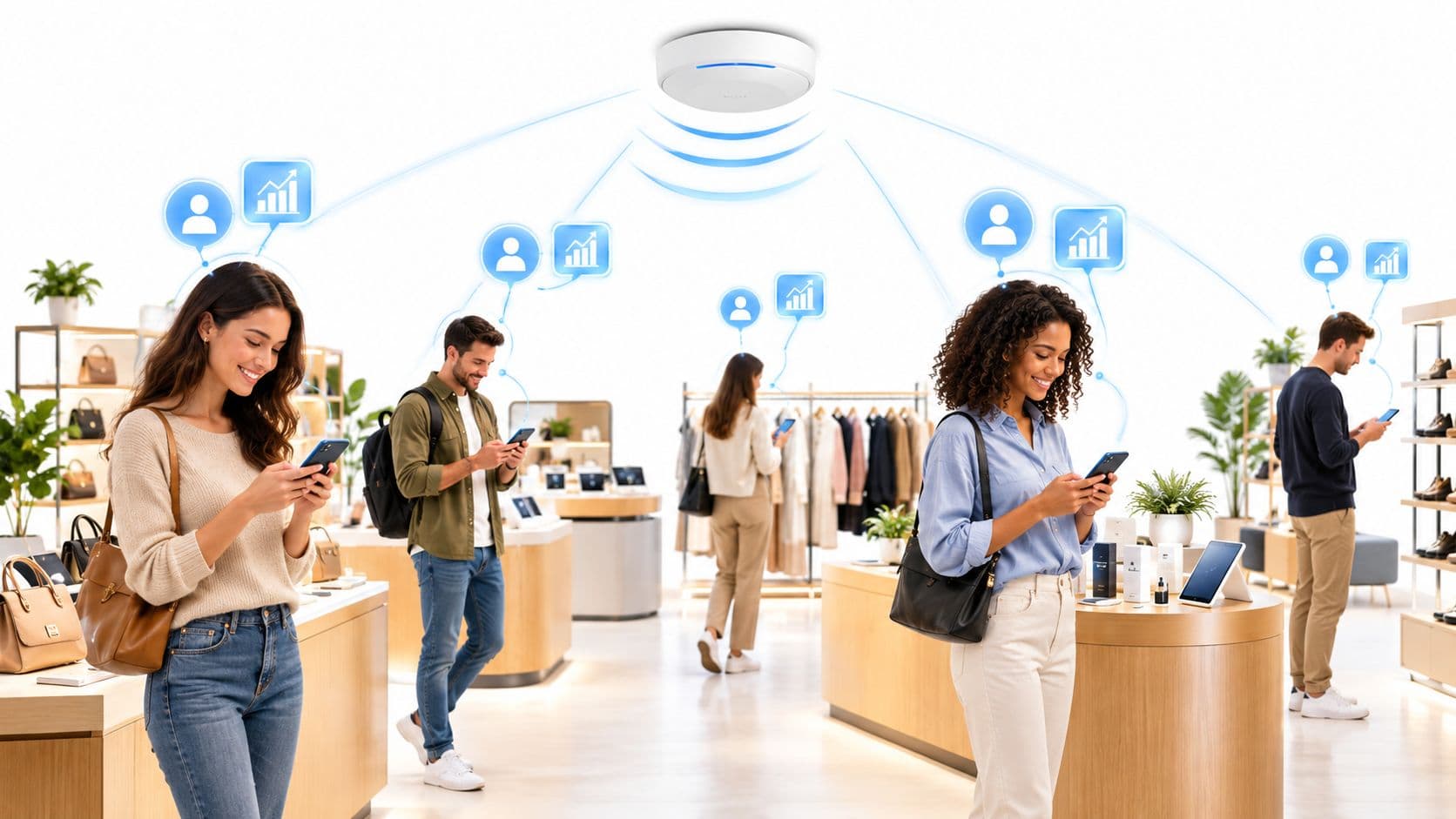
Replace paper forms and app downloads with a single opt-in on the WiFi splash page. Shoppers sign in with email, a mobile number or a social account, tick the loyalty consent box, and are enrolled before they reach the rail.
7.8% of your unique shoppers become identifiable members each year.
Executive summary
Customer loyalty is one of the most critical drivers of predictable retail revenue and sustainable profitability. According to Bain & Company research, increasing customer retention rates by just 5% increases profits by 25% to 95%, while acquiring a new customer costs 5 to 7 times more than retaining an existing one. Furthermore, enrolled loyalty members spend on average 18% more per transaction and visit 30% more frequently than non-members.
However, traditional brick-and-mortar retailers face a major operational hurdle: in-store loyalty programme enrolment is filled with friction. Long checkout queues, awkward paper forms, and slow app downloads cause over 70% of shoppers to decline loyalty sign-ups at the till. Meanwhile, between 85% and 90% of in-store footfall leaves the store completely anonymous.
Enterprise guest WiFi platforms bridge this gap. By deploying a branded captive portal, retailers turn everyday guest WiFi connections into frictionless, one-tap loyalty programme enrolments. When combined with real-time presence analytics and automated marketing workflows, retail brands capture verified first-party CRM data, deliver timely location-based offers, and drive measurable repeat footfall.
This comprehensive guide examines consumer loyalty behaviours across international markets, analyzes why legacy in-store promotion fails, and provides a practical framework for integrating guest WiFi with retail CRM and POS systems.
Global retail consumer trends: physical store vs online shopping
Understanding customer shopping preferences is essential when designing effective reward schemes. Proprietary Purple consumer survey research across the United States, United Kingdom, and Mexico reveals distinct regional dynamics and a clear demand for a blended shopping experience:
| Metric / Shopping Trend | United States (US) | United Kingdom (UK) | Mexico |
|---|---|---|---|
| Shopped in-store in past 12 months | 92% | 92% | 95% |
| Active loyalty programme membership | 66% | 52% | 47% |
| Consumers demanding reward promotions | 63% | 69% | 76% |
| Grocery shoppers visiting store weekly | 60% | 69% | 72% |
| Consumers accessing in-store guest WiFi | 71% | 74% | 68% |
United Kingdom (UK) retail dynamics
UK consumers exhibit the highest blended omnichannel behaviour globally, with 92% regularly shopping through both physical and online channels. Since the launch of the Tesco Clubcard in 1995 - the world's first national supermarket loyalty scheme - British shoppers have developed high expectations for automated loyalty rewards. Over 81% of UK respondents belong to at least one grocery reward programme, and 69% believe retailers must actively promote in-store loyalty benefits.
United States (US) retail dynamics
In the US market, in-store shopping remains dominant, with 92% of consumers purchasing in brick-and-mortar stores. American shoppers exhibit strong loyalty engagement, with 66% holding active retail memberships. Big-box and apparel sectors saw significant increases in hybrid shopping, where digital research directly informs physical store browsing.
Mexico retail dynamics
Mexican consumers demonstrate the highest demand for reward programmes (76%), yet only 47% currently hold active retail memberships. This 29% market gap represents a major commercial opportunity for retailers who eliminate sign-up friction and introduce accessible digital reward mechanics.
Why traditional in-store loyalty promotion fails
Despite heavy marketing investment, traditional in-store methods of promoting reward schemes suffer from significant operational weaknesses:
- Checkout bottleneck and staff fatigue: Asking cashiers to pitch loyalty programmes during busy checkout periods slows down queue throughput and creates customer frustration. Survey data shows that 13% of consumers are never informed about in-store loyalty schemes, while 48% are only told occasionally.
- App-download friction: Requiring customers to search an app store, enter passwords, and wait for a 150MB mobile app download while standing in an aisle leads to immediate drop-off. Over 65% of consumers abandon app-gated loyalty sign-ups in-store.
- Generic paper flyers and unsegmented promotions: Printed coupons handed out at checkout lack personalization and context. Over 80% of printed vouchers are discarded before leaving the retail park.
- Anonymous cash and contactless transactions: Contactless card payments and digital wallets (Apple Pay, Google Pay) do not share customer email addresses or names with the merchant, leaving the customer profile completely anonymous.
How enterprise guest WiFi solves the loyalty enrolment bottleneck
Free guest WiFi is an expected amenity in modern retail venues, with over 71% of shoppers actively connecting in-store. Upgrading your wireless network with an enterprise captive portal transforms this basic utility into your most productive customer acquisition channel:
- Frictionless one-tap onboarding: Shoppers authenticate via existing social credentials (Google, Apple, Facebook) or mobile phone verification. During connection, a pre-checked, GDPR-compliant consent checkbox allows the customer to join your reward programme in under 15 seconds.
- Verified first-party customer data: Because email addresses and phone numbers are validated during network authorization, retailers eliminate typos, fake contact records, and spam submissions.
- Instant digital loyalty pass delivery: Upon WiFi connection, the splash screen can automatically push an Apple Wallet or Google Wallet loyalty card directly to the shopper's smartphone - no native app download required.
- Real-time CRM and POS synchronization: Connecting profiles are synchronized instantly into enterprise systems such as Salesforce, HubSpot, Klaviyo, Braze, or Aptos POS via webhooks and REST APIs.
4 automated WiFi marketing workflows that drive retail repeat visits
Once shoppers are connected and enrolled in your loyalty programme, marketing teams can deploy automated, location-aware engagement workflows:
1. Real-time in-store promotional triggers
Using WiFi presence analytics, the platform detects when a shopper has spent more than 15 minutes in a specific department (e.g. cosmetics or consumer electronics). An automated SMS or push notification can deliver a tailored discount coupon valid for the next 30 minutes, converting browsing interest into immediate checkout revenue.
2. Automated post-visit review and feedback collection
Between 30 and 60 minutes after the customer leaves the store, an automated message invites them to complete a 2-question microsurvey. Satisfied customers (rating 9 or 10) are routed directly to leave a 5-star Google review, while dissatisfied shoppers are directed to store management to resolve complaints before negative reviews appear online.
3. Dwell-time and VIP loyalty tier acceleration
Reward high-frequency shoppers automatically. Customers who visit more than three times per month receive automatic tier upgrades and bonus reward points, reinforcing brand affinity and discouraging competitor switching.
4. Automated lapsed-shopper win-back campaigns
When an enrolled loyalty member has not visited any store location within 30, 60, or 90 days, the platform triggers an automated "We miss you" email containing an exclusive return incentive. Retailers using Purple automated win-back workflows achieve an average 24% increase in customer return rates.
Data privacy and compliance: GDPR, CCPA, and global regulations
Collecting customer data in physical retail requires strict adherence to international data privacy regulations. Enterprise platforms ensure compliance through:
- Granular, unbundled consent: Clear, individual opt-in checkboxes for marketing communications, WiFi terms of service, and third-party data processing.
- Automated Subject Access Requests (SAR): Self-service privacy portals allowing shoppers to view, export, or permanently erase their stored personal profiles.
- Enterprise security standards: ISO 27001 certified infrastructure, end-to-end encryption, and full compliance with PCI-DSS guidelines.
Summary and key takeaways
Retail customer loyalty is no longer built on plastic cards and generic printed vouchers. By turning in-store guest WiFi into a frictionless digital acquisition engine, retailers capture clean first-party data, automate hyper-personalized marketing campaigns, and significantly increase customer lifetime value.