How many customer contacts could your store capture?
Compare consented contacts from guest WiFi sign-up with a till or paper prompt, and see what they are worth in repeat visits.
Your venue
Short visits (10 to 25 minutes), so the splash page has to be quick. Best captured with a one-field email form or social login.
Capture assumptions
Rises with dwell time and visible signage.
Returning visitors are already on your list, so they do not add contacts.
With an unticked box and WiFi available either way.
Rising to £257,400 a year once the full list is in place. Revenue, not profit.
How this is calculated
- WiFi sessions = footfall x 25% connect rate. Only the 55% made by new visitors can add a contact.
- Consented contacts = new WiFi users x 40% opt-in. The till or paper comparison uses 1.5% of new visits.
- Revenue = average list size in year one (half the year-end list) x 0.5 extra visits per contact per year x £65 spend.
- Benchmarks are typical starting points by venue type. Unsubscribes are not deducted, and attribution is best proven with a hold-out group that receives no campaigns.
Want this modelled on your own footfall?
Send us your venue count and footfall and we will size contact growth per site, using your access point vendor and CRM.
Since the launch of Google Analytics in 2005, ecommerce operators have had total visibility into the digital customer lifecycle. Digital marketers track traffic sources, bounce rates, basket abandonment, lifetime value, and repeat purchases with mathematical precision.
In contrast, physical stores have long operated as data black holes. Millions of shoppers walk through retail doors every week, browse physical displays, try on products, and exit without leaving a single identifiable record. When only 10% to 20% of visitors make a transaction at the checkout counter, traditional retailers lose touch with 80% or more of their total store footfall.
Closing the data gap between online and offline retail is now an urgent commercial priority. With the deprecation of third-party tracking cookies and rising digital advertising costs, verified first-party customer data captured in-store represents a retailer's most valuable marketing asset. Below is an enterprise analysis of the five methods used to capture customer data in-store, evaluating capture rates, technical complexity, compliance, and ROI.
The 5 methods of in-store customer data capture compared
Every data capture channel offers distinct trade-offs between visitor participation rate, setup cost, and profile richness.
| Capture Method | Typical Capture Rate | Hardware Required | Data Captured | GDPR / CCPA Status |
|---|---|---|---|---|
| 1. Guest WiFi Captive Portal | 25% - 45% of total footfall | Existing WiFi APs | Name, verified email, mobile number, age, gender, dwell time, visit frequency | Explicit opt-in with automated privacy consent |
| 2. POS Digital Receipts & Loyalty | 10% - 20% of paying customers | POS terminals & scanners | Email, basket items, spend value, transaction time | Verbal or terminal prompt (prone to clerk errors) |
| 3. Mobile App & QR Codes | 5% - 15% of active shoppers | Printed signage / shelf tags | App profile, scanned product SKUs, in-app actions | App permission model |
| 4. Interactive Kiosks & Tablets | 3% - 8% of store visitors | Floor-mounted tablets | Survey answers, CSAT / NPS score, contact email | On-screen form agreement |
| 5. Spatial Sensors (BLE / LiDAR) | 100% anonymized headcount | Overhead optical/radio sensors | Footfall volume, zone dwell, heatmaps (No PII) | Anonymous by design (No contact capture) |
Method 1: Guest WiFi captive portal authentication
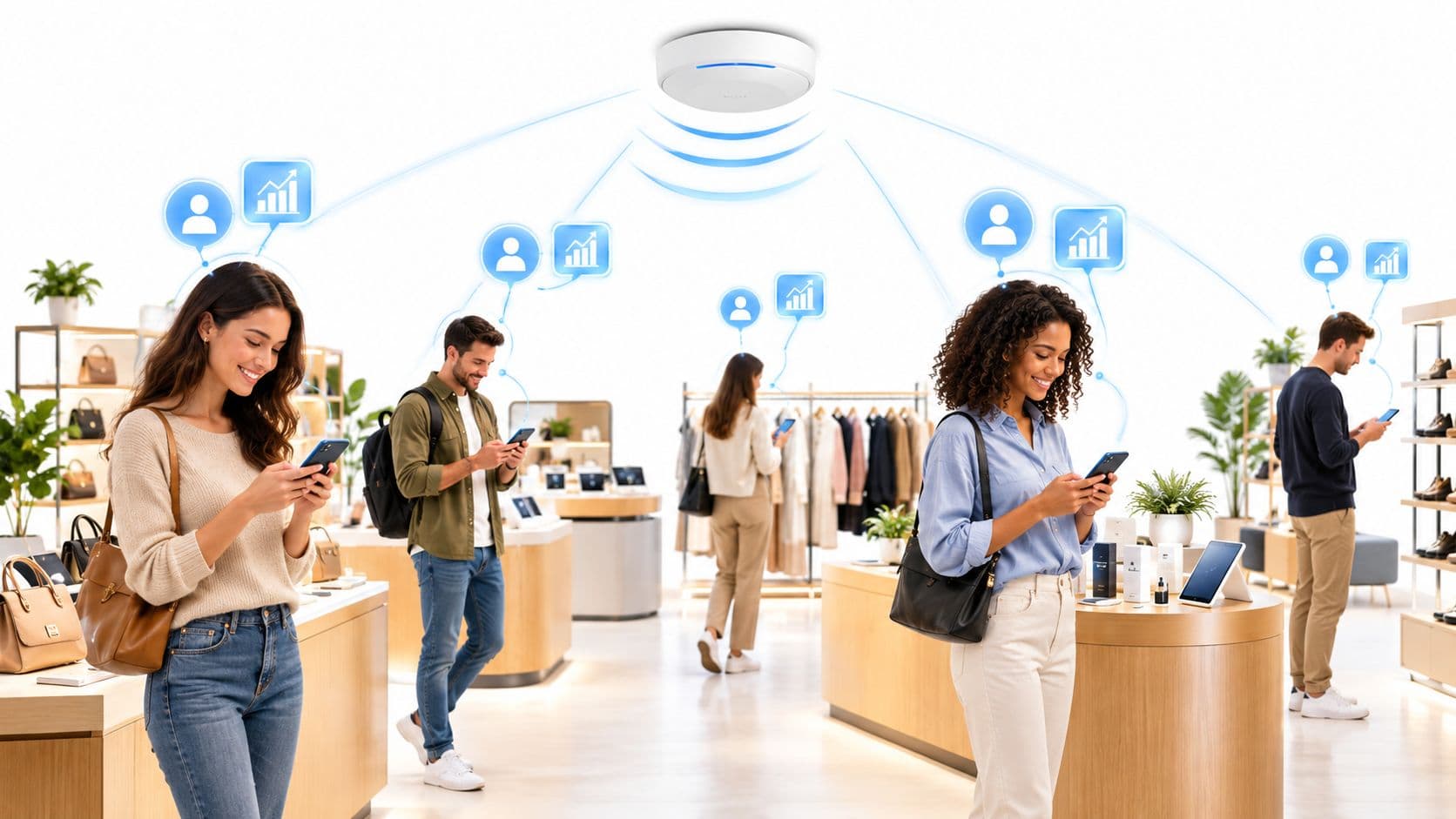
Modern consumers expect reliable connectivity when visiting physical retail destinations. Providing high-speed guest access via a branded captive portal transforms wireless connectivity into an automated data capture engine.
When a shopper selects the store network, a mobile-optimized splash screen loads automatically. Shoppers authenticate using their email address, mobile number, or social credentials (e.g., Apple, Google, LinkedIn). During login, the portal presents clear, granular consent checkboxes for marketing communications and terms of service.
Why retailers prioritize guest WiFi capture:
- Non-purchaser capture: Captures contact details from browsers who do not buy today, allowing re-targeting campaigns to bring them back.
- Zero extra hardware: Operates as a software overlay on existing access points from vendors like Cisco Meraki, HPE Aruba, Ruckus, and Juniper Mist.
- Verified data quality: Real-time email validation and SMS one-time passcodes (OTP) prevent fake email entries.
- Spatial enrichment: Automatically binds physical visit telemetry (dwell time, return frequency, store location) to the customer record.
Across more than 440 million logins processed annually on Purple's platform, venues consistently achieve 75% to 85% marketing opt-in rates when offering fast, transparent WiFi access.
Method 2: Point-of-sale digital receipts and loyalty lookup
Point-of-sale (POS) capture occurs at the checkout counter when cashiers request customer contact details to send digital e-receipts or enroll shoppers in store loyalty programmes.
While digital receipts provide direct attribution between customer profiles and basket transactions, this method has two primary limitations:
- High staff friction: Cashiers rushing through checkout queues often skip verbal requests or enter misspelled email addresses (e.g., typing
gnail.cominstead ofgmail.com). - Missed window shoppers: Only reaches individuals who complete a transaction. If store conversion is 15%, 85% of shoppers leave uncaptured.
Method 3: QR codes and mobile app engagements
Retailers place QR codes on shelf displays, fitting room mirrors, and window posters to encourage product information lookups, digital competitions, or mobile app downloads.
This method generates high engagement among loyal brand advocates, but requires active shopper effort. Requiring an app installation creates substantial friction for casual or first-time store visitors.
Method 4: Interactive in-store kiosks and feedback stations
Touchscreen kiosks and tablet stands positioned near store exits capture Net Promoter Scores (NPS), customer satisfaction ratings, and competition entries. They provide qualitative customer sentiment, though daily capture volumes remain limited compared to automated wireless authentication.
Method 5: Spatial sensors, LiDAR, and BLE beacons
Overhead optical sensors, thermal cameras, and radio frequency beacons measure aggregate footfall volume, entrance conversion rates, and aisle congestion heatmaps. However, spatial sensors do not collect Personally Identifiable Information (PII), meaning they cannot populate marketing CRMs or deliver personalized email/SMS campaigns.
How to build a compliant in-store data capture architecture
Collecting personal data in physical spaces requires strict compliance with global privacy regulations, including the UK GDPR, European Union GDPR, California Consumer Privacy Act (CCPA/CPRA), and Brazilian LGPD.
A compliant in-store data capture framework includes five technical controls:
- Unbundled consent: Marketing consent checkboxes must never be pre-ticked or made a mandatory condition of accessing basic in-store WiFi.
- Real-time email and phone validation: Automated syntax checks and SMS OTP prevent unverified or fraudulent records from entering your database.
- Irreversible MAC hashing: Passive unassociated device signals must be cryptographically hashed and salted to prevent unauthorized cross-venue tracking.
- Direct CRM API synchronization: Verified customer records must stream directly into platforms like Salesforce, HubSpot, Klaviyo, or Microsoft Dynamics via encrypted Webhooks or REST APIs, eliminating manual CSV exports.
- Automated data subject rights: Shoppers must have access to a self-service portal to view, export, or delete their stored personal data on demand.
Learn more about privacy engineering in our guide to enterprise WiFi security and WiFi analytics compliance.
Real-world retail case study: Turning footfall into identifiable CRM profiles
Leading global brands use Purple's guest WiFi and analytics platform to scale in-store data acquisition:
- Domino's Pizza: Deployed Purple guest WiFi across high-street stores, capturing thousands of verified customer profiles weekly and achieving direct integration with localized digital marketing campaigns.
- Harrods & Luxury Retail: High-end department stores use multilingual captive portals to capture international shopper demographics, tailoring VIP concierge communications based on language preferences and visit frequency.
- McDonald's: Manages high-density guest authentication across thousands of quick-service restaurant locations, supporting app adoption and promotional coupon distribution.
Calculating the ROI of in-store customer data capture
To quantify the financial value of in-store data capture, retailers track four key performance indicators:
| Metric | Formula | Retail Benchmark |
|---|---|---|
| Data Capture Rate | (Captured Records / Total Store Footfall) x 100 | 25% - 40% with optimized captive portal |
| Marketing Opt-In Rate | (Marketing Consents / Total Logins) x 100 | 75% - 85% with clear value proposition |
| Cost Per Acquired Record | Platform Software Cost / Total Captured Records | < £0.05 per record (vs £1.50+ on paid social) |
| Repeat Visit Lift | Return Frequency of Re-targeted vs Untargeted Shoppers | 12% - 22% increase in 90-day return rate |
For an interactive projection based on your venue size and footfall, use our guest WiFi ROI calculator or explore WiFi marketing automation.
Frequently asked questions
What is in-store customer data capture?
In-store customer data capture is the process of collecting first-party shopper information - such as contact details, demographics, and visit behaviour - inside physical retail stores using technologies like guest WiFi captive portals, POS systems, and mobile apps.
How does guest WiFi capture customer data without manual forms?
When visitors connect to store WiFi, a branded splash screen appears on their mobile device. Visitors sign in using their email, mobile number, or social credentials, providing verified contact information and marketing consent in seconds.
Is in-store customer data collection compliant with GDPR and CCPA?
Yes, provided the retailer uses transparent, unbundled consent checkboxes, publishes clear privacy policies, hashes unassociated device MAC addresses, and supports data subject deletion requests.
Can retailers capture customer data if visitors do not make a purchase?
Yes. Guest WiFi captive portals capture contact details and visit telemetry from all connected store visitors, including window shoppers and browsers who leave without making an immediate POS transaction.
Which CRM and marketing platforms connect with in-store WiFi data?
Modern guest WiFi platforms integrate natively via API and Webhooks with major CRM and marketing automation platforms, including Salesforce, HubSpot, Klaviyo, Mailchimp, Microsoft Dynamics, and ActiveCampaign.