WiFi proximity marketing ROI & campaign planner
Estimate how many marketable contacts your venue builds in a year and the repeat visits those contacts are worth.
Footfall ÷ 1.6 visits per person gives monthly visitors. Contacts = visitors × WiFi login × opt-in, plus QR sign-ups. Year one counts 60% of later months as new people. Extra visits = average database size × 19 visits a year × frequency lift. Beacons and geofences only add lift for the estimated 10% of contacts with your app and the right permissions.
Put a same-day voucher on the portal completion page to drive spend on this visit.
Invite every visitor to review two hours after they leave. Asking only happy guests breaches Google’s review policy.
Send a “we miss you” offer to contacts who have not connected for 30 days.
Launch proximity marketing in your venue
Purple works with Cisco Meraki, HPE Aruba, Ruckus, Juniper Mist, Ubiquiti UniFi, Cambium, Extreme and Fortinet networks to capture first-party data and automate campaigns.
WiFi proximity marketing strategy & ROI calculator
Work out what in-venue offers could return, then pick the proximity technology that fits your visitors.
High footfall and variable dwell. Capture shopper data at entry and run timed offers to lift basket size.
Enter your own quote for software and any hardware.
Opted-in visits × offers per month × redemption rate = redemptions. Each redemption adds 30% of an average basket, because most redeemers would have spent something anyway. Database value and repeat visits are not included here.
Purple works with the access points you already have, so there is no new hardware to start.
Proximity marketing engages physical venue visitors in real time based on their precise location. By reaching customers on their mobile devices during their visit, retailers, hospitality venues, healthcare facilities, and transportation hubs turn casual foot traffic into verified marketing leads and repeat revenue. When paired with a cloud-managed guest WiFi solution, proximity marketing becomes one of the most cost-effective first-party data capture channels available to physical businesses.
Key takeaways: WiFi proximity marketing strategies
- Real-time venue engagement: Proximity marketing connects with visitors on their cell phones while they are physically present in your store, hotel, stadium, or venue. Explore our WiFi marketing guide.
- First-party data acquisition: Guest WiFi splash pages capture compliant opt-in contact details (email addresses, phone numbers, demographics), creating enriched customer profiles without relying on third-party cookies. Learn more in our captive portal guide.
- Behavioral segmentation: Segment venue visitors by dwell time, visit frequency, and historical engagement to send personalized offers, post-visit review requests, or loyalty rewards. Discover our WiFi analytics guide.
- Multi-technology options: Combine Guest WiFi captive portals with QR codes, BLE beacons, geofencing, and NFC/RFID to build a comprehensive location-based marketing stack. Review our guest WiFi guide.
- Proven commercial ROI: Hardware-agnostic platforms like Purple integrate with existing access points (Cisco Meraki, HPE Aruba, Ruckus, Ubiquiti) to turn passive WiFi into a revenue driver. Calculate your potential return with our captive portal ROI calculator.
What is proximity marketing?
Proximity marketing is a location-based communication strategy that delivers targeted marketing messages, digital splash pages, notifications, or promotional offers to consumers based on their physical presence within a defined area. Unlike broad geographic targeting, proximity marketing relies on micro-location technologies - such as Guest WiFi captive portals, QR codes, Bluetooth Low Energy (BLE) beacons, and geofencing - to engage visitors when their purchase intent is highest.
How WiFi proximity marketing works
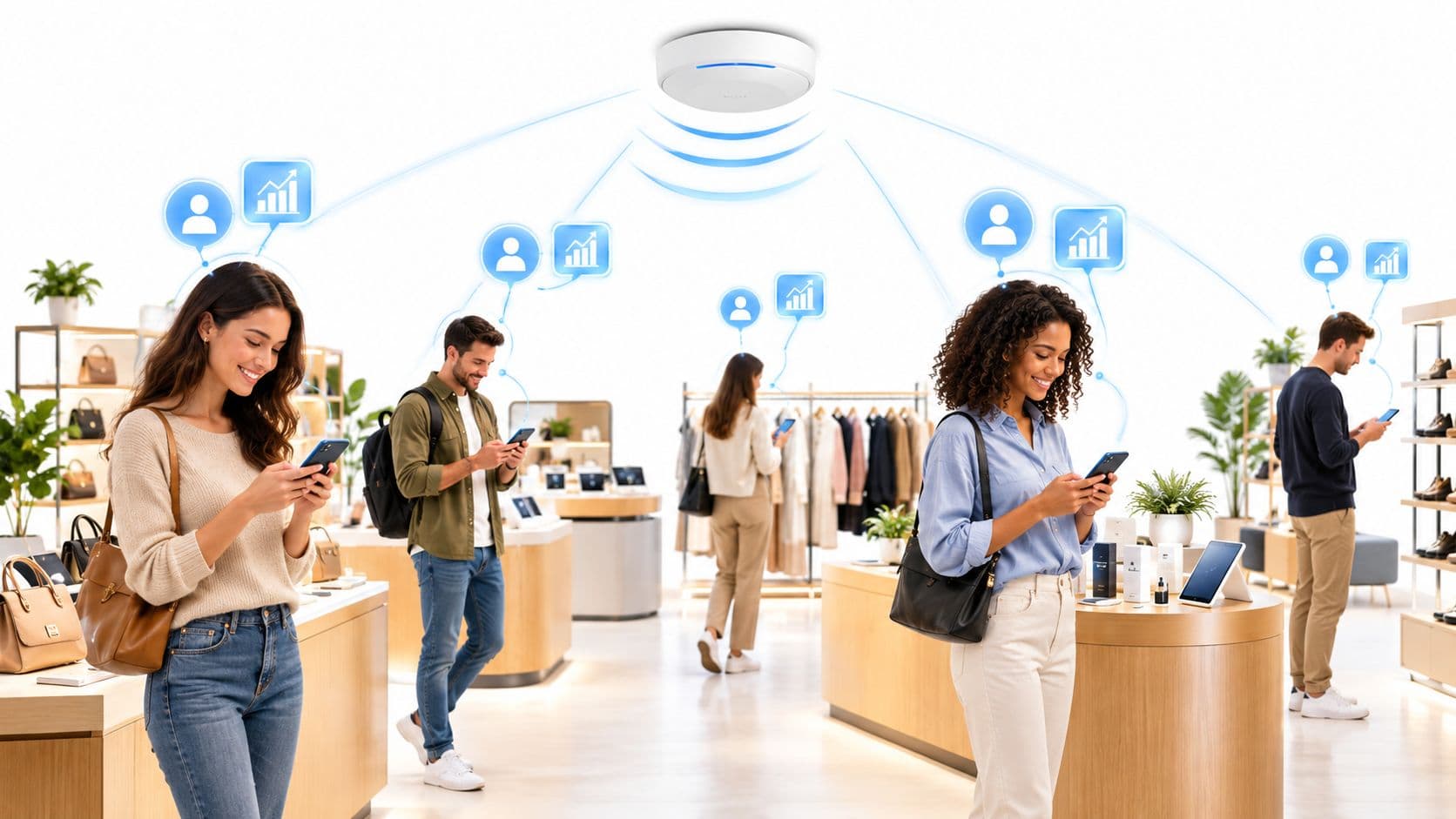
WiFi proximity marketing uses a venue's wireless infrastructure to detect nearby mobile devices and deliver personalized digital experiences. The process operates in four straightforward steps:
- Device detection: As visitors enter a venue, wireless access points detect the MAC address of their smartphone or tablet.
- Captive portal sign-in: When guests connect to the complimentary venue network, a branded captive portal splash page displays automatically on their screen.
- First-party data capture: Guests authenticate using email, social sign-in, or SMS verification, granting explicit, CCPA/CPRA-compliant marketing consent.
- Automated campaign execution: The platform logs visit frequency, dwell time, and venue location, triggering targeted emails, SMS promos, or post-visit review prompts via CRM integrations.
Key commercial benefits of proximity marketing for physical venues
Relying solely on traditional print signs or broad social media ads leaves venue operators with limited insight into foot traffic impact. Deploying an automated proximity marketing platform delivers measurable commercial advantages:
- High-volume first-party data collection: Build a clean, CCPA/CPRA-compliant customer database with verified contact details and explicit consent preferences, reducing reliance on third-party tracking cookies.
- Contextual in-moment engagement: Deliver targeted offers - such as daily food specials, event announcements, or loyalty reward reminders - while guests are inside your venue.
- Granular footfall & dwell time analytics: Analyze peak visitor hours, average length of stay, and new versus returning guest ratios across single or multi-site venue portfolios using WiFi analytics.
- Increased customer lifetime value: Automated post-visit follow-ups, birthday coupons, and feedback prompts drive repeat visits and build long-term guest retention.
Purple operates across more than 80,000 live venues globally, processing 440 million logins in 2024 alone. Leading luxury brands like Harrods have achieved up to 57x return on investment by converting Guest WiFi interactions into structured customer loyalty channels.
5 types of proximity marketing strategies compared
While Guest WiFi provides the highest volume of verified data capture, venue operators can deploy multiple complementary location technologies depending on venue layout and budget.
| Technology | Detection Range | Data Capture Quality | Consent Model | Best Suited For |
|---|---|---|---|---|
| WiFi (Captive Portal) | 100 - 330 feet (Venue wide) | High (Email, Cell Phone, Demographics) | Explicit Opt-In (CCPA/CPRA Compliant) | Retail, Hospitality, Stadiums, Airports |
| QR Codes | Visual Line of Sight (< 6 feet) | Medium (Web form submission) | User Initiated Scan | Table ordering, Event signage, Menus |
| BLE Beacons | 3 - 230 feet (Micro-zone) | Medium (App required) | App Permission & Bluetooth ON | Aisle navigation, Museum exhibits |
| Geofencing (GPS) | 330 - 1,600+ feet (Macro radius) | Low (Anonymized mobile ad IDs) | Location Services Permission | Competitor targeting, Regional ad campaigns |
| NFC & RFID | Contact - 10 centimeters | Transaction Specific | Physical Touch / Tap Required | Contactless payments, Access badges, Smart tags |
Deep dive into proximity marketing technologies
1. WiFi proximity marketing (Guest WiFi & captive portals)
WiFi proximity marketing utilizes a venue's existing access points to deliver a branded portal experience. When visitors join the network, they complete a short login form (providing email, phone number, or social media authentication). Purple's Guest WiFi platform works seamlessly across major enterprise hardware vendors - including Cisco Meraki, HPE Aruba, Ruckus, Juniper Mist, and Ubiquiti UniFi - overlaying cloud analytics and marketing automation without replacing existing hardware.
2. QR code marketing
Quick Response (QR) codes offer a straightforward visual trigger. Printed on table tents, posters, or digital displays, QR codes direct visitors to specific landing pages, digital menus, or feedback forms when scanned using a smartphone camera. While low cost, QR codes rely entirely on active customer initiative.
3. BLE (Bluetooth Low Energy) beacons
BLE beacons are small hardware transmitters placed throughout a physical venue. They broadcast radio signals to nearby smartphones equipped with a compatible mobile app. Beacons excel at granular micro-location tracking (such as identifying which specific retail aisle or museum display a visitor is standing near).
4. Geofencing & GPS targeting
Geofencing establishes a virtual geographic boundary around a venue or competitor location using mobile GPS data. When cell phone users enter the defined boundary, ad networks trigger mobile display banners or push notifications through partner apps.
5. RFID and NFC
Radio-frequency identification (RFID) and Near-field Communication (NFC) involve short-range wireless communication. Retailers use RFID tags for inventory tracking and fitting room analytics, while NFC enables tap-to-connect interactions and mobile payment processing.
Segmenting WiFi users for personalized proximity campaigns
Capturing guest contact information is only the first step. To maximize engagement, marketing teams segment WiFi users based on real-world venue behavior data:
- First-time vs. repeat visitors: Welcome new visitors with an introductory incentive, while rewarding returning guests with exclusive loyalty perks.
- Dwell time thresholds: Distinguish between quick drop-in visitors and long-stay guests (e.g. cafe remote workers vs dining parties) to tailor campaign timing.
- Venue location & region: Send localized announcements specific to individual store locations or regional venue clusters.
- Automated CRM synchronization: Automatically push captured profiles into CRMs such as HubSpot, Salesforce, Mailchimp, or Klaviyo to trigger multi-channel email and SMS workflows.
Frequently asked questions about WiFi proximity marketing
How do proximity marketing campaigns work?
Proximity marketing campaigns deliver targeted digital messages or offers to visitors based on their physical presence in a venue. Devices connect to Guest WiFi, scan a QR code, or pass a BLE beacon, presenting a branded portal or landing page that captures contact details and triggers automated engagement workflows.
How do businesses segment WiFi users for targeted marketing?
Businesses segment WiFi users by analyzing dwell time, visit frequency, store location, and historical login data. Profiles automatically sync into marketing CRMs to trigger customized email and SMS campaigns based on specific visitor behaviors.
Is WiFi proximity marketing compliant with CCPA/CPRA and GDPR privacy laws?
Yes. Purple's Guest WiFi platform ensures full compliance with CCPA/CPRA, GDPR, and global privacy standards. Captive portals present clear, unbundled opt-in check boxes for marketing communications, recording explicit consent for every captured profile.
What hardware is required to deploy Purple WiFi proximity marketing?
Purple is hardware-agnostic and overlays directly onto your existing enterprise access points and controllers. It supports Cisco Meraki, HPE Aruba, Ruckus, Juniper Mist, Ubiquiti UniFi, and other RADIUS-compatible wireless systems without replacing infrastructure.
What is the difference between BLE beacons and WiFi proximity marketing?
BLE beacons broadcast signals over short micro-zones (1 to 70 meters) and typically require visitors to have a specific mobile app installed. WiFi proximity marketing covers the entire venue, works natively through standard smartphone web browsers via captive portals, and captures rich first-party contact data.
Turn your venue WiFi into a powerful customer acquisition engine
Capture compliant first-party guest data, analyze traffic analytics, and automate proximity marketing campaigns across your physical locations.