
NAC Posture Assessment: Ensuring Managed Device Compliance Before Network Access
This technical reference guide provides a deep-dive into NAC Posture Assessment, detailing the architecture, standards, and deployment strategies required to enforce managed device compliance. It equips IT managers and network architects with actionable insights to mitigate risks and ensure secure network access across multi-site enterprise environments.
Listen to this guide
View podcast transcript
Part of our core series: Enterprise WiFi Security Guide →
Executive Summary
For enterprise IT leaders managing complex and multi-site environments, identity alone is no longer a sufficient metric for network access. Knowing who is connecting is less critical than knowing the security state of the device they are using. Network Access Control (NAC) posture assessment is the mechanism that bridges this gap, ensuring that only managed and compliant devices gain access to corporate infrastructure before a single packet of production traffic is transmitted.
This guide provides a comprehensive technical reference for designing, deploying, and managing NAC posture assessment. We explore its underlying architecture, including 802.1X, RADIUS, and EAP-TLS, evaluate the pros and cons of agent-based versus agentless interrogation, and outline a phased deployment strategy that minimizes operational disruption. Whether you are securing a corporate headquarters, a distributed retail estate, or hospitality back-office operations, implementing a robust posture assessment is a critical step in mitigating risk and enforcing compliance.
Listen to our 10-minute technical briefing podcast below for an executive overview of the key concepts and common deployment pitfalls.
Technical Deep-Dive
Posture Assessment Architecture
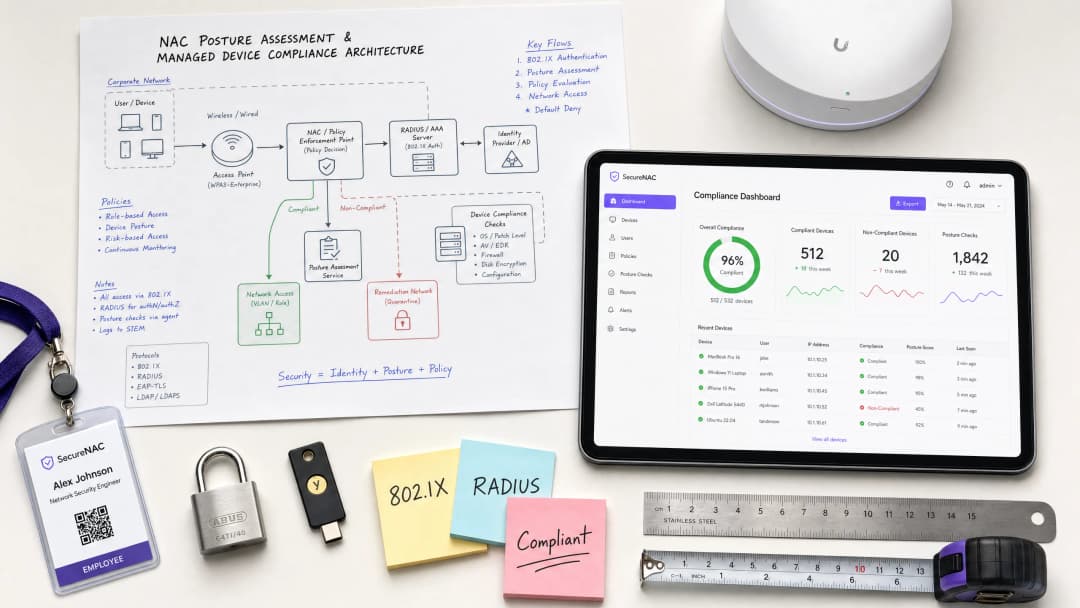
Network Access Control controls device connectivity, but posture assessment is the specific interrogation of a device's security health. Its architecture relies primarily on three main components working in unison:
- Policy Enforcement Point (PEP): This is the physical or logical gatekeeper - typically a wireless access point, switch port, or wireless LAN controller. The PEP physically controls the flow of traffic based on directives from the policy engine.
- Policy Decision Point (PDP): Often integrated with a RADIUS or AAA server, the PDP is the brains of the NAC architecture. It receives posture data, evaluates it against defined compliance policies, and issues enforcement directives to the PEP.
- Posture Assessment Engine: This component gathers the actual health data from the endpoint. This can be an agent running locally on the device, or an agentless mechanism using network protocols (such as SNMP, WMI) or API integration with a Mobile Device Management (MDM) platform.

The Role of IEEE 802.1X and EAP-TLS
The foundation of enterprise NAC is the IEEE 802.1X standard, which defines port-based network access control. Within this framework, three roles are defined:
- Supplicant: The endpoint device attempting to connect.
- Authenticator: The PEP (switch or access point) facilitating the connection.
- Authentication Server: The RADIUS server validating the credentials.
Communication between the Supplicant and the Authentication Server occurs via Extensible Authentication Protocol (EAP), tunneled through the Authenticator. For managed corporate devices, EAP-TLS is the gold standard. It mandates mutual authentication using X.509 digital certificates, ensuring that both the device and the network cryptographically verify each other's identity. This prevents credential theft and rogue access point attacks.
Posture Check Categories
When a device attempts to connect, the posture assessment engine evaluates several critical vectors:
- OS and Patch Management: Verifying that the operating system is supported and that critical patches have been applied within defined SLAs.
- Endpoint Security (AV/EDR): Ensuring that approved anti-virus or Endpoint Detection and Response agents are installed, active, and running updated definitions.
- Firewall Status: Confirming that host-based firewalls are enabled and their policies have not been tampered with.
- Disk Encryption: Verifying that full-disk encryption (e.g., BitLocker, FileVault) is active and not suspended.
- Certificate Validation: Checking for the presence and validity of required machine certificates.
- Configuration Compliance: Ensuring the device's security baseline aligns with corporate policy (e.g., screen lock timers, disabled USB mass storage).

WPA3-Enterprise and Cryptographic Strength
As network security evolves, so do its underlying cryptographic standards. WPA3-Enterprise, particularly when operating in 192-bit mode, provides significant advancements over WPA2. It mandates the use of GCMP-256 for encryption and HMAC-SHA-384 for integrity. For organizations handling sensitive data - such as retail environments subject to PCI DSS or healthcare facilities under strict data governance - transitioning to WPA3-Enterprise is a necessary step to future-proof network infrastructure.
Got questions about your specific setup?
Our team works with venue operators, IT managers, and network engineers across 80,000 venues. Book a 20-minute call and we will show you how others like you solved it.
Implementation Guide
Deploying NAC posture assessment requires careful planning to avoid widespread network outages. The following phased approach is recommended for enterprise environments:
Phase 1: Infrastructure Readiness and PKI Design
Before enabling posture checks, ensure your underlying infrastructure can support the architecture. If deploying EAP-TLS, a robust Public Key Infrastructure (PKI) is essential. Certificates must be automatically provisioned and renewed via your MDM or Group Policy. Manual certificate management will inevitably lead to connectivity failures when certificates expire.
Phase 2: Monitor Mode (Visibility Phase)
The most critical phase of any NAC deployment is Monitor Mode. During this phase, the NAC system evaluates device posture and logs the results, but does not enforce policies. The PEP allows full access regardless of the posture outcome.
Run Monitor Mode for at least 2 - 4 weeks. This provides visibility into the actual compliance state of your estate. You will identify devices failing checks due to broken agents, pending reboots, or misconfigurations. Use this data to proactively remediate the estate.
Phase 3: Segmented Enforcement
Once the compliance baseline reaches an acceptable level, begin enforcement. Based on policy evaluation, devices are categorized into three states:
- Compliant: The device passes all critical checks and is assigned to the production VLAN with full required access.
- Conditional: The device fails a non-critical check (e.g., a minor OS update is pending). It may be granted restricted access (e.g., internet only) and the user is notified to remediate within a specified grace period.
- Non-Compliant: The device fails a critical check (e.g., AV is disabled). The PEP assigns the device to a quarantine VLAN.
Phase 4: Remediation Architecture
The quarantine VLAN must be strictly isolated. It should only permit traffic to the remediation portal, necessary update servers (e.g., Windows Update, AV definition servers), and internal IT support resources. If a quarantined device can route traffic to production subnets, the NAC architecture has failed.
Best Practices
- Continuous Assessment: Legacy NAC only evaluates posture at the time of connection. Modern deployments must support continuous assessment, re-evaluating posture at regular intervals or in response to events (e.g., an EDR alert) and dynamically updating the device's access level via Change of Authorization (CoA).
- Agent vs. Agentless: For managed corporate devices, an agent-based approach provides the deepest visibility and continuous monitoring capabilities. Agentless interrogation is suitable for unmanaged devices or environments where deploying an agent is administratively prohibited.
- MAC Authentication Bypass (MAB): MAB is required for devices incapable of 802.1X (e.g., legacy printers, IoT sensors). However, MAB is inherently insecure as MAC addresses can be spoofed. MAB devices must be deeply profiled and placed in strictly controlled, isolated VLANs.
- Aligning with Standards: Base your posture policies on established frameworks such as CIS Benchmarks. This ensures your compliance checks are vendor-neutral and aligned with industry best practices.
- Isolating Guest Traffic: Corporate NAC posture assessment should never intersect with public access networks. In venues where both are required, use a dedicated Guest WiFi platform to manage public access on entirely separate infrastructure, such as Purple's WiFi Analytics solution.
Troubleshooting and Risk Mitigation
Common Failure Modes
- 'Big Bang' Enforcement: Transitioning from open access to strict enforcement across the entire estate all at once is a guaranteed recipe for operational disruption. Always use a phased rollout by site or department.
- PKI Failure: Expired root or intermediate certificates, or failures in the Certificate Revocation List (CRL) / Online Certificate Status Protocol (OCSP) infrastructure, will cause widespread authentication failures. Implement robust monitoring for your PKI.
- Remediation Loops: Ensure that devices in the quarantine VLAN have sufficient network access to download the updates required to become compliant. If they cannot reach update servers, they will remain permanently quarantined.
ROI and Business Impact
Implementing NAC posture assessment delivers measurable business value beyond simple security metrics:
- Risk Mitigation: By ensuring only healthy devices gain access to the network, the lateral spread of malware and ransomware is significantly reduced, decreasing the likelihood of costly data breaches.
- Compliance Verification: For highly regulated sectors such as hospitality and transport, automated posture assessment provides continuous proof of compliance with standards like PCI DSS and CCPA/CPRA, simplifying the audit process.
- Operational Efficiency: Automating the quarantine and remediation process reduces the burden on the IT helpdesk, allowing engineers to focus on strategic initiatives rather than manually cleaning infected endpoints.
Key Definitions
802.1X
An IEEE standard for port-based network access control that provides an authentication mechanism to devices wishing to attach to a LAN or WLAN.
The foundational protocol that ensures a device must authenticate before the switch port or access point allows any IP traffic to pass.
EAP-TLS
Extensible Authentication Protocol - Transport Layer Security. An authentication framework that uses X.509 digital certificates for mutual authentication.
The recommended standard for managed corporate devices, as it relies on cryptographic certificates rather than easily compromised passwords.
Posture Assessment
The process of evaluating the security state and configuration of an endpoint device against a defined corporate policy.
Ensures that a device is not only authenticated but is also "healthy" (patched, encrypted, protected) before being granted network access.
Policy Enforcement Point (PEP)
The network device (switch, wireless controller, or access point) that physically blocks or allows traffic based on the NAC policy.
The component that actually executes the "allow" or "quarantine" command issued by the NAC server.
Policy Decision Point (PDP)
The central server or engine (often a RADIUS server) that evaluates authentication requests and posture data to determine access rights.
The brain of the operation that holds the rulebase and decides what level of access a specific device should receive.
MAC Authentication Bypass (MAB)
A fallback authentication method that uses a device's MAC address as its credential when it cannot perform 802.1X.
Used for headless devices like printers or IoT sensors. It is inherently weak and must be combined with strict network segmentation.
Change of Authorization (CoA)
A RADIUS extension that allows the NAC server to dynamically change the authorization state of an active session.
Crucial for continuous assessment; if a device becomes non-compliant while connected, CoA allows the NAC server to instantly move it to a quarantine VLAN without requiring a disconnect.
Quarantine VLAN
A strictly isolated network segment designed to hold non-compliant devices, providing access only to remediation resources.
Prevents an infected or vulnerable device from communicating with production systems while it downloads necessary updates or patches.
Worked Examples
A 400-room hotel requires corporate staff laptops to securely access the back-of-house property management system (PMS). However, the venue also hosts numerous unmanaged IoT devices (smart thermostats, digital signage) that cannot run a NAC agent.
Implement an 802.1X EAP-TLS policy for all corporate staff laptops, enforcing strict posture checks (AV active, disk encrypted, patched). These devices are dynamically assigned to the Corporate VLAN upon successful compliance. For the IoT devices, implement MAC Authentication Bypass (MAB) combined with deep device profiling. Ensure these MAB devices are placed in isolated, dedicated IoT VLANs with ACLs restricting their access solely to the specific controllers they need to communicate with. Under no circumstances should the IoT VLAN route to the Corporate VLAN or the PMS.
A retail chain is rolling out new point-of-sale (POS) terminals across 50 locations. The IT team wants to enforce posture compliance to meet PCI DSS requirements but is concerned about disrupting store operations during the rollout.
Deploy the NAC architecture in Monitor Mode for 30 days. During this period, the NAC system will authenticate the POS terminals and evaluate their posture against the PCI DSS baseline (e.g., firewall active, no unauthorized software) but will log failures without blocking access. The IT team reviews the logs weekly, identifies terminals failing the checks, and remediates them via the MDM platform. Once the compliance rate reaches 100%, the policy is switched to Enforcement Mode site-by-site during maintenance windows.
Practice Questions
Q1. A recently deployed NAC solution in a corporate office is causing widespread connectivity issues. Devices that were compliant yesterday are now being placed in the Quarantine VLAN. The IT helpdesk reports that the devices appear healthy, with AV running and patches applied. What is the most likely architectural failure?
Hint: Consider the lifecycle of the credentials used in EAP-TLS.
View model answer
The most likely cause is a failure in the Public Key Infrastructure (PKI). If the machine certificates used for EAP-TLS authentication have expired, or if the NAC server cannot reach the Certificate Revocation List (CRL) or OCSP responder, the authentication will fail regardless of the device's actual security posture. The NAC system defaults to a fail-closed or quarantine state.
Q2. You are designing the VLAN architecture for a new NAC deployment. The security team insists that the Quarantine VLAN must allow access to the corporate proxy server so users can browse the internet while their devices remediate. Is this a sound design?
Hint: Evaluate the risk of allowing a potentially compromised device access to shared infrastructure.
View model answer
No, this is a flawed design. Allowing a quarantined device access to the corporate proxy introduces significant risk. If the device is infected with malware, it could use the proxy to establish command-and-control communication or attempt to pivot to other internal systems accessible via the proxy. The Quarantine VLAN must be strictly isolated, permitting access only to specific remediation servers (e.g., Windows Update, AV definition servers) and the remediation portal itself.
Q3. A hospital IT team needs to secure network access for a fleet of new wireless medical infusion pumps. These devices do not support 802.1X supplicants and cannot run a posture agent. How should network access be controlled for these devices?
Hint: Consider alternative authentication methods and the principle of least privilege.
View model answer
The devices must be authenticated using MAC Authentication Bypass (MAB). Because MAB is inherently weak (MAC addresses can be spoofed), the network access must be heavily restricted. The infusion pumps should be placed in a dedicated, isolated Medical IoT VLAN. Access Control Lists (ACLs) must be applied to this VLAN, permitting communication only with the specific central management servers required for their operation, and blocking all other lateral movement or internet access.
Continue reading in this series
PPSK wpa3: comparing features and deployment models
This technical reference guide compares PPSK and WPA3-SAE, explaining their architectural differences and deployment models for multi-tenant environments. It provides actionable guidance for IT managers and property developers on achieving secure, isolated WiFi networks using Purple's identity-based solutions.
Managing Bandwidth for Staff WiFi: Shaping, QoS and Reducing Traffic
This guide details practical methods for managing bandwidth for staff WiFi in enterprise venues. It covers traffic shaping, QoS implementation, and how deploying Purple Shield reduces network load without requiring infrastructure upgrades.
How to Reduce the Number of WiFi SSIDs Using Per-Device PSK (iPSK, DPSK, MPSK)
This authoritative technical reference guide explains how IT teams can eliminate WiFi performance degradation caused by SSID beacon overhead by collapsing multiple purpose-built networks into a single SSID using per-device PSK (xPSK). It covers the vendor landscape across Cisco iPSK, HPE Aruba MPSK, Ruckus DPSK, Juniper Mist PPSK, and Ubiquiti UniFi PPSK, with practical implementation guidance on dynamic VLAN assignment, IoT onboarding, and PCI DSS compliance. Venue operators in hospitality, retail, stadiums, and public-sector organisations will find actionable architecture guidance and real-world worked examples.
Got questions about your specific setup?
Our team works with venue operators, IT managers, and network engineers across 80,000 venues. Book a 20-minute call and we will show you how others like you solved it.